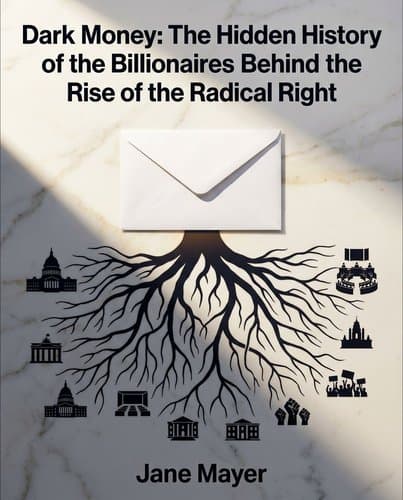
27833614_dark-money
by Jane Mayer
Follow the money behind "grassroots" movements and you'll find a small network of billionaires who spent decades buying courts, universities, and think tanks…
In Brief
Follow the money behind "grassroots" movements and you'll find a small network of billionaires who spent decades buying courts, universities, and think tanks to make their self-interest look like political philosophy—systematically rigging American democracy before most voters knew the game had started.
Key Ideas
Ideology Follows Corporate Liability, Not Principle
When evaluating a 'principled' anti-regulatory campaign, map the donor's corporate regulatory exposure first — in case after case documented here, the ideology follows the liability, not the other way around.
Upstream Institutions Drive Long-Term Political Power
The most durable political investments target upstream institutions — who sits on federal courts, what economic frameworks dominate law schools, which think tanks get quoted as neutral authorities — not who wins next November. By the time a policy reaches a vote, the ideological groundwork was laid a generation earlier.
Tax-Exempt Foundations Disguise Political Infrastructure Strategy
Tax-exempt charitable foundations can legally fund a permanent political infrastructure while donors simultaneously claim they're pursuing the public good. The IRS framework has no mechanism to distinguish genuine philanthropy from strategic disguise — and the founders of this network knew it and planned for it explicitly.
Instant Grassroots Movements Signal Pre-Built Infrastructure
A 'grassroots movement' that appears within hours of a triggering event is almost always the deployment of pre-existing infrastructure. Ask who registered the domain, who was already on payroll, and which donor networks had been meeting in private resorts for years before the first protest sign appeared.
Stealth Strategies Fail When Popular Majority Needed
The stealth strategy documented across three decades — Hayek's 'cagey' instruction, Piereson's law school confession, Koch's 1976 secrecy recommendation — eventually ran into the limits that Fink's own polling revealed: voters in the 'middle third' still wanted a clean environment and opportunity for others. A strategy built on disguise cannot survive indefinitely when it has to win a popular majority.
Who Should Read This
History readers interested in Democracy and Policy who want a deeper understanding of how we got here.
Dark Money: The Hidden History of the Billionaires Behind the Rise of the Radical Right
By Jane Mayer
8 min read
Why does it matter? Because the "grassroots movements" you watched on television were built in boardrooms — and the money trail has been hiding in plain sight.
The comfortable assumption is that money in politics means campaign ads and horse-trading — visible, if ugly, exchanges between donors and politicians. Follow that money and you find the usual suspects doing the usual things. What Jane Mayer found was different. The most consequential political spending of the past half-century wasn't aimed at elections. It was aimed at law school hiring committees, federal judges' vacation schedules, state legislative district maps drawn in locked back rooms, and university economics programs that trained the people who would eventually draft the policies. A small network of extraordinarily wealthy families, whose fortunes depended on escaping environmental, labor, and financial oversight, built a shadow government within the shell of American philanthropy. They didn't try to win arguments. They tried to determine which arguments were allowed to exist. That distinction is what this book is about.
The Ideology Tracked the Regulatory Exposure
The Koch brothers' libertarian convictions tracked their corporate liability with a precision that principle alone cannot explain. The clearest proof arrived in a 48-hour window in late September 2008.
Americans for Prosperity, the Kochs' political organization, had staked out a principled free-market position against the federal bank bailout — the kind of stand that earns respect in libertarian circles. On September 29, the House voted down TARP and the Dow shed 777 points in a single session, then the largest single-day point drop in market history. The Kochs' own investment portfolio was bleeding. Within two days, Americans for Prosperity had quietly reversed. Republican senators received a list of conservative groups now backing the bailout; AFP was on it. The Senate passed TARP. The principle had lasted until it was expensive.
Charles Koch said nothing about this at the January 2009 donor summit, the gathering he'd organized specifically to build opposition to Obama. Instead he sat silently at the front table while the room erupted at Texas Senator John Cornyn for casting the same pro-bailout vote the Kochs had quietly made themselves. A donor shouted "RINO." A staged debate between Cornyn's pragmatic conservatism and South Carolina Senator Jim DeMint's scorched-earth purism ended with the crowd choosing DeMint's line: he'd rather have thirty Republicans who believed in something than a majority who believed in nothing. The Kochs, whose position had mirrored Cornyn's exactly, watched without a word.
The conviction held until the portfolio was threatened, then evaporated in under 48 hours.
Koch Industries spent the 1980s and 1990s accumulating the largest documented regulatory liability in American corporate history: a felony guilty plea for concealing benzene emissions fifteen times the legal limit, a $30 million Clean Water Act fine (the largest at that time), 24,587 documented false claims to the government for oil stolen from Native American lands. The anti-regulatory spending, the donor summits, the manufactured grassroots campaigns — they look different once you know the company those campaigns were protecting. The ideology didn't precede the liability. It followed it.
They Targeted the People Who Shape What Politicians Think, Not Politicians Themselves
The sharpest window into this strategy is a confession. James Piereson, the Olin Foundation's executive director, told the New York Times in 2005: "I saw it as a way into the law schools — I probably shouldn't confess that." He was talking about Law and Economics, a field that evaluates regulations primarily through cost-benefit analysis rather than through concepts like social justice or worker safety. It sounds like neutral scholarship. That was the point. "If you said to a dean that you wanted to fund conservative constitutional law," Piereson explained elsewhere, "he would reject the idea out of hand. But if you said you wanted to support Law and Economics, he would be much more open." Between 1985 and 1989, the Olin Foundation underwrote 83% of all Law and Economics program costs at American law schools — $68 million in total, with $18 million going to Harvard alone. Within five years, nearly 80 law schools taught the subject.
Law students were only the first target. The Olin Foundation also sponsored two-week seminars for sitting federal judges (all expenses paid), held at places like the Ocean Reef Club in Key Largo. Mornings were lectures on why environmental regulations failed cost-benefit tests; afternoons were golf and dinner. The formula worked. Within a few years, 660 judges had attended — 40% of the entire federal judiciary by one count, including two future Supreme Court justices.
The durability of this approach is its whole point. You fund the scholars who train the professors who train the students who become the clerks who become the judges; meanwhile, you educate the judges already on the bench. Not through bribes but through subsidized vacations that happened to come with a framework. No one hands a sitting judge a check. The ideology arrives wearing the credentials of disinterested scholarship and tells them, on principle, that the EPA overreaches, that regulations damage efficiency, that cost-benefit analysis is clarity rather than a corporate preference wearing academic clothes.
The Tea Party Was Built Before Anyone Had to Build It
On February 19, 2009, Rick Santelli, a former futures trader turned CNBC commentator, stood on the floor of the Chicago Mercantile Exchange and delivered the rant that would enter political mythology as the Tea Party's founding moment. He called stressed homeowners "losers," proposed a Chicago Tea Party on Lake Michigan to rally capitalists against the federal homeowner rescue plan, and asked whether viewers wanted to pay their neighbor's mortgage. Within hours, conservative aggregator Matt Drudge flagged the clip to three million daily readers as an emergency.
That same news cycle, a website called TaxDayTeaParty.com appeared. Its domain was registered by Eric Odom, a young libertarian activist in Chicago, until recently an employee of the Sam Adams Alliance, a tax-exempt organization whose chief executive had ties to the Koch donor network dating to David Koch's 1980 Libertarian vice-presidential campaign. The site didn't appear because people needed somewhere to gather. It appeared because the infrastructure was already built and waiting.
The machine had been running rehearsals for eighteen years. In 1991, Citizens for a Sound Economy (the Koch-funded predecessor to Americans for Prosperity) staged a Boston Tea Party re-enactment in North Carolina to protest taxes. The press corps nearly outnumbered the protesters. In 2007, Americans for Prosperity attempted the same in Texas. Another failure. None of this looked like success at the time. What it built was personnel, procedure, and playbook. By the time Santelli yelled, AFP maintained fifty paid field workers across more than two dozen states. The "grassroots" were always the final ingredient. The organization came first.
Eight months later, at an Americans for Prosperity summit in Arlington, Virginia, David Koch confirmed it himself. State chapter leaders reported in from around the country: this chapter had organized a dozen Tea Party rallies, that chapter had mobilized thousands. He stood at the lectern, beaming. "Five years ago, my brother Charles and I provided the funds to start Americans for Prosperity," he told the crowd. "It's beyond my wildest dreams how AFP has grown." Twenty-nine years earlier, he had run for vice president on the Libertarian ticket and received 1% of the vote. Now, as delegates paraded past their states' vertical banners under crisscrossing strobe lights, the scene resembled a presidential nominating convention — and Koch was standing where the nominee stands.
They Built a Political Party Inside the Shell of American Philanthropy
What kind of organization can spend hundreds of millions shaping elections, take charitable deductions on every dollar, and never disclose a single donor? The kind that Richard Fink designed.
In the late 1980s, Fink drafted a three-phase blueprint he called "The Structure of Social Change." Phase one: invest in intellectuals to produce ideological raw material. Phase two: fund think tanks to refine that material into concrete policy. Phase three: subsidize citizens' groups to pressure lawmakers into implementation. A political production line, from idea creation to legislation — which libertarian wags dubbed the Kochtopus.
What kept it all invisible was in the plumbing. Every stage ran through the tax code. The intellectual institutes were 501(c)(3) charities — the IRS designation for tax-exempt nonprofits — donations tax-deductible, donors hidden. The think tanks occupied the same category: publicly subsidized, officially nonpartisan, legally barred from lobbying, yet producing precisely the regulatory rollbacks Koch Industries needed. By the time money reached the citizens' groups pressing legislators, it had passed through enough nonprofit shells that no dollar could be traced to its source. One conservative insider summarized the logic candidly: these organizations were "just the best available option" for wealthy donors. Contribute to the charities and you control how it's spent. Pay it in taxes instead and you lose it entirely.
Koch Industries donated to foundations. The foundations funded the Mercatus Center at George Mason University, which the Washington Post described as "a staunchly anti-regulatory center funded largely by Koch Industries." Mercatus scholars testified before Congress and supplied fourteen of the twenty-three regulations on George W. Bush's deregulatory hit list, eight of them environmental protections. Weaker environmental enforcement meant lower liability for Koch Industries. Higher profits meant larger foundation donations. Larger donations funded more scholarship. The government subsidized every step through the charitable deduction.
When the 1996 Triad scandal emerged (a shell corporation channeling $3 million into attack ads across 29 congressional races, four Kansas seats flipped, the actual funders never publicly named), Charles Lewis of the Center for Public Integrity called it a historic moment: the first time a major corporation had used a tax-exempt nonprofit as "a cutout to secretly influence elections in a threatening way." What Lewis was describing wasn't an aberration. It was Phase Three — the citizens'-groups-pressing-legislators stage — in its first full production run.
The Policy Positions Had Victims with Names and Medical Records
Donald Carlson's nickname at Pine Bend was Bull — his colleagues gave it to him for taking the jobs nobody else wanted. Starting in 1974, he cleaned tanks holding leaded gasoline, scraped them by hand, worked in spaces where the fumes hit hard enough to knock his helmet off, stood in fuel pools that ate through his clothes. "I was a young guy," he later said. "They didn't tell me anything, I didn't know anything." He didn't know about benzene, a colorless compound refined from crude oil, linked to leukemia since 1928, classified as a human carcinogen by four federal agencies. He didn't know what hemoglobin was.
Federal regulations required refineries to offer annual blood tests to benzene-exposed workers and to notify employees of any abnormalities. Carlson took the tests every year. What he didn't know was that his results, flagged as increasingly abnormal in 1990, 1992, and 1993, had been sitting in company files without anyone telling him. Koch Refining finally notified him in 1994. By 1995 he needed transfusions of three to five pints of blood each week. The company denied his workers' compensation claim, which would have covered his medical bills and continued support for his wife and teenage daughter. He died of leukemia in February 1997 at 53. His widow pressed a legal claim for three years; Koch's lawyers settled the morning the case was to be heard, on the condition she sign a confidentiality agreement. "They just gave me those little crumbs," Doreen Carlson said, "and told me to keep my mouth shut."
The blood tests that might have prompted earlier treatment existed because federal regulators had mandated them — exactly the kind of rule Charles Koch had called "arrogant" and "totalitarian" and urged fellow businessmen to resist "wherever and to whatever extent you legally can." The ideology and the withholding of a man's own medical results occupy the same line of reasoning. Carlson was one name. That same regulatory framework governed every refinery, every mine, every state Medicaid program. The math of what it cost in aggregate never fit in a settlement.
Their Own Grand Strategist Explained the Game to a Room Full of Billionaires — On Tape
On the afternoon of June 15, 2014, Richard Fink took the floor of the Pacific Ballroom at the St. Regis Monarch Beach resort outside Laguna Beach, California, to address a private gathering of some of the country's wealthiest conservatives. The session was titled "The Long-Term Strategy: Engaging the Middle Third." What Fink didn't know (what no one in the room knew) was that one of the attendees was working with a journalist.
Fink had spent the months after Romney's 2012 loss analyzing 170,000 political surveys conducted over two decades. What they told him was uncomfortable. American voters divided into three groups: a base third already aligned with free-market conservatism, a liberal third unreachable, and a "middle third" whose votes would decide everything. These voters saw big business as suspicious and greedy. They felt sympathy for the poor rather than contempt. The network's agenda (cutting regulations, slashing taxes, opposing the minimum wage) registered to these voters as the program of people who wanted cheap labor and low liability.
Then Fink said something remarkable, even for a closed room full of billionaires: "We want to decrease regulations. Why? It's because we can make more profit, okay? Yeah, and cut government spending so we don't have to pay so much taxes. There's truth in that." Twenty years of surveys, he was saying, had confirmed what the network's critics had always argued. The response was not to reconsider the agenda. It was to reframe it. What the network needed, Fink announced, was to "launch a movement for well-being."
He offered the minimum wage as a worked example. Opposition to it should not be described as a preference for cheap labor. It should be presented as concern for the 500,000 workers who would "lose their meaning in life" without entry-level jobs — a condition he compared to the unemployment that enabled the Third Reich.
You can call that a rhetorical strategy. What you can't call it is a philosophical conviction. Anyone who genuinely believed free markets serve human dignity doesn't need 170,000 surveys and a resort seminar to discover the argument. The argument was already there. What the surveys had discovered was that it didn't work — and the conclusion was to make it sound more like it did.
What It Means That They Had to Rebrand
The machine didn't break down when the surveys came back bad. It recalibrated. Two decades of polling told Fink that the disguise wasn't holding, and the conclusion he brought to that Pacific Ballroom wasn't to reconsider whether deregulation actually served ordinary people. It was to design a better disguise. A strategist stood before some of the wealthiest people in the country and said it out loud — we want to decrease regulations because we can make more profit, okay? — then explained, in the same breath, how to repackage that as a movement for well-being. By the time you can name it, it's already law.
Notable Quotes
“because it reminded too many people of”
“To attract a bigger following, some suggested, they needed to organize synthetic”
“In order to avoid undesirable criticism, how the organization is controlled and directed should not be widely advertised,”
Frequently Asked Questions
- What is Dark Money about?
- Dark Money traces how a small network of ultra-wealthy donors used tax-exempt foundations, think tanks, and manufactured grassroots campaigns to build a permanent political infrastructure disguised as principled ideology. Author Jane Mayer reveals how these hidden financial networks shaped American politics since the 1970s. The book equips readers to recognize when "neutral" institutions serve donor interests and understand how policy battles are decided long before they reach a vote. Through three decades of documented strategy, Mayer demonstrates how ideology often follows financial liability rather than emerging from genuine principle.
- What are the key takeaways from Dark Money?
- Key insights include recognizing that donor ideology follows corporate regulatory exposure, not the reverse. The most durable political influence targets upstream institutions—federal courts, law school curricula, and think tanks—rather than electoral campaigns. Tax-exempt charitable foundations legally fund permanent political infrastructure while claiming to pursue the public good, with "no mechanism to distinguish genuine philanthropy from strategic disguise." "Grassroots movements" that emerge suddenly are pre-existing infrastructure deployments. Finally, the stealth strategy eventually faced limits when forced to win popular majorities, as voters in the "middle third" wanted "a clean environment and opportunity for others."
- What does Dark Money reveal about the link between donor interests and ideology?
- Dark Money demonstrates that in most cases, corporate interests determine ideology. When evaluating a "principled" anti-regulatory campaign, mapping the donor's corporate regulatory exposure reveals the pattern: "in case after case documented here, the ideology follows the liability, not the other way around." Rather than advancing abstract principles, wealthy donors fund campaigns against regulations threatening their business interests, then frame these efforts as matters of principle. This pattern—where financial exposure determines ideology—is central to understanding how the network shaped American politics. The book shows this wasn't philosophical accident but calculated strategy executed across decades.
- What does Dark Money say about grassroots movements and political infrastructure?
- Dark Money exposes spontaneous activism as often illusory. According to Mayer, "a 'grassroots movement' that appears within hours of a triggering event is almost always the deployment of pre-existing infrastructure." To verify authenticity, readers should "ask who registered the domain, who was already on payroll, and which donor networks had been meeting in private resorts for years before the first protest sign appeared." This framework reveals that apparent citizen action often represents decades of funded coordination. The book demonstrates that permanent political infrastructure enables rapid mobilization disguised as grassroots sentiment, crucial for evaluating contemporary movements.
Related Book Summaries
Read the full summary of 27833614_dark-money on InShort