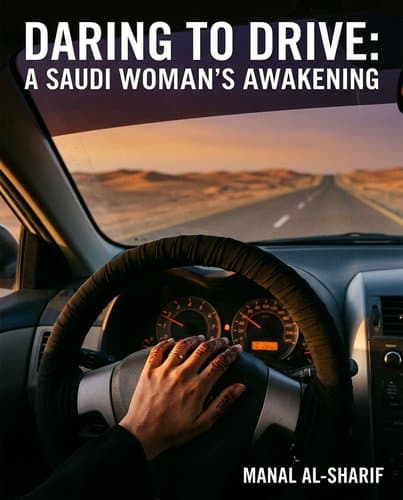
32620356_daring-to-drive
by Manal Al-Sharif
The most unbreakable prisons have no legal locks—just customs so deeply internalized that the oppressed become their own jailers. Manal Al-Sharif's defiance of…
In Brief
The most unbreakable prisons have no legal locks—just customs so deeply internalized that the oppressed become their own jailers. Manal Al-Sharif's defiance of Saudi Arabia's driving ban reveals how dismantling a single rule means nothing without confronting the entire logic of control that built the cage.
Key Ideas
Unchallengeable Systems Without Accountable Authors
Custom ('orf') can be more invincible than written law because it has no single author to challenge, no text to repeal, and no institution formally responsible for enforcement — which means everyone enforces it and no one can be held accountable for it.
Oppressed as Primary Enforcers of Oppression
Systems of oppression survive by training the oppressed to enforce them more zealously than required. Manal burned her brother's tapes and reported her sister without being asked. Recognizing your own role as enforcer — not just victim — is the first and hardest act of resistance.
Public Records Enable Future Legal Resistance
Legal documentation matters even when law doesn't govern the outcome. Forcing officials to say 'you broke custom, not statute' on record changes what can be said publicly and what arguments future activists can build on, even if the immediate verdict is unchanged.
Enclaves Hide System-Wide Oppression from Insiders
Freedoms granted inside a protected enclave — a corporate compound, an exception zone — are not systemic change. They can make the surrounding restrictions invisible to those inside, and reveal just how total those restrictions are for everyone who will never get in.
Change Logic Itself, Not Just Rules
The guardianship system is not a single law but a logic replicated at every threshold — hospital admissions, housing leases, marriage contracts, courts. Changing the driving rule without changing the underlying mahram logic leaves every other threshold intact.
Who Should Read This
Readers who connect with first-person stories about Memoir and Social Issues and want to see the world through someone else's eyes.
Daring to Drive: A Saudi Woman's Awakening
By Manal Al-Sharif
10 min read
Why does it matter? Because the law that kept Saudi women from driving never actually existed.
The assumption is easy to make: here is a woman who fought an unjust law and won. The stranger question, the one the book eventually has to answer, is whether there was a law at all.
That gap — between a rule everyone obeys and a rule no one can produce — is the book's real subject. The most durable cages, al-Sharif discovers, are built without locks: enforced by everyone, owned by no one, guarded most zealously by the people trapped inside them. She was one of those guards. This is the story of how she found out.
The Saudi Driving Ban Was Never a Law. That Made It Harder to Fight.
The knock came at two in the morning, hard enough to shake the doorframe. Manal al-Sharif was on her feet before she fully understood why, standing in her townhouse inside the Aramco compound in a Mickey Mouse T-shirt and sweatpants. Her porch light had burned out weeks earlier. Nine people waited in the dark: seven men, two veiled female guards, five cars. One man pressed his face against her sliding glass door and didn't move. The offense was already known to everyone present: the previous afternoon, officers had stopped her for driving her brother's car through the streets of Khobar, Saudi Arabia. Driving while female.
There's just one problem with that charge: it doesn't exist anywhere in Saudi law.
The night before, Manal had worked through the Saudi traffic code — every page, every violation cataloged across pages 117 to 121. No gender specification appears. No statute, no clause, no line. The prohibition on women driving traces to a Ministry of Interior statement, backed by a religious ruling from the Grand Mufti, Saudi Arabia's top religious authority. Not a legislature. Not a court. A ban with no author, no official text, nothing you could hold up and contest in a courtroom.
Hours later, after a night shuttled between police stations and interrogation rooms, the police chief admitted he couldn't cite a single statute. What she broke had a different name: orf. She signed the pledge calculating, even as she pressed pen to paper, that a custom is not a statute. A law can be challenged in court, debated in a legislature, overturned by a ruling. Orf has no author to hold responsible, no text to dispute, no institution authorized to repeal it. The situation was absurd — she'd been jailed for a rule that was never written — and, for that same reason, nearly impossible to fight directly. You cannot strike down a custom. You can only keep refusing to observe it.
The Deepest Cages Are Built Before You're Old Enough to Ask Who Locked Them
Twenty-three years before that arrest, it is the first days of summer vacation. Manal al-Sharif is eight years old, wearing a yellow jalabiya embroidered with red roses and green leaves, sitting on the apartment floor with her coloring books spread around her. Then the doorbell rings.
Two men and a woman stand outside: an Egyptian barber named Abdulaleem, his son, and a woman Manal has never seen. Within minutes, the barber's son has her by the shoulders, the unknown woman has her legs open, and her father stands behind her with the bathroom water hose — the same one he uses to beat his children when he can't find the bamboo cane. He threatens to whip her if she doesn't stop resisting. She stops.
The procedure takes a few snips with a single pair of scissors. No anesthetic. The scissors are dull enough that they only cut the upper part of the clitoris; when they find her sister Muna, they switch to a razor blade and take everything. Manal bleeds for three days. Her face turns yellow. They can't take her to a hospital. The procedure can be treated as a crime. When the bleeding finally slows, the barber sends Manal's sister for thread from their mother's sewing machine. He ties five knots in her most intimate tissue. No one removes them afterward. Those knots leave permanent deformities.
This happens in the years after the 1979 Grand Mosque seizure, as the crackdown on women's public life is still taking shape. The radical Islamist curriculum hasn't reached the schools yet. She is five years away from sitting in a classroom with no emergency exits. The cage is built into her body by her own parents, in her own apartment, years ahead of any institution.
The same logic carries forward. At thirteen, Manal gets her first period and spends days convinced she is ruined. Her mother's only word for that blood had always been ruin. When her cousin Amal explains what menstruation actually is, relief lasts about an hour. Then come the consequences: Amal's older sisters decree that Manal can no longer interact with her male cousins. Muhammad — who had once pressed a newly hatched pigeon into her palm in the dark, letting her feel its heartbeat — vanishes from her life without a word. She describes the loss as indistinguishable from grief over a death. The Arabic term for what Saudi girls must become at puberty is khidr: numbness. Outwardly devoid of feeling, voice silenced, body covered. Every institution you'd expect in a story about women's rights (schools, religious police, guardianship laws) operates on this same principle, already inscribed in her before she had language to name it.
The System's Most Reliable Enforcer Was a Thirteen-Year-Old Girl Named Manal
The most reliable enforcers the Saudi system produced weren't police officers or religious patrols. They were teenage girls who had been perfectly prepared to believe that their own confinement was righteousness.
The mechanism is visible in a single school afternoon when Manal was thirteen. A teacher announces that death itself will be the day's lecturer, then selects a volunteer from the class, covers her eyes with cotton wool, and draws a white burial shroud across her face. The room erupts in wailing. Afterward, each student receives a cassette called Throes of Death and instructions to sit alone in darkness at home to rehearse the loneliness of the grave. Manal goes home, puts on headphones, hears a preacher screaming "Have you prepared for death?" — and breaks. She weeps, promises God she will reform herself, then catalogs what else requires fixing: her family. Sixty percent of her school hours were already devoted to religious subjects: Koranic recitation, jurisprudence, hadiths, the theology of jihad against nonbelievers. Free booklets, cassette sermons, and pamphlets saturated every public space in Mecca, distributed at souks, mosques, and airport terminals. The propaganda didn't ask for passive compliance. It asked for active enforcement, and it found a willing recruit.
What followed was thorough and self-generated. Nobody ordered Manal to climb to the roof and burn her mother's Italian fashion magazines. She did it because she'd decided the glossy pages were a sin she could personally correct. Nobody told her to record over her brother's music tapes with preacher sermons; she replaced them herself, reasoning that she was saving him from hell. She refused to speak in shops because unmarried women should not be heard. She stopped traveling to Egypt because Egypt was sinful. She refused to greet a Coptic Christian neighbor named Umm Mina (a warm, ordinary woman who had politely explained she was fasting by avoiding meat) and wouldn't sit in the same room with her.
The cruelest element is that her most zealous peer was a woman from the United States. An American convert named Mariam had arrived in Saudi Arabia for pilgrimage, become equally indoctrinated in the militant Salafi tradition, an austere strand of Sunni Islam, and refused to go home. One day while Manal was making tea, Mariam walked into her room and destroyed the one thing Manal had protected through her entire radicalization: the blond Barbie in the skating dress, smuggled from Egypt as a child, kept for years as the sole surviving artifact from a happier time. She came back to find clothes torn, limbs snapped, the long golden hair chopped off. Mariam wasn't enforcing a law. She was acting from conviction — the same conviction the Saudi system had installed in Manal.
Every Room She Entered Was Built on the Same Foundation: Ask a Man First
Manal was at an Aramco technology summit — Yahoo!, Microsoft, and Amazon executives at the table, she representing female IT professionals — when her phone buzzed. One text from her estranged husband: she was divorced, papers at the court in Khobar. She left her seat, found the corridor, called a friend, sobbed, then walked back in. By lunch the CEO was passing her the hummus plate. The pleasure, he said, was all his.
The medium catches your attention. But Saudi law didn't require more. The mahram guardianship system gives a husband the right to dissolve a marriage by declaration alone; his wife's presence is beside the point. Manal already knew this from the other direction: she had been absent from her own wedding. The marriage contract was signed at the Grand Mosque in Mecca while she sat in a beauty salon in Jeddah, having her hair done. She was preparing to look like a bride, arranging hair and appearance for the reception, while the legal act that would define her status was completing without her. Her presence was for the party. Her wali signed the nikkah — the marriage contract — on her behalf. She was represented, not present. The same logic that sent someone else to the Grand Mosque to make her a wife would arrive years later as a text message to make her a divorcée. The system that determines whether a woman can sign a lease, board a plane, or be admitted to a hospital runs identically for the most intimate legal transitions of her life.
The Aramco compound where she lives and works is the only place this lifts. Women drive freely, walk without abayas, eat alongside men. A walled American petroleum enclave where Saudi law stops at the fence. That exception doesn't disprove the rule. It outlines it. You only need a fence around freedom when freedom is the exception.
She Made the Police Say It Out Loud. It Changed Nothing. It Changed Everything.
Inside the Thuqbah traffic station, past midnight, a police chief slides a pledge across the desk: sign it, promise never to drive again, and the night ends. Manal has been there five hours: no food, no sleep, her son at home without her. She doesn't sign. She asks, one more time, which law she broke.
The chief produces a word instead of a statute: orf. Tradition. The unwritten compact of how things have always been done.
She turns to him. "I want to hear both of you say it. Repeat it."
"You broke orf."
"Say it again."
"Orf. You broke orf."
"Good. We agree. I broke no traffic code."
This is a real win. She had spent the night before her arrest reading all 121 pages of Saudi traffic law, found no gender specification in the driver's license application, and arrived at the station with a completed license form already folded in her bag, which she produced while the colonel was still searching for grounds to detain her. When he said she needed a Saudi license, she cited the provision allowing foreign licenses for up to three months. When the police chief said orf on record, the argument was settled: she had broken custom, not statute. No one in that room could claim otherwise.
Then she was imprisoned for nine days anyway.
Her release didn't come through the legal argument, or from the lawyer she'd been demanding to see, or from the Saudi human rights representative who visited, asked for her story, took no notes, and left. It came from her father.
Abouya had never booked a flight in his life. A friend bought him the ticket. He flew to Jeddah, paid a hundred riyals to a scribe (he still couldn't read or write) to translate his daughter's story into the formal Arabic required for a royal petition, then pressed his thumbprint onto the paper as his signature. He stood in line with the family's tribal chief and two cousins to wait for an audience with King Abdullah, visibly frail at nearly eighty-seven, resting on a green silk sofa. The tribal chief delivered the words: apologies for Manal's actions, a promise they wouldn't recur, a petition for mercy. The king said two words — "Advise her" — and repeated them three times. That afternoon, Manal was released.
Both things happened. She had established on the record that no written law prohibited women from driving, that the ban was custom wearing the clothes of prohibition. And she had been freed by the precise patriarchal structure she was challenging: her father's submission, her tribe's apology, a king who required no justification.
She called Abouya from her brother's phone on the way home, prepared for a lecture. Three sentences came back: Are you fine? Then I'm fine. Goodbye. The man who freed her by apologizing for her had nothing more to add.
She doesn't try to reconcile this. Both truths are in the same afternoon: the legal argument mattered, the tribal petition mattered, and neither cancels the other. That's the territory she was navigating — not a clean confrontation between a modern woman and a medieval system, but something harder, where the tools that caged her and the tools that freed her were sometimes the same ones. Her second son, born in Dubai, could not enter Saudi Arabia. Her first son could not leave it. They had never met. They waved at each other across screens.
What Driving in Circles Looks Like When the Straight Road Is Still Closed
There's a theme park in Jeddah called Al Shallal. One night a week, women only. The most popular attraction is the bumper cars — where, for five minutes, women can drive freely. In circles. That image isn't a monument to failure so much as a portrait of how a system sustains itself: not by refusing freedom outright, but by offering it in a form that goes nowhere. Saudi Arabia put $3.5 billion into Uber. Eighty percent of its users are women who cannot drive themselves to the door. A Riyadh Starbucks posts a sign: Please no entry for ladies — only send your driver to order. At Al Shallal, the bumper cars are still running. One night a week, women only, in circles.
Notable Quotes
“Is this Manal al-Sharif's house?”
“he answered, his voice firm.”
“My brother did not have to ask why. That previous afternoon I had been pulled over by the traffic police for the”
Frequently Asked Questions
- What is "Daring to Drive: A Saudi Woman's Awakening" about?
- The book traces Manal Al-Sharif's transformation from an upholder of Saudi Arabia's restrictive customs to an activist challenging them. It reveals that unwritten social codes, rather than formal laws, create and sustain oppression in the country. A key framework the book provides is understanding how the guardianship system functions as a pervasive logic replicated across multiple thresholds—hospital admissions, housing leases, marriage contracts, and courts—rather than as a single statute. Most importantly, the book demonstrates that custom can be more invincible than written law because "it has no single author to challenge, no text to repeal, and no institution formally responsible for enforcement — which means everyone enforces it and no one can be held accountable for it."
- How do systems of oppression sustain themselves through custom according to "Daring to Drive"?
- Custom, or 'orf', sustains oppression through its structural invisibility and distributed enforcement across society. The book reveals that custom "has no single author to challenge, no text to repeal, and no institution formally responsible for enforcement — which means everyone enforces it and no one can be held accountable for it." This makes custom far more powerful than written law, which can be identified, debated, and potentially repealed. The guardianship system exemplifies this logic: it doesn't function as a single statute but as a principle replicated across hospitals, housing leases, marriage contracts, and courts. Because oppression is embedded in cultural practice rather than codified law, it becomes nearly impossible to mount a direct legal challenge against it, making resistance extraordinarily difficult.
- What role do the oppressed play in perpetuating their own oppression in "Daring to Drive"?
- The book reveals that systems of oppression survive by training the oppressed to enforce them more zealously than required. Manal Al-Sharif herself exemplified this, as she "burned her brother's tapes and reported her sister without being asked." The book emphasizes that "Recognizing your own role as enforcer — not just victim — is the first and hardest act of resistance." Understanding this dynamic is essential for activism: challenging external authorities is insufficient if the oppressed have internalized the system's logic and perpetuate it themselves. True resistance requires acknowledging and rejecting one's complicity in one's own oppression and in that of others, making internal recognition as vital as external defiance.
- Why isn't changing individual laws enough to create systemic change according to "Daring to Drive"?
- The book demonstrates that the guardianship system isn't a single law to be changed but "a logic replicated at every threshold — hospital admissions, housing leases, marriage contracts, courts." Even if the driving restriction changes, the mahram logic—requiring male permission—remains embedded across all these thresholds, leaving systemic oppression intact. Additionally, freedoms granted within protected enclaves like corporate compounds create an illusion of progress while masking the total restrictions beyond those boundaries. For those without access to these protected spaces, the restrictions remain absolute, revealing how localized exceptions cannot substitute for systemic reform. Addressing single issues without changing the underlying logic that governs them at every institutional threshold perpetuates oppression's fundamental architecture.
Related Book Summaries



Read the full summary of 32620356_daring-to-drive on InShort