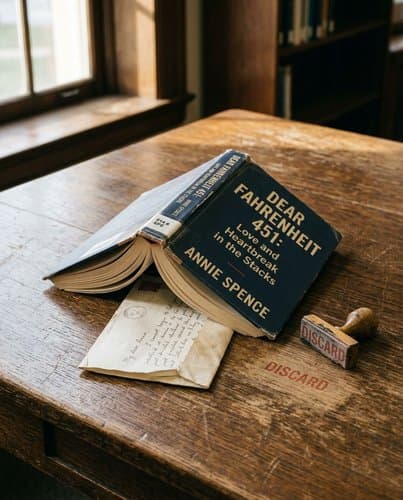
32768516_dear-fahrenheit-451
by Annie Spence
A librarian's witty, tender letters to beloved and despised books reveal that every title you've ever dog-eared, abandoned, or pressed into a stranger's hands…
In Brief
Dear Fahrenheit 451: Love and Heartbreak in the Stacks (2017) collects a librarian's letters to the books she has loved, resented, championed, and discarded. Annie Spence uses this format to show how reading histories function as self-portraits, giving readers a way to trace who they were — and who they've become — through the books they chose.
Key Ideas
What replaces abandoned books reveals truth
When you abandon a book mid-read, notice what you reached for instead — the substitution reveals more about what you were actually looking for than the book you left behind.
Resistance in discarding shows what's precious
Before you donate or discard a book, write one sentence about why you're letting it go. The resistance you feel (or don't) will surprise you.
Rereading old loves reveals personal growth
If you want to know what you were like at a specific moment in your life, reread the book you loved most then — your irritations and sympathies will have shifted, and that gap is the data.
Bookshelves tell truths conversations cannot
Treat every bookshelf you encounter as a portrait of its owner. What's prominently displayed, what's hidden, what's worn to illegibility — these tell you something a conversation might not.
Honesty with librarians sparks discovery
Get a library card, go to the desk, and actually tell the librarian what you loved last. Not what you think you should love — what you actually loved. They will find you something you couldn't have found yourself.
Reconnect with yourself through old books
The next time you feel like you have no idea who you are anymore, go to the shelf where you keep the books from when you did. You'll find yourself there, waiting.
Who Should Read This
Readers who connect with first-person stories about Memoir and Cultural Studies and want to see the world through someone else's eyes.
Dear Fahrenheit 451: Love and Heartbreak in the Stacks
By Annie Spence
9 min read
Why does it matter? Because your bookshelf is an autobiography you didn't know you were writing.
The setup sounds charming: a librarian writes funny breakup letters to books she's weeding. Clever. A little precious. Something you'd give your English-teacher aunt.
Then you notice the trap door. Every letter to a book is actually a letter to the person who read it — to the 23-year-old in it for the stirrings, speed-reading past everything else; to the new mother at 2 AM who reached for the closest book and found her way back to herself; to the girl who stamped her name in a hand-me-down and slammed it shut because she was scared. Annie Spence writes about books as evidence — evidence of who you were at specific, embarrassing moments you forgot you were living. Once you see that, your own shelves start to look different. Less like a collection. More like a confession you never meant to keep.
You Only Know What a Book Meant to You After You Let It Go
Annie Spence, a librarian, carries a destroyed copy of The Goldfinch home from the stacks. The spine is gone. Duct tape holds the cover together. The title page bears a DISCARD stamp, the library's declaration that this book is finished, unfit to circulate. She could have left it in the donation bin. Instead she puts it on a shelf above her record player and makes a promise: no one but the two of them will ever know how fragile it is on the inside.
That scene opens Dear Fahrenheit 451, and it does something the premise's gimmick doesn't prepare you for. You pick up a book of farewell letters written to books — a librarian composing breakup notes to her collection — and your first assumption is that the joke is the point. The format is witty, the conceit warm, the humor charming. Then the Goldfinch letter ends and you realize the format isn't a joke. It's a method.
The letter exists because Spence broke something she loved. She recommended The Goldfinch (nearly 800 pages of Donna Tartt) to every patron who walked through the door, regardless of whether they'd read anything longer than Hatchet. She calls this a violation of the Librarian's Reader's Advisory Code: the professional rule that you match books to readers rather than push your own obsessions. She broke it, repeatedly, for this one book. Mass-market paperback readers cracked open a hardcover doorstop and cracked it in the process. Instead of discarding the evidence, she took the consequence home.
What the letter forces her to say — forces her to see — is that her love for the book was tangled up with possession and vanity. She can't shelve those feelings in a donation bin. Writing the goodbye is the only way to account for what the relationship actually was. Passive ownership never required that accounting. Departure does.
The Same Book Is a Different Book When You're 32 Than When You Were 23
Think of a photograph from ten years ago — a candid one, you mid-laugh at someone's kitchen table. The photograph doesn't change. But every year you look at it differently, because the person looking has accumulated more distance, more comparison, more knowledge of what came after. Books work the same way. The problem is we treat reading as extraction: you go in, locate the meaning, carry it away. The book is fixed. You are the variable. Spence spends the entire collection demonstrating that this is exactly backwards.
The clearest proof is her letter to The Time Traveler's Wife, which she read first at twenty-three while working at the Newberry Library in Chicago (the very institution where Henry, the novel's protagonist, is employed). That coincidence hooked her. She wandered the same cold stacks on her breaks, visited spots the novel mentions, and read Clare's sacrificed art career as a minor inconvenience next to the spectacle of a husband who disappears through time. She was there for the longing. She speed-read the rest.
She picked it up again at thirty-two, married with a child. It dismantled her.
The novel's central conceit (a husband who keeps vanishing against his will, leaving his wife to wait) turns out to be a ruthlessly precise portrait of ordinary marriage. The obstacles just change costume. Instead of a man dissolving into another decade, it's a child's night terror arriving at the wrong moment, or someone's funny video killing the mood, or honestly just wanting to finish your own book. Underneath all of it, the same emotional logic that powers the science fiction: the bone-level fear that the person you love might one day simply not come back.
The moment Spence realizes this is both comic and devastating. She shakes her husband mid-reading to announce she loves him. He's watching a 2009 Blur concert video — for what she estimates is the six hundredth time — which is, she notes, the only version of time travel he'll ever manage. She ends up sobbing on the floor. He offers chicken shawarma. Same logic as the novel: the ordinary gesture is the miracle.
The Person Who Knows What You Read Knows You Better Than You Think
A librarian knows more about you than you realize you've handed over. Every book you've ever borrowed is a data point in a portrait you didn't mean to sit for: what you reach for when anxious, what you can't finish, what you return without comment after two days. Reader's advisory, the professional practice of matching a specific human to a specific book based on their history, is librarian work at its most intimate.
A patron comes in devoted to Fern Michaels's Captive Innocence, a historical romance about a Puritan beauty who falls for her worst enemy in Brazil. She asks for more historical romance set in South America. The sensible answer is Isabel Allende — wade her in gently. Instead, something about a sugar high from the break-room Costco cake loosens Spence's professional judgment, and she hands the woman Gabriel García Márquez's Of Love and Other Demons.
The novel opens with crypts, diseased animals, tortured slaves, and corpses washing up on the shore. Another hundred and twenty pages in lies the payoff: a priest who drags himself through a sewer to reach his twelve-year-old beloved, whom the colonial church believes to be possessed. The patron returns the book in two days and stops making eye contact.
What makes this something other than a cautionary tale is what Spence does next: she defends the book fully, with genuine feeling. A man who drags himself through sewage to reach the woman he loves — that's love, she writes, and she clearly means it. The apology goes to the book. The patron deserved a better guide. The failure came from surplus care: she wanted to change someone's reading life so badly that a piece of discount sheet cake was enough to tip her into the deep end.
That's the intimacy the book is describing. The joke only works because the effort is real.
At 2 AM Holding Your Newborn, a Children's Book Can Remind You Who You Are
It's two in the morning. Spence is on the couch with her sleeping newborn, Walden, and she can't bring herself to stand up — if she moves, he might wake, and she's not sure how many times she can start the cycle over. Her body doesn't feel like hers anymore. Her mind doesn't feel familiar. She's been crying since they brought him home from the hospital, and the crying isn't about the baby. It's about herself, about the person who walked through those doors a week ago and didn't quite walk back out. She's ashamed to say this out loud. Everyone keeps reassuring her about the baby.
So she reaches for the nearest book.
It's The Fledgling, a 1980 children's novel by Jane Langton, about a small girl named Georgie who escapes to a secret hideout of bushes, eats imaginary meals, and learns to fly alongside a magical Goose Prince in Concord, Massachusetts, Henry Thoreau's hometown. Spence had read it as a kid and loved it. The Concord setting was the beginning of a long road to Thoreau, an interest that eventually ran so deep she named her son after his masterwork. The baby in her arms exists, in some small way, because of this book. She hasn't thought about that until now.
She opens it, reads, and for the first time since coming home she feels like herself — not because the novel has anything to say about motherhood, or because Georgie's situation maps onto hers in any obvious way. She feels like herself because she remembers laughing at a snobbish old neighbor's plastic flowers. She remembers hoping every time Georgie gathered herself and jumped. The specific, silly, beloved details of a book she hasn't touched in years pull her back through time, like a tether she didn't know she'd kept.
It has nothing to do with literary quality or thematic fit. The book that rescues you at 2 AM isn't the right book by any measure. It's just the one within reach — which happens to be the one a younger you loved for reasons you can't quite place until you're reading them again. Those reasons are still in there. The book is just how you remember.
The Fledgling ends with the Goose Prince's long-promised gift finally arriving: a rubber ball, ordinary-looking, except that when Georgie is alone with it, the thing comes alive — catches the light, starts to turn. She understands then what he meant when he asked her to take care of it. It's the world. And she finds she's capable of that.
Spence closes the book and looks at her sleeping son. She recognizes what she's holding.
Weeding a Book Is a Kind of Grief, and Librarians Do It Every Day
Spence is standing in the 792s (the theater section), trying to explain something simple to an eighty-year-old theater anthology. She has new plays and needs shelf space. She is not getting rid of it; she is moving it. It should take two minutes.
The anthology cannot answer plainly. It is a book of scenes, and it only knows how to perform. When Spence says it hasn't circulated in a decade, it responds with a character speaking in an Italian accent, smelling a ham. When she explains that borrowing is free, it complains about people who leave shops without buying anything. When she tries to finish a sentence, it accuses her of insolence, ignorance, and debauching. She snaps back that there is no need to bring up her drinking. That flash of self-incrimination, one unguarded word in the middle of a bit, is the chapter's sharpest joke.
What Spence is doing here, what every weeding letter in the collection is doing, is grief work dressed as administration. It sounds like clearing a closet. It isn't. Every letter is a eulogy wearing a punchline.
The theater chapter makes this clearest because the comedy goes furthest. The anthology calls her Deenie, then Mary, then Sam. It never gets her actual name; its plays don't contain it. It delivers speeches about flames and purgatory while she's trying to move it three feet to the left. When she finally breaks through — she is moving it, not discarding it — the anthology responds: "That's the nicest thing you ever said to me, Mary."
She exits defeated. The book delivers its last line to an empty aisle: she never considers me. It never occurred to her to kiss me goodbye.
The whole escalating farce has been this book fighting to stay seen — and it never even got her name right. Comedy and grief turn out to be built from the same material. Spence just assembled them in the order that lets you survive.
The Public Library Is the Last Place That Still Believes Everyone Deserves to Know Everything
When did you last walk into a place that would help you with anything, no appointment required, no explanation owed? Spence answers this with an inventory from a single desk shift: a test-prep book, a car repair manual, help filling out a job application, a phone number for a domestic violence shelter, a kid thrilled to get the next Percy Jackson, a woman with no support system who needs a divorce guide, an email account set up from scratch, a copy of Small Business for Dummies, and an encouraging smile. No credentials required. You showed up.
The funny letters to Bradbury and the theater anthology are how Spence tells you she loves books; the desk shift inventory is how she tells you what books are for. The premise, stated plainly: the desire to know is sufficient. Not your income, your education, your English fluency, your reason. The library is the one institution that takes you at your word.
Spence never lets it go abstract. In the Epilogue, she lists what the library can do without asking why: help you find a job, research your new medication, learn a language, get directions to your aunt's house, find out if a celebrity is still alive, help you give your kid the sex talk. Then she makes her biggest claim: there's nowhere else you can walk in, say you need help with some part of your life, and have someone just start helping. No explanation, no justification, no credentials required. She notes your mom might manage it, but she's worse at search engines.
That's the joke. But the joke is also the argument. Spence has spent the whole book in love with books — with the physical, embarrassing, intimate experience of reading — and it turns out the love was never really about the objects. It was about what happens when someone who needs to understand something walks through a door and a person meets them there. She signs her Fahrenheit 451 letter "It Was a Pleasure to Learn." The novel opens: "It Was a Pleasure to Burn." One desk shift at a time.
The Book That's Already Looking for You
Somewhere within walking distance of where you're sitting right now, there is a book that will matter to you in a way you can't predict yet — at the crisis you haven't hit, the 2 AM you're not expecting, the version of yourself you don't know is coming. It's on a shelf. It doesn't need to know you're coming. No credentials. No explanation. Just walk in. The book is already there. So, probably, is a librarian who will find you exactly the right one — if you tell them what you actually loved, not what you think you should have.
Notable Quotes
“I fucking love you. Don't ever travel to different years!”
“I'm just trying to watch this 2009 Blur live concert for the six hundredth time,”
“You're right. That old noodge Ignorance plodding too close behind with its hot dumb breath on your neck can help up your game. The library is a good gig to have—convincing people that I want to help them with literally WHATEVER they want to learn about. Helping create more”
Frequently Asked Questions
- What is Dear Fahrenheit 451 about?
- Dear Fahrenheit 451 is a collection of letters from librarian Annie Spence to the books she has loved, resented, championed, and discarded. The book demonstrates how reading histories function as self-portraits, allowing readers to trace who they were and who they've become through their book choices. Spence uses this epistolary format to explore how the books we keep, abandon, and return to reveal fundamental truths about our evolving selves and changing values throughout our lives.
- What does abandoning a book reveal about you?
- When you abandon a book mid-read, notice what you reached for instead — the substitution reveals more about what you were actually looking for than the book you left behind. Rather than viewing abandoned books as failures, recognizing what drew you away becomes a form of self-knowledge. This practice illuminates your current needs and desires, showing what resonates with who you are in that particular moment, making every unfinished book a data point in understanding yourself.
- How can rereading past favorite books help you understand your growth?
- If you want to know what you were like at a specific moment in your life, reread the book you loved most then — your irritations and sympathies will have shifted, and that gap is the data. This practice transforms reading into archaeological self-discovery, with changed reactions revealing personal evolution. The distance between your past and present responses to the same text creates a measurable record of transformation, turning every reread into an intimate conversation with your former self.
- Why should you tell a librarian what you actually loved?
- Get a library card, go to the desk, and actually tell the librarian what you loved last. Not what you think you should love — what you actually loved. They will find you something you couldn't have found yourself. A librarian armed with your genuine preferences becomes a guide to discovering books precisely calibrated to your authentic tastes. This honest conversation transforms the librarian into a co-conspirator in your reading journey, helping you find works that speak directly to who you are.
Related Book Summaries
Read the full summary of 32768516_dear-fahrenheit-451 on InShort