13531538_dearie
by Bob Spitz
Julia Child didn't touch a stove until her mid-thirties, yet became America's most trusted culinary authority by treating failure as data, shame as optional…
In Brief
Julia Child didn't touch a stove until her mid-thirties, yet became America's most trusted culinary authority by treating failure as data, shame as optional, and her own late-blooming obsession as a superpower—proof that finding your calling late makes you hungrier, not weaker.
Key Ideas
Willingness to fail beats raw talent
Talent is less important than a willingness to be wrong repeatedly and publicly — Julia's secret was not skill but an absence of shame about not knowing things, which she turned into a methodology of empirical testing and immediate retry.
Right environment unlocks dormant gifts
The container matters as much as the contents: Julia spent forty years with gifts that had no obvious outlet; the right environment (Paris, the OSS, Paul's intellectual world) didn't create her capacities but finally gave them somewhere to go.
Private rigor enables public authenticity
Perfectionism and performed fallibility can coexist: Julia spent hours in private eliminating every variable in a recipe, then deliberately showed herself making mistakes on television — the private rigor made the public ease genuine, not fake.
Rejecting monetization preserves authentic authority
Refusing to monetize your authority is how you keep it: Julia's 'anti-shill' stance — turning down endorsements, sabotaging sponsors on camera — was the source of her trustworthiness with audiences, not a sacrifice of commercial opportunity.
Late arrival strengthens lasting mastery
Mastery arrived late and by accident, which made it more durable: because Julia didn't stumble into cooking until her mid-thirties, she approached it with the curiosity of a student and the obsessiveness of someone who has finally found the right thing — she never took it for granted.
Who Should Read This
Readers interested in Memoir and Professional Growth, looking for practical insights they can apply to their own lives.
Dearie
By Bob Spitz
14 min read
Why does it matter? Because the person who changed American food spent her first forty years being spectacularly, magnificently lost.
Here's the conventional wisdom about greatness: you find your gift early, you pursue it obsessively, and talent does the rest. Julia Child found her gift at thirty-six, in a restaurant in Rouen, eating a plate of fish. Before that, she was a six-foot-three Pasadena socialite with a C average, a slide-whistle voice, a failed advertising career, and a kitchen so dangerous she once set her apron on fire making toast. Bob Spitz's Dearie is the biography of a woman who became the most influential figure in American food culture not despite arriving catastrophically late, but because of it — because someone who learns everything the hard way, in public, without shame, turns out to be exactly the teacher a nation of terrified home cooks desperately needed. What happened between that plate of sole and fifty years of television is stranger and funnier than any story about early talent could ever be.
Before She Became Julia Child, She Was a Magnificent Waste of Potential
Sometime around 1930, an eighteen-year-old from Pasadena sat down with a Smith College registration form and confronted a line marked "Vocational Choice." The women on either side of her were filling in things like pediatrician, historian, interpreter. Julia McWilliams picked up her pen and wrote: "No occupation decided; marriage preferable." It is one of the funniest and most accurate self-portraits in the biography.
She was not being cynical. She genuinely had no idea what she was for. This was the central problem of Julia's first four decades — not unhappiness, not lack of ability, but a persistent mismatch between her dimensions and every available container. Physically she was enormous, topping six feet by her teens and still growing, a fact that put her in the back row of every school photograph, usually among the boys. Temperamentally she was equally outsized: loud, ringleading, constitutionally unable to follow instructions she found inconvenient. She shoplifted fruit from a hotel, rode behind moving trucks by grabbing the fender, taught the neighborhood children to smoke using bamboo stems stuffed with corn silk, and got herself stuck in a chimney inspecting a house she wasn't supposed to be in. She was expelled from W. & J. Sloane for ignoring a corporate directive she thought was trivial. She failed the typing test at Newsweek.
Her lineage was pedigreed on both sides — Mayflower Westons, Midwestern banking McWilliamses — and her father had opinions about everything, especially the French (untrustworthy) and salads (Bolshevist). Food at home ran to meat cooked to what Julia later called a "ghastly medium gray." Nobody expected her to cook. Nobody expected her to do much of anything except marry well and circulate gracefully. She was almost thirty before anything changed.
The comedy of the early Julia is that her gifts were real and obvious and completely untethered. All she needed was a subject large enough to contain her — and she hadn't found it yet.
The War Gave Her the First Thing She Was Actually Good At
The Navy rejected Julia McWilliams for being too tall. She was six feet one — or possibly six-three, depending on the measuring tape — and some anonymous bureaucrat circled the number on her application and sent it back. So she did what oversized women of ambition do when one door closes: she found a bigger door. By December 1942 she was walking into the Office of Strategic Services in a leopard-fur coat, about to discover that she had a genuinely formidable mind, and that all she'd needed to activate it was the right kind of chaos.
The OSS was, famously, 'Oh So Social' — a fraternity of Ivy League misfits funded by Wild Bill Donovan and answerable only to Roosevelt, where the operative credo was that standard procedure was practically forbidden. Julia was assigned to organize Donovan's classified files: the code names, the encoded dispatches, the personnel records for every shadow agent in Southeast Asia. She called herself a file clerk for the rest of her life. Colleagues called that 'poppycock.' As keeper of the Registry in Kandy, Ceylon, she was the single person who knew where every undercover agent was, what they were doing, and who else was allowed to know. That kind of trust isn't placed in someone who's merely organized; it's placed in someone whose judgment is airtight.
What the war actually gave her was a container proportionate to her scale. The files were endless, the stakes were real, and Julia — who'd been fired from a furniture showroom and failed the Newsweek typing test — turned out to be extraordinary at it. The transformation baffled even her. She'd spent thirty years convinced her brain was 'only working on half cylinders.' Then she spent three years routing 600 pieces of classified intelligence a month through a system she'd built herself, dispensing operational opium payments to field agents, and sending fake policy memos to department heads just to watch them initial the absurdities. The memos came back approved. She found this hilarious and clarifying in equal measure.
The man who completed the equation was waiting in Kunming, China. Paul Child was forty-two, balding, imperious, and possessed of the kind of taste that makes everyone around it feel slightly underdressed. He'd spent a decade in love with a Boston intellectual who'd introduced him to serious French cooking, Mozart, and the Harvard salon circuit. Edith Kennedy died in 1942, and Paul had more or less concluded that nobody could replace her. Julia, he wrote to his brother, was warm and funny but lacked 'worldly knowledge' — she was, at best, a diamond in the rough.
Then the army food became unbearable — water buffalo, canned tomatoes, rice — and they started eating their way through Yunnanese restaurants instead. Over bowls of rice noodles cooked in dense, oil-sealed broth, over steam-pot chicken and plantain-wrapped fish, over tables so loud that waiters had to shout the orders across the kitchen, something shifted. Paul taught Julia to use chopsticks. She taught him that enthusiasm, properly focused, is a form of intelligence. They talked for months — about his dead love, her distant father, the versions of themselves they wanted to become after the war — hunched over dishes that kept arriving, each one a small surprise. When Japan surrendered and separation loomed, Paul wrote her a birthday sonnet thick with harvest imagery and heat. He signed it 'Paulski.' The diamond had found its setting.
One Plate of Fish in Normandy Reorganized Her Nervous System
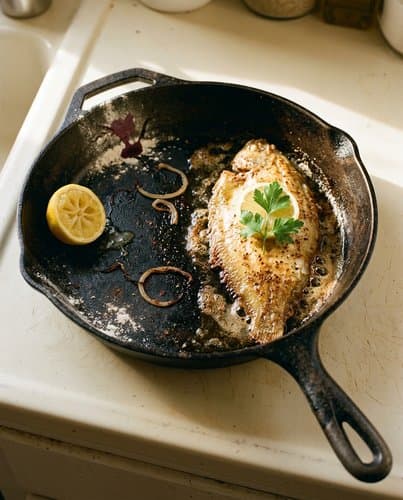
November 3, 1948. A restaurant in Rouen called La Couronne, the oldest in France according to the Michelin guide, drab and white-tableclothed and utterly unprepossessing. Julia Child is thirty-six years old, still adrift, husband across the table ordering in flawless French. The waiter arrives. Before the plate touches the tablecloth, she smells it — clarified butter with a scorched, caramel undertow, then the sea, then something faintly citrus that vanishes before she can name it. Then the dish appears: a sole, a pool of molten gold around it, a pinch of parsley. That's all. She leans forward and inhales. Her whole chest fills.
Paul had chosen sole meunière almost as an afterthought, something gentle on stomachs battered by five days of North Atlantic swells. What arrived was Dover sole, genuinely fresh, cooked in clarified butter until its flesh was firm and giving at once — not the cardboard flounder sold under false pretenses back home, not the sheetrock her mother used to serve in Pasadena — and finished with foaming brown butter and a squeeze of lemon. Julia later said it tasted like the sea. What she meant, though she didn't have the vocabulary yet, was that it tasted like nothing she'd been told food could be: specific, honest, alive.
The meal that followed — oysters from the Iberian coast, a cold glass of Chablis, the sole, a green salad, cheese — lasted two hours. Each course arrived and was eaten at a pace Julia associated with ceremonies, not lunch. She left the restaurant shaken. Not charmed, not impressed: shaken. Something had reorganized itself in her body before her mind could catch up.
Back home in Washington she had once spent all day on a recipe from a women's magazine, eaten dinner at ten o'clock because the steps kept defeating her, and still produced something wrong. The French had made her realize the problem wasn't effort or even technique — it was that she'd never once tasted food that revealed what food could actually be. The sole in Rouen wasn't the solution to that problem. It was proof that the problem had a solution. That distinction mattered. She drove toward Paris already hungry for what came next.
Mastery Is Not Talent — It's a Willingness to Be Wrong 284 Times
Think of mastery the way a locksmith thinks about a lock. You don't stand outside guessing. You take it apart, lay each component on a cloth, study how the pins respond to pressure, and then put it back together and try again. Most people cook from the outside — they follow instructions and hope the lock opens. Julia Child, beginning in her Paris kitchen in 1949, was a locksmith.
The mayonnaise episode illustrates the method precisely. Julia could make mayonnaise, and she could make it fast — half a pint in seven minutes, reliably creamy, no trouble at all. Then the weather changed, and the same process produced a thin, oily mess. A recipe follower throws out the batch and adjusts by instinct. Julia threw out the batch and started a research project. What she eventually discovered, after dumping enough failed attempts down the toilet to embarrass a professional kitchen, was that temperature governs everything: the bowl, the eggs, the oil, even the workspace have to be at room temperature before the yolk can bind. A wire whisk matters because it lets you modulate pace in a way beaters don't. The ratio of four parts oil to one part yolk is not a suggestion but a structural requirement, the precise proportion at which the yolk can hold the emulsion. She made so much mayonnaise during this period that she and Paul eventually couldn't bring themselves to eat it. She poured it down the drain and made more. Not compulsion. This was how she separated what she knew from what she merely assumed.
She brought the same orientation to everything. Early batches of onion soup came out pale and flat; later ones swung to burned and acrid. The ingredients weren't wrong. The problem was time — forty-five uninterrupted minutes of slow caramelization, constant stirring, fat turning nut-brown before the onions release their sweetness. No shortcut produced the same result. The lesson wasn't a technique tip. It was a philosophical position: certain transformations cannot be hurried, and pretending otherwise just moves the failure forward.
By the time Julia and Paul had spent two years and 284 pounds of flour trying to develop a workable French bread recipe — burning through wet towels, ice cubes, a medieval bundle of dampened straw, and finally a glowing iron weight dropped into a pan of water — the pattern was clear. What looked from the outside like enthusiasm was a systematic refusal to accept incomplete understanding. She wasn't trying to make bread. She was trying to understand bread well enough to teach it to someone who'd never held a baguette. A French professor eventually pointed them toward wet dough and cool fermentation; the recipe that came out of those 32 experiments ran 32 pages and sold by the millions. The scale of the thing — the obsessive, almost deranged specificity — was precisely what made it work. Readers sensed they were holding something that had been earned rather than assembled.
The television warmth was real. But it was built on this: on years of anonymous failure in a Paris kitchen, on the willingness to be wrong 284 times in a row and keep the flour coming.
Her Greatest Teacher Tried to Humiliate Her — and Accidentally Set Her Free
On a bright April morning in 1951, Julia Child descended to the basement kitchen of Le Cordon Bleu in what she later described as a cold and clean fury. She had spent months demanding her diploma examination, writing increasingly pointed letters to the school's headmistress, Madame Brassart, finally invoking the U.S. ambassador's name and threatening to take the exam in her own well-appointed kitchen. Brassart had stonewalled every request until Julia's old mentor, Chef Bugnard, intervened personally. The exam had finally arrived.
The written portion was easy. Then someone handed Julia an index card listing the practical cooking requirements — dishes pulled from a pamphlet distributed to six-week housewife enrollees. Not Filets de sole Walewska, not the galantines and terrines she'd spent years mastering, but soft-boiled eggs she didn't know how to coddle and a veal chop to be reheated inside a paper bag. Brassart had given the woman who could debone a chicken in twelve minutes the test designed for someone who'd never held a knife.
Julia improvised her way through it, poaching eggs that should have been coddled, sautéeing mushrooms when the recipe demanded duxelles, omitting the ham entirely. She failed. Standing in the wreckage of the exam, she ran through her own inventory — galantines, terrines, hollandaise, cassoulets, soufflés, braised lettuces, mousse de faisan en gelée — and landed on the only conclusion that mattered: the main thing is that I know how to cook.
Brassart had tried to take away a credential. What she actually took away was Julia's need for one. Within months, Julia was co-founding her own cooking school, L'École des Trois Gourmandes, teaching on her own terms — and beginning work on a cookbook that nobody, including Julia, quite understood yet would change American cooking permanently.
'If a Book with That Title Sells, I'll Eat My Hat'
On May 5, 1960, with the editorial meeting at Knopf dragging into the lunch hour, a legendary editor named Angus Cameron stood up and announced that he had a cookbook to discuss. The room deflated. Alfred Knopf had recently watched two French cookbooks lose money and had declared himself done with the category. His wife Blanche, who handled cookbooks by default, had already delivered her verdict to a colleague: 'I don't think we need this, do we?' What Cameron knew — and what Alfred didn't yet — was that four editors had spent the previous month cooking their way through the manuscript and were prepared to go to war over it.
The manuscript had arrived at Knopf through a kind of underground railroad. Houghton Mifflin had already turned it down, editor-in-chief Paul Brooks writing that while the work was 'culinary science,' it was too expensive to produce for an audience that, the thinking went, only wanted twenty-four-word recipes and canned shortcuts. Julia had stared at that letter in her Oslo living room and briefly concluded the book might be unpublishable. What rescued it was Avis DeVoto routing the manuscript to a Knopf executive named Bill Koshland, who took it home, cooked from it, and then quietly deputized two allies: Cameron and a junior editor named Judith Jones, who had previously pulled Anne Frank's diary from the reject pile. Jones and her husband spent a month working through the recipes every evening, and she arrived at the editorial meeting convinced she was holding a future classic.
Cameron's pitch was deliberately timed for maximum exhaustion. He waited until the meeting had ground everyone down, until eyes were drifting toward the door, and then made his case. Alfred relented with a shrug. Blanche, sensing she'd been outmaneuvered in her own house, stood up and walked out. Then came the title. Julia had generated forty-five candidates — 'French Magicians in the Kitchen,' 'How It Can Be Cooked French' — each worse than the last. Jones tried rearranging words on her desk until one combination clicked: Mastering the Art of French Cooking. She presented it to Alfred Knopf in his paneled office, where she was not offered a chair. He scowled at her across the mahogany. 'If a book with that title sells,' he said, 'I'll eat my hat.' He meant it as a dismissal. It turned out to be a promise.
She Accidentally Invented the Celebrity Chef by Treating the Camera Like a Neighbor
What actually made Julia Child a television phenomenon? The cooking was real, but so was Dione Lucas's cooking, and Lucas — technically flawless, actively contemptuous of her audience — died a regional curiosity. The difference was something stranger: Julia Child had no shame. Not the performative confidence of someone who has rehearsed away their fear, but a constitutional indifference to looking ridiculous in public. And American housewives, who had been quietly ashamed of their own kitchens for years, recognized it immediately and went faintly insane with relief.
Consider what happened during the onion soup episode, the second show. Julia topped her soup bowls with bread and cheese, slid them under the broiler, and promptly forgot about them while chatting with the camera. When she finally retrieved them, smoke was rising off the rack and the tops were carbonized black. A normal television personality would have apologized, cut away, or looked mortified. Julia peered at the wreckage, announced that it 'gives good effect,' carried the smoking pot to her dining table anyway, and inhaled the aroma as though savoring something magnificent. That was not a bit. She genuinely wasn't embarrassed. When a potato pancake flipped onto the stove instead of the plate, her observation was simple: if you're alone in the kitchen, who exactly is going to see? The question was rhetorical but the implication was liberating — failure is just cooking in progress.
The producer Russ Morash understood what he had before the audience did. He'd warned Julia that she needed to treat the camera like a friend she cared about. She took this further than he intended. She sat down after the soufflé, poured herself an actual glass of wine — live television, 1963, when on-air drinking was roughly as acceptable as an open flame — and drank it with visible pleasure. Nobody did that. Wine was a prop or it was a scandal. For Julia it was dinner.
The audience's response was less about French cooking than about permission. After she featured broccoli, local supermarkets sold more of it in a single week than they had the entire previous year. After she mentioned specific kitchen tools, stores sold out of fish poachers and wire whisks overnight. What her viewers were buying was not equipment but the license to cook badly, to char the croutons and laugh at themselves and keep going. Julia never apologized, never endorsed a product, never let a network tell her what to make. She ate the butter. She drank the wine. She turned to the camera like a neighbor leaning over the fence and said, in effect: I made a mess too, come have some anyway. That turned out to be the most radical thing on television.
The Woman Who Democratized French Cooking Refused Every Dollar That Came With It
The refusal was the point. Every time Julia turned away a corporate suitor — and by the mid-1960s they were arriving in convoys, advertising agencies dangling supermarket deals, detergent campaigns, a standing offer to jump to ABC — she wasn't protecting her image. She was protecting the only thing that made her worth anything: the audience's certainty that she meant what she said. James Beard had made the opposite choice, lending his name to Kraft, Borden, Omaha Steaks, and a dozen other brands until the endorsements outnumbered the opinions and nobody could quite tell where the man ended and the logo began. Julia watched this and felt something between pity and contempt. On her set, olive oil went into an unmarked glass cruet. Wine was described generically. Even Hills Brothers Coffee, one of the show's early sponsors, never had its label turned toward the camera. This wasn't modesty. It was the source of her authority.
That authority had a logical conclusion, and it arrived during the filming of her late-career series with Jacques Pépin. Kendall-Jackson Winery had underwritten much of the production — cases of their best wine arriving regularly, sponsors gathered in Julia's dining room to watch the final sessions on monitors. Jacques uncorked two bottles of the winery's sauvignon blanc and made a gracious on-camera case for it. Julia reached under the counter and produced two bottles of Sam Adams beer. She had clearly placed them there in advance. Jacques's face went, according to witnesses, visibly panicked. He asked if perhaps they could have beer and wine. She looked at him the way you look at a child suggesting a compromise that was never on the table. 'No, Jack. We're having beer.' The sponsors watched from the next room.
That moment is the whole biography in miniature — not French cuisine, not television fame, but a model for how to live. Refuse to apologize, refuse endorsements, refuse to stop, eat the butter. The doctors told her to quit butter and she called them silly boys. At ninety-two, facing sepsis and dialysis, she asked her physician plainly whether the treatment would restore her energy. He said no. She said don't bother, then made herself a bowl of onion soup with plenty of butter and ate two bowls. That was the final Julia Child recipe: do only what you believe in, and mean every bite.
The One Thing She Could Not Fix
In September 1989, Julia Child spent over an hour in a nursing home room in Lexington, Massachusetts, selling her husband of forty-five years on the idea that he was only there temporarily. She had arranged his familiar pictures on the shelves beforehand — and when Paul looked around and said flatly, 'This isn't our house,' she held her ground and told him it was a place to rest, just for a while. Paul had been the force behind everything: the man who'd handed her reading lists in Kunming, steadied her chopstick grip over Yunnanese noodles, carried dishes and scrubbed floors on every television shoot without complaint, and written her birthday sonnets dense with heat and harvest. Now she was explaining a nursing home to him as though it were a hotel. When she finally left, she climbed into Marian Morash's car, put her head in her hands, and wept all the way home.
The methodology that had carried Julia through every obstacle — the 284 batches of bread dough, the failed Cordon Bleu exam, the Houghton Mifflin rejection, the lost shows and lousy reviews — was a methodology of forward motion. Feel the problem, diagnose it, reorganize the kitchen, hire the speech therapist, install the elevator, get back to work. It had served her brilliantly for forty years. But there was no technique for what Paul had become: a man who turned his beloved Rolleiflex over in his hands like a puzzle he couldn't solve, whose drawings looked like a preschooler's work, who had lost his French along with his coordination. Julia's survivalist logic — 'the survivors have to survive' — was genuinely true and genuinely heartbreaking, because it meant she never got to stop. She was practical where other people were allowed to be wrecked. The cost was the right to grieve in the ordinary way, messily and all at once, instead of in the car between one obligation and the next.
The Last Bowl of French Onion Soup
The soup was French onion, made with plenty of butter, ordered by a woman who had spent decades learning exactly how long the onions need and exactly why you cannot rush them. That is the whole lesson, sitting in a bowl. You can acquire all the technique in the world, but without the willingness to fail in public — to pour out the broken mayonnaise and start again, to hand the sponsor a beer — none of it adds up to much. Julia Child didn't teach America to cook French food — she taught it something older and harder: that patience and pleasure are not in competition, that a mess in the kitchen is not a moral failure, and that the most subversive thing you can do in a world that monetizes your every opinion is simply to mean what you say. She was ninety-one years old and she knew exactly what she wanted. That's the recipe.
Notable Quotes
“the fundamental principles that underlie each and every recipe”
“after that demonstration of Boeuf B. [as she called bœuf bourguignon], I came home and made the most delicious one I ever ett.”
“thoroughly analyze texture and flavor.”
Frequently Asked Questions
- What is "Dearie" by Bob Spitz about?
- Dearie chronicles Julia Child's unlikely transformation from directionless late bloomer into America's most trusted culinary authority. Drawing on extensive research, Bob Spitz reveals how Julia's willingness to fail publicly, her refusal to compromise her integrity for commercial gain, and her accidental discovery of cooking in her thirties combined to produce a form of mastery that readers can apply to their own late-starting pursuits. The book demonstrates how these factors—perseverance through public failure, ethical unwavering, and late discovery—can lead to transformative expertise and trusted influence.
- What are the key takeaways from "Dearie"?
- Talent is less important than a willingness to be wrong repeatedly and publicly—Julia's secret was not skill but an absence of shame about not knowing things, which she turned into a methodology of empirical testing and immediate retry. The book reveals that perfectionism and performed fallibility can coexist: Julia spent hours in private eliminating every variable in a recipe, then deliberately showed herself making mistakes on television. Additionally, refusing to monetize your authority is how you keep it; Julia's anti-shill stance of turning down endorsements and sabotaging sponsors on camera was the source of her trustworthiness, not a sacrifice of commercial opportunity.
- How did Julia Child become a culinary authority according to "Dearie"?
- Julia Child didn't discover cooking until her mid-thirties, and this late start proved crucial to her mastery. The container matters as much as the contents: Julia spent forty years with gifts that had no obvious outlet, but the right environment—Paris, the OSS, Paul's intellectual world—finally gave them somewhere to go. Once she found cooking, she approached it with the curiosity of a student and the obsessiveness of someone who has finally found the right thing, never taking her expertise for granted. This combination of late discovery, rigorous private practice, and public humility created a form of authority that audiences deeply trusted.
- Is "Dearie" worth reading for people interested in late-blooming success?
- Yes, "Dearie" is invaluable for anyone pursuing achievement later in life. The book demonstrates that mastery arrived late and by accident, which made it more durable—because Julia didn't stumble into cooking until her mid-thirties, she approached it with the curiosity of a student and the obsessiveness of someone who has finally found the right thing. Bob Spitz's research reveals how public failure, personal integrity, and the right environment can combine to create genuine expertise. The book offers practical insight into how refusing to compromise one's values—despite commercial pressure—ultimately builds the trust and authority that sustains influence over decades.
Related Book Summaries



Read the full summary of 13531538_dearie on InShort