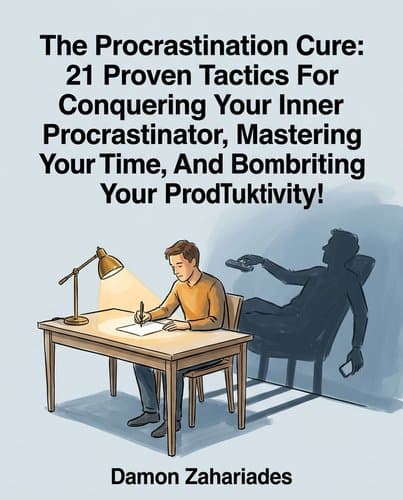
35180801_the-procrastination-cure
by Damon Zahariades
Procrastination isn't laziness—it's a predictable reaction to diagnosable psychological triggers like fear of failure, perfectionism, and overwhelm.
In Brief
Procrastination isn't laziness—it's a predictable reaction to diagnosable psychological triggers like fear of failure, perfectionism, and overwhelm. These 21 tactics show you how to engineer your environment and compress your timelines so that starting any task becomes structurally easier than avoiding it.
Key Ideas
Identify Your Procrastination Trigger
Before trying any fix, identify your specific trigger: fear of failure, perfectionism, overwhelm, and boredom each require different remedies. Keep a two-week log — when you feel the urge to delay, pause and write down what's actually driving it.
Shrink Your Daily Task List
Shorten your daily to-do list to 3–7 items (or experiment with 3). Fewer items means fewer escape routes. The same 2,000 words that take five hours on a long list take three hours on a short one.
Compress Time to Compress Work
Apply Parkinson's Law deliberately: give yourself less time for a task than you think you need. A two-hour window becomes 90 minutes; work expands to fill the time available, so compress the available time.
Master the First Ten Minutes
Focus only on the first 10 minutes of a dreaded task, not the whole thing. Drive to the gym and you'll work out. Open the software and collect resources and you'll write the presentation. Starting is where all the resistance lives.
Use External Deadlines for Better Results
When possible, ask someone else to set your deadlines. MIT research shows externally-imposed deadlines consistently produce better work than self-imposed ones — even when people voluntarily set their own deadlines earlier.
Remove All Distractions and Exit Routes
Strip your environment of options before starting a task: close browser tabs, delete social media apps, find a room with nothing else in it. You're not building resolve — you're removing exits. Victor Hugo gave his clothes to a servant.
Forgive Yourself to Reduce Future Procrastination
After you procrastinate and feel guilty, forgive yourself quickly and move on. The 2010 Wohl/Pychyl study found that self-forgiveness after slipping reduces future procrastination; prolonged self-blame makes the next slip more likely.
Pair Tasks with Enjoyable Rewards
Bundle a dreaded task with a genuinely enjoyable activity — access to the TV show, the coffee shop visit, the video game — but make it conditional on completing the task first. You're not fighting the pull of pleasure, you're turning it into fuel.
Who Should Read This
People working on personal growth in Time Management and Focus, especially those tired of generic motivational advice.
The Procrastination Cure: 21 Proven Tactics For Conquering Your Inner Procrastinator, Mastering Your Time, And Boosting Your Productivity!
By Damon Zahariades
11 min read
Why does it matter? Because treating procrastination as a character flaw guarantees you'll never fix it.
You've called yourself lazy so many times it's started to feel accurate. The gym membership, the project you keep pushing to next week, the email sitting in drafts since November — you've decided what they mean about you. Damon Zahariades made the same call about himself. Then he started looking at why the stalls kept happening rather than what they said about him, and the answer kept pointing away from character and toward environment: the wrong setup, tasks arranged so avoidance was easier than starting them, triggers he hadn't noticed. Procrastination is a behavioral pattern with identifiable causes and predictable workarounds, not a character flaw. The problem was never willpower. It was design. Understanding why you stall matters less than structuring your days so delay becomes harder than action.
You're Not Lazy — You're Obeying Your Brain's Reward System
That second towing fee points to the actual definition of procrastination — not a failure to care, but a gap between caring and acting. Zahariades fully intended to register his car. The word for that gap isn't laziness; it's timing. A lazy person has no intention of doing the task — not now, not later. A procrastinator intends to do it. He just keeps picking later.
The reason comes down to biology. The brain prefers rewards that arrive now over rewards that arrive later, even when the later reward is bigger. Applying a sticker delivers no immediate pleasure. The brain registers relief the moment you decide not to bother — walking back inside is the reward. That calculation runs instantly, every time, and it almost always votes for the present. That's not weakness. It's a predictable feature of how reward systems are wired.
Which means the fix isn't trying harder, or wanting it more, or feeling appropriately terrible about yourself. If the brain is just doing what brains do — chasing immediate reward, avoiding present effort — the question becomes: how do you restructure the situation so that taking action carries more immediate appeal? That's a design problem. And design problems can be solved.
Procrastination Has a Root Cause — And It's Probably Not the One You Think
Most productivity advice treats procrastination as a single disease with a single cure: more discipline, better systems, stronger willpower. That's like prescribing the same antibiotic for every illness. It works occasionally, when the guess happens to match the problem. The rest of the time, you just feel worse for having tried.
Zahariades identifies at least eight distinct causes of procrastination, each operating through a different psychological mechanism. The reason most anti-procrastination tactics fail isn't that you lack the will to use them. You're applying the right tool to the wrong problem.
Consider two of the most common: fear of failure and perfectionism. Both produce avoidance. Both feel, from the inside, like the same formless reluctance to start. But they run on opposite engines.
Fear of failure is about outcome. You hold back because you imagine the result: the embarrassing presentation, the rejected application, the disastrous first attempt. The anticipation feels worse than the discomfort of delay. The fix, Zahariades argues, is to redefine what failure means. Rather than treating it as evidence of a character flaw, treat it as data: a specific tactic didn't work, which points toward a different one. Michael Jordan missed more than nine thousand shots over his career, lost nearly three hundred games, and was handed the game-winning shot twenty-six times and missed every single one. He didn't succeed despite those misses. He succeeded because of them. Failure wasn't a verdict on his ability; it was information about what to try next.
Perfectionism arrives through a different door. The perfectionist isn't afraid of a bad outcome; they're afraid of an imperfect good one. The standard is so high that starting feels futile, because any effort that falls short of flawless isn't worth making. Anne Lamott put it plainly: perfectionism is "the voice of the oppressor." Not an internal quality-control mechanism, not conscientiousness — an authoritarian you've been obeying when you should be ignoring it.
Apply the Jordan reframe to a perfectionist and you get nowhere, because the issue was never about fear of failure. Apply the "quiet the inner tyrant" approach to someone who's genuinely afraid of embarrassment and it misses the mechanism entirely. Same symptom, opposite disease, incompatible cures.
This is why Zahariades spends the first third of his book on diagnosis before offering a single tactic. Overwhelm, for instance, isn't just "too busy." He maps six distinct triggers for it: sleep deprivation, grief, credit card debt, too many open projects, a major decision sitting unresolved, information overload. Same word, six different root causes, none of them fixed by trying harder. The reader who leaves thinking "I just need more willpower" has skipped the only step that actually matters: figuring out which cause is running the show.
Victor Hugo's Solution to Procrastination Wasn't Discipline — It Was Architecture
Every morning in his Paris study, Victor Hugo undressed completely, handed his clothes to his servant, and instructed the servant not to return them until he'd finished his day's writing. No clothes, no leaving. No leaving, no cafés, no parks, no bars. Only the manuscript.
Hugo was not a man without options. Paris in the nineteenth century was stocked with them, and that was exactly the problem. Every hour he spent at his desk was an hour he could see himself spending elsewhere. His solution wasn't to strengthen his resolve against those alternatives. It was to make accessing them physically impossible.
The intuitive approach to procrastination is motivational: want the right things more, feel the consequences more vividly, summon the discipline you apparently lack. Hugo points somewhere else entirely. The problem isn't the will — it's the environment. Leave enough exits in the room and you'll eventually take one. The fix is to seal them before you sit down.
What Hugo did, stripped to its logic, was remove every competing option from physical reach. Zahariades calls this limiting your options to one. Close every browser tab except the paper you're reading. Take a legal pad to a conference room and leave your phone behind. The task you're avoiding becomes easier to start when there's nothing else to do instead. That's not a psychological trick; it's a design constraint, the same logic as removing junk food from the house rather than trusting yourself to resist it at 11pm.
The same logic applies to time. Motivation is unreliable, and it conveniently fails when you need it most. Zahariades recommends a fixed daily window instead: 6 to 7pm, every evening, side business only. A few weeks of that and it stops being a decision. It becomes a habit, running without fresh willpower each time.
But the sharpest version of the argument comes from a 2002 study by Dan Ariely and Klaus Wertenbroch. MIT students were split into two groups: one received externally set deadlines for three papers; the other set their own. The self-deadline group had to declare their dates in advance and couldn't change them, a genuine attempt at self-binding. Seventy-five percent chose earlier deadlines than required, explicitly trying to pre-empt their own procrastination. They knew the problem and took deliberate steps against it.
They still turned in work later. And caught fewer errors.
Even motivated self-constraint underperforms against an external structure you had no hand in creating. Hugo's trick was technically self-imposed too, but it belongs in a different category: a declared deadline is a promise you can renegotiate with yourself; clothes locked in another room are a physical fact. That gap is what the Ariely study points at: the difference between constraint you can reason around and constraint you can't. Hugo wasn't eccentric — he'd just removed willpower from the equation entirely.
The argument isn't about becoming a more disciplined person. It's about arranging your environment so the disciplined behavior is the only one available.
The Wrong List Is Why Five Hours of Work Takes Five Hours
Why does the same task take two hours less when it's the only thing on your plate?
Zahariades tracked this on himself. Writing 2,000 words appears regularly on his to-do list, and for years it took him roughly five hours (he's candid about being a slow writer). Then he ran an experiment: instead of working from a long list, he reviewed his master list each evening and selected just three items for the following day, tasks substantial enough to fill his available work hours. When the writing assignment was one of those three, it took three hours. Same task, same person, same blank page. Two hours gone, attributable to nothing except the length of the list around it.
He's careful not to claim the shorter list made him a better writer. The gain was purely psychological: less ambient anxiety, fewer competing demands pulling at his attention, something closer to a flow state. A long list scatters your focus across everything you're not yet doing, and that's what slows individual tasks.
The same logic applies to time limits. Parkinson's Law says work expands to fill whatever time you give it. Treat that as a design constraint rather than a complaint and it becomes a tool. A visible finish line focuses attention; a blank afternoon invites drift.
The practical move is almost absurdly simple: when you assign a time limit to a task, shorten it immediately. Your first instinct will be conservative — you'll pad generously, just in case. That's where most of the waste lives. Trim before you start, not after you've coasted through it.
Neither tactic requires motivation. They require structure. That's the shift: not feeling differently, but building differently. Most procrastination cures ask you to want it more, or dread the consequences more vividly. These ask you to arrange things differently, fewer items on the list, tighter windows on each, and let the psychology follow from the design.
Multitasking Is Procrastination Wearing a Productivity Costume
Multitasking is procrastination — the same behavior wearing better clothes.
Here's the mechanism. When you juggle tasks, you feel productive, and that feeling is its own reward. Media theorist Clay Shirky named it exactly: multitasking moves the pleasure of procrastination inside the period of work. The emotional payoff that usually comes from avoiding a task, the relief of doing something easier, doesn't vanish when you sit down and "work." It gets smuggled in. You switch from the difficult project to five smaller ones, and your brain registers the switches as accomplishment. The feeling is indistinguishable from genuine productivity, which is exactly why the habit is so hard to stop. You keep multitasking because it keeps feeling like it's working.
Meanwhile, your highest-priority work stays untouched. Every attention switch carries a cost: a reorientation before you're back at full capacity. Run that across a day of constant switching and you've burned real hours generating nothing but the sensation of progress.
The fix Zahariades recommends is unglamorous: write down every task, assign it a priority level, work through the list in order. Prioritize the night before so the morning requires no decisions. Keep one browser tab open. Name the urge to switch before you act on it. That pause is enough to make the cost visible. Single-tasking builds like any other habit: slowly, through repetition.
The sting is that multitasking's signal, the feeling of being productive, is indistinguishable from real productivity. You can't use the feeling as your guide. You can only trust structure: is the important task getting your hours, or is something else?
That's a harder question than it sounds, because there's a legitimate case for deliberate delay. Hemingway reportedly stopped writing each day mid-sentence (not at a natural break, right in the middle of a thought) so the next morning's start was already in motion. Sleep researchers have documented the same effect at scale: problems left overnight often yield solutions that hours of grinding didn't. The creativity literature calls it incubation.
So not all delay is avoidance. Some of it is strategy. The honest difference is this: intentional delay means setting the problem down and stepping away, trusting it's still running somewhere while you do something else. What most of us do instead is keep the problem open, technically present and never touched, while filling the time with easier substitutes. That's not incubation. That's avoidance with a better story.
Blaming Yourself After Slipping Makes the Next Slip More Likely
Imagine you're coaching a friend who's trying to run every morning. They miss three days straight. You don't sit them down and detail every character flaw the absence reveals — you say "okay, go tomorrow." The grace is automatic when it's someone else. When you're the one who slipped, something different kicks in: a long, specific inventory of your failures, the evidence that you'll never change, the familiar conviction that feeling terrible is at least doing something productive.
It isn't. A 2010 study by Michael Wohl and colleagues at Carleton University tracked 134 first-year students across two consecutive exams, measuring whether they procrastinated before the first, how guilty they felt afterward, whether they forgave themselves, and whether they procrastinated again before the second. Students who forgave themselves after the first slip were measurably less likely to delay before the second exam. Those who didn't were more likely to procrastinate again. The researchers' explanation: guilt and self-blame don't motivate better behavior; they become a burden the mind keeps dragging around, consuming the very resources needed to start. Self-forgiveness dissolves that weight.
The mechanism makes sense when you trace what guilt actually does. You put off a project, then spend the next several hours feeling bad about it. Now you've lost the time and you're in a worse mental state than before you procrastinated. The self-blame was supposed to be accountability; it turns out it was just punishment, which is a different thing. Accountability says "I made a choice I'll make differently next time." Punishment just makes you feel like someone who keeps making the wrong choice.
Zahariades isn't writing from outside this. His own procrastination habit is years in the making; the inner voice, he says, is still there, just a little quieter than before. Breaking it takes months, not a single committed afternoon. Along the way, you will slip. That's not failure; it's the predictable shape of how habits actually change. What happens after the slip determines whether the streak ends there or resumes the next day. Forgiving yourself is how you get back on the road. Treating it as weakness — softness, making excuses — is the trap. The research says it's the only thing that actually works.
The Inner Procrastinator Never Disappears — It Just Gets Quieter
Zahariades never promises you'll beat this permanently. That's worth sitting with. His own inner procrastinator still surfaces — not occasionally, in moments of unusual weakness, but regularly, as a feature of the person he is. The target the book quietly argues toward isn't elimination. It's control: habits and structures that make action feel slightly easier than delay, most of the time. Not every time. Most.
And when you slip (because you will), the self-forgiveness research isn't asking you to go easy on yourself. It's telling you what actually works. Guilt doesn't motivate the next attempt; it burdens it. Forgive yourself quickly, and the clock doesn't reset. Every time you catch yourself mid-avoidance and choose action anyway, the next catch comes a little sooner. The gap between the impulse and the override shrinks. That's the actual win on offer — not a cured condition, but a progressively shorter delay.
Notable Quotes
“failed on an epic scale”
“signifies a high priority while”
“in the medium-term column, and”
Frequently Asked Questions
- What is The Procrastination Cure about?
- The Procrastination Cure reframes procrastination not as a character flaw but as a predictable response to specific psychological triggers — fear, perfectionism, overwhelm, or boredom. Published in 2017 by Damon Zahariades, the book delivers 21 practical tactics for diagnosing your personal triggers and restructuring your environment and habits so that starting becomes easier than delaying. Rather than treating procrastination as a motivation problem, the book emphasizes identifying what specifically triggers your avoidance behavior, then applying targeted solutions like shortening your to-do list, applying time pressure, or removing environmental distractions to make action the path of least resistance.
- What are the main tactics recommended in The Procrastination Cure?
- The book offers 21 tactics including several high-impact strategies: keep a two-week log to identify your specific trigger (fear, perfectionism, overwhelm, or boredom), then apply targeted remedies. Shorten your daily to-do list to 3–7 items; fewer items means fewer escape routes. Apply Parkinson's Law by giving yourself less time than you think you need. Focus only on the first 10 minutes of dreaded tasks, not the whole thing — starting is where all the resistance lives. Strip your environment of options: close browser tabs, delete social media apps, find a distraction-free room. Bundle dreaded tasks with genuinely enjoyable activities, making pleasure conditional on task completion.
- How does the book suggest using Parkinson's Law to overcome procrastination?
- Parkinson's Law states that work expands to fill the time available. The Procrastination Cure recommends applying this deliberately by compressing your available time for a task. Give yourself less time than you think you need — for example, convert a two-hour window into 90 minutes. This artificial time constraint forces focus and reduces the mental energy wasted on task avoidance. The same 2,000 words that take five hours on a long timeline take three hours when you compress the deadline. By reducing available time, you eliminate the mental space where procrastination thrives, making it harder to delay and easier to maintain momentum.
- Why should I read The Procrastination Cure instead of other productivity books?
- The Procrastination Cure stands out by treating procrastination as a solvable problem rooted in specific psychological triggers rather than a character flaw or motivation deficit. Zahariades grounds recommendations in research—including MIT studies showing externally-imposed deadlines produce better work than self-imposed ones, and a 2010 Wohl/Pychyl study proving self-forgiveness after procrastination reduces future avoidance. The book emphasizes environmental restructuring and habit design over willpower, offering immediately actionable tactics. Rather than generic advice, it provides a systematic framework: identify your trigger, diagnose which of the 21 tactics fits your situation, and restructure your environment or schedule accordingly. The focus on diagnosis before prescription makes it practical and personalized.
Related Book Summaries

Read the full summary of 35180801_the-procrastination-cure on InShort