36071_first-things-first
by Stephen R. Covey
Urgency is addictive—and it's stealing your life. Learn to schedule your "big rocks" by role before the week fills with noise, so your calendar finally…
In Brief
First Things First (1996) argues that effective time management isn't about doing more faster — it's about organizing your life around what genuinely matters.
Key Ideas
Big rocks go in calendar first
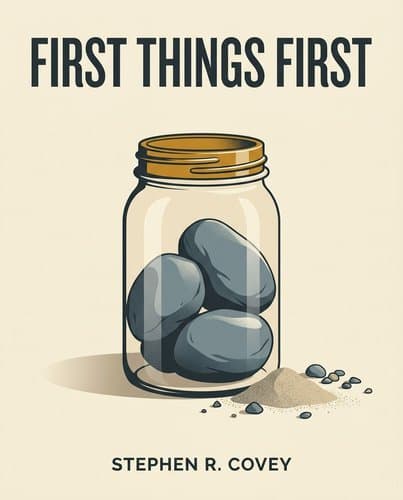
Schedule your priorities — don't prioritize your schedule. Each week, identify your 'big rocks' (Quadrant II goals tied to your roles) and put them in the calendar before everything else fills the jar.
Deep why powers durable goal commitment
When a goal feels hard to commit to, keep asking 'why?' until you hit the emotional truth. Goals without a deep 'why' are willpower projects; goals rooted in genuine care are powered by something more durable.
Review mission weekly, name key roles
Spend 30 minutes at the start of each week reviewing your personal mission, naming your key roles (no more than seven, including one for your own renewal), and selecting one or two important-but-not-urgent goals per role.
Recognize when urgency crowds real priorities
Urgency provides reliable adrenaline and social validation — notice when you're choosing the crisis or the inbox precisely because it feels productive, and ask whether it's crowding out a Quadrant II commitment.
Small ethical choices compound over time
Integrity shows up in small moments: the pause between sensing what conscience is asking and choosing what's comfortable instead. The cost of the 'quick fix' check-in is invisible in the moment and enormous over time.
Seek genuine understanding before advocating positions
Traditional time management treats people as resources or interruptions. When you shift to genuinely seeking to understand another person's position before advocating your own, the third alternatives that emerge are often better than anything either party started with.
Who Should Read This
People working on personal growth in Time Management and Goal Setting, especially those tired of generic motivational advice.
First Things First
By Stephen R. Covey & A. Roger Merrill & Rebecca R. Merrill
11 min read
Why does it matter? Because you're probably already working hard — and that's exactly the problem this book is diagnosing.
You already know you're not lazy. You work hard, you care, you've tried the systems. And still there's a gap — between how your days actually go and what you'd say matters most if someone pressed you at the end of one. The natural conclusion is that you need a better method. A tighter schedule. A smarter prioritization framework.
This book's first argument is that this conclusion is the problem. Better tools pointed in the wrong direction don't close the gap — they widen it. The three authors spent years in the time management industry before one of them started to wonder if he was just helping people fail faster. The gap, they eventually saw, isn't a scheduling failure. It's a compass failure. Every scheduling system they'd ever seen was answering the wrong question.
The Time Management Consultant Who Wondered If He Was Making Everyone Worse
For years, Roger Merrill built his career on a simple promise: watch how you work for a day, then tell you how to do more in less time. He'd sit with clients, observe their habits, and walk away with a list of improvements — handle phone calls differently, cluster similar tasks, protect your mornings. People paid for it. He got good at it.
Then, somewhere in the middle of his career, something started to bother him.
His techniques were sound. Clients got more done. But getting more done, he began to suspect, wasn't actually the point. By making people more efficient at what they were already doing, he might simply be accelerating them toward the wrong destination. The real question wasn't how efficiently someone was moving — it was whether they were moving in a direction that mattered to them at all.
That suspicion became the central diagnosis of First Things First. Three generations of time management had each promised to close the gap between how you spend your time and what genuinely matters to you: notes and checklists first, then calendars and appointments, then systems that tied daily priorities to personal values. Each generation got more sophisticated. The gap stayed. In many cases, it grew. Merrill and Covey call this the clock-versus-compass problem: better tools for scheduling commitments, but no tools for asking whether the commitments were right.
Speed without direction doesn't close that gap. If you're heading south when your destination is New York, better gas mileage just carries you further from where you're trying to go. The question First Things First starts with isn't how to do more things faster. It's whether you've figured out which things are worth doing at all.
Busyness Isn't Productivity — It's a Socially Rewarded Addiction
Busyness feels virtuous because it produces genuine rewards. Just not the ones we think. The authors make an uncomfortable claim: the pull toward urgency isn't a productivity strategy. It's an addiction, and it works through the same mechanisms as chemical dependency.
Urgency temporarily erases pain. That's where the hook is. When the crisis lands, you stop thinking about the stalled project, the relationship that needs attention, the question you've been avoiding. You feel competent, needed, in motion. The adrenaline is real, the relief is real, and so are the other hallmarks, drawn from substance-abuse recovery literature: reliable sensations, absorbed attention, artificial self-worth, consequences that accumulate while the payoff arrives immediately. Urgency also makes the underlying problem worse and corrodes relationships, which you won't notice for a while, because everything around you keeps reinforcing the habit. Being overloaded has become a status signal. "I'm completely slammed" reads as importance; "things have been pretty calm" is almost embarrassing. The person handling the emergency at 11 p.m. feels validated in a way the person who quietly prevented it at 9 a.m. never does.
The sharpest illustration in the book comes from a seminar the authors ran for senior executives at a multinational firm. One participant, a regional manager from Australia, walked up during the break, visibly shaken. He'd just worked through a self-assessment of urgency habits and recognized himself in every item. "I can't believe it," he said. "I am absolutely addicted. It's the whole culture of our business. Nothing ever gets done until somebody says it's urgent." His second-in-command was standing beside him, nodding. Then the manager turned and looked at the man he'd hired and trained. Something clicked. "When he joined our company, he wasn't that way," he said. "But now he is too." A pause. Then: "I'm not only an addict — I'm a pusher."
That's the moment the metaphor stops being a metaphor. The Australian executive hadn't just stumbled into an urgency habit; he'd built a culture around it. His organization ran on manufactured pressure because pressure felt like work, because busyness felt like importance, because responding to crises was something everyone could see, measure, and admire. What genuinely mattered lived in the invisible quadrant — important but not urgent, the work that never calls you, never shows up red in your inbox, and will quietly wait forever if you let it: the relationships, the strategic thinking, the prevention work. Urgency addiction is what fills the space where that work should be.
The Rocks That Matter Most Will Never Fit If You Wait Until Later
A lecturer pulls a wide-mouthed gallon jar from under a table and sets it beside a platter of fist-sized rocks. He asks how many rocks will fit. The audience guesses. He drops them in, one by one, until no more will go. "Is it full?" Everyone says yes. He reaches under the table and pours in a bucket of gravel, which settles into every gap. Still full? He pours in sand. Then a full quart of water. The jar won't hold any more.
"What's the point?" he asks.
Someone says the obvious thing: you can always squeeze more in if you try hard enough.
"No," he says. "The point is: if you hadn't put the big rocks in first, would you ever have gotten any of them in?"
Every prioritization system quietly fails here. The lists, the A-B-C rankings, the daily planners all start with a jar already half-full of gravel and sand. You sit down Monday morning with forty small commitments already packed into your week and try to find crevices for the things that actually matter. Sometimes you find a gap. More often you don't, and the important thing gets bumped again, which is why it's been getting bumped for three years.
The weekly Quadrant II practice — the important, non-urgent work — inverts the sequence. You don't start with your task list; you start with your roles: the six or seven domains where you carry actual responsibility, parent, partner, professional, whatever is true for you. Then, before you add a single appointment, you ask one question per role: what's the most important thing I could do here this week? Not the most overdue. Not the most urgent. The most important.
The answer comes from conscience, not your inbox. In one seminar exercise, a participant names his most important goal: improving his relationship with his teenage son. The authors press him: why? He gives a reasonable answer. Why that? Another answer. Why? The room gets uncomfortable. Someone calls it from across the table: "Because you love him." Something in the man's expression breaks open. Of course. But he hadn't reached it, because the goal was still framed as a task to complete rather than a relationship to tend. When you know the real why, the goal stops being a willpower project. It's powered by love, which doesn't run out the way willpower does.
Once you've named the big rocks from that place, you schedule them first. Actual calendar blocks, actual protected time: not "I'll get to it if the week clears," which means you won't, but Tuesday morning blocked and held.
One father who tried this for a few weeks came home on a Monday to find his son reaching for his hand after dinner. "Monday's my favorite day of the week, Dad," the boy said. "I just like to talk."
That sentence is what the system is for. Not the system — that.
When You Faked the Dinner-Table Check-In, Your Son Already Knew
You come home tired. There's a video you've been looking forward to all week — rented it on the way home, it's on the counter. At dinner, something about your teenage son tells you he's struggling. A quiet signal: be here tonight.
You don't want to hear it.
You love him. But you've spent ten hours commuting, grinding through office friction, handling irate clients — all of it, you tell yourself, for him. Two hours to decompress feels earned. So instead of following the signal, you reach for the quick fix. "Hey, you doing all right?" The tone isn't quite sincere and he can tell. "Yeah, I'm okay." A few surface questions. Monosyllabic answers. He's pulling on his jacket. On his way out you call after him — "If you've got a problem I'm here for you" — and he says yeah, he knows, and the screen door closes. Within minutes, the lingering discomfort inside you is drowned out by the screen.
Meanwhile your son is walking around more alone than before.
The authors trace this scene in uncomfortable detail because the mechanism matters more than the outcome. The parent didn't fail to think about the right thing to do; conscience flagged it immediately, at dinner, in the slight tension of the room. The failure came in the next split second, when the rationalizing machinery kicked in. You've been working all day for him. You deserve this. You asked, didn't you? Each thought is individually plausible. Together they form what the book calls "rational lies" — rationalizations that feel plausible enough in isolation but are built to protect a decision you've already made. The "yes, but" that insulates you from the answer you already know.
The cost doesn't arrive in one moment. The son who leaves feeling blamed and unheard builds a small wall. You settle in, your account of the evening already feeling justified, and build one on the other side. Nothing was said; nothing happened. But brick by brick, across weeks and months of similar exchanges, the distance becomes structural. Communication turns superficial, then strained, and when it does happen, accusatory. By that point you're not dealing with one missed evening. You're managing the compound interest on a pattern.
None of this is a planning problem. The gap between what you value and how you act doesn't close with better scheduling. It closes in the fraction of a second after conscience speaks and before rationalization drowns it out. Sometimes that means nothing more than turning off the video, going back to the kitchen, waiting.
The planner can't reach that moment. Only you can.
The Productivity Lever You've Been Ignoring Is Other People
The corporation and its union had been at war long enough that when a joint meeting was scheduled, the union walked out before it started. Management's instinct was to cancel. Covey pushed back: hold it now. Management apologized (apparently for the first time in anyone's memory) and the union president agreed to come, though he made his position clear: they'd arrive late, as a statement of non-capitulation.
That's where the framework built over the previous four chapters runs out of road. The weekly rhythm, the role-based goals, the Quadrant II discipline: all assume the bottleneck is you. Often it isn't. The problem lives between people, not inside any one of them. And no amount of personal scheduling fixes that.
Win-win isn't goodwill dressed as strategy. The arm-wrestling exercise makes the point without sentiment: the loser walks away with nothing while the winner pockets a dime, but if both cooperate, each makes three dollars in the same sixty seconds. The scarcity mentality baked into most organizations is ethically dubious. It's also numerically inferior. Forced rankings and competitive compensation guarantee that someone loses for someone else to win, and the cost — the politicking, the Quadrant III churn, the energy spent covering yourself instead of doing actual work — dwarfs any gains from better individual scheduling.
The practical tool for converting that potential into results is a stewardship agreement: a shared document spelling out who owns what and how performance gets measured. The authors estimate roughly 60 percent of organizational time gets consumed by problems clear expectations would have prevented. Building those expectations up front isn't relationship management on a separate track from the real work. It's what makes the real work possible.
When the meeting convened, Covey asked 700 or 800 people in the auditorium two questions. First: how many honestly believed the organization could achieve its stated goals given the current culture? Not a hand went up. Then: how many believed they could hit those goals if they genuinely practiced win-win thinking, sought first to understand each other, and worked toward synergistic solutions? Almost every hand in the room. The company's ambitions weren't blocked by poor planning or insufficient individual productivity. They were blocked by two groups of people who had stopped believing the other side wanted anything good. The union president, the one who'd arrived late to make a point, raised his hand. Then he and the company president shook hands and embraced in front of the room, and the auditorium erupted.
The Compass Doesn't Care How Fast You Move
The farm doesn't negotiate. You can skip the planting, stay busy all summer, and still expect nothing in the bin come fall — and the field will simply agree with you. Principles work the same way. The gap between how you actually spend your Tuesday and what you'll wish you'd done with it isn't a scheduling problem you can solve with a better system. It's a harvest problem. It closes, if it closes, because you stopped optimizing and started deciding.
The person this book is written for already knows how to work hard. The question it's actually asking is whether you know which direction you're pointed. Maria, getting the third kid down for the second time, already knows the difference between a day she decided something and a day she just survived. That's not idealism. That's arithmetic.
Notable Quotes
“I'd love to spend quality time with you, but I have to work. There's this deadline. It's urgent. Of course you understand.”
“I just don't have time to exercise. I know it's important, but there are so many pressing things right now. Maybe when things slow down a little.”
“I am absolutely addicted! It's the whole culture of our business. We live from crisis to crisis. Nothing ever gets done until somebody says it's urgent.”
Frequently Asked Questions
- What is First Things First about?
- First Things First (1996) argues that effective time management isn't about doing more faster—it's about organizing your life around what genuinely matters. The book teaches that the key is to schedule your priorities rather than prioritize your schedule, using a weekly planning framework built around roles, values, and Quadrant II goals. This approach helps you close the gap between how you spend your time and what you actually care about, fundamentally transforming your relationship with time and productivity.
- What does it mean to schedule your priorities rather than prioritize your schedule?
- To schedule your priorities, identify your 'big rocks'—Quadrant II goals tied to your roles—and put them in the calendar before everything else fills the jar. The weekly framework starts with reviewing your personal mission and naming key roles (no more than seven, including one for renewal), then selecting one or two important-but-not-urgent goals per role. By protecting these priorities in your schedule first, you prevent urgent but less meaningful tasks from consuming your time and eroding your commitment to what matters most.
- Why does First Things First emphasize finding your emotional 'why'?
- First Things First teaches that when a goal feels hard to commit to, keep asking 'why?' until you hit the emotional truth. Goals without a deep 'why' are willpower projects that drain your energy, while goals rooted in genuine care are powered by something more durable. This emotional foundation transforms your relationship with the goal from something you force yourself to do into something you genuinely want to achieve, creating sustainable motivation rather than relying on willpower alone.
- How does urgency interfere with meaningful work according to First Things First?
- Urgency provides reliable adrenaline and social validation, making it deceptively appealing. First Things First warns that people often choose crises and inbox items precisely because they feel productive, but this urgency crowds out Quadrant II commitments—important-but-not-urgent work that truly matters. The book emphasizes that integrity shows up in small moments where you pause between what conscience asks and what's comfortable instead. The cost of the 'quick fix' is invisible in the moment but becomes enormous over time.
Related Book Summaries
Read the full summary of 36071_first-things-first on InShort