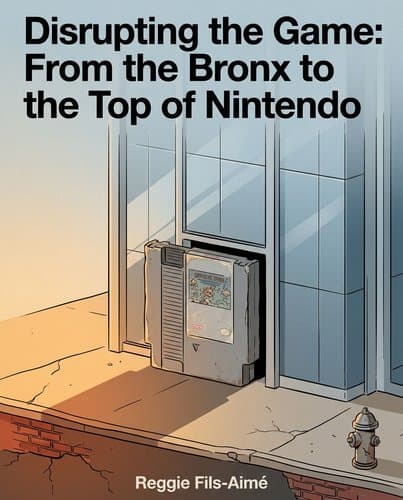
58429316_disrupting-the-game
by Reggie Fils-Aimé
A kid from a Bronx tenement who became president of Nintendo reveals the career discipline no one teaches: how to convert decades of preparation into the exact…
In Brief
A kid from a Bronx tenement who became president of Nintendo reveals the career discipline no one teaches: how to convert decades of preparation into the exact moment opportunity appears—and how to seize it inside even the world's most unconventional corporate culture.
Key Ideas
Three advisor types unlock career growth
Distinguish three types of advisors: coaches tell you what to do, mentors think through problems with you, and sponsors advocate for you when you're not in the room. Most people find only one. Actively seeking all three — and recognizing which type you need at each career stage — is the most underused career strategy in the book.
Ask hard questions with peak leverage
The best time to ask hard, uncomfortable questions about a company or role is during late-stage recruiting, when they already want you. You have maximum leverage and they have maximum incentive to answer honestly.
Multi-angle momentum builds organizational buy-in
When selling a disruptive idea to a skeptical organization, push from multiple angles simultaneously — legal, operational, strategic — rather than relying on a single conversation with the final decision-maker. Let the idea gain momentum from multiple directions before the key meeting.
Single owner prevents creative compromise
One person must own approval end-to-end on major creative decisions. Identify who that person should be before production begins and protect that structure even when it creates friction — committees produce compromises, not breakthroughs.
Protect advocates to maintain credibility
When a launch fails, protect your earliest advocates immediately and decisively. They are your most credible ambassadors during a correction; if they feel misled, they become your loudest critics. Design the recovery around keeping them inside the tent.
Separate decisions from persuasion outcomes
Think about persuasion as a batting average, not a report card. Aim for .750 on decisions and .950 on selling ideas. Tracking both separately forces you to distinguish when you were right and overruled from when you were simply wrong — and prevents you from confusing the two.
Who Should Read This
Business operators, founders, and managers interested in Business Leaders and Memoir who want frameworks they can apply this week.
Disrupting the Game: From the Bronx to the Top of Nintendo
By Reggie Fils-Aimé
10 min read
Why does it matter? Because the story you've been telling yourself about luck is probably wrong.
Seneca said luck is preparation meeting opportunity. Reggie Fils-Aimé opens by quoting him — then immediately says he wasn't lucky. That's not false modesty. It's a precise claim about causality. The Bronx tenement, the Cornell scholarship, the Nintendo presidency: none of it was random collision. It was a specific discipline — building preparation broad enough that opportunity becomes visible before other people can see it — inherited from a grandfather who flew to New York in 1957 and never came home, and a mother who chased teenagers five blocks to recover fifty cents. This book is the operating manual behind that discipline: when to hold your ground against a global president, why the word that nearly killed a career-defining speech was worth fighting for, and what separates the one person talking about you when you're not in the room from everyone who merely talks to you.
The Stubbornness That Keeps You Alive Is Inherited, Not Invented
In 1957, a Harvard-educated Haitian doctor named Camille prepared to fly to New York to address the United Nations about the deteriorating situation in his country under the newly installed dictator François Duvalier. He had already paid once for speaking up: jailed in 1951 after quitting his government post over official corruption rather than pretend it wasn't happening. Now the warning was starker — leave Haiti and you can never return. His wife Rolande and their young son would remain behind. Rolande, it turned out, would never be permitted to leave either. She would spend years in hiding. They never saw each other again. Camille boarded the plane anyway.
Reggie Fils-Aimé, who would go on to run Nintendo of America, is this man's grandson. The principle he returns to throughout his career didn't emerge from a management book or a corporate turning point: life is hard, so you dig deep; don't wait for someone to hand you an advantage. It was already in the family before he was born. Camille gave up his country rather than give up his voice.
The same disposition appeared in smaller form when Fils-Aimé was six. Two teenagers robbed him and his younger brother of their quarters on the way to a Bronx bodega. Their mother marched both boys back to the scene, spotted the teenagers, and chased them five blocks on foot. She confronted them in front of a group of older men, got the coins back, and walked away without looking back. The boys looked back. The teenagers were being lectured. The move is Camille's: principle over convenience, scaled to the neighborhood.
Fils-Aimé's career would eventually ask a version of the same question Camille faced: how much are you willing to give up to do the thing you believe is right? The chapters that follow are his answer.
Real Mentors Don't Comfort You — They Show Up at a Demolition Site
The people who actually change your career are rarely the ones who comfort you. They're the ones who arrive at the right moment with an inconvenient truth, in a place you didn't expect.
Bob Gill recruited Fils-Aimé out of Cornell. During salary negotiations, Bob tried to rattle him by pulling out a penknife and playing with it across the desk. Fils-Aimé laughed and pushed for more money anyway. He got it. Years later, Bob became his mentor and division head.
Three years into his P&G tenure, Fils-Aimé was watching peers get promoted and fielding recruiter calls. He took a sick day on a Friday — his first ever — to interview at a competing company. Bob left messages at his office and home. When Fils-Aimé called back that evening, Bob told him to come to his house Saturday morning.
The house was mid-demolition. Bob was alone in it, swinging a sledgehammer at drywall despite a bad back from college football. He handed Fils-Aimé the spare. They worked while they talked. The company already knew about the interview, Bob told him. Multiple levels of management. Then: the company loves you, you have a future here, be patient. Within weeks, Fils-Aimé was promoted into Bob's own division.
The lesson cost him once more before it stuck. On Crisco, he authorized a holiday ad campaign to start in September without approval authority; the budget overran and P&G threatened to fire the agency. He wrote a memo taking full responsibility. The holiday quarter outperformed every projection. P&G let him go anyway. He left as a brand manager, the credential Bob had told him was worth staying for. Right call, wrong process.
What Bob did was clarity, not comfort. He separated what Fils-Aimé wanted to hear from what he needed: the brand manager title at P&G was the credential, worth more than any outside offer. That kind of mentorship isn't assigned. It builds over years, then lands when the stakes make it matter.
Every Expert Said Nintendo Was Career Suicide — He Joined Anyway
How much should you trust expert consensus about a declining company? In 2003, every mentor Reggie Fils-Aimé consulted gave him the same answer about Nintendo: don't go. GameCube was being outsold by Sony's PlayStation 2 by more than three to one. Sony had just announced the PlayStation Portable at E3, and Nintendo's stock dropped ten percent on the announcement alone — the company's most profitable business, handheld gaming, was suddenly under attack. The advisors were right about the facts. They were wrong about what the facts meant.
Fils-Aimé prepared pages of notes anyway. Then he did something that caused internal panic at Nintendo headquarters in Kyoto: he asked for a videoconference with Satoru Iwata, who had just been named global president. The reaction was immediate. "Who does he think he is? This request is unheard of!" He wasn't yet an employee. He got the meeting anyway.
Iwata came alone — no translator. He controlled the cameras to create the illusion of an across-the-table conversation, close and direct. Fils-Aimé used the time to press on the question his advisors couldn't answer: what was Nintendo's actual response to the PlayStation handheld threat? Iwata didn't deflect. "Accept the job and come to Kyoto," he said. "I will show you how we will continue to innovate." The meeting ran well past the scheduled thirty minutes.
That exchange shows the gap between reading data and reading a person. His advisors were reading the current scoreboard. Fils-Aimé was reading Iwata — someone who refused to explain his plan to a stranger, which meant he had one. The decision to join a struggling company against unanimous expert advice wasn't a gamble. It was a conclusion nobody else thought to draw, in a meeting nobody else thought to request.
Most Leaders Find a Mentor. Very Few Find a Sponsor.
When Fils-Aimé walked into Kyoto University Hospital in the summer of 2014, Satoru Iwata was standing in his hospital gown, smiling. His hair was longer than usual, parted down the middle — a Japanese John Lennon, with small oval glasses. He introduced his wife and daughter, translating between them since neither spoke English. His daughter wanted a selfie, but the problem was immediate: Reggie is tall, she was small, and no framing worked. Iwata, still in his gown, still the head of a global company, took her phone and spent several minutes playing photographer, adjusting angles until she was satisfied.
That scene is only legible if you understand what kind of relationship they'd built. Fils-Aimé names three categories: coaches talk to you; mentors talk with you; sponsors talk about you when you're not in the room. Most people stop at mentor. Iwata was all three, and getting into that hospital room is what makes the sponsor dimension visible.
In Japan, business associates don't visit hospitalized colleagues. Iwata refused the request more than once. Fils-Aimé reframed it: "I want to visit you not as the president of Nintendo of America but as a friend." That reframe unlocked the visit — and within two days, Iwata had opened his room to other Nintendo colleagues who had been waiting for permission. A sponsor is someone who makes space for you not because it serves them, but because your success has become part of how they measure their own.
A Single Pronoun Changed Gaming History the Night Before the Biggest Presentation of His Career
Don Varyu didn't read the opening lines to Satoru Iwata. He read them for Reggie, so Reggie could watch.
The setup was deliberate. Three months before E3 2004, Fils-Aimé and Varyu, a former journalist who had been Nintendo's PR partner for over a decade, had written three sentences to introduce Reggie to the world: "My name is Reggie. I'm about kicking ass and taking names. And I'm about making games." The lines had to survive Kyoto before they could reach Los Angeles. So Fils-Aimé let Varyu deliver them aloud while he studied Iwata's face.
Iwata's face went blank. The room went quiet. His translator, Mr. Minagawa, said something in Japanese, then put a question back to Reggie: "Why are you so angry?"
The gap between how American media culture reads combative language — as energy, confidence, disruption — and how it lands in Japanese corporate culture had just cracked open in one sentence. Fils-Aimé explained: not anger, conviction. Nintendo had made advances the industry hadn't credited it for. Aggressive messaging was honesty about a new direction. After a long silence, Iwata spoke: "We are embarking on a very different path than our competitors. I support this opening line."
That was obstacle one. The night before the presentation, Perrin Kaplan, Fils-Aimé's head of communications, raised a different problem: "I'm about making games" didn't work. Reggie was a marketer, not a developer. She wanted to cut the whole opening. He refused and asked for a surgical fix instead. Varyu had one: change "I'm" to "we're." Nintendo makes the games. The developers, the business partners, the whole organization. One pronoun moved ownership from a single executive to an entire company. The line held.
Landmark public moments rarely come from landmark ideas. They come from one precise cut, made at the last possible moment by someone who refuses to scrap everything just because one word is wrong.
How to Win a Fight Against the World's Best Game Designer
The conventional fear about arguing with your boss is that you can win the point and lose the career. At Nintendo, Fils-Aimé tested that assumption against Shigeru Miyamoto, creator of Mario and Zelda, and came out with both the decision and the relationship intact. What protected him wasn't stubbornness. He went into the fight with Miyamoto's actual interests in mind.
The argument was about what to bundle with Wii at launch. Fils-Aimé had been pushing for months to include Wii Sports, a five-sport collection designed to showcase the motion-sensing remote, with every console sold in Western markets. Nintendo's institutional position, held firmly by both Iwata and Miyamoto, was that the company didn't give away software. Miyamoto proposed an alternative: Wii Play, a shallower mini-game collection featuring a shooting game, table tennis, and billiards. Fils-Aimé listened to the Kyoto pitch, acknowledged that the games were polished, and said what he actually thought: Wii Play was cotton candy, fun for a moment but without the staying power to make someone spend an hour with the system, let alone buy one. Wii Sports had that depth. Baseball, bowling, boxing — played with your own customizable avatar. You could hand the remote to your grandmother and she'd understand the game in thirty seconds.
Then he turned the liability into a decision: bundle Wii Play with the Wii Remote accessory instead. Drive accessory sales, not hardware confusion. Miyamoto didn't disguise his reaction — the famous smile was gone. He told Fils-Aimé that he didn't understand what it took to create something people genuinely wanted to play.
Iwata sided with Reggie. Wii Sports shipped packed-in with every Western console. Japan sold it separately.
That made Japan the control group. Wii was a global success, but the bar tournaments, nursing home bowling leagues, and cruise ship competitions all happened in the West, where the software came with the hardware. When the results were in, the argument didn't need to be relitigated. It was simply over.
His Greatest Win and His Biggest Failure Had the Same Root Cause
In December 2010, Fils-Aimé recommended a $199 US launch price for the 3DS — the system replacing the DS, which had sold over 100 million units. The reasoning was airtight: Western retailers set their own prices. Above $100, they prefer points ending in $49 or $99. Hardware margins run about 4%. Suggest $219 or $229 and retailers simply price at $249 anyway, pocketing the margin. The real options were $199 or $249. Fils-Aimé pushed for $199. Iwata said $249. "With that, the decision was made."
The launch set a record — 3.6 million units in the first month, outside the holiday season. Then sales stalled exactly as predicted. Four months later, Nintendo cut the price by $90. That also meant everyone who'd bought a 3DS at launch had paid $90 too much; Nintendo's answer was 20 free NES and Game Boy Advance games, which softened the anger without restoring the trust.
Fils-Aimé calls this his biggest failure, and he's precise about the kind: not wrong about the analysis, unable to move the structure. The committee that set the price had no Western retail experience. He wasn't on it. The same conviction that won every time he could get into the room had no leverage when the room was in Kyoto without him.
The Three Words That Collapse an Entire Career Into One Sentence
In late 2018, Reggie Fils-Aimé, still president of Nintendo, stood in front of teenagers at Dreamyard Preparatory Academy, a public school in the South Bronx less than three miles from the tenement where he grew up. Harold Goldberg, a journalist who ran a nonprofit using video games to build literacy skills in underserved teenagers, had brought him in to speak.
He could have talked about Switch. The consoles, the records, the market share. He delivered nine words instead: "I was you, and you can be me."
The line is testimony, not advice. Advice is transferable, a formula handed from a safe distance. Testimony requires that the speaker actually came from where you're standing. Fils-Aimé did. The Bronx tenement. The quarters stolen by teenagers. The mother who chased two thieves five blocks to get the coins back. The grandfather who chose exile over silence. The precise geography, three miles from that building, made the claim verifiable in a way no résumé could. He wasn't describing a path you might take. He was showing you one already walked from this same block.
After retiring in April 2019, Fils-Aimé built the rest of his working life around the same logic: Cornell's Leader in Residence program, the board seat at Goldberg's nonprofit, the commencement address at Ringling College built around five principles (own your journey, dig deep, be open to alternatives, embrace your fear, live in the moment). None of it is advice. All of it is return. The compound interest on a career isn't the market share or the franchise launches — it's the sentence a teenager in the Bronx can actually use.
The Promise That Has to Be Personal
Fils-Aimé describes watching Miyamoto at Keens Steakhouse in Midtown, neck craned upward, studying the thousands of clay churchwarden pipes packed into the ceiling — pipes belonging to Babe Ruth, Teddy Roosevelt, Albert Einstein — needing to understand the system behind the collection before he could enjoy the meal. That is creative obsession as lived practice, not pose. Hold that image next to Fils-Aimé standing three miles from the tenement where he grew up, in front of teenagers who live near where he once lost his quarters to a pair of thieves: "I was you, and you can be me." The second sentence only works because the first is verifiably true. That's what the book is finally asking you: preparation matters, conviction matters, the right people matter. But none of it travels forward unless someone who actually made the crossing turns around and names the path specifically, to someone still standing at the start.
Notable Quotes
“Oh boy. I had a lot of explaining to do.”
“--- The day before the presentation, I met with Perrin Kaplan, my head of communications. She said,”
“Initially, Perrin wanted to scrap the entire opening and write something else. I pulled Don Varyu into this impromptu meeting, and we began to exchange ideas.”
Frequently Asked Questions
- What are the three types of advisors discussed in this book?
- Reggie Fils-Aimé distinguishes three critical types of advisors that most professionals overlook. Coaches tell you what to do, mentors think through problems with you, and sponsors advocate for you when you're not in the room. Most people find only one of these types. The book argues that actively seeking all three—and recognizing which type you need at each stage—represents "the most underused career strategy" in professional development. This framework is essential for building the sponsor networks that create advancement opportunities.
- When should you ask difficult questions about a job offer?
- The best time to ask hard, uncomfortable questions about a company or role is during late-stage recruiting, when they already want you. This is when you have maximum leverage and the company has maximum incentive to answer honestly. Many candidates avoid difficult questions until after accepting a position, but this eliminates your strongest negotiating power. By asking during recruitment when you're most valued, you can clarify expectations, compensation, and cultural fit before committing to a role.
- How do you pitch a disruptive idea in a resistant organization?
- When selling a disruptive idea to a skeptical organization, push from multiple angles simultaneously—legal, operational, strategic—rather than relying on a single conversation with the final decision-maker. This multi-directional approach lets the idea gain momentum from different departments before the key meeting. Instead of concentrating your effort on one persuasive conversation, build coalitions across the organization. This creates broader buy-in and makes it harder for any single executive to dismiss the idea, increasing approval odds.
- How should you measure success as a decision-maker?
- Fils-Aimé recommends thinking about persuasion as "a batting average, not a report card," aiming for .750 on decisions and .950 on selling ideas. Tracking these metrics separately forces you to distinguish when you were right and overruled from when you were simply wrong, preventing confusion between the two. This framework reduces self-deception about performance. By maintaining separate metrics, you develop honest self-awareness about where to improve and when circumstances, not capability, caused setbacks in your leadership journey.
Related Book Summaries

Read the full summary of 58429316_disrupting-the-game on InShort