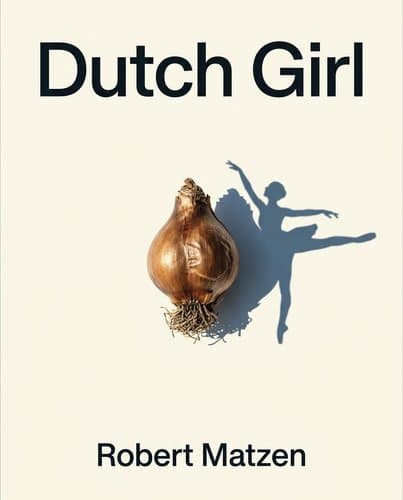
41219594_dutch-girl
by Robert Matzen
Behind Audrey Hepburn's celebrated grace lay a starving Dutch girl who survived Nazi occupation by learning to stay silent, invisible, and uncomplaining — and…
In Brief
Behind Audrey Hepburn's celebrated grace lay a starving Dutch girl who survived Nazi occupation by learning to stay silent, invisible, and uncomplaining — and what the world would spend decades calling elegance and discipline were survival strategies she could never fully shed.
Key Ideas
Strength Born from Wartime Survival
The qualities we most admire in a person often trace directly to suffering they could never fully name — Audrey Hepburn's famous discipline, her refusal to burden others, her imperviousness to physical pain were not personality traits but survival strategies forged by Nazi occupation, starvation, and compulsory silence.
Curated Truth Differs from Dishonesty
Silence about the past isn't the same as dishonesty: Audrey didn't lie about her wartime experience, she curated it — omitting the dancing years she was proudest of because the post-war world had no gray area for what she had actually lived. Understanding this distinction changes how we read every celebrity biography.
Childhood Abandonment Reverberates Across Lifetime
Childhood abandonment by a parent leaves a wound that ripples across an entire lifetime: Audrey's father walked out when she was six and she spent the rest of her life seeking father figures, recognizing this explicitly — 'I don't care who they are. It tortures a child beyond measure' — and returning to it in interviews for decades.
Trauma Etches Into Body Permanently
Trauma has lasting physical consequences that shape behavior for years: the Hunger Winter left permanent metabolic damage, disordered eating patterns, and stretch marks that Audrey carried for the rest of her life — a reminder that wartime suffering isn't only psychological.
Parental Complexity Defines Child's Identity
Moral complexity in a parent doesn't cancel their influence — it complicates it permanently: Ella's fascism, her eventual resistance, and her lifelong refusal to let Audrey boast all shaped the same daughter, and Audrey spent her entire public life navigating the gap between what her mother was and what she had become.
Who Should Read This
Readers interested in Memoir and World History, looking for practical insights they can apply to their own lives.
Dutch Girl
By Robert Matzen & Luca Dotti
10 min read
Why does it matter? Because the grace you see in Audrey Hepburn's face came from places she spent her entire career hiding.
Everyone knows what Audrey Hepburn was. The doe eyes, the dancer's posture, the self-erasure so complete it read as grace. What almost no one knows is where she came from — not Belgium or England or Hollywood, but a cellar in a Dutch village, winter of 1944, eating tulip-bulb flour, her uncle shot in a forest at dawn, her mother's pro-Nazi past sitting undiscussed between them like a loaded gun. Five years of occupation, starvation, and loss forged every quality the world later celebrated as uniquely, almost impossibly, Audrey Hepburn. The discipline. The silence. The compulsion to feed hungry children. The dancing she was most proud of — three years of performances she had to erase completely before she arrived in New York, because the world of 1951 had no tolerance for gray.
The Woman Who Made Audrey Hepburn Was a Genuine Nazi Sympathizer
In September 1935, Baroness Ella van Heemstra stood inside Nuremberg's Zeppelin Field and watched German war planes pass so thick overhead they darkened the sky. Below them, tanks rolled past 300,000 assembled spectators while drum corps beat a tattoo that vibrated through the seats. Hitler made his way around the perimeter in an open car, standing to accept the crowd's adoration. Ella had already shaken his hand in Munich earlier that year — she'd written a glowing column about him for The Blackshirt, the British Union of Fascists' weekly newspaper, and Oswald Mosley had liked it enough to invite her on this tour of the Reich. She returned home to Belgium and published her impressions in Mosley's Action newsletter: "The Germany of today is a most present country, and the Germans, under Nazi rule, a splendid example to the white races of the world." She signed it with her full title: Baroness Ella de Heemstra, Brussels.
This is Audrey Hepburn's mother.
Ella was not watching from the fringes of the fascist movement. She traveled with the Mitford sisters — a family of British aristocrats whose most devoted member, Unity, had relocated to Munich to orbit Hitler personally. When the 1935 Nuremberg congress passed laws stripping Jews of German citizenship, Ella absorbed the news and set aside her mild discomfort, borrowing Diana Mitford's rationalization that Jewish people who objected were free to leave. Ella had Jewish friends in Belgium. It didn't slow her down.
Audrey Hepburn would become one of the twentieth century's most recognizable humanitarian figures — a UNICEF ambassador who walked through famine zones and held starving children. Robert Matzen's biography Dutch Girl, drawn partly from personal archives kept by Audrey's son Luca Dotti, asks you to hold that image and then look at where she came from: a household shaped by ideological fervor on one side and by rupture on the other. Ella's husband Joseph Ruston, who had used the same British Union of Fascists Germany tour to feed intelligence to the German military, walked out when Audrey was six. Audrey would call the abandonment the most traumatic event of her life, and she would spend decades trying to make sense of it.
The Occupation Took Her Favorite Uncle Away on Her Thirteenth Birthday — Then Shot Him at Dawn
On the morning of May 4, 1942 — Audrey's thirteenth birthday — two Dutch SS officers knocked at Zijpendaal, a country estate on Velp's outskirts where her uncle kept rooms. They presented a warrant. Otto Ernst Gelder, Count van Limburg Stirum, a jurist and one of Audrey's two surrogate fathers, was given twenty minutes to pack. He took his wife Meisje's hands, told her all would be well, and was driven away in a German Mercedes.
For the next three months he sat among roughly 460 prominent Dutchmen in a converted Catholic seminary in the province of North Brabant: judges, mayors, professors, bankers. The Germans called them "death candidates" (Todeskandidaten). The logic was purely mechanical: any act of resistance would trigger executions proportional to the offense. Otto gained weight from family food parcels, played contract bridge with fellow prisoners, and discussed post-war career plans over dinner. His final diary entry noted "lovely weather, a little wind and some sunlight."
In the predawn hours of August 15, boots sounded in the seminary corridors. Otto was given time to write Meisje a final letter, then a brief visit from his brother Constant, who found him perfectly calm, handing out cigarettes. Four other men were brought in: three from Rotterdam and a young baron named Alexander Schimmelpenninck, not yet thirty, pulled from his pregnant wife the previous afternoon, a van Heemstra relation.
The five were driven to a forest near the village of Goirle and handed shovels. At dawn, tied to stakes and blindfolded, they heard rifle bolts click. Schimmelpenninck spoke last: he hoped his death would yield something for his homeland. The others shouted for the queen. The soldiers fired, then drove away singing. Birds came back to the trees.
Otto had not been selected at random. The Nazi ruler of the Netherlands, Seyss-Inquart, had searched the hostage lists for names that would wound Queen Wilhelmina personally. She had just addressed the American Congress, drawing his fury. Otto's ancestor was one of the three men who, in 1813, had founded the modern Netherlands and invited the Oranje royal line to power. Killing a Limburg Stirum was symbolic regicide. Otto died not for anything he had done, but for what his name carried in the memory of a nation.
Back in Velp, Meisje placed a black-bordered death notice in the local paper listing Otto's judicial title (the one the Germans had formally stripped from him months before) as if the dismissal had never happened. Hundreds of men still imprisoned in the seminary copied her words by hand and tacked the page to a fence. The occupation had taken Audrey's uncle. Meisje made sure it could not take his name.
She Performed for the Dutch Resistance — and Then Had to Pretend She'd Never Performed at All
The wartime story Audrey Hepburn told the world was true. It was also carefully edited.
The Resistance work was genuine and dangerous. From spring 1944 onward, she performed at illegal zwarte avonden (black evenings) in houses with blacked-out windows across Velp, dancing while guards stood outside to warn of approaching German patrols. Ella sewed costumes, a friend played piano, and afterward money went to the network hiding roughly 600 Jews in the village. When she finished performing, the audience sat in complete silence. That silence, she said later, was the best response she'd ever received. The crowd was too afraid to applaud.
But the story polished for public consumption erased the dancing years she was proudest of.
The erasure crystallized at a September 1951 screen test for Roman Holiday at Pinewood Studios. Director Thorold Dickinson, shooting informal footage between scripted scenes, asked Audrey to tell him about the war. She had been relaxed. At the question she froze. She managed to say it had been very bad. When he asked if entertaining people was how she'd gotten her start, she answered with careful precision: she'd gone to ballet school in Arnhem, and "in about 1944, about a year before the end of the war," she'd given some concerts for the Underground. Every word was technically accurate. But she had just erased three years — her July 1941 debut at the Arnhem Musis Sacrum (requisitioned by the German military and renamed the Wehrmachtheim), Ella's pro-Nazi Mozart commemoration five months later in which Audrey performed alongside her brothers, and three years of Schouwburg recitals that had earned her name in the local press. These were the performances that had made her a dancer. Surrendering them meant surrendering the greatest accomplishments of her life.
The logic was cold and simple. The post-war world sorted the occupation years into two columns: for the Nazis or against. No one would stop to weigh what it meant for a twelve-year-old to dance because she needed to, or that the school's director had joined the Dutch Nazi party (NSB) specifically to keep his students from being shipped to labor camps. Joining the enemy to protect your students: exactly the kind of moral position the post-war binary erased. Broadway publicists Richard Maney and Frank Goodman built the curated version — underground concerts, hunger, her brother Ian conscripted to a Berlin munitions factory — into a template that followed her through Gigi, Roman Holiday, and every interview for the next two decades, planting misdirection that confused every biographer who came after.
Anne Frank's Diary Was the One Place Audrey Could Read Her Own Wartime Life
What made Anne Frank's diary so devastating to Audrey Hepburn wasn't that she found it moving. It was that she found herself in it.
The parallels were almost uncanny. Two dark-haired girls, born outside the Netherlands, less than six weeks apart — Audrey on May 4, 1929; Anne on June 12. They followed the same Radio Oranje broadcasts (the Dutch government-in-exile's BBC transmissions from London), endured the same rationing, watched the same American bomber streams cross the sky toward Germany.
In 1946, living in a single room in Amsterdam, Audrey came across the Dutch manuscript of Het Achterhuis (The Diary of a Young Girl) through an editor who worked upstairs. She described what happened next in plain terms: floods of tears, hysteria. She became one of the earliest visitors to the Secret Annex at Prinsengracht 263 — not as a tourist paying respects, but as someone walking through the rooms of an alternate self.
Six years later, in New York and packing for Rome to begin Roman Holiday, she learned the diary was about to appear in America. The news knocked her flat again. She had marked a specific passage where Anne, writing from hiding, recorded that five hostages had been shot that day. "That was the day my uncle was shot," Audrey said later. The uncle was Count Otto van Limburg Stirum, taken on her thirteenth birthday and executed at dawn in a forest near Goirle. "In this child's words I was reading about what was inside me and is still there."
Still there. The diary didn't remind her of something processed and set aside. It gave language to an interior life she had no permission to name: not because the occupation forbade it, but because the years that followed demanded she move forward, stay quiet, keep the family secrets intact.
When director George Stevens offered her the Anne Frank role in 1958, she re-read the diary and refused. "It's a little bit as if this had happened to my sister," she said. "I couldn't play my sister's life." The word she chose was sister, not symbol, not martyr. Anne Frank was the girl sixty miles away who had the same war and didn't survive it. That Audrey did was not something she could put a price on, let alone a performance.
Audrey Hepburn's Famous Thinness Was Not Elegance. It Was Starvation's Permanent Scar.
Audrey Hepburn's legendary thinness was not a dancer's discipline or European restraint at the table. It was the Hunger Winter's permanent mark on her body.
By early 1945, she weighed roughly eighty pounds. The famine had reduced her to anemia, colitis, and hunger edema — her wrists and ankles swelling as her body, lacking the proteins to regulate water retention, pooled fluid in her limbs. She described it plainly in later years: edema starts in the feet, and when it reaches the heart, you die. Her buttocks had withered so completely she couldn't sit without pain. She couldn't get warm under any number of blankets. The stretch marks the swelling left on her ankles never disappeared; she still had them decades later.
The family physician in Velp, Dr. Adriaan van der Willigen, prescribed a pound of red meat daily. With the van Heemstras surviving on brown bean bread and tulip bulb flour, the prescription was nearly fictional, but the family pooled every scrap of their rations and got her the meat. She recovered, slowly.
Six years later, in a New York restaurant in 1951, a reporter watched her order steak raw, blood still pooling on the plate. She was twenty-two, the toast of Broadway, already becoming the face of a new kind of elegance. She was also still eating exactly as Dr. van der Willigen had told her to.
By the late 1950s, her pattern had settled into what the world would associate with her: boiled eggs, wheat bread from a health food store, yogurt. When nervous — and much made her nervous — she smoked rather than ate, somewhere between six and sixty cigarettes a day. The image that endured looked like the considered choice of a woman who had always known exactly what she wanted. It was the permanent record of a winter in a Velp cellar where she nearly didn't make it out.
The War That Built Audrey Hepburn Eventually Caught Up with Her
In a courtyard in Baidoa, Somalia, September 1992, there is a single tree. Under its shade, children are being fed by nurses — one careful spoon every few minutes — because they have lost the will to eat on their own. Audrey Hepburn watches a boy of about fourteen struggle for each breath. Then he stops struggling. She said later: "Silent children. The silence is something you never forget."
She knew that silence from the inside. She had been one of those children, not metaphorically but physiologically. The Hunger Winter of 1944–45 had left her at eighty pounds, ankles swollen with edema, her body pooling fluid because it lacked the proteins to do anything else. What she was watching in Baidoa was what she had been. That recognition, not sympathy, was the engine behind two decades of UNICEF work across Ethiopia, Vietnam, and Somalia. She wasn't a celebrity lending her face to a cause. She was a survivor returning to the scene.
Somalia broke something that had held for forty-seven years. Her sons Sean and Luca had called before this trip, the only time, across all her UNICEF missions, they had ever asked her not to go. She went anyway. On the ground she was described as especially thin and fragile. She came back with nightmares about dead children, unable to sleep, crying constantly. "I'm running out of gas," she said. Her friend Anna Cataldi, who saw her in Nairobi afterward, embraced her and felt something wrong. "War didn't kill me," Audrey told her, "and this won't either." Cataldi's private thought: sooner or later, war kills you.
She was diagnosed with abdominal cancer shortly after returning. She died January 20, 1993, at sixty-three. Her son Luca said later that when his mother wanted to teach him something about life, she never reached for her career. She always reached for the war. The Hunger Winter, the occupation, five adolescent years under Nazi rule — they didn't just make her who she was. In the end, they came back to collect.
What She Could Never Say Made Her Who She Was
What Luca Dotti understood, and what takes a while to sink in, is that the person his mother became wasn't built from the outside in. The roles, the awards, the photographs that defined midcentury elegance: none of that was what she reached for when she wanted to explain something true. She always reached for the war. Not because it was dramatic, but because it was the only place where everything inessential had already been stripped away. Starvation does that. It reduces you to what you actually are. The discipline, the inability to waste anything, the absolute refusal to look away from a dying child in a courtyard in Somalia — these weren't qualities Audrey Hepburn cultivated. They were what remained after everything else was taken. The war gave her that. And then, forty-seven years later, it came back to finish what it had started.
Notable Quotes
“Otto smiled on sight of his brother.”
“I'm busy with my letter.”
“Do you have any final words?”
Frequently Asked Questions
- What is Dutch Girl about?
- Dutch Girl traces Audrey Hepburn's formative years under Nazi occupation in the Netherlands through wartime diaries, testimonies, and family accounts. The book reveals how starvation, loss, and compulsory silence during this period directly shaped the discipline, empathy, and reserve that the world celebrated as her defining qualities. Rather than presenting these as innate personality traits, Matzen and Dotti demonstrate they were survival strategies forged by trauma. The work reframes our understanding of Hepburn's iconic persona, showing how her public image—carefully curated restraint, emotional reserve, and physical discipline—emerged directly from the necessity to survive and remain silent about her experiences during wartime.
- How did Audrey Hepburn's wartime experiences shape her personality?
- Audrey Hepburn's "famous discipline, her refusal to burden others, her imperviousness to physical pain were not personality traits but survival strategies forged by Nazi occupation, starvation, and compulsory silence." These survival mechanisms manifested in lasting physical consequences—the Hunger Winter left permanent metabolic damage, disordered eating patterns, and stretch marks she carried lifelong. What the world celebrated as her defining character traits were actually trauma responses. Understanding this reframes not only Hepburn's biography but the broader insight that the qualities we admire in public figures often mask deep suffering that shaped them in ways they could never fully articulate.
- What role did Audrey Hepburn's father's abandonment play in her life?
- Audrey Hepburn's father abandoned her when she was six years old, an event whose impact rippled across her entire lifetime. She spent decades seeking father figures in her relationships and explicitly recognized this pattern, stating: "I don't care who they are. It tortures a child beyond measure." Hepburn returned to this theme repeatedly throughout her life in interviews, never fully healing from the early wound. This abandonment shaped not only her romantic choices but her understanding of parental influence and its lasting consequences. Dutch Girl traces how this foundational loss intersected with her wartime trauma.
- Why did Audrey Hepburn stay silent about her wartime experiences?
- Audrey Hepburn's silence about her wartime past wasn't dishonesty—"she curated it—omitting the dancing years she was proudest of because the post-war world had no gray area for what she had actually lived." This strategic silence emerged from survival necessities that persisted long after the war ended, her famous restraint and refusal to burden others deeply rooted in years of Nazi occupation and compulsory silence. Dutch Girl reveals that understanding this distinction between silence and dishonesty fundamentally changes how we interpret celebrity biography and biography generally, forcing us to reconsider what we assume about public figures.
Related Book Summaries

Read the full summary of 41219594_dutch-girl on InShort