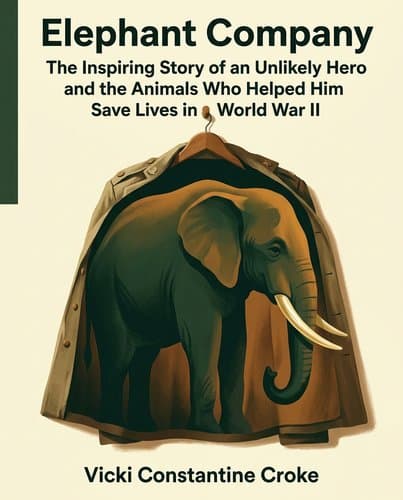
18691058_elephant-company
by Vicki Constantine Croke
Jim Williams earned the loyalty of 53 war-traumatized elephants not through commands but through two decades of quiet, consistent care—then led them on an…
In Brief
Jim Williams earned the loyalty of 53 war-traumatized elephants not through commands but through two decades of quiet, consistent care—then led them on an impossible Himalayan escape route that saved hundreds of lives. This WWII true story redefines leadership through the unexpected teachers he found in the jungle.
Key Ideas
Trust built through years of patient care
Trust is built through accumulated small acts of care, not through authority — Williams's ability to lead 53 elephants up a cliff face in wartime was inseparable from twenty years of treating their wounds, suppressing unjust rogue reports, and feeding them tamarind balls by hand
Confidence matters more than dominance in leadership
The most dangerous assumption in leadership is that dominance and leadership are the same thing — elephants crossing a wide river will follow a confident female, not the largest bull, and Williams watched this play out enough times that it changed how he thought about human organizations
Gentleness produces loyalty and economic advantage
Positive reinforcement isn't just kindness — it's economically superior: Po Toke's 'gentling' method produced Bandoola, the only working elephant in the forest with no training scars and a willingness to attempt things no other animal would try, while the 'breaking' method produced animals that were cheaper to acquire and more expensive to rely on
Leadership lessons from observing matriarch elephants
The qualities we most admire in leaders — patience, fairness, the ability to earn rather than demand trust — are observable in matriarch elephants, and Williams's insight is that you can learn them there if you're willing to stop treating observation as passive
Personal ethics crumble at borders and limits
Applying your ethics consistently regardless of species (or nationality, or rank) is harder than it sounds — Williams's philosophy broke down at the Indian border when colonial rules prevented his Burmese servants from crossing, and Po Toke's philosophy broke down when possessive love curdled into what Williams called murder
Silence about personal suffering proves fatal
Stoicism has a cost — the man who advocated most fiercely for attending to animal distress died because he applied his own code of silence to himself
Who Should Read This
History readers interested in Military History and Leadership who want a deeper understanding of how we got here.
Elephant Company: The Inspiring Story of an Unlikely Hero and the Animals Who Helped Him Save Lives in World War II
By Vicki Constantine Croke
13 min read
Why does it matter? Because the man the newspapers called a hero always said the elephants saved him — not the other way around.
Every dispatch from the Burma campaign celebrated James Howard Williams — Elephant Bill — as the man who tamed the jungle, who wrangled two-thousand-pound animals into service, who outmaneuvered the Japanese with a herd. Williams knew it, and he said so plainly: he didn't rescue the elephants. They rescued him. The man who arrived in Burma in 1920 was a soldier hollowed out by the First World War, locking away whatever the trenches had taken. What reconstructed him wasn't human company or military purpose or colonial adventure — it was years of close attention to creatures who taught him, through sheer example, everything he'd failed to learn about trust, courage, and loyalty. Before Williams could save anyone, he had to be remade. The question worth sitting with is how, exactly, an elephant does that to a person — and what it costs to finally let yourself be changed by one.
A WWI Veteran Who Couldn't Be Healed by Humans Found His Cure in the Jungle
Williams arrived at the Chindwin River in November 1920 not as a restless adventurer chasing glory, but as a decorated captain of twenty-two who had spent four years in some of the worst fighting of the Great War — the camel campaigns in Egypt, the slaughter along the Tigris, the hand-to-hand combat in the mountains of Waziristan. He never spoke about any of it. Those who knew him understood that the things he stayed silent about were the things that cut deepest. What he did say was that the vision of an empty jungle full of animals had called to him the moment the guns stopped — not as an adventure, but as a remedy. He turned down his father's offer of a prosperous Cornish farm without hesitation, sprinted down to the sea to think it over, and came back already certain. Burma wasn't a proving ground. It was the only prescription he trusted.
The Bombay Burmah Trading Corporation, which hired Williams to oversee teak logging deep in the Burmese interior, was honest about the odds: roughly four percent of European forest men lasted in the job long-term. Disease, isolation, and fear of the elephants themselves drove most out within months. Of the 41 recruits hired alongside Williams in 1920, only 16 remained by 1927. Williams knew the figures and chose the jungle anyway — because returning to ordinary life with what he'd seen and done wasn't really a choice at all. What he needed was something that human company, in all its well-meaning inadequacy, had consistently failed to provide: the kind of presence that asked nothing about the war, remembered nothing of it, and offered no condolences. Only the jungle qualified.
Elephants Don't Just Tolerate Human Presence — They Read It Like a Book
The day Bandoola crossed the Yu River in the monsoon of 1927, Williams was barely conscious. A jungle fever had swollen his lymph nodes to the size of fists and left him limp in a bamboo cargo basket strapped to the tusker's back. Before the crossing began, Bandoola did something Williams couldn't explain but couldn't dismiss: he pressed his trunk directly against the bundled, delirious man and inhaled. What the elephant was doing, Williams eventually understood, was reading him — pulling in chemical data from his armpits and groin that mapped his condition with a precision no doctor nearby could match. The rank breath, the altered hygiene, the particular sharp signature of active infection. Bandoola processed all of it in seconds.
Assessment is the better word for what this was, not instinct. Elephants maintain something like a continuously updated file on every individual they know. Over the seven years Bandoola had known Williams, he had tracked the man's transformation from a nervous city recruit to a seasoned forest hand — not in memory the way humans hold memory, but in accumulated scent profiles that recorded shifts in diet, muscle-to-fat ratio, hormonal output, even fear. When Williams stopped smelling afraid around elephants, Bandoola registered it.
On the day of the crossing, what Bandoola read was catastrophe. And then he acted on it — driving his enormous frame through a current churning with two-ton logs, pausing before each step to feel the boulder-strewn riverbed underfoot, leaning his full weight sideways against the force of the water. Williams, slipping in and out of consciousness, felt the power of the animal beneath him and grasped something he would spend the rest of his life trying to articulate: elephants aren't reacting to humans, they're modeling them — tracking emotional states, physical conditions, intentions — the way a doctor reads a patient they've known for decades, or a handler reads a volatile animal they've worked beside every day. The difference is that Bandoola was reading hormonal output and fear-scent directly, without asking.
To Understand an Elephant, Williams Decided He Had to Climb Inside One
Before dawn one morning, Williams was shaken awake by his uzis with news that Pin Wa had died in the night. She was the oldest of his traveling elephants, a gaunt female with cloudy eyes and skin that hung off her bones like a loose garment. He followed the men into the forest to her body and stood looking at eight thousand pounds of stilled animal. Then he did something no field manual had prepared him for: he picked up a machete and went in.
He worked all day. The first cuts released a wave of methane. He needed help dragging the skin back — it had the sodden weight of a waterlogged carpet. Through three dense layers of muscle, then the omentum, a vascular apron that scaffolds the gut, then the digestive organs themselves, which seemed to expand as they slid free, filling more space outside the body than seemed possible within it. He laid everything out in a line to examine. Her heart was the size of a bulldog and had two apexes where a human heart has one. Then he hit the lungs and found something that stopped him: they were fused directly to the rib cage with no surrounding cavity at all. Every other mammal breathes by expanding that cavity like a bellows. Elephants use chest muscles instead — which is why, Williams learned, they suffocate if they lie pinned on one side too long. He emerged at sundown covered in gore, typed up his observations, and filed the cause of death as simply 'Found dead.'
What he had found was a way of learning through the body rather than the textbook, and he extended it to everything he did next. The uzis were walking encyclopedias of elephant behavior, but physiology was his to discover. He followed the elephants into the jungle at night to watch them on their own terms, and he ran his palms along every animal's body at inspection until the skin taught him what to feel for. By the time he left Burma, he could read kheddaring scars on an ankle the way a doctor reads an X-ray. Each body was an archive. Williams was learning to read it.
The Most Important Lesson in Leadership Williams Ever Got Came From a Mahout Who Used Bananas Instead of Chains
Po Toke was fifteen years old when he decided the industry was wrong.
The industry's position was explicit: rearing captive calves was a financial waste. Infant elephants couldn't haul logs until they were twenty-one, so why feed something for two decades? Mothers were returned to heavy work days after giving birth. Calves trailed behind, unable to nurse properly or stay close enough for protection. Tigers took them. They wandered and died. The mortality rate climbed to nearly seventy percent. Companies absorbed the loss and sent buyers to capture more adults from the wild — a brutal process called kheddaring that left animals with festering rope wounds around their ankles before they'd worked a single day. The system sustained itself by treating suffering as overhead.
Po Toke spent fifteen years quietly refusing that logic. When a calf named Bandoola survived a tiger attack the night he was born, Po Toke took the animal on as a personal project — steering Bandoola's mother away from the most dangerous work assignments, consulting an astrologer to get the calf designated a sacred white elephant so the camp's superstitions would protect him, using fruit and patience rather than chains and fire to teach him commands. The company pushed back; a calf that couldn't work for two decades was a liability, not a project. Po Toke kept going anyway. By the time Williams arrived and opened Bandoola's ledger, what he found in the identification scars column was a single word: nil. Every other working elephant Williams had encountered carried the physical record of its training on its ankles. Bandoola carried nothing. He was also the most capable animal in the camp, absorbing complex log-moving commands that ordinarily took years to teach, working with a precision and willingness the kheddared elephants couldn't match.
Williams looked at that ledger entry and understood what he was looking at: proof. Not sentiment — proof. He took Po Toke's methods and built them into the company's first elephant school, pairing five-year-old calves with twelve-year-old boys so the two would grow into their expertise side by side, spending their working lives together. Bribery — bananas, tamarind, sugarcane — replaced coercion. Enrollment eventually reached twenty-nine. The animals the industry had been discarding as economically unviable became its most reliable workers. The one thing the colonial system had never tried was the one thing that actually worked.
Bandoola Snapped His Chains, Uprooted a Tree, and Taught Williams Something No Management Manual Ever Could
The day Po Toke tried to blunt Bandoola's tusks, the great bull was chained to a tamarind tree — a reasonable precaution, given the tree's girth and the weight of the forty-foot chains. The procedure was routine. A few strokes of a handsaw across the tip, far from the nerve, a finger's-width of ivory to prevent the kind of goring accident that could kill a man. Po Toke marked the cut line in red betel nut and raised the blade. Bandoola snapped his foreleg chains on the first stroke with a sound like cannon fire.
What happened next Williams would spend years turning over in his mind. The tusker didn't charge the fleeing men. He turned to the tree. He drove his tusks into the bark above his head and shoved — backing up for momentum, rolling his full mass into each impact — until tamarind fruit and branches rained down with every blow. The roots began to pop underground. The thing the men had assumed was immovable started to lean. And then the entire tree came down directly on top of him, burying him in timber and debris.
When the dust cleared, Williams ran forward expecting a corpse. What he found instead was Bandoola rising slowly to his feet, shaking off branches, unmarked except for a few scratches. The men stood in silence. Nobody ever picked up that saw again.
Williams had started his years in Burma believing his job was to impose human order on animals operating at the edge of the controllable. Bandoola kept revising that assumption. The tusker's refusal wasn't aggression for its own sake — he had tolerated years of camp discipline without incident. It was something more specific: a line that simply would not be crossed, communicated with a clarity no chain could answer. Authority and dominance are different things. The animals had always known which one actually worked. Williams was still learning.
Williams Applied Elephant Ethics to Human Justice — and Found They Were Stricter
What standard does a man apply to justice when he's the one who's been stabbed? For Williams, in 1926, the answer turned out to be the same one he'd always applied to elephants — the same framework he used whenever an animal killed a man: what happened to it first?
Aung Kyaw was a blacklisted itinerant worker — tall, magnetic, unreliable — whom Williams hired against company rules because he found the ban arbitrary. When Aung Kyaw returned from a supply errand empty-handed, having spent or lost the fifteen rupees he'd been trusted with, Williams didn't simply reprimand him. He made a performance of contempt: kept the man squatting on the rug while he ostentatiously checked timber figures, questioned him in a way designed to humiliate rather than inquire, and finally drove him out with a bark of Burmese so stripped of courtesy it functioned as an insult. Aung Kyaw drew a knife. They wrestled. The blade went into Williams's side with a sensation he later described not as pain but as the sound of a stone dropped into still water.
He spent the next three weeks recovering and, by the end of them, had reached a verdict nobody expected: he had provoked it. In all his years managing elephants, he had never seen an animal destroyed for killing a man out of provocation — the act was understood as a response to circumstance, not evidence of character. If that standard was rigorous enough to spare a bull elephant, it was rigorous enough to spare Aung Kyaw. At the trial in Mawlaik, Williams broke colonial protocol by taking the Burmese oath on a bundle of palm leaves rather than an English Bible — a public signal, in a courtroom stacked with British-employed locals, that he was operating under a different authority than the one the prosecution assumed. His testimony held that the attack was not premeditated. Aung Kyaw received three years. A year after his release, he fell to his knees when Williams came to visit and wept asking forgiveness. Williams had already given it — worked out in a jungle camp while his ribs healed, on the logic that the only honest question to ask about a man is the same one you'd ask about an elephant in trouble: what happened to him first?
That logic would soon be tested on a larger scale. The war was coming, and with it, decisions about which lives — human and animal — were worth the risk of saving.
When the Japanese Invaded, Elephants Became the Most Valuable Military Asset No One in Headquarters Could Classify
The military didn't know what to do with an elephant, and Williams spent two years fighting that confusion as hard as he fought the Japanese. Army brass wanted the animals as cargo carriers — a slow version of a truck. Williams kept insisting they were something the army had never had a word for: mobile engineering that could move silently at night without headlights through terrain that swallowed vehicles whole.
The clearest proof came when a Royal Engineers officer showed Williams the blueprints for a crossing over a shallow two-hundred-foot waterway — architectural drawings produced from a pigskin portfolio, configured for two-way traffic, requiring professional sappers Williams didn't have. He looked at them, picked up a pencil, and drew something the officer had no category for: two simple spans set side by side, built from jungle timber by elephants and their riders, completed in fifteen days, capable of bearing twice the required ten-ton load. No sappers needed. No imported materials. The officer went to check with his superiors. Williams didn't wait for the answer — he sorted the harnesses and gave the uzis their timber dimensions. A brigadier's passing nod was authorization enough. On December 15, 1942, a full brigade with trucks rolled across on schedule. The engineers went from skeptical to astonished, and demand for Elephant Company immediately outstripped its capacity.
What headquarters kept missing was that the elephants' real strategic value was inseparable from the men who worked them. The uzis — the Burmese riders who had spent lifetimes with these specific animals — would cross enemy lines at night to rejoin Williams, bells muffled, moving undetected through forests where Japanese patrols operated. No motorized unit could do that. The loyalty ran both ways: Williams stayed behind through the monsoon of 1943 when the British retreated rather than abandon the riders who had trusted him.
Bandoola, meanwhile, had been declared a legitimate military target. The RAF killed over fifty elephants to deny them to the Japanese. American pilots machine-gunned convoys and followed with fire bombs when the animals refused to stop. The most valuable asset on the Burma front had no proper classification, no designated branch of service, and no place in any army manual ever written — because no army had ever thought to write one.
Everything Williams Had Learned in Twenty Years Led to a Single Cliff Face in the Burmese Mountains
Po Toke had been silent through the entire argument — the officers debating hand-carved steps, sandstone porosity, ledge width, whether an eleven-thousand-pound animal could climb what amounted to a ladder up a 270-foot rock face. When the old mahout finally spoke, he offered roughly four words: Bandoola would go first. He wasn't reassuring anyone. He was reporting what he knew.
By April 1944, Williams had forty-five elephants, sixty-four Gurkha refugee women and children, and a party of riders and soldiers threading through 120 miles of unmapped Burmese mountain terrain with food for fifteen days and two Japanese forces closing in from behind. Every road out of the Imphal Plain was blocked. Scouting parties spent entire days following the base of the escarpment north and south and came back empty-handed. The cliff ran without interruption as far as anyone could travel in a day. The only exit was a slight geological fault in the sandstone where a local man had once scrambled over — barely climbable for an athletic person unencumbered by supplies, children, or four legs.
What Williams and his crew spent forty-eight hours building was, by any rational measure, absurd: a staircase cut into the rock face, brush piled along the outer edges so the animals couldn't see the drop below them — elephants move more carefully when they can't see how far there is to fall — each ledge cleared and widened to the maximum the stone could yield. The order of ascent came from watching river crossings, where the weakest animals walked in the middle rather than at the exposed edge. When the steps were done, Williams climbed them himself to check the footing, went down on all fours at the worst sections, and came back down knowing the answer was still maybe.
The morning of the ascent, he climbed up alone before dawn and waited midway. He couldn't look down. What he couldn't see was Bandoola arriving at the base, Po Toke giving the single command — the same word used for scaling teak log piles — and the tusker placing his front feet on the first narrow ledge. Then Bandoola went still. For nine full minutes, the animal stood motionless, the other elephants waiting behind him, the refugees watching from below. And then, exactly as a young female had once walked into a flooded river and changed the calculus for an entire herd, Bandoola decided. Slowly, precisely, one step at a time, he climbed.
An hour later, Williams was startled by what rose above the cliff edge to meet him: Bandoola's head and tusks, filling the sky. They were eye to eye. The elephant's legs trembled with involuntary contractions for the next hour — the physical record of what the climb had cost him. All fifty-two other animals followed. Not one refused or fell.
Williams understood what that meant more personally than any debrief could capture. He hadn't asked Bandoola to climb an impossible wall. He'd asked a specific elephant — one who had never been broken, never been coerced, never been given a reason to doubt the man waiting at the top — whether he was willing. Bandoola had been shot through the skull with a single military bullet not long after, his right tusk already hacked off for ivory by the soldier who killed him, a man who had seen an asset where Williams had seen a person. Everything Williams had learned, from Pin Wa's dissected lungs to Po Toke's banana-and-patience school to the flattened tamarind tree, was present in that question at the base of the cliff. And Bandoola answered it.
The Man Who Understood Animal Distress Better Than Anyone Couldn't Admit His Own
The man who spent thirty years learning to read animal suffering with extraordinary precision died because he refused to do the same for himself. Williams's lifelong stoicism — the quality that had let him endure fever, isolation, a knife wound, and years of wartime danger without complaint — turned inward in the summer of 1958 and killed him. He mistook the sharp, new agony of a bursting appendix for the familiar ache of his chronic ulcers and said nothing until it was too late. He was sixty years old.
The cruelest part is that he understood this flaw in himself. Standing at the Southampton docks in 1957, watching his son Treve board a ship for veterinary school in Australia, Williams told Susan quietly that he would not live to see the boy again. He was right — which means some part of him could read the failing creature clearly enough to know the outcome. But Williams could extend that attention to every suffering animal he encountered; when it came to himself, he simply couldn't act on what he saw.
The loss of Bandoola years earlier had the same shape. In 1944, Williams found the tusker dead in the jungle — shot through the skull with a single military bullet, right tusk already hacked off for ivory. He kept the left tusk for the rest of his life, intending it as a way to hold the memory of the animal he had called nine-tenths love. Instead, he wrote, it filled him always with sorrow rather than comfort. He couldn't alchemize the grief into anything else. The tusk just sat there: proof of what the world does to what you love when you're not watching carefully enough, and proof that even the most perceptive men have blind spots they cannot see past — especially when the thing in distress is themselves.
What 'Nine-Tenths Love' Actually Means
There's a word missing from the heroic version of this story. Williams came back from Burma celebrated, and the celebration wasn't wrong — the cliff was real, the bridge was real, the lives were real. But the missing word is cost. He carried Bandoola's tusk for fourteen years not because it comforted him, but because it didn't, and he couldn't put it down. The elephant who climbed the impossible wall was shot through the skull by the man who loved him most and couldn't bear to lose him to someone else. And Williams, who had spent three decades learning to read suffering in creatures that couldn't speak, died because he applied his own code of silence to the pain in his own body. Nine-tenths love, he called it — which means he always knew what the remaining tenth was. Grief isn't the failure of the bond. Sometimes it's proof that the bond was the realest thing you had.
Notable Quotes
“It was not merely that chance or fortune brought me together with him,”
“a feeling of understanding him as a fellow-creature closer than many human beings.”
“a rare elephant in his generation, born in captivity and educated to man’s service not through cruelty and the breaking of his spirit, but by the indomitable patience of Po Toke. He represented a new generation of elephants.”
Frequently Asked Questions
- What is Elephant Company about?
- Elephant Company chronicles British officer Jim Williams, who spent two decades managing timber elephants in Burma before leading refugees and soldiers through the Himalayas during World War II. The book explores how his relationship with elephants transformed him into an unlikely wartime hero. Drawing on practical examples from elephant behavior, the narrative reveals fundamental leadership principles: trust is built through accumulated small acts of care, dominance differs fundamentally from leadership, and positive reinforcement produces superior results to coercion. Williams's story demonstrates that the qualities we most admire in leaders—patience, fairness, and earned trust—are observable in elephant matriarchs and learnable through careful observation.
- How does Jim Williams build trust with elephants in Elephant Company?
- Williams's ability to lead fifty-three elephants up a cliff face in wartime was inseparable from twenty years of treating their wounds, suppressing unjust rogue reports, and feeding them tamarind balls by hand. The book demonstrates that trust is built through accumulated small acts of care, not through authority. His consistent attention to individual animals' needs created a foundation strong enough that elephants followed him through wartime evacuations. This principle transcends species: the qualities enabling this trust—patience, fairness, and genuine care—are observable in elephant matriarchs and directly applicable to human leadership.
- What does Elephant Company teach about dominance versus leadership?
- The most dangerous assumption in leadership is that dominance and leadership are the same thing. In Elephant Company, Williams observes that elephant herds cross wide rivers following a confident female, not the largest bull. This observation fundamentally changed how he thought about human organizations. The book demonstrates that authority and size matter less than confidence and the ability to inspire trust. Williams's insight reveals that effective leadership relies on qualities like fairness, patience, and earned respect—observable in elephant matriarchs—rather than physical dominance or hierarchical position alone.
- What does Elephant Company reveal about positive reinforcement versus coercion?
- Po Toke's 'gentling' method produced Bandoola, the only working elephant in the forest with no training scars and a willingness to attempt things no other animal would try. The book contrasts this with the 'breaking' method, which produced animals cheaper to acquire but more expensive to rely on. This comparison demonstrates that positive reinforcement isn't just kindness—it's economically superior. Bandoola's success under gentling versus the limitations of broken animals reveals a fundamental truth: earning cooperation produces more reliable, capable leaders and workers than demanding obedience through dominance or punishment.
Related Book Summaries

Read the full summary of 18691058_elephant-company on InShort