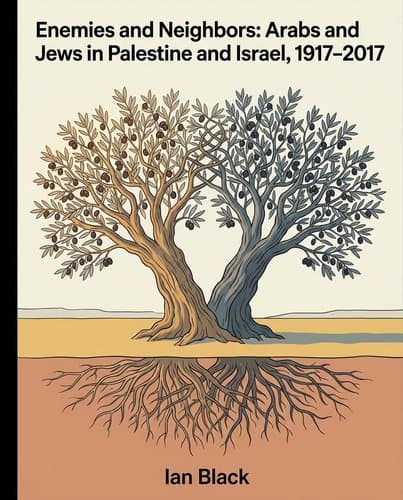
34218167_enemies-and-neighbors
by Ian Black
Two peoples built mirror-image narratives of justice from the same century of bloodshed—and every peace process has failed because accepting the other side's…
In Brief
Two peoples built mirror-image narratives of justice from the same century of bloodshed—and every peace process has failed because accepting the other side's story means surrendering the moral foundation of your own. Ian Black traces how power asymmetry, settlement ratchets, and dueling griefs have made resolution structurally self-defeating.
Key Ideas
No neutral positions, only narrative frames
When evaluating competing claims about this conflict, ask which narrative frame is being assumed — what one side calls 'legitimate resistance,' the other calls 'terrorism,' and both descriptions are simultaneously accurate within their respective stories. There is no neutral vantage point, only acknowledged starting assumptions.
Framework gains eliminate negotiation incentives
Look at who bears the cost when a peace process fails to conclude. If the stronger party's core interests (recognition, security, no immediate territorial pressure) are already secured by the framework agreement, they have minimal structural incentive to close the deal on the harder permanent-status questions.
Settlements act as permanent ratchets
Settlement construction functions as a ratchet, not a bargaining chip: each new housing unit and bypass road makes withdrawal more politically costly for any future Israeli government, regardless of party or stated position. The number of settlers on the ground matters more than any rhetorical commitment to negotiation.
Security measures generate their own crises
Movement restrictions and checkpoints do not only impose costs — according to Israeli security officials who designed and operated them, they manufacture the desperation that produces violence. A security architecture that generates the threat it claims to manage is not primarily a security tool.
Acknowledge both griefs as genuine truths
Sympathizing with one narrative does not require dismissing the other: the Israeli fear of elimination and the Palestinian grief over dispossession are both genuine emotional realities with deep historical roots. Understanding the conflict means holding both simultaneously — not finding a compromise between them.
Who Should Read This
History readers interested in Geopolitics and World History who want a deeper understanding of how we got here.
Enemies and Neighbors: Arabs and Jews in Palestine and Israel, 1917-2017
By Ian Black
10 min read
Why does it matter? Because this conflict isn't stuck — it was built this way.
The easy version of this story is about missed chances — the handshake that almost held, the deal that almost closed, the leader who almost chose peace. For decades that story organized how the world read the conflict: a tragedy of timing and personality, solvable in principle, derailed by bad luck and bad actors. It's comfortable because it implies a fix: better leaders, better timing, better luck. Ian Black's account of a hundred years between the Jordan River and the Mediterranean refuses that comfort. What he documents, in testimony from soldiers and refugees and architects of failed negotiations, is something more disturbing: that the tools of resolution — partition plans, Oslo frameworks, Camp David summits — were each structurally weighted toward the stronger party, which had little incentive to conclude negotiations it was winning by prolonging. Both peoples built their claims on the same ground, from the same century of events, and each claim was genuine. That's not a paradox the book resolves. It's the one it forces you to hold.
Same People, Two Verdicts: Why Both Sides Are Simultaneously Right
In June 2013, a 23-year-old from Gaza named Mohammed Assaf won Arab Idol, the Arab world's most-watched singing competition, before an audience of millions. His grandparents had been among the hundreds of thousands of Palestinians who became refugees in 1948. One of the songs that carried him to victory, "From Acre Gaol," is a ballad about three Palestinians hanged by the British in 1929 for their roles in violence that left Jews dead in Hebron and Safed. Their names: Mohammed Jamjoum, Fuad Hijazi, and Ata al-Zir. Palestinian Authority television called them martyrs and beacons of national history; the state issued stamps in their honor. An Israeli monitoring organization, Palestinian Media Watch, called those same broadcasts an example of glorifying terrorism.
Same men. Same gallows. Two completely incompatible verdicts.
Neither side is wrong by its own logic, which is exactly the problem. Israel simultaneously honors figures the British hanged as terrorists in that same Acre prison. President Reuven Rivlin marked the 75th anniversary of Avraham "Yair" Stern's death on his Facebook page; Stern, founder of the militant Lehi underground, had himself been shot by the British in 1942. Israel's National Library describes the Irgun — which bombed the King David Hotel in Jerusalem in 1946, killing 91 people — as a "Jewish resistance group." The reasoning is exactly parallel: fighters for their people's survival against a power that denied their rights.
Black establishes this from the opening pages: the two narratives aren't competing interpretations of disputed facts. They are complete, internally coherent stories built from the same events, arriving at conclusions you can't reconcile. For Israelis, 1948 was liberation after centuries of persecution culminating in genocide. For Palestinians, it was mass displacement, ethnic cleansing, permanent exile. Both happened. There is no midpoint between them, only the recognition that holding both simultaneously is the only honest starting point.
One Nation Promised to a Second the Country of a Third: The Collision Was Scheduled
Imagine a property deed that transfers ownership of a house currently occupied by a third family. The family gets a mention: a clause says nothing will be done to harm their "civil and religious rights." But they are not named. They have no political rights under the document. No one asked them to sign. And the drafters privately agreed that the family's preferences were beside the point.
That's not an imperfect bargain. That's a design.
On November 2, 1917, British Foreign Secretary Lord Balfour wrote 67 words to Lord Rothschild of the World Zionist Organization, pledging British support for "a national home for the Jewish people" in Palestine. The declaration included what sounded like a safeguard: nothing would be done to "prejudice the civil and religious rights of existing non-Jewish communities." Those communities were 90 percent of the population. They were not named. They were not consulted.
One member of the war cabinet tried to stop it. Lord Curzon, former viceroy of India and a man with actual experience governing colonized peoples, asked a pointed question before the final vote: what would become of the Arabs who had occupied Palestine for fifteen centuries? He predicted his own answer. They would not be content, he said, to be displaced by Jewish immigrants or reduced to servitude. His objection was overruled.
Two years after the declaration, Balfour wrote privately to Curzon that Zionism was "rooted in age-long traditions, in present needs, in future hopes, of far profounder import than the desires and prejudices of the 700,000 Arabs who now inhabit that ancient land." Balfour wasn't claiming the Arabs didn't exist — he was ranking: Jewish claims were of "far profounder import"; Arab claims were merely desires and prejudices. The reservation clause wasn't genuine protection; it was written over a hierarchy that had already been decided.
Arthur Koestler captured it in one sentence: one nation had solemnly promised a second nation the country of a third. The architects knew who lived in Palestine. The one voice who asked about them was overruled. What followed over the next century was not a tragedy of unforeseen consequences. The collision was written into the blueprint.
'Remove Them': How One People's Liberation Became Another's Catastrophe
In July 1948, a medical student named George Habash stood at a roadside in Lydda watching fifty thousand people walk out of their city in punishing summer heat, during Ramadan. Women carried infants. Children held on to their mothers' clothing. Some people fell by the road and did not get up. The order came from Ben-Gurion, but not in writing. His field commander Yitzhak Rabin later described the moment: the prime minister gestured with his hand and said, simply, "Remove them."
That gesture — unminuted, deniable — is why the argument over intentionality lasted decades. Historians could point out, accurately, that no high-level meeting had explicitly ordered mass expulsion. Plan Dalet, the March 1948 military blueprint, was framed in defensive terms. The Nakba, Israeli historian Benny Morris argued, was "born of war, not by design."
What undermines that argument is the preparation. Through the mid-1940s, the Haganah, the main Jewish paramilitary organization, compiled systematic intelligence files on Arab villages across Palestine: clan structures, political loyalties, water sources, access roads. The field method had a certain ingenuity: members of the Palmah, the Haganah's strike force, arrived posing as botanists, gathered villagers around plant specimens while colleagues moved through the houses sketching layouts and noting the mukhtar's location. Those files were used first for land acquisitions through legal loopholes, then as operational blueprints when the war came. And the logic behind them had been stated plainly: Yosef Weitz, the Jewish National Fund official responsible for land purchases, wrote in his 1940 diary that there was no room for both peoples and all Arabs would have to go. By June 1948, Foreign Minister Moshe Sharett was calling the mass exodus a "miraculous simplification."
What followed 1948 was continuation, not resolution. Palestinians who remained inside Israel's borders were reclassified as "present absentees": physically present, legally absent, property confiscated without deportation. The category could only have been designed by someone who needed the fiction. Hundreds of destroyed villages were buried under forests planted by the Jewish National Fund. Town names were Hebraized across the country — not as administrative tidying but as what Palestinians would later call memoricide, the deliberate erasure of a people's names, places, and physical traces. Ben-Gurion told the Negev Names Committee in 1949 that removing Arabic names was an obligation of state; Israeli law recognized neither Arab political nor spiritual proprietorship of the land. In the first year alone, roughly 120,000 new Jewish immigrants moved into homes Palestinians had left behind.
Black's conclusion is understated and exact. The historiographical debate over intent matters less than the outcome: 700,000 displaced, hundreds of villages gone, a catastrophe shaped by decisions made long before the first shot was fired.
The Occupation Manufactures the Resistance That Justifies the Occupation
In 1956, standing at the grave of a kibbutz member killed by Palestinian fighters, Moshe Dayan did something unusual for a military commander — he acknowledged why the killing made sense. Palestinians in Gaza's refugee camps, he said, were watching Israelis transform the lands their families had worked into Israeli property, and of course they hated the people doing it. Then, in the same breath, he declared that Israel had no choice but to fight. Acknowledgment of dispossession folded directly into justification for perpetuating it. That was 1956. The system ran on that logic for the next fifty years.
By 2003, a veteran of the Shin Bet (the Israeli service that ran informant networks and managed the occupation's daily mechanisms) could describe the system's self-defeating logic with clinical precision. Nissim Levy was not a critic; he was an architect. His illustration was stripped to its bones: a young Israeli man in Beersheba who falls for a woman in Haifa picks up the phone and drives to see her. A young Palestinian man in Bethlehem who falls for a woman in Nablus needs permits, checkpoints, and approvals that may or may not come. In Levy's words: "The moment that you reach the conclusion that you have nothing to live for, you immediately find that you have something to die for." A man who spent his career building and running that apparatus was explaining, without apparent irony, exactly how it manufactured the violence it existed to suppress.
The machinery that produced those checkpoints was deliberate. After 1977, Ariel Sharon as agriculture minister designed settlement expansion that was explicitly geographic: housing placed on hilltops so each settlement could maintain visual contact with the next, overlooking Palestinian cities and road junctions below. Ordinary Israeli families filled them, drawn by subsidized mortgages, tax breaks, and the advertising promise of being "five minutes from Kfar Saba." Palestinian farmland was reclassified as military or public land to make room. By 1980, 12,500 settlers lived on territory the occupation had controlled for thirteen years. Each new settlement made withdrawal harder. Each movement restriction generated the economic pressure Levy would later anatomize.
The loop was visible to anyone who looked: settlements justified restrictions in the name of security, restrictions produced desperation, desperation produced violence, violence justified more settlements. The occupation didn't persist despite this dynamic. It persisted through it.
Oslo's Hidden Trap: The Stronger Party Wins by Not Concluding
When Arafat signed the Oslo Declaration of Principles on the White House lawn in September 1993, Israel had already gotten almost everything it needed from the agreement. The PLO recognized Israel's right to exist and pledged to stop fighting. Those gains were immediate, irrevocable, locked in before anyone left the lawn. Palestinian gains — statehood, refugees, borders, Jerusalem — were deferred to permanent status negotiations to be concluded within five years. That asymmetry wasn't a side effect of a rushed deal. It was the structure.
Mahmoud Abbas understood it at the signing table. Speaking to the PLO central council in Tunis, he told his colleagues that the agreement contained either the seeds of statehood or the permanent stamp of occupation; everything depended on what came next. But Israel had already received what it came for. The party with everything to lose if those talks never closed was the Palestinians.
The logic held at every subsequent stage. By the time Ehud Barak arrived at Camp David in July 2000, seven years of negotiations had produced no permanent agreement. The settler population was growing steadily through the very years Oslo was supposed to be building toward a final deal — not despite the process, but during it. Barak's opening map proposed annexing 14 percent of the West Bank and leasing another 10 percent, leaving Palestinians with 76 percent in three disconnected blocks. He called it a generous offer. When Barak subsequently moved those positions, Rob Malley — Clinton's Middle East adviser — concluded that the piecemeal approach had backfired: early positions presented as firm floors generated mistrust; shifting them later confirmed no floor was real. A review Malley co-authored with Hussein Agha concluded the Palestinian account of Camp David was significantly more accurate than the Israeli one. But the Camp David narrative mattered less than the structural fact it revealed: after seven years and every advantage of superior power, the party that had already secured its core gains still hadn't closed.
Yitzhak Shamir, the prime minister Oslo replaced, had stated the underlying logic with unusual candor. Asked afterward what he would have done if he'd won the 1992 election, he said he would have dragged the talks out for ten more years while building the settler population toward half a million. He didn't describe this as obstruction. He described it as strategy. Oslo changed the partners. It didn't change the incentive structure.
Two States, One State, No Plan: The Arithmetic That Doesn't Add Up
In February 2017, Netanyahu arrived at the White House to meet Donald Trump, who had just been inaugurated as president. Asked about the Israeli-Palestinian conflict, Trump offered his framework: "I'm looking at two-state and one-state, and I like the one that both parties like." He'd apparently set aside decades of American foreign policy in a sentence. His ambassador quickly clarified that the US still backed two states. But what you notice, reading Black's account of that moment, isn't Trump's ignorance — it's how little it mattered. By 2017, the question of which solution an American president preferred had become secondary to a simpler one: whether any solution was still geometrically possible.
The arithmetic had been moving in one direction for years. The settler population stood at 262,500 when Oslo was signed in 1993. It passed 630,000 by 2016, roughly 10 percent of Israel's Jewish population, spread across 230 settlements, connected by bypass roads Palestinians weren't permitted to use, served by infrastructure that no Israeli government could dismantle without political self-destruction. Netanyahu described the maximum he'd consider as "state-minus… not exactly a state with full authority." December 2016 polling found only 55 percent of Israelis and 44 percent of Palestinians still supporting two states in principle.
Ehud Olmert had seen the terminus clearly in 2004, when he was still a government minister. If two states failed, he said, Palestinians would stop fighting the occupation and start demanding equal rights inside a single state. "That is, of course, a much cleaner struggle, a much more popular struggle — and ultimately a much more powerful one. For us, it would mean the end of the Jewish state." He wasn't describing a nightmare scenario. He was describing the structural logic that activates when one solution becomes physically impossible — and warning his own side that the clock was running. His side didn't listen.
Black's verdict is cold: two states remained the most achievable of bad options, but perhaps already a delusion; one state was a slogan with no program and no joint Palestinian-Israeli movement promoting it; the most probable near-term outcome was what Palestinian-American historian Rashid Khalidi called "an imposed reality of one-state" — not negotiation but indefinite Israeli control maintained by force. A century of structural decisions had arrived at its logical address.
The Question the Century Leaves Open
Habash watched the column leave Lydda, thousands of people on foot into the July hills, and spent the rest of his life trying to reverse it. The couple closing on a house five minutes from Kfar Saba isn't thinking about Lydda at all.
The question Black leaves you with isn't the one you started with. You came in asking why this conflict hasn't been solved. You leave asking whether "solution" is even the right word for what's required. Because any resolution that sticks demands something more than a map — it demands that one side accept its own foundational story as someone else's wound. Palestinian recognition of Israel means treating the Nakba as the acceptable price of another people's liberation. Israeli withdrawal means conceding that the homeland was occupied before it was reclaimed. Neither people has been asked to do anything less than grieve on behalf of their enemy.
The cold arithmetic: two states perhaps already a delusion, one state a slogan with no movement behind it, indefinite control the likeliest terminus. That isn't a failure of diplomacy. It's what irreconcilable truths look like when they run out of room.
Notable Quotes
“only the donkey wears a tarbush, buy a hatta”
“I don't trust you and I don't respect you. I fear you and I will stay away from you. And if you come into my space I will kill you.”
“… did not denote, except for the most ignorant, the physical absence of the native population', argued the Ottoman scholar Beshara Doumani. 'Rather, it meant the absence of”
Frequently Asked Questions
- What is Enemies and Neighbors about?
- Enemies and Neighbors (2017) traces a century of conflict between 1917 and 2017 through the competing narratives that Arabs and Jews have constructed from the same historical events in Palestine and Israel. Author Ian Black examines how structural asymmetries of power have undermined every peace effort. The work provides readers with analytical tools to evaluate claims about settlement expansion, security doctrines, and peace frameworks without adopting either side's moral assumptions. Rather than seeking a neutral vantage point, Black shows that understanding the conflict means acknowledging different starting perspectives and how they shape interpretation.
- What are the main insights from Enemies and Neighbors?
- Black identifies several key structural patterns undermining the Israeli-Palestinian conflict. Most significantly, settlement construction functions as "a ratchet, not a bargaining chip: each new housing unit and bypass road makes withdrawal more politically costly for any future Israeli government, regardless of party or stated position." The book emphasizes that competing narratives—such as "what one side calls 'legitimate resistance,' the other calls 'terrorism,' and both descriptions are simultaneously accurate within their respective stories"—require readers to recognize that understanding the conflict means acknowledging both Israeli and Palestinian claims simultaneously as genuine.
- How does Ian Black explain the role of settlements in the Israeli-Palestinian conflict?
- According to Black, settlement construction functions as "a ratchet, not a bargaining chip: each new housing unit and bypass road makes withdrawal more politically costly for any future Israeli government, regardless of party or stated position." The book emphasizes that the number of settlers on the ground matters more than any rhetorical commitment to negotiation. Rather than functioning as negotiable assets in peace talks, settlements irreversibly increase the structural costs of any territorial concession. This dynamic explains why settlements have persisted through decades of peace processes—they systematically entrench one party's position.
- How does Enemies and Neighbors teach readers to analyze competing claims in the Israeli-Palestinian conflict?
- Black teaches readers that competing narratives about the conflict resist objective evaluation. As he explains, "what one side calls 'legitimate resistance,' the other calls 'terrorism,' and both descriptions are simultaneously accurate within their respective stories." When analyzing claims, readers should ask which narrative frame is being assumed, recognizing that there is no neutral vantage point. The book further argues that "sympathizing with one narrative does not require dismissing the other: the Israeli fear of elimination and the Palestinian grief over dispossession are both genuine emotional realities with deep historical roots." True understanding requires holding both perspectives simultaneously.
Related Book Summaries
Read the full summary of 34218167_enemies-and-neighbors on InShort