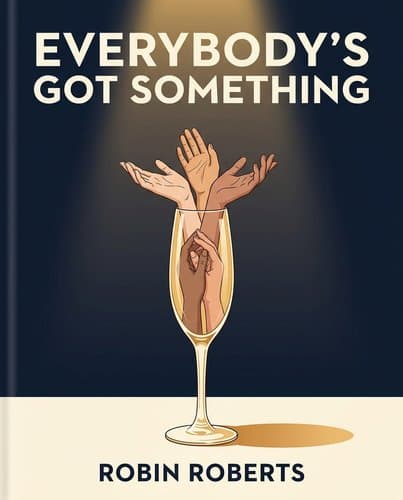
18296165_everybody-s-got-something
by Robin Roberts, Veronica Chambers
Robin Roberts' near-fatal bone marrow transplant revealed that survival isn't a solo act of willpower—it's built on relationships, vulnerability, and learning…
In Brief
Robin Roberts' near-fatal bone marrow transplant revealed that survival isn't a solo act of willpower—it's built on relationships, vulnerability, and learning to receive help before crisis strikes. Her raw account reframes asking for support not as weakness, but as the smartest strategy you'll ever deploy.
Key Ideas
Build Support Networks Before Crisis Arrives
Build your support team before the crisis hits — Robin's survival depended on relationships (the 'Robin's lunch' group, Diane Sawyer's research team, Dorothy's caregiving infrastructure) that existed long before the diagnosis
Asking for Help Is Strategic Strength
Letting people in is not weakness; it is strategy. Roberts spent more energy worrying about being a burden than she spent actually being one — and the worry was wasted
Listen Well, Show Support Through Details
The RC Cola principle: genuine support isn't grand gestures, it's proof you were listening. When Josh Elliott brought a six-pack of RC Cola the night before the transplant, referencing a childhood memory Robin had mentioned once in passing, it meant more than flowers
Caregivers Need Safe People to Vent
Caregivers need their own support person — someone they can 'just ramble to' without freaking out. Amber's breakdown in the elevator happened because she had no outlet; Roberts advises identifying that go-to person before you need them
Take Medication Even When Feeling Better
'Noncompliant' is a real danger in recovery — Roberts nearly died of walking pneumonia because she stopped taking a medication that tasted bad and felt she was well. Being well is often the result of taking the medicine, not a reason to stop
Celebrate the Present as Living Practice
Celebrate the now as a discipline, not a mood. Roberts didn't wait until she recovered to throw the party — she threw it the night before the transplant, because she had learned from a lifetime that if you save joy for the destination, the destination rarely feels the way you imagined
Gratitude Has No Artificial Limits Ever
You can't put a limit on gratitude — Lucimarian's instruction to thank the postman and the neighbors who moved away is the book's final philosophy: gratitude is not sentiment, it is practice
Who Should Read This
Readers who connect with first-person stories about Memoir and Resilience and want to see the world through someone else's eyes.
Everybody's Got Something
By Robin Roberts & Veronica Chambers
11 min read
Why does it matter? Because when the worst arrives, strength is not what saves you — other people are.
Here's what we tell ourselves: that when the worst arrives, what saves you is the person you've become — the discipline you built, the grit you stored, the spine you didn't know you had. Robin Roberts believed that, too. She'd beaten breast cancer. She was anchoring the number-one morning show in America. She had earned her resilience — built it out of a childhood in Mississippi, a disease that had already tried to kill her once, and sixteen years of 4 a.m. alarms nobody sees. Then, on the same morning she clinked champagne with her team to celebrate sixteen years of catching up finally done, a doctor turned a computer screen toward her and showed her a dot. One dot. Sitting between one year and two. That's what willpower buys you without a bone marrow match. What actually saves her — and what this book is really about — is something far less cinematic and far more demanding than courage. It's learning to let people carry you when you can't carry yourself.
The Champagne Toast and the Dot on the Graph Arrived the Same Morning
The earpiece crackled with Tom Cibrowski's voice as Robin Roberts walked off the GMA set on the morning of April 19, 2012: the numbers were in, the show had won. For the first time in 852 weeks — sixteen years — Good Morning America had beaten the Today show. Roberts started pumping her fist. Her co-anchors George Stephanopoulos, Sam Champion, Josh Elliott, and Lara Spencer were soon jumping around like children who'd just heard school was cancelled. Champagne appeared. Toasts were made. Roberts told the entire ABC News division that anyone who'd ever answered a phone for the show was part of the victory. She meant it.
Then she left to go see her doctor.
She had been waiting on these results for weeks — ever since a bone marrow biopsy confirmed a diagnosis of myelodysplastic syndrome, a rare disease that stops the bone marrow from producing healthy blood cells. That morning she still didn't fully understand what she was facing. She found out in a small, cluttered office on the Upper East Side, sitting across a tired specialist who opened a Diet Coke and turned his computer screen toward her and her partner Amber. On it was a simple graph — one year, two years — with a single dot plotted somewhere in between.
"That's your life expectancy if you don't do anything."
She had been drinking champagne forty minutes earlier.
What Roberts does next is the thing worth holding onto. She doesn't collapse. She leans forward, puts her fists on the desk, and asks: "Okay, what do we do?" The doctor tells her the only path to a cure is a bone marrow transplant — grueling, uncertain, dependent on finding a compatible donor. She fixes on the word "cure" and doesn't let go. A chance is enough.
That same evening she puts on skinny jeans and walks down the street to a rooftop party overlooking the Hudson, where her team is dancing and the ABC News president is beaming with hard-earned pride. She almost pulls him aside and tells him everything. She decides not to. The team had worked too long and too hard for her to dissolve their joy with her news. So she stands at the quieter end of the roof and watches their faces and keeps her secret.
Nobody Outsmarts the Dirty Snowball — The Diagnosis Finds You Anyway
Imagine you're in a snowball fight and you know all the rules: build fast, aim true, be ready to run. The whole game depends on seeing the threat coming and moving before it lands. Now imagine you can't move. That's the image Robin Roberts reaches for when her oncologist calls back after a second round of blood tests, voice already weighted with what she has to say. She needs to see a specialist. The snowball is already in the air. Roberts freezes.
The weeks before that call had the texture of ordinary anxiety — a little more tired than usual, blood counts running lower than her doctor liked, probably just travel, maybe a virus, wait two weeks and test again. The kind of thing you almost convince yourself is nothing because the alternative is too large to look at directly. She'd had minor scares before. They always turned out fine.
This one didn't.
After the specialist calls with a name for what he's found — myelodysplastic syndrome, a rare pre-leukemia that attacks the bone marrow — Roberts does what anyone does when they're sitting alone on a couch with a phone in their hand and just got the worst news of their life. She opens a browser and tries to type the word. She can't spell it at first. She pieces it together letter by letter and hits search, and what comes back is a stack of terms she wasn't ready to read: leukemia, bone marrow transplant, dead. She starts shaking. Then she starts crying and can't stop.
The Odds Were 7 Percent — And Then a Sister Said 'I Was Born to Do This'
The central problem with finding a bone marrow donor isn't paperwork or patience — it's genetics, and genetics doesn't care about urgency. The national marrow registry holds more than eight million Americans, which sounds like good odds until you understand that a Caucasian patient has roughly a 50 percent chance of finding a compatible stranger in that database. For an African American patient, that number can fall as low as 7 percent. Roberts explains why with a single sweep across the spectrum of Black America: think about the genetic distance between a Michelle Obama and a Beyoncé, a Serena Williams and an Alicia Keys. That extraordinary diversity — the layered mixture of ancestry that produced so many different faces, skin tones, and biological signatures — is also precisely what makes a precise genetic match so difficult to locate. The same thing that makes the community remarkable makes the search nearly impossible. With her dot on the graph already plotted between one year and two, Roberts didn't have time to wait and hope. She needed to look inside her own family.
Her brother Butch was ruled out on health grounds. That left her two sisters. Sally-Ann, a broadcast journalist in New Orleans, had a well-documented fear of needles. So when the test came back confirming that Sally-Ann was a match, Roberts did something that quietly reveals her character: she offered her sister a way out. You don't have to do this. Nobody would blame you. What Sally-Ann said back stopped her cold: 'I don't want to do this, baby sister. I was born to do this.'
Roberts felt it physically — something releasing in her chest, she'd later say, like a breath she hadn't known she was holding. She had spent years projecting competence and warmth from a national platform, the woman who could hold two contradictory truths in the same breath and still show up at 3:45 in the morning. But the 7 percent figure made the lone warrior myth biologically impossible. The cure wasn't inside her. It was inside someone else — someone scared of needles, who already knew the answer before her sister had finished asking the question.
Letting People In Is the Hardest Part of Getting Well
Here is a question worth sitting with: when does staying silent stop protecting you and start isolating you? Robin Roberts spent months turning it over, and the book never fully resolves it — because it can't. Both answers are true, and they cost different things.
After her MDS diagnosis, Roberts found herself dreading her own caller ID. She describes spending hours in what she later called needless worry — convinced that her name on a friend's phone had become a small alarm, a signal to brace for another crisis. The 'what now?' dread. She had gone through breast cancer five years earlier, had leaned on her people, and now here she was, needing them again. That anxiety didn't come from weakness. It came from knowing how much courage it takes to receive someone else's worst news, over and over, and not wanting to spend down the reserves of the people she loved.
She refuses to call Nora Ephron's choice a failure. Ephron kept her leukemia almost completely private until the end, and when she died, people who cared about her felt blindsided. Roberts understands why she did it anyway. When you tell someone you're sick, the friendship shifts — not because they want it to, but because they can't help it. You stop being Nora and start being Nora with cancer. The desire to remain simply yourself, unhyphenated, is not selfishness. Roberts says she has watched people in her audiences visibly exhale when she tells them that keeping a battle private is a legitimate choice — that they are not bad people for not performing their illness in public.
But then there is what happened when Roberts chose the other path. When she sat on the GMA couch in June 2012 and announced her diagnosis live, without a teleprompter, something moved beyond the studio. She talked about MDS, about the bone marrow registry, about the desperate shortage of Black donors. Her colleague Amy Robach had heard Roberts push her for years to schedule an on-air mammogram for a breast cancer awareness segment. Robach finally did it — and the test found cancer she didn't know she had. Roberts's willingness to make her own illness part of the public conversation had created a current that eventually ran all the way to the person sitting beside her on the same couch.
The Night Before the Transplant, She Threw a Rager
Josh Elliott arrived at the party with a six-pack of RC Cola. Not wine, not a flower arrangement — a cheap regional soda that nobody north of the Mason-Dixon line stocks in their fridge. He'd heard Roberts mention once, in passing, that she used to walk to the corner store as a kid in Mississippi and treat herself to an RC. He'd filed it away. And on the night before her bone marrow transplant, he showed up with it.
That six-pack never got opened. It sat on Roberts's kitchen counter for the entire recovery, and she describes glancing at it as a kind of medicine — not because RC Cola has healing properties, but because it was proof someone had been paying attention. Not performing attention, not expressing care through a grand gesture that required no real knowledge of her, but genuinely listening. She'd said it once. He'd heard it. There it was on the counter.
The party itself was technically inadvisable. Her transplant specialist, Dr. Sergio Giralt, has a standing directive for his patients: Keep It Boring. In transplant medicine, boring means no crowds, no infections, no surprises — survival measured in uneventful days. What Roberts threw the night of September 9th, 2012 — ten days after burying her mother and one day before checking into Memorial Sloan Kettering — was the opposite of boring. People were doing shots. There was dancing. Josh was found after the caterers left, rummaging through the refrigerator for leftovers like a nineteen-year-old at a house party.
A medical memoir is supposed to treat the pre-transplant period with hushed gravity. Roberts refuses that. Celebration before a crisis, she argues, is not denial — it's the specific fuel that gets you through it. She describes lying in a hospital bed days later, nauseated, and laughing out loud at the memory of Josh and the refrigerator. The nurses learned to read it: that chuckle meant the party again. She was carrying it room by room through her hardest days.
The Day the Stem Cells and a Mother's Last Breath Arrived Together
On August 28, 2012, Sally-Ann Roberts was lying in a hospital bed at Memorial Sloan-Kettering, a needle in her arm, watching an apheresis machine pull blood from her body and separate out the stem cells. The cells were being collected into a bag with Robin's name on it. Downstairs, Hurricane Isaac was on every television screen. Down in Mississippi, it was making landfall.
Those two facts — the bag filling in New York, the storm hitting the Gulf Coast — were not separate events in Robin Roberts's life that week. They were one event. Dorothy was at their mother Lucimarian's bedside, managing a feeding tube and a notebook dense with medication names and dosing schedules she'd never heard before taking leave from work. The hospice nurses couldn't get through the storm. Dorothy called one by phone, described what she was seeing, and the nurse said: if there's anything you want to say, say it tonight.
Robin flew south as soon as Sally-Ann was cleared by her doctor. The drive from the Gulfport airport meant navigating downed power lines and flooded streets — the same eerie geography she'd moved through after Katrina seven years before. When she arrived, Lucimarian wouldn't take her eyes off her. Her voice was barely a whisper from the stroke, but she looked at Robin the way you look at something you've been waiting to confirm. She seemed to be asking: is Sally-Ann okay? Does she have what she needs?
That night, with the rest of the family resting, Robin sat with the night attendant, Jeanette, on a chaise in the corner of the room. Jeanette told her that Lucimarian, barely able to speak, had still been teaching her — that strangers were just people you hadn't met yet, that every person's story has significance. Robin looked across the small distance to the bed and said aloud what she needed her mother to hear: she had no reason to doubt herself. She was an amazing woman. A blessed mother. The words were barely out when Lucimarian coughed. They rushed to the bed. She turned her head and was gone.
Her siblings later told Robin this was their mother's last gift — that Lucimarian had held on long enough to confirm what she needed to know, and then released them all. Robin had been there for her mother's first breath as her child and, navigating flooded roads on the anniversary of Katrina, for her last. What the memoir asks you to feel in that convergence isn't tragedy alone. It's the shape of how people actually hold each other up: Sally-Ann giving cells, Dorothy giving days, Lucimarian giving Robin the freedom to go into isolation without fear.
The Caregiver Behind the Mask Was Also Falling Apart
Surviving a bone marrow transplant is not something one person does alone — and the proof of that isn't in the patient's chart. It's in the person standing just outside the room, holding themselves together with both hands.
For weeks after Robin Roberts's transplant, her partner Amber walked into that hospital room wearing a mask and gloves, the same as every other visitor. Roberts describes standing at the window in her door before they arrived — catching one last glimpse of their faces before the protective gear went on. She hoarded those seconds. A forehead, a pair of eyes, the shape of someone's mouth. That was all she could get. What she didn't know was what it cost Amber to put that mask on every single day, because the mask didn't just block germs. It blocked terror. Amber has said that the job of the caregiver, when you're physically present, is to become the one steady thing the patient can look at. You cannot afford to be scared. You cannot afford to grieve. You absorb the fear and you show up with your eyes smiling above the cloth, hour after hour, for weeks on end. Amber's real breaking point didn't happen at Roberts's bedside. It happened in a hospital elevator, alone, when a nurse stepped in at the last moment and found her in complete collapse — sobbing, shaking, finally letting out everything she had been compressing behind that mask. A stranger held her until it passed.
That detail — the elevator, the stranger, the bottled grief finally detonating between floors — is the one the book earns. Caregiving at this intensity is its own kind of injury. Amber wasn't just managing logistics. She was performing emotional containment as a full-time medical function, around the clock, with no equivalent of a call button. The patient could push a button and someone came. The caregiver pushed everything down and kept walking back in. What kept Amber sane was a single friend she designated as her one honest outlet — the person she could call from the sidewalk and just say all of it, uncensored, without protecting anyone. Amber needed that person the way Roberts needed her nurses. Not a luxury. A survival requirement. You cannot pour from what you've already spilled in an elevator.
Strength Isn't Solo — It Grows Every Time You Accept Help
The hardest lesson Robin Roberts carried out of that transplant wasn't about discipline or willpower. It was this: strength isn't something you manufacture inside yourself. It's something other people build into you, piece by piece, whether you ask them to or not.
She said it plainly at the ESPYs in July 2013, less than a year after her bone marrow transplant, standing in a red dress before a room full of athletes to accept the Arthur Ashe Award for Courage. The speech could have been a victory lap. Instead, she traced the credit backward, and kept going. Every kind word, she said. Every prayer, every tweet, every nurse who came back to check on her after a shift had already ended. The strength people kept congratulating her for wasn't hers alone. It had been assembled out of other people's attention.
Roberts had been standing backstage at that same ceremony twenty years earlier, waiting to go on as the next presenter, when Jim Valvano stepped up to receive the first Arthur Ashe Award and told the audience that cancer research needed their money — that it might not save his life, but it would save someone's. The room gave. Researchers worked. And one of the lives those donations eventually made possible was hers. Roberts had no role in that. She hadn't earned it, hadn't willed it into existence. She had simply been the recipient of a chain of generosity she didn't even know was forming.
You don't just feel thankful in the abstract. You name the names. You trace the chain. You stand in front of a room and say: Jim Valvano spoke, people gave money, researchers worked, and I'm standing here. Before walking onto the GMA set 174 days after her transplant, Roberts looked up and blew two kisses to the sky — one for her father, one for her mother. Then she said good morning to America. The celebration was real. But it belonged to everyone who got her there.
The Two Kisses
Two kisses. That's the whole book, really. Not the diagnosis, not the statistics, not the dot on the graph — two kisses blown to parents who didn't live to see the morning she walked back out. The survivor's lesson Roberts is teaching isn't the bumper-sticker version, the one that tells you to cherish every sunset. It's harder and more specific than that: you celebrate before you know the outcome, you name the people who carried you when you couldn't carry yourself, and you show up for the ordinary Tuesday with the same intention you'd bring to the last day you'd ever get. Gratitude, practiced that way, isn't a feeling. It's a decision you make at 4 a.m. before the cameras are hot, every single time — because you know, better than most, exactly what it cost to still be there.
Notable Quotes
“If there’s anything you want to say to your mom you should do it tonight.”
“Are you sure we should try and go? The airports are still closed because of the storm; it could be dangerous. Mom always rallies.”
“Sister, dear, I’m going home. If you want to hitch a ride, fine. If not, I’ll go by myself.”
Frequently Asked Questions
- What is Everybody's Got Something about?
- Everybody's Got Something chronicles Robin Roberts's journey through a life-threatening bone marrow transplant, revealing how survival depends on community support rather than willpower alone. Roberts and co-author Veronica Chambers draw on her personal experience to offer practical wisdom on building support systems before crisis strikes, accepting help without shame, and practicing gratitude and presence as daily disciplines. The book explores Roberts's relationships—her lunch group, colleagues, and caregivers—to demonstrate that genuine survival requires interdependence. It challenges the cultural narrative that strength means going it alone, showing instead that allowing others in is both a realistic necessity and a source of profound connection.
- What are the key takeaways from Everybody's Got Something?
- The book emphasizes building support systems before crisis strikes, as Robin's survival depended on pre-existing relationships like her lunch group and caregivers. Accepting help is strategy, not weakness—Roberts realized her worry about being a burden consumed more energy than actually being one. The RC Cola principle teaches that genuine support means proving you listened. Roberts stresses that caregivers need their own support person, celebrates joy in the present rather than saving it for recovery, and practices gratitude as a discipline toward everyone in life. Being well often results from taking medicine, not a reason to stop.
- What is the RC Cola principle in Everybody's Got Something?
- The RC Cola principle illustrates that genuine support isn't grand gestures but proof you were listening. When Josh Elliott brought a six-pack of RC Cola the night before Robin's transplant—referencing a childhood memory she'd mentioned once in passing—it meant more than flowers or expensive gifts. The lesson is that meaningful support comes from paying attention to small, personal details someone has shared and demonstrating you remember them when it matters most. This principle reveals that emotional presence and attentiveness form the foundation of authentic caregiving. It shows that the most meaningful gifts often cost little but require genuine attention to another person's life.
- What does Everybody's Got Something teach about caregiving?
- The book reveals that caregivers themselves need support—someone they can "just ramble to" without freaking out. Amber's breakdown in the elevator occurred because she lacked an outlet for her stress, prompting Roberts to advise identifying a go-to person before crisis hits. Roberts also warns against noncompliance in recovery: she nearly died from walking pneumonia after stopping medication that tasted bad because she assumed she was well. The book emphasizes that wellbeing often depends on taking medicine, not a reason to stop. Caregivers must balance supporting the patient while maintaining their own mental health through personal support systems.
Related Book Summaries
Read the full summary of 18296165_everybody-s-got-something on InShort