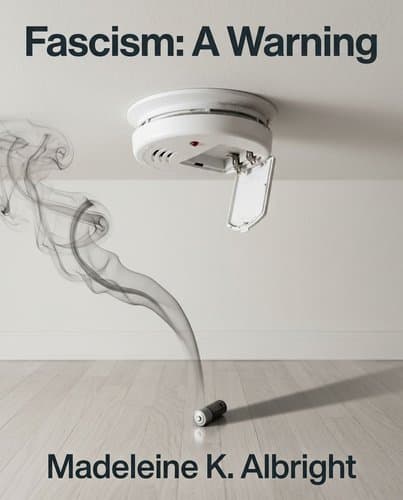
35820413_fascism
by Madeleine K. Albright
Fascism isn't a political ideology—it's a repeatable method for seizing power, and every elite who believed they could contain it has been wrong.
In Brief
Fascism isn't a political ideology—it's a repeatable method for seizing power, and every elite who believed they could contain it has been wrong. Albright maps its behavioral fingerprints across history so you can recognize the pattern while recognition still matters.
Key Ideas
Fascism is method, not ideology
Fascism is a method for seizing power, not an ideology — which is why 1920s Italian fascists simultaneously included self-described left, right, and center variants, and why no historical diagnostic of fascism maps cleanly onto a left-right spectrum.
Elite containment of fascism always fails
Elites who believe they can contain or manage a fascist-in-the-making have been wrong every time: the Church, big business, and the military all thought they could control Mussolini and Hitler. The belief that 'we can handle this' is not reassurance — it's a pattern that has preceded every successful fascist consolidation on record.
Fascism's genuine appeal drives mass adoption
Fascism's most dangerous feature isn't its cruelty — it's that it works for a while. It offers community, explanations, material improvement, and belonging. Any defense that dismisses the genuine appeal of fascist movements will fail to understand why ordinary, decent people joined them.
Nine behavioral questions reveal fascist trajectory
Apply the nine behavioral questions to any leader, regardless of party: Does the leader cater to ethnic or religious prejudice? Nurture grievances toward revenge? Refuse electoral defeat? Speak casually about using violence? Attack the press and judiciary? These reveal trajectory, not current position.
U.S. institutional attacks embolden global autocrats
The U.S. presidency has a global reach that cuts both ways: when an American president undermines the press and judiciary at home, autocrats worldwide use those words as operational cover — Cambodia, China, Hungary, Libya, and others have done so with named quotes and documented policy actions.
Active vigilance prevents invisible democratic erosion
Democratic erosion is invisible from inside it — the German civilian's 'corn growing' testimony is the book's most practical warning. The defense isn't institutional faith ('our courts will handle it') but active, named vigilance: asking the nine questions about every leader, in every election, before the moment when recognition can still matter.
Who Should Read This
History readers interested in Democracy and Geopolitics who want a deeper understanding of how we got here.
Fascism: A Warning
By Madeleine K. Albright
10 min read
Why does it matter? Because you've probably used the word "fascist" as an insult this year — and in doing so, accidentally disabled your best early-warning system.
The word has been so cheapened — shouted at yoga instructors, copy editors, anyone whose coffee order takes too long — that it can no longer do what it was built to do: warn. That's where Madeleine Albright begins, and the provocation cuts deeper once you realize who's asking. She fled fascism twice before her twelfth birthday (once when the Nazis occupied Czechoslovakia, once when the Communists seized it after the war), then spent her career as a diplomat sitting across from the men most likely to revive it. Her case isn't that history repeats. It's stranger than that. Fascism isn't an ideology with a fixed address. It's a method: one that surfaces wherever genuine grievances meet a leader willing to stir crowds rather than lead them. By the end, you'll have a nine-question diagnostic for spotting it anywhere, in any party, before the moment for recognition has passed.
A Word That Means Everything Warns You About Nothing
The word "fascist" has become so elastic that it has stopped being useful, and that, Madeleine Albright argues, is the first thing that makes you vulnerable to the real thing.
In 2016, Merriam-Webster named "surreal" their word of the year — searches spiked in the days after the November election — while "fascism" became the most-searched political term of the year. The two words sharing a year is its own dark joke. Yoga instructors get called fascists. So do cyclists, copy editors, and the designers of childproof packaging. When a word expands to fit every irritant, it loses its edges. You can no longer use it to point at something specific and say: there.
To recover those edges, Albright convened a graduate seminar — two dozen students seated in a circle in her Georgetown living room, plates of lasagna balanced on their knees — and asked them to build a definition from the ground up. What emerged surprised them. Fascism, they concluded, is less a political ideology than a technique for seizing power. That reframing explains something otherwise puzzling: Italian fascists of the 1920s simultaneously described themselves as left-wing, right-wing, and centrist. The Nazis combined violent racism with demands for better pensions, free education, and improved maternal care. What unified these movements wasn't doctrine. It was method. Loyalty to the leader was the only non-negotiable.
From that foundation, Albright arrives at a definition precise enough to be diagnostic: a fascist is someone who claims to speak for an entire people, treats the rights of outsiders as irrelevant, and will use any means necessary, including violence, to prevail. The key distinction from ordinary tyrants is behavioral. Kings, historically, tried to pacify their populations. Fascists do the opposite: they inflame the crowd, arm it, and point it outward.
That distinction matters because recognition precedes resistance. If the word means whatever feels most infuriating on a given day, you won't notice when someone actually fits.
Every Fascist Who Took Power Was First Underestimated by the People Who Could Have Stopped Him
None of the fascists Albright examines took power by force. They were handed it. By parliaments, by presidents, by conservative establishments that were certain they'd made a clever bargain. What happened at the Kroll Opera House in Berlin on March 23, 1933, is the pattern in miniature.
That morning, Adolf Hitler walked to the lectern and spoke in a soft, reassuring voice. Outside, Himmler's secret police ringed the building. Inside, SA brownshirts (the Nazi paramilitary, already larger than the German army) lined the walls. The Reichstag was being asked to vote itself out of existence: to hand Hitler the power to govern by decree, ignore the constitution, and bypass the legislature entirely. He promised there was nothing to worry about. Institutions would stay intact. The press would remain free. The Church would keep its rights.
Only the Social Democrats refused. Hitler wheeled on them and told them their death knell had sounded. The rest voted yes, by a wide margin. Within weeks, the parties that had trusted him were abolished. Their members were arrested. The Third Reich had begun. Not with tanks rolling over a barricade. With a parliamentary vote.
What made it possible wasn't Hitler's violence, which everyone could see. It was the certainty of Germany's conservative establishment (the Church hierarchy, the industrialists, the military) that they had him under control. They'd dismissed the Nazis for years as loudmouthed street thugs. Then they'd welcomed them as a firebreak against Communism. Then they'd installed Hitler as chancellor, confident an uneducated Austrian with no governing experience would be easy to manage. He was, to them, a rough tool that civilized men thought they could point and release.
Hitler knew exactly what they thought. In February 1933, he told a colleague: "They regard me as an uneducated barbarian. Yes, we are barbarians. We want to be barbarians. It is an honorable title."
The line is easy to read as a boast. It's also a diagnosis. The establishment had assumed that what they called barbarism in him — the contempt for rules, the disregard for institutions, the willingness to do what they would not — was a liability. Hitler understood it was the source of his power. The old guard's deference to norms was the door he walked through.
Mussolini was cabled to Rome and asked to form a government; the conservatives assumed they'd rein him in. Hitler was handed the chancellorship by a president who felt he had no better option. The people best positioned to stop them chose instead to manage them: the institutions, the elites, the parliamentary majorities. They were mistaken about who was using whom, and you should expect that mistake to be made again, because the whole arrangement is designed to produce it.
Fascism Doesn't Win With Hatred Alone — It Wins Because It Offers Something Real
But the mechanics only hold if they deliver something. What did ordinary Germans actually get from fascism, before everything collapsed?
Not permission for cruelty — though that came too. A German woman from that period, no fascist herself, recalled watching her circle of friends move through the 1930s. Their small lives, she said, "went on, altered only for the better, in bread and butter, in housing, health, and hope." The economy had recovered. Jobs came back. Food was on the table. Families could afford children again.
Then she recalled a night at the cinema with a Jewish friend. In the dark, her friend's daughter leaned over and whispered something to her mother. The girl had already been marked for destruction by the regime. Even so, she could articulate exactly what fascism was offering everyone around her.
What it offered was belonging, direction, a nation's pride restored after years of humiliation. Fascism gave young people organizations to join, the unemployed networks to find work, struggling couples the confidence to have four children instead of two. It gave people explanations for confusing times and an identity that felt earned rather than inherited. The community was genuine.
Albright's most uncomfortable argument is also her most important. If fascism seduced only the irrational and the cruel, you have no reason to worry about your neighbors, your community, or yourself. But if ordinary, decent people were drawn in because their daily lives genuinely improved, while others were being destroyed in ways the comfortable were nudged not to notice, the warning sounds different. The question isn't only whether a strongman could seize power. It's whether enough people's lives could improve quickly enough that they'd accept a cost paid entirely by someone else.
The comfort was real. That's what makes the complicity hard to look at clearly.
Erdoğan, Putin, and Orbán Are Running the Same Mechanics Mussolini Perfected a Century Ago
On June 16, 1989, a 26-year-old stood before 250,000 Hungarians packed into Budapest's Heroes' Square and said what none of the day's other speakers had dared. The crowd had gathered for the reburial of Imre Nagy, the leader of a 1956 uprising that Soviet tanks had crushed, his body finally exhumed from an unmarked grave. Speakers all day had been careful, restrained. Then Viktor Orbán stepped up: he announced that his generation could put an end to Communist dictatorship, demanded the immediate withdrawal of Russian troops, and promised a real elected government. The crowd erupted. Four months later, Hungary proclaimed a democratic republic.
That same man, in 2017, mailed a questionnaire to every Hungarian household. It asked whether residents supported the "Soros Plan": a scheme to flood the country with migrants, pay them welfare, and go easy on their crimes. There was no Soros Plan. George Soros's foundation had no such agenda. The questionnaire was built on a fabrication. What Albright finds most instructive is the mechanism: take a democratic tool — the plebiscite, the direct appeal to the people — and use it to embed a lie so deeply into national conversation that the lie becomes the starting point for all further debate. She traces the method to the Third Reich, which used staged referenda to lend a thread of legality to Hitler's rule. Nazi propaganda minister Joseph Goebbels captured the logic precisely: the most effective persuasion is the kind you don't recognize as persuasion.
The man who electrified Heroes' Square and the prime minister who mailed that questionnaire are the same person. That's Albright's argument at its most compact: the threat comes from elected leaders in NATO member states, some of them long-standing US treaty allies, and the transformation happens gradually enough that each step looks defensible until you glance back and can't find where you crossed the line.
Recep Tayyip Erdoğan follows the same arc. In his first term as prime minister, he produced genuine results: inflation fell from 47% to single digits, the economy tripled, infant mortality halved. Then came the 2016 coup attempt. Around 140,000 government employees were fired or suspended. Some 180 media outlets shut. The prime minister's office was abolished, power consolidated into a presidency Erdoğan now holds with term limits reset to potentially 2029. Albright's diagnosis: the voice telling him that only he knows what's best for Turkey is the siren's song that turns power into an end in itself.
And Orbán didn't develop this alone. Vladimir Putin's Russia, Albright argues, has turned these techniques into an exportable curriculum. She imagines the course catalog: how to run a constitutional referendum whose outcome is decided before the ballots are printed. What once looked like responses to local crises turn out to be off-the-shelf methods. Russia is the instruction manual.
When a U.S. President Calls the Press the Enemy, Autocrats Quote Him to Justify Their Own Repression
The words a U.S. president uses about his own press don't stay inside American borders. They travel, and autocrats collect them.
In his first month in office, Trump barred prominent reporters from a White House briefing. Within weeks, Cambodia's government announced it might expel American journalists from the country. Spokesmen in Phnom Penh said they had received a "clear message" from Trump that the media's coverage "does not reflect the truth" and that "freedom of expression must respect the state's power." No Cambodian official arrived at that argument independently. They read the American president, identified a permission structure, and used his words to threaten the people whose job was to hold their government accountable.
That was the opening move. China's state-run People's Daily made the logic explicit: if the U.S. president himself says American media distorts reality, then negative stories about China are obviously suspect too. Hungary had the same argument: Viktor Orbán's government had spent years absorbing independent media into state-friendly outlets, and now it had an American president to point to. These governments didn't merely borrow Trump's contempt for the press. They cited him by name as justification for suppressing the reporters covering them.
The human cost is specific. A journalist working in Phnom Penh or Warsaw is a person with a source and a deadline, in a country where the gap between "threatened" and "arrested" is narrow. When their government can point to the American president as proof that a free press is a political weapon rather than a democratic institution, the journalist's work gets more dangerous: not in theory, but in the week that follows a Trump tweet. The U.S. president's attacks on his own press corps corrode American democracy and hand autocrats a citation.
The trust numbers show what else goes with it. Allied confidence in the U.S. president doing the right thing dropped. In Germany, from 86 percent to 11. In France, from 84 to 14. In South Korea, from 84 to 17. In a single year. That's not a soft-power bruise. Seven decades of alliance architecture — built precisely to contain the kind of authoritarian drift documented here — is far harder to reconstruct than it was to build.
Nine Questions That Reveal a Leader's Direction Without Asking Which Side They're On
Lincoln arrived for his own inauguration in disguise, mocked by allies and enemies alike as a bumpkin too weak for the moment. What his critics read as weakness was something else: he never mocked those below him, never bragged, and his aim never moved. He demanded more from Americans than any president before or since. He told a war-torn nation it had perhaps earned its catastrophe by tolerating slavery so long, then asked those same Americans to bind the wounds rather than inflict new ones.
Nelson Mandela is the other half. He spent twenty-seven years imprisoned for opposing apartheid, the prime of his life, with every reason to emerge consumed by hatred. Instead he used those years to learn the language, history, and fears of the people who had put him in jail. When he was finally released, he could communicate with them, find common ground with them, forgive them, and lead them. He served one presidential term and declined a second. Both men spent years studying power at its worst; neither became it.
That discipline is the book's standard. Then Albright gives you the diagnostic: nine questions, each behavioral rather than ideological. Does the leader stoke ethnic, racial, or religious contempt? Nurture grievances into revenge? Express contempt for governing institutions? Attack the press and judiciary? Weaponize patriotic symbols to divide? Refuse to accept electoral defeat? Promise to personally solve every problem? Invoke violence casually? Treat followers as raw material to be shaped rather than citizens to be served?
The questions aren't abstract. Take "Refuse to accept electoral defeat?" On January 6, 2021, a sitting president told supporters gathered outside the Capitol that the election had been stolen and that they should march to where Congress was certifying the results and "fight like hell." That question now has a recent, specific answer. Each of these nine does.
These questions don't separate left from right. They separate leaders who invite you to build something from those who only want you to obey.
What Lincoln Knew That Fascism Never Could
The asymmetry Albright wants you to hold onto is this: under a dictator, if the institutions fail, there is no mechanism left — no court to appeal to, no ballot to cast, no press to name what happened. In a democracy the damage is reversible. Slowly, painfully, but reversible — as long as enough people are paying attention. That is not a comfort. It is a condition. The nine questions are not a checklist you complete before an election and file away. They are a permanent posture: not asking what a leader believes but watching what they invite you to become. Lincoln's strength didn't announce itself. Mandela's emerged from twenty-seven years of deliberate refusal. Fascism cannot produce either kind, because both require people who think for themselves. That is what you're being asked to remain.
Notable Quotes
“I said. He looked puzzled.”
“was searched on the Merriam-Webster dictionary website more often than any other word in English except”
“which experienced a sudden spike after the November presidential election. To use the term”
Frequently Asked Questions
- What is Fascism: A Warning about?
- "Fascism: A Warning" examines fascism as a method for seizing power, not a fixed ideology. Published in 2018 by former Secretary of State Madeleine K. Albright, the book draws on historical cases from Mussolini to the present, providing readers with a practical behavioral checklist for identifying authoritarian trajectories before democratic erosion becomes irreversible. The work explains why fascism appeals to ordinary people through community, belonging, and material improvement—not just ideology. It also reveals why elite attempts to contain fascist movements have consistently failed, emphasizing that active vigilance is the only reliable defense against authoritarianism.
- What does Albright mean by saying fascism is a method rather than ideology?
- Albright argues that fascism is a method for seizing power, not a fixed ideology—which explains why 1920s Italian fascists included self-described left, right, and center variants simultaneously. This insight means fascism cannot be cleanly mapped onto a left-right political spectrum; instead, it describes behavioral patterns and tactics for consolidating control. The distinction matters because understanding fascism as a method reveals its true danger: it can emerge in any political context whenever leaders employ techniques like exploiting prejudice, rejecting electoral defeat, attacking institutions, and normalizing violence. This framework allows readers to identify fascist trajectories regardless of party affiliation or stated ideology.
- What are the nine behavioral questions in Fascism: A Warning?
- Albright provides nine questions to identify authoritarian trajectories in any leader regardless of party: "Does the leader cater to ethnic or religious prejudice? Nurture grievances toward revenge? Refuse electoral defeat? Speak casually about using violence? Attack the press and judiciary?" These questions reveal behavioral patterns that precede fascist consolidation, not current ideological position. The framework applies universally across historical and contemporary contexts. Rather than diagnosing fixed ideology, the questions identify methods fascists use: appealing to prejudice, exploiting grievance, rejecting democratic norms, normalizing violence, and attacking institutions. Leaders exhibiting these behaviors signal dangerous trajectories before democratic erosion becomes irreversible.
- Why do ordinary people join fascist movements?
- Fascism's most dangerous feature is not cruelty but efficacy: "it works for a while." The book emphasizes that fascist movements offer genuine, tangible benefits—"community, explanations, material improvement, and belonging." Dismissing fascism's appeal fails to explain why ordinary, decent people joined these movements historically. This insight reveals why elite efforts to contain fascist leaders failed: the Church, big business, and the military all believed they could manage Mussolini and Hitler. Understanding fascism's legitimate appeal to people seeking community and material security is therefore not moral relativism but practical necessity for building effective democratic defenses against authoritarian movements.
Related Book Summaries
Read the full summary of 35820413_fascism on InShort