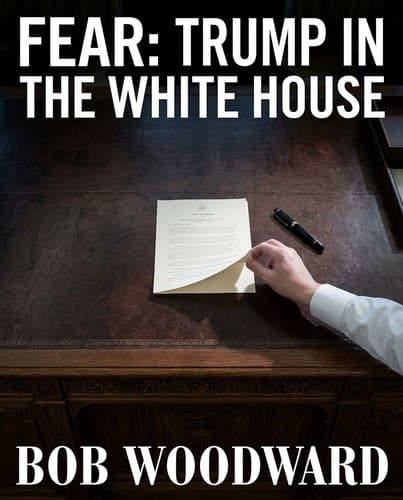
41012533_fear
by Bob Woodward
Trump's own cabinet called him a "fucking moron" and a "fifth grader" in private—then showed up the next day and kept serving. Woodward reveals how senior…
In Brief
Trump's own cabinet called him a "fucking moron" and a "fifth grader" in private—then showed up the next day and kept serving. Woodward reveals how senior aides secretly removed documents from the Resolute Desk to stop presidential orders, exposing the shadow government that quietly ran America.
Key Ideas
Guardrails Collapse Into Individual Heroic Action
When evaluating whether institutional guardrails are holding in any administration, ask what mechanism is actually doing the holding — in Trump's White House, the mechanism was individual aides physically removing unsigned documents from the president's desk, which Woodward explicitly calls 'an administrative coup d'état' while the rest of the book treats as heroic crisis management. These are not compatible verdicts, and the tension is the book's most important argument.
Concessions Radicalize Against Future Intervention
Trump's Charlottesville corrective speech reveals a specific self-defeating pattern: he could be managed into saying the right thing through ego appeals, but the experience of making any concession immediately radicalized him against future persuasion. Each successful intervention made the next one harder to achieve. Advisors who understood this kept trying anyway, which tells you something about what they believed the alternative was.
Attention Management Governs Presidential Memory
The most analytically useful insight in the book is Rob Porter's 'trigger' theory: Trump's memory required external activation to access a prior decision — something on his desk, something on TV, someone appearing in the Oval. Remove the trigger and the decision ceased to exist. His aides governed partly by managing his attention as a physical resource. This framework explains more about White House operations than almost anything else in the book.
Unreported Crises Pose Greater Danger
The most alarming material involves crises the public never learned about — particularly the North Korea dependents tweet, drafted and seriously considered, which North Korea had explicitly warned intermediaries would be read as a sign of imminent attack. The near-misses that don't reach the news are often more consequential than the ones that do.
Proximity to Power Silences Accountability
Every senior official who served Trump reached devastating private conclusions about his fitness — 'fucking moron,' 'fifth or sixth grader,' 'crazytown,' 'professional liar' — while serving publicly and saying nothing. The question this pattern raises isn't only about Trump: it's about what the gap between private judgment and public accountability costs in any institution where proximity to power creates silence rather than accountability.
Who Should Read This
History readers interested in Political Figures and Leadership who want a deeper understanding of how we got here.
Fear: Trump in the White House
By Bob Woodward
10 min read
Why does it matter? Because the guardrails everyone praised weren't institutions holding — they were individual aides stealing documents off the president's desk.
The story we were told was reassuring: experienced adults in the room, guardrails holding, institutions working as designed. The story Bob Woodward documented is something else entirely. The chief economic adviser physically removing executive orders from the president's desk before he could sign them. The staff secretary slow-walking documents until the president forgot they existed. A senior aide making a private admission that the real measure of their service wasn't what they accomplished for the country: it was what they quietly stopped the president from doing to it. This wasn't the system working. This was individuals improvising a shadow government in real time, operating through theft and deliberate delay, making unilateral decisions about which presidential impulses the country would actually have to live with. Sit with what that means: if the guardrails were never institutional at all — if they were always just one person willing to grab a piece of paper — how close did things actually get?
The President Never Noticed the Letter Was Gone
Gary Cohn walked into the Oval Office in early September 2017 and found a single-page letter on the Resolute Desk: addressed to the president of South Korea, announcing that the United States was pulling out of the Korea Free Trade Agreement. Cohn, former president of Goldman Sachs, picked it up, placed it in a blue folder marked "KEEP," and walked out with it.
He told an associate he'd taken it deliberately. The president would never see it. Protecting the country required as much.
Trump never noticed it was gone.
What made the letter so dangerous wasn't the trade question. Under a mutual defense treaty dating to the 1950s, the U.S. stations nearly 29,000 troops in South Korea and runs intelligence programs classified at the highest levels, programs that can detect a North Korean missile launch in seven seconds. From Alaska, the same detection takes fifteen minutes. That eight-minute gap is what makes intercepting an incoming missile possible; a missile from North Korea reaches Los Angeles in 38 minutes. The math is tight. The intelligence relationship that produced those seven seconds was woven into the same alliance fabric as the trade deal Trump wanted to tear up over an $18 billion annual deficit.
Cohn's theft wasn't a one-time improvisation. Staff secretary Rob Porter (Harvard, Harvard Law, Rhodes Scholar) ran a parallel operation. Decisions got slow-walked. Legal reviews that hadn't been requested were cited as pending. Draft letters were manufactured as props, carried into meetings as evidence of progress, then quietly buried. When a document landed on Trump's desk, Cohn would sometimes simply remove it, knowing the president would forget what he'd wanted to sign. "If it was on his desk, he'd sign it," Cohn noted. The point, he said, wasn't what they'd accomplished. It was what they'd kept the president from doing.
Porter estimated this kind of intervention — the delays, the bureaucratic friction, the manufactured amnesia — happened ten times more often than the physical document removals.
The Warning Signs Were All Visible in 2010. Every Expert Still Got the Prediction Backwards.
August 2010, Trump Tower, 26th floor. David Bossie — a Republican congressional investigator who had spent nearly two decades pursuing Clinton scandals — has arranged a meeting with a television celebrity apparently considering a presidential run. Steve Bannon, dragged along skeptically, responds to the idea with a question about which country.
The meeting is a tutorial in political basics for a man who knows none of them. Bossie arrives with stacks of public records documenting Trump's three biggest liabilities. He presents them one by one.
Trump has a documented pro-choice history: donations to abortion-rights candidates, public statements on record. Trump says he's pro-life before Bossie finishes the sentence. Shown the records: no problem, it's all changeable, he's pro-life, he's telling you.
The voting record: he claims every election since eighteen; the records show one primary vote, ever; shown the evidence, he pivots mid-sentence — right, that was for Rudy.
Then the hardest one: eighty percent of his political giving has gone to Democrats. He denies it. Shown the public disclosure documents, he shifts: Democrats run all the cities, he explains, you can't build hotels without paying them off. A local politician in Queens demanded a cash envelope before any permit cleared. Then the frame clicks into place. It's a rigged system, he says. These guys have been shaking me down for years.
Bannon walks out. Zero chance Trump ever runs, he says. Less than zero. "Look at the fucking life he's got, dude." His reasoning: Trump will never write the fundraising checks Bossie recommends, never write the policy book, wouldn't trade the life he has for the one he'd need. All of it accurate about Trump's character. None of it right as a prediction.
On election night 2016, as the results came in, Chris Christie, the chairman of Trump's transition team, was vacationing in the Bahamas.
In Private, They Called Him a Moron. In Public, They Called Him Mr. President.
On July 20, 2017, six months into the presidency, Defense Secretary James Mattis walked Donald Trump into a room the Pentagon calls the Tank, a windowless, high-security chamber with gold curtains and no televisions, and attempted a presidential intervention.
Mattis and Gary Cohn had planned it like a corporate off-site. Two large wall screens displayed maps of every U.S. military deployment, trade relationship, intelligence asset, and treaty around the world. The whole post-war architecture, rendered visible. The theory: you couldn't stand in front of it and still want to tear it down.
Mattis opened: the rules-based international order was the great inheritance of the generation that fought World War II. Secretary of State Rex Tillerson echoed him: seventy years of peace. Cohn laid out the numbers: $130 billion in agricultural exports annually, $75.9 billion in arms deals, the way South Korean trade and U.S. military presence were woven together at the same airports.
Trump shook his head through most of it.
When the presentation turned to South Korea — nearly 29,000 troops, $3.5 billion a year — his patience broke. He wanted them out. Cohn tried the math: repositioning the Navy to compensate would cost ten times as much. Trump said he'd sleep soundly without any of it.
Priebus ended the meeting. Trump walked out and greeted reporters in the corridor. Very good meeting, he told them.
Inside the room, Tillerson — former CEO of ExxonMobil, a man who had negotiated with Vladimir Putin — turned to Mattis and Cohn, loud enough for the room to hear. The president was a fucking moron.
They Didn't Manage the President — They Managed What Reached Him
The West Wing developed something with no official name and no authorization from anyone: a theory of presidential memory as a manageable physical system.
Rob Porter, the staff secretary, eventually put it plainly. Trump's impulses needed a trigger — something on his desk, something on television, someone slipping into the Oval for an unscheduled meeting. Without one, Porter concluded, the impulse would simply expire. Gary Cohn grasped the corollary, which was almost childlike: if the paper isn't there, the president can't sign it. "If he's going to sign it," Cohn told Porter, "he's going to need another piece of paper." So he removed the paper.
The NAFTA withdrawal cycle was the clearest test. Trump had instructed Porter to produce a formal 180-day withdrawal notice, the outcome Porter had spent months fighting against. He drafted the letter anyway. Cohn lifted it off the Resolute Desk. They agreed to slow-walk any replacement. Porter had also built an elaborate memo system that August, requiring a signed decision document before any oral instruction became final. Woodward dismissed it in two words: "It was a fantasy."
Then Peter Navarro slipped into the Oval Office for a meeting nobody had scheduled. He had told a reporter that his job was to confirm Trump's instincts. Now he told the president the staff secretary process was the bottleneck. Trump summoned Porter: "What the fuck are you stalling for?" Porter drafted another withdrawal letter. Cohn removed that one too.
That was not staff running interference; it was a parallel government, operating entirely without the knowledge of the executive.
He Could Be Talked Into Saying the Right Thing — and It Made Him Worse
The West Wing was under renovation in August 2017, which is why Rob Porter and Donald Trump worked through the Charlottesville corrective speech on a laptop. No printer available. Porter scrolled through the draft while Trump sat behind the desk and told him, more than once, what he thought of it. "This doesn't feel right to me. It looks weak."
Getting Trump to this moment had taken Porter the better part of a day. His strategy was entirely ego-based, because ego was the only lever that worked. He told the president he could be a healer in chief, a consoler in chief, the figure at the center of national reconciliation. He framed the corrective speech not as capitulation but as Trump making the moment his own. Trump didn't agree, but he didn't walk away either.
In the residence, Porter watched what he described as two Donald Trumps visibly at war — the one who would not bend to political correctness and the one who understood he needed to bring the country together. Eventually Trump said, "All right. We'll do this."
He delivered the speech from the Diplomatic Reception Room looking, in Porter's account, like someone coerced to speak in a hostage video. He named the KKK, neo-Nazis, and white supremacists by name. He said racism is evil. It was the right speech, five minutes long, and when he returned to the residence his advisers treated it as a triumph. Gary Cohn told him it was one of his finest moments as president.
Then Trump watched Fox News.
A former Navy SEAL appeared on screen and said the speech was "almost an admission of okay, I was wrong." A correspondent called it a "course correction." That framing, the suggestion that he'd been wrong and corrected himself, detonated something. Trump told Porter it was the biggest mistake he'd ever made. You never make those concessions. You never apologize. He hadn't done anything wrong in the first place — so why look weak? It was the worst speech he'd ever given. He was never going to do anything like that again.
He didn't blame Porter, though Porter had spent four hours shaping the speech. The rage wasn't at the aide. It was at the act of having yielded at all.
Trump could be reached through his ego, maneuvered toward better behavior through careful framing. The staff had learned to do it. But every successful persuasion taught him the same lesson: that giving ground felt like losing. Each time he was talked into the right thing, he came away more certain the right thing was weakness. The persuasion worked. And it made the next attempt harder.
The Near-Miss That Never Made the News
How close did it actually get? The "Rocket Man" tweets, the "fire and fury" press conference, the nuclear button boast — if you followed the North Korea standoff in 2017 and 2018, you probably understood it as a game of rhetorical chicken, reckless but ultimately contained by the adults surrounding Trump. What the public never learned was that one of the near-misses wasn't rhetorical at all.
In early January 2018, after Kim Jong Un declared the entire American mainland within range of his nuclear weapons, Trump responded publicly with the "my button is bigger" tweet. Privately, he went further: he drafted a tweet ordering the withdrawal of all U.S. military family members from South Korea — a move North Korean officials had already told intermediaries they would read as a sign of imminent attack.
What stopped it wasn't a protocol or an institution. It was a phone call from a golf course — Lindsey Graham, who had publicly called for removing the families just a month earlier. When Trump raised it, he reversed: don't start that process, he told Trump, unless you're ready to go to war.
The tweet never went out. The families in South Korea never knew how close it came. Neither did anyone else.
The Truth His Own Lawyer Couldn't Say to His Client's Face
John Dowd turned to his co-counsel Jay Sekulow in Robert Mueller's office on March 5, 2018, and proposed something unusual. "You play the president," he said. "I'll play Mueller."
What followed made Dowd's case better than any legal argument. Sekulow, playing Trump, answered questions with invented details, sudden anger, and outright contradictions. It was, unmistakably, Trump. Dowd, playing Mueller, slammed the table: "Gotcha! Gotcha, 1001!" — the federal statute on making false statements. He then asked Sekulow how many times Trump had actually said "I don't know" in their White House prep sessions.
"Oh, a dozen, twenty."
Dowd turned to Mueller and laid it out plainly. His client would reach the third question, scramble it, and spend the rest of the session saying he couldn't remember — not as evasion, but because he genuinely couldn't. A president absorbed information in volumes that made precise recall of year-old conversations nearly impossible. "I don't want him looking like an idiot," Dowd said. "And I'm not going to sit next to him and let him look like an idiot."
Mueller studied him. "John, I understand."
Trump did not. He kept insisting he was a good witness. Reaching him on Air Force One, Dowd made his position final: don't testify. The other path ended in prison. Trump wouldn't move. On the night of March 21, he called to say his mind was set. Dowd resigned the next morning.
Woodward closes on Dowd's private reckoning. After 47 years of law, he had seen the thing that explained everything — the memory gaps, the rages, the reflexive denials, the inability to sit still and answer basic questions about events he had lived through. He could say it to himself. The attorney-client relationship made it impossible to say to Trump's face. The truth that would have ended the representation: Trump wasn't misremembering. He was lying.
Dowd was the only one who quit.
Who Authorized the Guardrails?
Here's what you're left with after all of it. Every person who prevented a catastrophe in this book was substituting their own unelected judgment for the constitutional authority of a president. Woodward admires them for it. He also calls what they did a coup. Both verdicts appear in the same book, and he offers no way to reconcile them, because there isn't one.
What the book cannot tell you is what happens when those people are gone. Cohn left. Tillerson was fired. Mattis resigned. The individuals who formed the guardrail dispersed — because it had never been anything other than individuals. No institution summoned them into that role. No institution replaced them when they left. The question the book raises and walks away from isn't whether the right people showed up this time. It's what you're supposed to count on when they don't.
Notable Quotes
“The great gift of the greatest generation to us,”
“is the rules-based, international democratic order.”
“This is what has kept the peace for 70 years,”
Frequently Asked Questions
- What is Fear: Trump in the White House about?
- Fear: Trump in the White House documents the hidden power struggles inside the Trump administration based on hundreds of hours of interviews by investigative journalist Bob Woodward. The book reveals how senior aides routinely circumvented presidential decisions they considered dangerous, offering a detailed account of informal checks on executive power. Woodward explores the mechanisms through which administration officials managed crises and the personal costs they paid for exercising these checks, providing an inside look at how governance actually functioned beneath formal structures.
- How does Rob Porter's 'trigger' theory explain Trump's behavior?
- Rob Porter's 'trigger' theory provides the most analytically useful insight in the book for understanding White House operations. According to Woodward, 'Trump's memory required external activation to access a prior decision — something on his desk, something on TV, someone appearing in the Oval. Remove the trigger and the decision ceased to exist.' His aides governed partly by managing his attention as a physical resource. This framework explains more about White House operations than almost any other concept in Woodward's account, offering key insight into how the administration's daily governance functioned.
- What pattern does Fear reveal about Trump accepting advice?
- Woodward documents that Trump could be managed into saying the right thing through ego appeals, but each concession immediately radicalized him against future persuasion. The Charlottesville corrective speech exemplifies this self-defeating pattern: advisors succeeded in getting Trump to deliver an appropriate statement, yet the experience made him resistant to future intervention attempts. Each successful persuasion made the next one harder to achieve. Advisors who understood this pattern continued trying anyway, which reveals their deep concerns about what might happen without their interventions to manage his impulses and decisions.
- What unreported crises does Fear document?
- The most alarming material in the book involves crises the public never learned about. Particularly significant was the North Korea dependents tweet, drafted and seriously considered, which North Korea had explicitly warned intermediaries would be read as a sign of imminent attack. The near-misses that don't reach the news are often more consequential than the ones that do. These unreported near-misses reveal how dangerous moments emerged behind closed doors, and understanding them illuminates what informal crisis management cost both individually and institutionally.
Related Book Summaries
Read the full summary of 41012533_fear on InShort