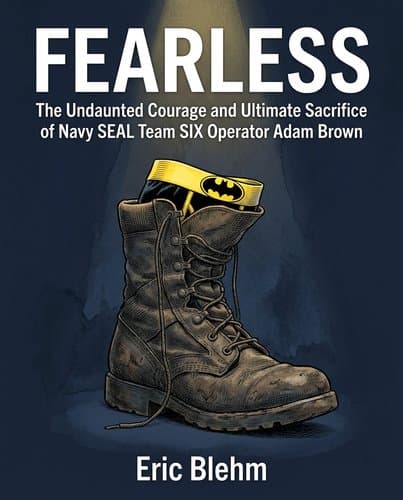
12878300_fearless
by Eric Blehm
Adam Brown was a drug addict, a criminal, and a man who nearly destroyed everything he touched—before becoming one of the most decorated Navy SEALs in history.
In Brief
Adam Brown was a drug addict, a criminal, and a man who nearly destroyed everything he touched—before becoming one of the most decorated Navy SEALs in history. His story reveals how the same relentless intensity that once consumed him became the force that made him unstoppable.
Key Ideas
Direction and structure channel identical inner traits
The qualities that make someone destructive and the qualities that make someone exceptional are often the same trait — what changes is the direction it's aimed and the structure around it
Recovery requires external supports over willpower alone
Recovery from addiction is not a finish line; it is a daily negotiation that requires external load-bearing supports — relationships, stakes, purpose — not just internal resolve
Compassion and ferocity are complementary skills
Compassion and ferocity are not opposites; the most effective people in extreme situations often hold both, and learning to switch between them is a skill, not a contradiction
Hiding pain from loved ones enables dishonesty
Hiding the severity of your struggles from the people who love you — even with the best intentions — is its own kind of dishonesty, and the book shows both the cost and the logic of it
Tough love requires others to bear pain
Tough love, when it comes from people who genuinely refuse to give up on you, can be the most loving act available — but it requires those people to absorb enormous pain themselves
Legacy lives in small, specific physical details
Legacy is built in the small, specific, physical details — a pair of Batman underwear, 500 pairs of children's shoes, a jar of ankle bone fragments on a kitchen counter — not in the official record
Who Should Read This
Readers interested in Memoir and Military History, looking for practical insights they can apply to their own lives.
Fearless: The Undaunted Courage and Ultimate Sacrifice of Navy SEAL Team SIX Operator Adam Brown
By Eric Blehm
13 min read
Why does it matter? Because the qualities that nearly destroyed Adam Brown are the exact ones that made him irreplaceable.
There are two letters Adam Brown wrote to his children. One arrived on a birthday morning, stuffed inside a card, full of bad dad jokes and crayon drawings he'd made himself. The other was sealed in an envelope marked only if. Same handwriting. Same man. Except the second letter knew things the first one couldn't say out loud — that he understood failure from the inside, that he'd stolen from his own mother, that the person who nearly destroyed his family and the person who died in the mountains of Afghanistan (the Hindu Kush) were not opposites but the same relentless, unregulated force. Fearless is the story of what happened between those two letters — and of the stubborn, inconvenient truth that the qualities which broke Adam Brown were the same ones that ultimately made him irreplaceable.
The Same Instinct That Built a Warrior Almost Killed Him First
The same engine that would one day carry Adam Brown through some of the most dangerous raids in Afghanistan was running long before he had any useful outlet for it — and for a while, it nearly destroyed him.
Consider what that engine looked like at six years old: Adam pushes a chair across the back porch of the family home in Hot Springs, climbs onto the railing twelve feet above the ground, and jumps. Not because someone dared him. Not because he miscalculated the distance. He just wanted to see what would happen. His mother charged outside to find him rolling on the grass, laughing. She spanked him hard enough to leave a handprint. A few days later, he did it again. His peewee football teammates eventually named this quality: they called him Psycho, because he volunteered for the biggest opponents when nobody else would, took hit after hit from players who outweighed him by fifty pounds, and popped back up each time asking for more.
By 1994, that same engine had found crack cocaine — and the trait that made him fearless on a football field made him catastrophic in a drug house. He later admitted that the first time he smoked crack, he knew he had sold his soul. And kept going anyway. Within weeks he had burned through two thousand dollars.
You feel the distance between those two versions of Adam when you read the letter he left for his children before a deployment — the one they weren't meant to see unless he died. He tells his son he'll be there for every failure, that he knows tears and disappointment from the inside. That's not a warrior being poetic. That's a man who watched his own mother's legs buckle the day she saw him handcuffed and put in a sheriff's cruiser.
Addiction Doesn't Take Everything at Once — It Takes It in the Order You Value It Most
Ryan Whited was driving south on Highway 7 when a blue Toyota pulled up behind him and honked. He recognized Adam Brown and rolled down his window, and what he found wasn't the kid who'd once walked to the school nurse with most of his tongue hanging off, calm as if he were heading to the water fountain. This Adam was weeping. He told Ryan he was addicted to crack, that he'd been stealing from his own parents, that he couldn't stop. He asked Ryan to follow him back to where he'd been staying and help him collect his things — and if he vanished into any of the five crack houses along the way, to come drag him out. At the end of a broken road outside town, in a trash-strewn clearing, sat the trailer. Dishes with rotting food stacked in the sink, clothes heaped on the floor, a crib in the living room. Ryan stood in the middle of it and couldn't reconcile the place with the person he knew. 'It was in a state that animals shouldn't be living in.'
That clearing is where you finally see it whole, because it wasn't a single catastrophic moment — it was a sequence of losses, each one preceding the next. First the grades went, then the football dream, then the direction, then the money, then the honesty. Adam forged checks from his mother's purse. He charged tools to the family business account and sold them for cash. His brother Shawn quit his job as a pharmacist and moved back near Hot Springs but refused to give Adam his address. 'I don't trust him,' he told their parents — a sentence that meant something specific coming from Shawn, the brother who had once been the first to defend him.
The bottom arrived on New Year's Eve 1995. In the grip of a drug-induced psychosis, Adam locked himself in a bathroom with a knife and began stabbing at his own neck. A friend kicked the door in, punched him to get the knife away, and called an ambulance. Days later, in a treatment center, Adam worked through a recovery autobiography. He described his earlier self as someone who had 'always wanted to impress everyone and be the very best.' Then he described his current self: 'a miserable drug addict that hurts other people.' The last line of the workbook was almost a whisper against everything that came before it — 'But I will climb out of this hole and be somebody.' Not a plan, just a declaration, written by a twenty-two-year-old who had methodically lost every version of himself he had ever been.
Redemption Isn't a Moment — It's a Deal You Have to Keep Renegotiating
Teen Challenge wasn't comfortable. The faith-based program in Sanford, Florida kept Adam up at 5 a.m., shipped him to a commercial car-detailing lot six days a week, and filled his evenings with Bible classes and counseling. No money, minimal free time, nowhere to run. What took root there was genuine — he found the parable of the Prodigal Son and read it the way someone reads a letter addressed to them personally: a son who wasted everything and came home expecting punishment and got an embrace instead. He wrote his parents that graduating the program would be the first day he could look at them without shame. He meant it. He stood in front of Second Baptist Church a year later and said so out loud, weeping in front of the people who had been praying for him.
Then he was back in Hot Springs, and within weeks he relapsed. Then again. The drug kept calling his name the way he described it — not as a temptation he could argue with, but as a direction his hands would steer toward before his mind caught up. Faith had redirected him, not immunized him.
What held things in place long enough for something permanent to happen was a combination of people who refused to look away. Kelley Tippy, who had tracked him through red lights in a car chase and sat with him in a hotel room until 4 a.m., coaching him through a high by sheer determined presence. And a phone call from Jeff Buschmann in Texas, where Adam had fled to protect Kelley from himself, that produced the idea of the Navy. The problem was eleven felonies and admitted crack use on a federal form. Adam disclosed all of it voluntarily at the recruiting office, and the recruiter was already reaching for the rejection when Adam pointed to a framed photograph on the wall — Jeff's father, Captain Roger Buschmann, the highest-ranking Navy recruiter in the entire Southeast. The recruiter called. The Captain said he'd stake his own reputation on the young man sitting across from his son's friend. Issue every waiver. Treat him like my son.
That voucher didn't erase the addiction. It gave Adam a context in which the cost of relapsing was finally, concretely higher than the pull. He didn't stop needing to renegotiate the deal. He just finally had enough people around him — people who wouldn't let go — that he could keep renegotiating and not lose.
The Relapse Your Heroes Don't Put in the Brochure
Here is the version of Adam Brown that doesn't make the recruiting poster. June 2003, five years after he first pinned on his Trident: Adam disappears after a neighborhood gathering, spends a night on crack, and walks back through his front door Sunday morning looking, in Christian's words, like a dog that knows what it did. His wife Kelley says nothing loud enough for their three-year-old to hear. She says, quietly, 'How dare you. You have a family. How dare you.' Then she takes the children and leaves for twenty-four hours — not as punishment but as a demonstration. She wants him to feel the exact weight of what he keeps risking, to sit alone in a quiet apartment and understand that the thing he nearly threw away is two small children and a woman who has been dragging him toward his own life for years.
Then Christian sits across from him at a Village Inn and makes it simple. 'We're going to war soon,' he tells Adam. 'I have to be able to trust you. You have to be the guy that's got my back when we go in and we're on target.' That's the argument that lands — not health, not family in the abstract, but a specific man asking whether his life is safe in Adam's hands.
The addiction never got fixed. It got managed, under conditions precise enough to make the cost of relapse concrete and immediate. The faith was real, the change was real, but neither one rewired the circuitry the drug had altered. What held was the accumulation of people — Kelley, Christian, his kids, his teammates — who made the stakes visible enough, again and again, that Adam could choose. The book's real argument is that he kept choosing, under pressure, not to be consumed.
What a Man Does When He Has Nothing Left to Prove — and Still Can't Stop
Dave Cain sees it before Adam says a word. The Humvee has just finished cartwheeling down a stretch of Afghan blacktop — three complete rotations — and Adam is already inside the wreckage, pressing on the leg wound of an FBI agent named Billy White, whose rifle has been driven through his own armpit by the force of the impact. Billy is screaming. Another man, thrown clear, staggers in shock. Adam is keeping pressure on the bleeding and directing the corpsman to administer morphine. Only when Dave circles the vehicle does he notice Adam's right hand: every finger except the thumb severed and dangling by skin and tendons, the hand that had been gripping the window frame when the Humvee met the road. 'Adam, your hand is messed up.' 'Yeah, yeah. Focus on these guys.' After a corpsman lays the fingers back into place and bandages the whole assembly, Adam picks up his M4, balances the stock on his forearm just above the bandages, and holds a perimeter while a crowd of locals gathers around the wreckage. Dave tells him to sit down. Adam shakes his head. He keeps pushing people back until the medevac lands, and then waits — still on security — until every other casualty is loaded before he steps aboard.
That scene is the clearest picture of who Adam Brown had become by 2005, but it also raises the question the book quietly circles at this point. At some stage, refusing to stop stops being evidence of toughness and starts looking like something harder to name. Adam had already lost most of the functional vision in his dominant eye to a training accident. Now he had a mangled hand on his dominant side. Any rational accounting would have pointed toward a medical discharge and a quieter life. Instead, while surgeons repaired his nerves and tendons — he requested a local anesthetic so he could watch — he was already planning his next Green Team application, the selection pipeline for DEVGRU. He had been medically disqualified two weeks before the course was set to begin. His response was to intercept his commanding officer on a morning run and ask for a chance.
He got it, conditionally: no accommodations, every standard met or he was out. What followed was Adam teaching himself to shoot left-handed with a weapon designed for right-handers, while developing what his instructors nicknamed the 'rubber neck swivel' — a full cranial rotation to compensate for the blind quadrant where his right eye used to be. Other candidates failed who had both eyes and both hands. Adam passed. The nickname stuck the way nicknames do when they're accurate: he had turned a deficit into a habit, the swivel so automatic it barely registered as compensation anymore.
By the time he cleared Green Team, he had nothing obvious left to prove — and that changed nothing about what he was willing to attempt next.
The 5 Percent Problem: How Do You Be the Most Compassionate Man in the Room and Also the Scariest?
Heath Robinson has a framework for it, borrowed from Dave Grossman's writing on the psychology of combat. A small fraction of the population — roughly five percent — is constitutionally wired to run toward gunfire rather than away from it. The profile sits close to sociopathy. Heath reframes that: the firefighter sprinting into a burning building isn't broken, he's necessary. Someone has to be built that way. A horse-owning friend gave Heath the sharpest version of the justification: you pull on waders every weekend, shovel the manure, do the miserable thing nobody else wants to touch — so your family can walk out into the paddock and enjoy what they have. When Heath's squadron boarded a flight to Afghanistan, he asked Adam if he had his waders. Adam said yes, let's go shovel some.
What the framework doesn't account for is the Easter Sunday scene. Adam's squadron had hit multiple compounds in a single night, killing a group of insurgents that included, by physical evidence, at least half a dozen men who had been preparing for suicide operations. Tactically, it was a success. But walking back to the rally point in the early morning hours, Adam's head was down in a way his teammates noticed. It was Easter, he told Dave Cain. The Resurrection. And here he was sending men to their deaths on the morning Christianity sets aside to celebrate life overcoming death.
He didn't resolve that on the mountainside. He carried it home, and about a week after returning, he ran a bath and stayed in it for two hours, then called for Kelley to come sit with him. It was the first time, he told her, that he had ever said out loud what his job actually required. They prayed together. He slept well that night and, according to Kelley, never revisited it.
The waders analogy explains why men like Adam can function. The bathtub scene tells you something the analogy doesn't: that functioning costs something, that the accounting gets done in private, and that the man who emerges afterward — ready to board another flight, sling his rifle, kneel in the dirt to help an Afghan child tie a new pair of shoes — is not someone who has stopped feeling the weight. He's someone who has learned exactly where to put it down.
The Batman Underwear
On the evening of February 5, 2010 — his thirty-sixth birthday — Adam Brown unwrapped a present from his two kids and pulled out a pair of black-and-yellow Batman briefs, adult-sized and ridiculous. He put them on over his pants and struck superhero poses around the kitchen while Nathan and Savannah dissolved into laughter. Then he got down to their level, lowered his voice, and made them a promise: these were going to be his undercover underwear, worn on every mission, his secret source of superhero power. The bad guys would never know it was really Batman showing up.
Three weeks later he kissed them goodbye and told his son, 'This is the last time, buddy. Last time.'
Six weeks after that, on a mountainside in Kunar Province in the early hours of Saint Patrick's Day, a hidden fighter inside a barn opened up with an AK-47 and cut Adam down through both lower legs and across his side. His teammates Brian Bill and Nick Null dragged his full dead weight — roughly two hundred fifty pounds with gear — through the branches of a tree and out through the compound gate. A medic tore through Adam's clothes to find and pack the wounds. The bleeding was severe, the injuries worse than anything field medicine could fix. And there, as the medic cut away the last of his cammies, the men around him went quiet. Brian Bill would say afterward: the world stopped for a few seconds, and they just stared. He was wearing the Batman underwear.
A promise kept, on the worst possible morning. The children's gift, the playful vow, the mountainside — the whole book compressed into one image. Not the absence of fear but the presence of something that laughs at fear, wraps it up in a silly pair of briefs, and walks through the gate anyway.
Adam died before reaching a forward operating base. His wounds were unsurvivable. His teammates refused to let his body travel back through standard military transport rotation. They escorted him themselves.
At his burial, Captain Pete Van Hooser — the man who had first pinned Adam with his gold SEAL Trident a decade earlier — walked to the casket, raised his fist, and drove the Trident into the wood. One by one, more than fifty SEALs did the same. The only sound was the thud of metal against pine, repeated again and again. Six of those men would be dead within seventeen months.
Fearless, in the end, doesn't mean unafraid. It means you made a promise to a seven-year-old girl and a ten-year-old boy, and you kept it — all the way to the last morning.
What 'Fearless' Actually Means
Here is what Adam Brown actually asked for, in writing, before he died: make the worst of it public. The crack houses, the forged checks, the years he spent becoming someone his brother wouldn't give his address to. He wanted it known — not because he was proud of it, but because somewhere out there was a twenty-two-year-old in a trailer, writing in a workbook that he would climb out of the hole and be somebody, and Adam believed the specific truth of his own wreckage might reach that person in a way that polished heroism never could. That's what the Batman underwear really tells you — not that he was brave enough to die, but that he was brave enough to be fully seen. The willingness to be completely known is a choice. He made it twice: once on the mountainside, once on the page.
Notable Quotes
“This doesn’t even compare to what Adam was up against,”
“Everything is on paper, and you either accomplish what is needed to qualify or you don’t. We were skeptical about Adam because you have to use your peripheral vision a lot; you have to clear corners, be aware of movement to alert you to threats.”
“We’re working against an enemy’s reaction time and making sure our guys are faster,”
Frequently Asked Questions
- What is Fearless about?
- Fearless chronicles the life of Adam Brown, a Navy SEAL Team SIX operator who transformed from a drug addict and convicted felon into one of the most decorated operators in the unit's history. Eric Blehm's 2012 biography explores how addiction, redemption, and extreme purpose intersect in Brown's remarkable journey. The book examines the intersection of destructive and exceptional qualities, showing how the same traits can be channeled in different directions through proper structure and support. It demonstrates what it takes to rebuild a life from complete collapse into something extraordinary, offering insights into recovery, resilience, and human potential.
- What are the main lessons from Fearless about addiction and recovery?
- Fearless reveals that recovery from addiction is not a one-time achievement but a daily negotiation requiring ongoing external support systems. The book emphasizes that internal resolve alone is insufficient; recovery depends on relationships, stakes, and purpose. Adam Brown's story demonstrates how structure and community become essential supports for rebuilding from addiction. The narrative also explores hiding struggles from loved ones—a form of dishonesty with significant costs. Tough love from people who genuinely refuse to give up provides powerful motivation, though it demands tremendous sacrifice from supporters. The book illustrates recovery as a continuous process of recommitment rather than reaching a finish line.
- What does Fearless reveal about human potential and personal transformation?
- Fearless demonstrates that the qualities making someone destructive and exceptional are often the same trait—direction and structure determine the outcome. Adam Brown's transformation from felon to decorated SEAL exemplifies how destructive impulses redirect toward extraordinary purpose. The book reveals that compassion and ferocity are not opposites; effective people in extreme situations hold both and develop skill switching between them. Legacy is built not in official records but in small, specific physical details: "a pair of Batman underwear, 500 pairs of children's shoes, a jar of ankle bone fragments on a kitchen counter." These details reveal character and priorities more authentically than conventional achievements.
- Is Fearless worth reading?
- Fearless is worth reading for anyone interested in genuine human transformation, Navy SEAL operations, or addiction and recovery. Eric Blehm's biography transcends typical military memoir by exploring destructive and redemptive qualities within one person. The book offers insights about recovery, resilience, and community's role in transformation. Adam Brown's story challenges conventional narratives about who deserves second chances. The detailed narrative reveals how legacy forms through specific actions rather than official accolades. For readers seeking inspiration grounded in real struggle rather than sanitized success, Fearless examines what rebuilding from collapse requires and demonstrates the intersection of vulnerability and extraordinary human potential.
Related Book Summaries

Read the full summary of 12878300_fearless on InShort