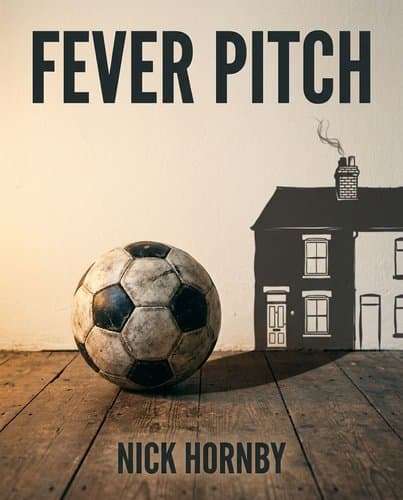
4264_fever-pitch
by Nick Hornby
Obsession isn't weakness—it's autobiography. Nick Hornby traces how Arsenal football became the secret structure holding him together through divorce…
In Brief
Fever Pitch (1992) is Nick Hornby's memoir tracing his lifelong obsession with Arsenal Football Club and what it reveals about identity, family, and emotional life. It shows how a consuming passion — however irrational or embarrassing — can be the lens through which a person processes formative pain, and what that says about the obsessions we all carry.
Key Ideas
Trace obsessions to broken origins, not choice
Trace your most embarrassing obsession back to when it started — it almost certainly formed in response to something broken, not as a free choice, and that origin changes how you hold it
Your deepest shame reveals honest self-portrait
The things you're most ashamed to admit caring about are often the most accurate self-portraits you have; the embarrassment is worth interrogating rather than resolving
Spectatorship as genuine work, not consumption
Watching is a form of participation — investing in an outcome you can't control is real psychological work, not passive consumption, and the communal dimension makes certain moments genuinely irreplaceable rather than merely exciting
Long communal waits create irreplaceable moments
An 18-year wait makes an outcome structurally different from any private pleasure — the combination of communal investment, powerlessness, and genuine surprise explains why sporting moments can honestly be the best moments of a life
Stop separating your virtue from your vice
Self-exculpation forecloses the most important question — Hornby's most honest move is refusing to cleanly separate 'the fans like me' from the worst things fandom produces, and that same refusal applies to whatever obsession you carry
Who Should Read This
Readers interested in Memoir and Cultural Studies, looking for practical insights they can apply to their own lives.
Fever Pitch
By Nick Hornby
12 min read
Why does it matter? Because the thing you're most embarrassed to love is the most honest thing about you.
You probably think obsession is just caring too much — enthusiasm that's lost the plot, intensity without an off-switch. A more extreme version of the same thing ordinary people feel. It's not. It works differently: it doesn't amplify your thoughts, it substitutes for them. And it doesn't arrive by choice. It gets constructed around you, usually in childhood, usually because something else collapsed — and by the time you understand what happened, it's already load-bearing. Nick Hornby spent twenty-five years assuming his Arsenal fixation was an embarrassing habit he hadn't gotten around to quitting. What Fever Pitch reveals is that he had it exactly backwards. The football wasn't a distraction from his real life. It was the scaffolding the rest of it was built on.
You're Not Thinking About Martin Amis — You're Lying
It's a Sunday morning in July 1991, and Nick Hornby is lying in bed with his partner, sipping tea. No football for months. The season is over. He mentions a friend named Matthew, which reminds him that Matthew still has his Champions video, which makes him wonder what Matthew would think of Arsenal's new Swedish winger, and suddenly he's gone: penalty kick, back-heel flick, a goal at Anfield, Wembley in 1987, Stamford Bridge in 1978, fifteen years of football unreeling inside his skull before the tea has gone cold.
"What are you thinking about?" she asks.
He lies.
Not out of cruelty. Out of necessity. The truth (that his mind traveled from a friend's name to a match played two years ago, in under twenty minutes, on a morning in July with no football anywhere) is simply not something you can say to someone who inhabits the real world. So obsessives lie. They learn to. Hornby is unsentimental about what happens if they stop: the daydreams grow longer, the relationships fall away, and eventually you're alone on the floor, rewinding the same video to memorise David Pleat's commentary from a match played on 26th May 1989. He knows that date without looking it up.
That's the tell. It's a cognitive condition that runs through your mind faster than you can intercept it, through chains of association you didn't choose, landing on details (the exact corner of the net, the commentator's phrasing) that serve no practical purpose and feel completely compulsory anyway. You can't think your way clear because you can't see yourself from the inside. That blindness, Hornby argues, is the actual definition of obsession. Not the depth of feeling. The inability to get any distance on it at all.
Arsenal Was the Home His Parents' Divorce Had Destroyed
Hornby didn't fall in love with Arsenal. He fell into it because his parents' divorce had created a problem nobody had a solution for.
The problem had a name — the "Winter Father," borrowed from an American short story he encountered years later but recognized instantly. A separated man with visiting rights and two young children, no shared domestic space, nothing to organize three hours around. Restaurants meant silence. Zoos meant awkward proximity dressed up as an outing. What these occasions lacked wasn't affection but context — a reason to be there that wasn't just two people going through the motions. Football provided exactly that. You could talk during it, or stay quiet. The silences had somewhere to go. His father took him to Arsenal's first home game of the 1968–69 season, and that was it: the stadium became their shared house, the fish-and-chip shop on Blackstock Road their kitchen, the West Stand their sitting room. The divorce problem was, for the moment, solved.
What Hornby couldn't have anticipated was what else football was solving. At that first game (Arsenal beat Stoke 1–0 on a penalty rebound), he barely watched the play. What he watched were the men around him: faces rigid with fury at the team's inadequacy, bodies coiled with grievance, the collective sensation of having come specifically to suffer. Every other entertainment he'd attended — cinema, pantomime, school concerts — had asked you to enjoy yourself. This one didn't. He recognized the difference as something he'd been waiting for.
The origin gets complicated here. Football gave a boy and his absent father a shared space with ready-made drama to fill it. But it was also solving something else in Hornby, something that needed a place for feelings he had nowhere else to put. And that second function didn't need the father to sustain it. The obsession outgrew him almost immediately.
By the following spring, when Arsenal reached a cup final against lower-league opposition they were expected to demolish, Hornby was already so frightened that he disguised a request for parental reassurance as casual sports chat on the stadium steps. His father predicted a comfortable win. Arsenal lost in extra time through a sequence of catastrophic errors. Hornby counted three separate paternal betrayals before they reached the car park, then took a knock to the floor from classmates on Monday morning.
The man whose absence had created the problem was now inside it. The cure had become the disease. The only difference was that Hornby had already decided he couldn't live without it.
The Littlewoods Cup Fixed What a Psychiatrist Couldn't
The psychiatrist's office is in Hampstead. It's March 1987, and Hornby has been seeing someone about the depression that has shadowed him through most of the decade — the kind that identifies with you specifically, that finds reasons to stay. He leaves the session and heads directly to White Hart Lane for an FA Cup semi-final against Tottenham.
Arsenal are a goal down with seven minutes remaining. Ian Allinson (Hornby describes him, fairly, as a trier rather than a match-winner) hits a near-post shot that deflects in off something it was never aimed at. Then David Rocastle wins it in the ninetieth minute. What follows isn't what happens when a football team wins. The depression he had been carrying for the better part of eight years began, that night, to lift.
He knows how this sounds. His explanation, offered carefully, is that he stopped feeling unlucky — that some log-jam had cleared. The log-jam language matters. Somewhere earlier in the decade, after a League Cup defeat left him too exhausted to speak, Hornby had reached a conclusion he barely admitted to himself: he believed Arsenal's stagnation and his own were the same obstruction. Not similar. The same. Clearing it required Arsenal's intervention, not his. Years of actual therapy, and what shifts the weight is a deflected near-post shot from a journeyman winger.
The disproportion would be purely comic if it weren't also exactly right. Football was doing psychological work that nothing else in his life could reach. It gave him community. Pete, his season-ticket partner since 1984, is as comprehensively ruined by all of this as he is, with the same ludicrous memory and the same stomach-clenching fear before big games. It gave him identity, a category for himself that wasn't just "a nose, two eyes and a mouth." And it gave his depression somewhere specific to land: not formless dread but the contained, manageable terror of a semi-final in the eighty-third minute. You can do something with that. You cannot do much with the other kind.
The cost is what it always was. The girlfriend who phoned the morning after a League Cup quarter-final defeat heard such depletion in his voice that she feared something genuinely serious, then felt unmistakable relief when the explanation turned out to be football, a relief she scrambled to cover with sympathy. He caught it. He knew exactly what it meant. And knowing didn't change a thing.
Watching Is Doing — Except When It Isn't
Watching, Hornby insists, is doing. Not metaphorically — actually. When Arsenal won the 1987 Littlewoods Cup Final, he didn't feel vicarious joy radiating from the players. He felt his own, earned through decades of investment: every nil-nil draw at Chelsea, every Wembley defeat, every transistor radio pressed to his ear. The players were his representatives, chosen by the manager rather than elected by him. He'd put in more hours than any of them. The victory was equally his.
On 26th May 1989, Arsenal needed to beat Liverpool by two goals at Anfield to take the championship. That's when the claim was actually tested.
Then comes Gus Caesar.
Caesar was a central defender who cleared every checkpoint: South London youth teams, Arsenal apprenticeship, England Under-21 recognition. In the 1988 Littlewoods Cup Final, with Arsenal leading and time running short, the ball dropped to him in the box and he miskicked so badly he fell over. Luton equalized, then scored again. Within a few years Caesar was at Cambridge United, then Bristol City, then Airdrie, released by each club in turn until the game ran out of places for him.
The lesson is devastating: commitment, accumulated evidence, unwavering self-belief — none of it guarantees anything. Caesar had done everything right. And then he fell over in a cup final.
Hornby had been arguing, in effect, that the years of showing up constitute a claim on the outcome. Caesar's career answers that: they constitute nothing. The fan in the living room owns the joy — and owns nothing. Both of these things are completely true.
Nothing in Real Life Has Ever Been This Good, and That's Not Sad
Ninety-two minutes have elapsed in the last game of the 1988–89 season. Hornby is in a friend's living room wearing a shirt he bought that morning (he needed to do something), watching Arsenal play Liverpool at Anfield on television. Arsenal need to win by two goals to take the championship on goal difference. They're winning by one. The commentator is already offering consolation. Then a loose ball finds Michael Thomas alone in the penalty area, and Hornby is flat on the floor, and everyone in the room piles on top of him, and he has no idea what's happening because everything has gone white.
He sprints to the off-licence with both arms flung wide, apparently piloting something, while old ladies step out of their doorways to applaud. He overpays for champagne — the man behind the counter has assessed the situation. Eighteen years, forgotten in a second.
Then, recovering, he does something unexpected: he tries to find an analogy. He tests each candidate seriously and reports the results.
Orgasm: eliminated. Too familiar, too repeatable. You can see it coming. The whole point of Anfield was the suddenness, the arrival of the impossible in real time.
Childbirth: moving, but surprise is limited, and it takes too long.
Career achievement: lacks the last-minute time factor, and you're in control. Hornby wasn't in control of anything. He couldn't even get a ticket. He sat in a friend's house in a new shirt, contributing nothing, while his representatives settled the matter for him.
A large pools win: closer, but money affects a different part of the psyche, and the pools win is private. What happened at Anfield was communal: thousands of people experiencing the same detonation at the same instant, each carrying their own version of the eighteen-year wait.
No analogy survives. The search comes up empty not because Hornby can't think clearly — but because the conditions required for that moment almost never coincide. An eighteen-year accumulation of longing. Genuine powerlessness. Shared experience detonating simultaneously in thousands of people. And total surprise. Strip out any one of those four and you have a lesser thing.
People who name a football match as the best moment of their lives, he argues, aren't revealing some poverty of experience. They've found the one category of event that hits all four conditions at once. You might read that as charming self-deprecation — a man apologizing sweetly for his strange priorities. That's the wrong reading. The criteria are precise and the argument is serious: he has worked through the alternatives, rejected each on specific grounds, and arrived at a conclusion he can actually defend. The 1989 Championship is the best thing that ever happened to him. He's thirty-one. He knows how it sounds. He has checked.
The Innocent Majority Has Blood on Its Hands
Who is the book actually defending? Hornby establishes early that he belongs to the innocent majority — the fans who travel to Plymouth on a Wednesday night, who have never thrown a punch at a football ground. That framing holds for most of the book. Except here's the part the celebration tends to skip. Then Heysel happens — the 1985 European Cup Final between Liverpool and Juventus — and he dismantles it himself.
In May 1985, Hornby invited his Italian language students to his school to watch the match. He was the only non-Italian in the room. He turned on the television to find commentators still talking, no game yet, and gradually understood that English fans had caused a wall collapse in Brussels. Thirty-eight people died. He had to explain this in real time to a room of young Italians who'd come to watch football, and he kept apologizing, again and again, because there was nothing else to do.
What he refuses to sidestep is the argument about the continuum. Heysel wasn't the kind of violence he could look at from a distance and ask "who are these people?" It happened because English supporters ran at the Juventus fans, the same intimidation ritual (two-fingered gestures, chants designed to menace) that a large minority had treated as normal for twenty years. The Juventus supporters didn't know the grammar of English crowd behavior. They panicked. The wall came down.
Hornby had contributed to that culture. Not with fists, but with presence — the atmosphere that made the performance of menace feel normal. Then, with people dead in Brussels, the game kicked off and he sat in his school in England and watched it. His students were looking at him. He kept apologizing, not because sorry covered it but because nothing did. He couldn't explain why fans had done what they'd done, because the explanation pointed back at him: the chanting he'd stood among, the tribalism he'd loved, the English hard-man football culture he'd never personally escalated but never walked away from either. He watched anyway. He still can't fully account for why.
The conditions that made it all matter (the belonging, the collective intensity, the sense of being somewhere genuinely alive) were the same conditions that made Heysel possible. What shames you and what made you came from the same place. You don't get to keep one and disown the other. Most people have one of those they won't admit to.
The Shameful Thing and the Meaningful Thing Are the Same Object
Here's what Hornby is asking you to do: stop treating your version of this as a problem to outgrow. The team you follow obsessively, the band you know too well, the show you've rewatched until you could write it yourself — whatever yours is, it didn't arrive randomly. It arrived when something needed carrying. The embarrassment you feel about it is data. The useless facts you've retained for twenty years are a self-portrait. The irrational grief when it fails you is evidence of how much it's quietly been carrying. The shameful thing and the meaningful thing are the same thing — and most people have one they won't look at directly.
Notable Quotes
“Hornby has established himself ... as a maestro of the male confessional. [His] books reveal a fascination with the sheer voodoo of what so often passes for masculinity: the weird ritual facts, the useless objects, the losing clubs and teams.”
“Whether you are interested in football or not, this is tears-running-down-your-face, read-bits-out-loud-to-complete-strangers funny, but also highly perceptive and honest about Hornby's obsession and the state of the game. Fever Pitch is not only the best football book ever written, it's the funniest book of the year.”
“Hornby... comes closer to capturing the truths and absurdities of the obsessed sports fan's mind than anyone else I have read.”
Frequently Asked Questions
- What is Fever Pitch about?
- Fever Pitch is Nick Hornby's 1992 memoir exploring his lifelong obsession with Arsenal Football Club. The book traces how this consuming passion reveals deeper truths about identity, family dynamics, and emotional life. Rather than defending his obsession, Hornby examines what his irrational devotion to a sports team exposes about how humans process formative pain through seemingly arbitrary fixations. The memoir argues that these obsessions—however embarrassing or illogical—function as psychological frameworks that reveal authentic self-portraits. By investigating the origins of his Arsenal fixation and its grip on his emotional life, Hornby shows how passionate fandom operates as meaningful psychological work rather than mere entertainment.
- What are the key takeaways from Fever Pitch?
- The core insights include: trace your most embarrassing obsession back to its origin—it typically forms in response to something broken, not as a free choice, which transforms how you understand it. The things you're most ashamed to admit caring about are often your most accurate self-portraits; interrogating that embarrassment matters more than resolving it. Hornby argues that watching or investing in outcomes you cannot control is real psychological work, not passive consumption, particularly when communal investment is involved. An 18-year wait makes an outcome structurally different from private pleasure. Finally, Hornby's most honest refusal is not cleanly separating himself from fandom's worst elements—a principle applicable to any personal obsession.
- Is Fever Pitch worth reading?
- Fever Pitch rewards readers who recognize their own unexamined obsessions in Hornby's story. The book's value lies not in defending fandom but in its unflinching exploration of what obsessions reveal about psychological survival and identity formation. It speaks to anyone who's felt embarrassed about their consuming interests—whether sports, television, music, or otherwise. Hornby's refusal to pathologize or sanctify his Arsenal fixation creates space for readers to reconsider their own embarrassing attachments with similar honesty. The memoir offers permission to interrogate rather than dismiss these investments, and to recognize them as meaningful psychological work. It's especially valuable for understanding how communal experiences—particularly those involving powerlessness and genuine surprise—can authentically constitute life's best moments.
- How does Hornby explain the connection between obsession and formative pain?
- Hornby argues that obsessions almost never form as free choices but rather emerge in response to something broken—typically unresolved family pain. His Arsenal fixation crystallized around a formative moment of family dysfunction, becoming a profound psychological response. This reframes embarrassing obsessions as both symptom and survival mechanism: they're the lens through which a person processes formative pain. By tracing obsessions to their origin point, Hornby shows they function as adaptive responses to emotional need. His most crucial insight is refusing to cleanly separate the person from fandom's worst aspects—acknowledging that obsessions are implicated in both meaning-making and potential harm. This principle applies universally to any consuming interest, suggesting we should interrogate rather than dismiss our embarrassing attachments.
Related Book Summaries


Read the full summary of 4264_fever-pitch on InShort