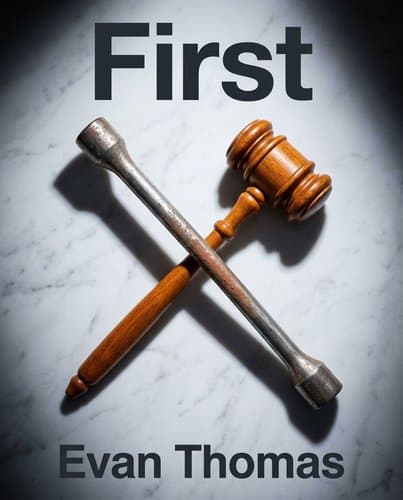
40594422_first
by Evan Thomas
Sandra Day O'Connor didn't break the Supreme Court's glass ceiling by demanding entry—she made herself so indispensable that exclusion became unthinkable.
In Brief
Sandra Day O'Connor didn't break the Supreme Court's glass ceiling by demanding entry—she made herself so indispensable that exclusion became unthinkable. But that survival strategy exacted a hidden price, one whose full cost only became clear when her pragmatic compromises unraveled everything she'd spent a lifetime building.
Key Ideas
Indispensability Outperforms Direct Institutional Challenge
Making yourself indispensable to an institution is more durable than confronting it directly. O'Connor got further by becoming necessary — socially, politically, intellectually — than by demanding access she wasn't being offered.
Strategic Ambiguity Preserves Institutional Optionality
Strategic ambiguity can be a form of institutional wisdom: refusing to stake out an absolute position preserves more outcomes over time than doctrinal purity, but it requires accepting that no one — neither side — will fully trust you.
Firsts Carry Compounding Invisible Burdens
The 'first' in any room is always doing two jobs simultaneously: the actual work, and the proof of concept that cannot afford to fail or be seen struggling. That invisible tax is real and it compounds.
Unseen Costs Follow Pragmatic Shortcuts
Every pragmatic shortcut has a downstream cost you cannot see at the time. O'Connor's Bush v. Gore vote — meant to end the chaos quickly — trapped her on the Court, delayed her retirement past the moment she'd chosen, and ultimately placed Alito in her seat to undo her life's work.
Societal Progress Outweighs Personal Monuments
Ask what actually moves society forward, not what builds a monument to yourself. O'Connor spent twenty-five years as the most powerful judge in America and concluded that teaching five million children annually to participate in democracy was more durable than anything she'd written from the bench.
Feminism Rejected, Female Experience Deployed
The 'women's voice' denial was a survival strategy, not an accurate self-description. O'Connor explicitly rejected feminist jurisprudence while consistently drawing on lived female experience her male colleagues didn't possess. You can hold both truths simultaneously — and so could she.
Who Should Read This
Readers interested in Political Figures and Leadership, looking for practical insights they can apply to their own lives.
First
By Evan Thomas
11 min read
Why does it matter? Because the woman who couldn't get a single law firm interview became the most powerful judge in America — and the gap between those two facts is the whole story.
Sandra Day O'Connor graduated in the top ten percent of her Stanford Law class (Order of the Coif, the top academic honor for law graduates) and applied to every firm on the bulletin board. Not one gave her an interview. At Gibson Dunn, a partner admired her résumé, then asked how well she typed. She said that wasn't the job she was looking for, walked out, and spent three decades making herself so essential to every institution that had excluded her that exclusion eventually became impossible. That wasn't protest. It was a method — and this book is about what it cost: legal doctrine trimmed to hold coalitions, a retirement decision she came to regret, and a legacy she watched dismantled by the very successor her own vote helped install. The woman who shaped American law for twenty-five years eventually concluded she'd done more lasting good teaching civics to middle schoolers. That gap is worth sitting with.
'You Should Have Started Earlier': The Ranch That Turned Hardship Into a Philosophy
July 1945, and fifteen-year-old Sandra Day has a problem. She is somewhere on the dirt tracks of the Lazy B ranch — 250 square miles of Arizona borderland where ten inches of rain counts as a good year — with a flat tire, a pot roast going cold in the truck bed, and ten hungry cowboys waiting at Antelope Well. No one is coming to help her. She braces the front tires with two rocks, cranks up the jack, discovers she can't get purchase on the lug nuts, and does the only logical thing: she stands on the wrench and jumps.
She changes the tire. She drives to camp, more than an hour late. Her father, Harry Day (DA to everyone on the ranch, its absolute ruler), doesn't acknowledge her arrival. When the crew finally breaks for lunch, DA's verdict: "You should have started earlier."
Sandra Day O'Connor told this story to every generation of her Supreme Court law clerks, and no two heard it the same way. One clerk, who became a close friend, heard a sad story about a daughter desperate for her father's approval. Another heard something harder and more useful: that life under conditions you didn't create doesn't owe you credit for ingenuity. That feeling good is not the priority. That you should expect anything out there, and plan accordingly.
Both readings are right. That's the point. The Lazy B didn't give O'Connor a single lesson; it installed an operating system. Harry Day could set a broken leg on a cow and deliver "you should have started earlier" in the same afternoon, then pile Sandra into his pickup after the rains broke and go careering after rainbows they both knew they'd never find. The harshness was real. So was the tenderness. She learned to hold both.
And from watching Ada Mae — her mother, who wore stockings and perfume while wielding a flyswatter, and absorbed Harry's harshness without giving him the satisfaction of a reaction — Sandra learned something the ranch never taught explicitly: how not to be rattled by the men who would try. Every institution she would later walk into as the only woman in the room would demand exactly that.
She Never Fought the Institutions That Excluded Her — She Made Them Need Her
In June 1981, two Reagan Justice Department lawyers flew to Phoenix to determine whether a state appellate court judge deserved a seat on the Supreme Court. Ken Starr had clerked for the Chief Justice; Jonathan Rose was Yale Skull-and-Bones, Harvard Law. They came to probe her constitutional jurisprudence — her genuine weak spot, since her state opinions dealt mostly with workmen's compensation, not First Amendment doctrine. On a day when the temperature was past a hundred degrees, O'Connor served salmon mousse.
She and her husband received their guests the way old friends get received: twin couches, cold drinks, easy conversation. She answered the constitutional questions carefully (courts interpret law rather than make it; old precedents should be reversed sparingly) and then, at the natural pause, went to the kitchen. Starr later described the whole session as "quite relaxed." His honest verdict: "Whoa. Very impressive." Judge Charles Renfrew, who spoke with Starr afterward, put it plainly: "They went out there to quiz her and came back talking about the salmon mousse."
When lunch ended, John O'Connor walked the two lawyers to their car and asked, carefully, as though it might not be answerable, whether anyone else was running as close a race. Starr said no, without hesitation. John went back inside and found his wife at the kitchen sink, washing dishes. He told her it was over.
The same play had been running for a decade. When Rehnquist's 1971 Supreme Court confirmation was in jeopardy, O'Connor had opened a notepad labeled "Assignments" and mapped every useful contact between Phoenix and the Senate, routing through Sherman Hazeltine, a Phoenix banker whose connections reached senators' campaign finance chairs. Rehnquist's thank-you letter said he'd been "virtually bowled over" by Hazeltine's contacts among the western bankers. She had been working this way the whole time: making herself useful to people who could, eventually, return the favor. Not scheming. Engineering.
Rejection by firms that refused to hire women lawyers could have curdled into bitterness. Instead it left her with a particular confidence: the confidence of someone who had accurately assessed her own worth and decided to make herself indispensable until the institutions that had excluded her couldn't imagine functioning without her.
Being First Means Performing Even When You're Coming Apart
October 1988, and Sandra O'Connor has just heard the diagnosis no one warns you about — not cancer, but the cascade after cancer. First the biopsy, then a second showing it invasive, now a doctor delivering a fifty-fifty survival estimate while she sits in a hospital bathrobe. She is crying. She tells her husband John she doesn't know if she wants chemotherapy, that they've had a good life, that maybe they should just let whatever happens happen. Their son Jay, walking in to find her like this, says it's the first time he's ever seen her lose it.
What brings her back isn't courage alone. It's calculation. She arranges her chemo doses on Fridays, so the worst nausea hits over weekends when the Court isn't sitting. She starts treatment two weeks ahead of anyone's timeline. And fifteen days after a mastectomy, she shows up at a Washington dinner dance. Her husband notes that when they walked in, heads turned across the room. A friend at her table described her as ashen. But she was there.
O'Connor had already told John she couldn't be a role model through this. She couldn't be seen struggling in public, in front of people watching for signs of fragility. Then she was one anyway. Because she understood something that doesn't appear in the tributes: the first woman on the Supreme Court wasn't allowed a visible collapse. She'd spent seven years building an image of effortless, relentless competence, and she knew that anything she showed of struggle or ordinary human limitation would be read differently than it would be for a man. Not as a rough patch. As evidence.
Ten days after surgery, she returned to her eight a.m. aerobics class in the gym directly above the courtroom. She stood in the back for exactly one day. Then she was back in the front row.
Her friend Judy Hope brought dinner that week: a chicken dish, a cold lemon soufflé. When O'Connor saw the soufflé, she cried. "Nobody takes care of me," she said. "The reason why," Hope replied, "is you don't let them." O'Connor didn't argue. She'd made that bargain herself, years ago, without naming it: she could have the room, but she had to perform in it. Every day. She brought the same control to the page — and it costs something, over time, to write clearly when you cannot afford to look uncertain.
The Woman Who Saved Roe v. Wade Spent a Decade Trying to Replace It
How do you square these two facts: Sandra O'Connor spent a decade insisting that Roe v. Wade's framework was constitutionally broken, then wrote the 1992 opinion that preserved abortion rights for a generation?
The answer lives in her 1983 dissent in City of Akron v. Akron Center for Reproductive Health, the first major challenge to Roe after the original ruling. Justice Blackmun's 1973 framework had divided pregnancy into three trimesters, with different rules applying to each. O'Connor called it "on a collision course with itself" — medical technology kept making fetuses viable earlier, which meant the framework's internal logic was being overtaken by the very science it had tried to codify. She proposed replacing it with a single test borrowed, pointedly, from the Reagan administration's own brief: whether a restriction placed an "undue burden" on a woman's right to choose, meaning whether it substantially blocked her access rather than merely inconvenienced her. Blackmun read this and wrote in the margin of her draft: "She just is against abortion."
He was wrong. Her behavior in the 1985 Thornburgh case, a Pennsylvania challenge to abortion restrictions, shows why. Steve Gilles, one of her clerks that year and a committed pro-life conservative, wanted her to join Justice White's dissent calling for Roe to be overturned outright. She refused. White's language located the state's interest in protecting fetal life "at conception" — a phrase O'Connor recognized as extending well past abortion to threaten contraception and reproductive technologies not yet widely available. She told a dinner companion around this time that "these abortion cases are going to be mooted by a new drug." Wishful, maybe. But it reveals someone working through consequences the other justices hadn't followed to their ends. She was trying to build protection for abortion rights on ground that could actually hold.
Which is why Planned Parenthood v. Casey, the 1992 case that would define abortion law for the next three decades, looked the way it did. O'Connor joined a secret coalition with Souter and Kennedy to save Roe's central holding, scrapped Blackmun's trimester framework entirely, and installed the undue burden test as permanent law. Then she struck down Pennsylvania's requirement that wives formally notify their husbands before obtaining an abortion, drawing on her years as an Arizona state judge confronting what abusive marriages actually looked like from the bench. A year earlier at NYU, she had explicitly warned that claiming women think differently was "dangerous": that kind of thinking, she argued, had historically served to confine women rather than protect them, the Victorian notion that feminine nature required special accommodation. Only she, among the nine justices, had actually handled those domestic abuse cases. She spent her career denying a distinctly female perspective in her jurisprudence. Casey is what that perspective looked like.
The Vote That Trapped Her — and What It Cost the Country
The night of November 7, 2000, O'Connor was at a Washington dinner party watching the networks call Florida for Al Gore. She went pale, said "This is terrible — that means it's over," and walked out of the room. Her husband John stayed behind and, with the unfiltered bluntness of someone whose Alzheimer's had begun stripping his inhibitions, explained to the remaining guests exactly what she'd meant: she wanted to retire to Arizona, but she wouldn't leave the Court while a Democrat could name her successor.
That accidental confession makes what happened next almost unbearably clear. When Bush v. Gore arrived at the Supreme Court weeks later (the recount case that would decide the presidency), O'Connor voted with the four other Republican-appointed justices to stop the Florida recount and effectively hand Bush the election. The legal reasoning she helped construct was, by her own admission, a one-time workaround. She personally inserted the phrase "limited to the present circumstances" into the opinion, a sentence acknowledging, in the decision's own words, that the equal-protection rationale wasn't genuine doctrine but a borrowed tool pressed into service for a single occasion. Justice Scalia, who signed on to it, privately described the same rationale in barnyard terms, as he later admitted to colleagues. She knew.
But here's what she hadn't fully calculated: the Lazy B ethic that had served her for seven decades — fix the broken thing, take the splatter (own whatever mess the solution makes), move on — couldn't work here. By helping elect the Republican president who could name her successor, she had made immediate retirement impossible. To step down right away would look, in her own word, "unseemly." So she stayed. She watched Chief Justice Rehnquist deteriorate, played bridge with him in his chambers, and when he declared he would serve another term despite his cancer, told her friend Cynthia Helms, walking back down the marble hallway: "If he's going to stay, well, then I can go." Rehnquist died three months after her retirement letter. Her seat went to Samuel Alito, a committed conservative who would spend the next two decades dismantling the jurisprudence she'd spent a career building, including, eventually, the abortion rights framework she had personally rescued in Casey.
In January 2017, sitting in a wheelchair at an assisted living facility, she was asked about Bush v. Gore. "It looked like a party-line vote, I know," she said. Her face went quiet. The woman who had spent fifty years fixing things and moving on had found the one problem her method couldn't solve: herself.
She Concluded That a Civics Video Game Mattered More Than Her Twenty-Five Years on the Court
The most durable thing O'Connor ever built wasn't a legal standard — it was a video game.
By the time she retired, the Roberts Court had already begun reversing the compromises she'd spent twenty-five years building. She told a Stanford classmate that everything she'd stood for was being undone. Jurisprudence, she came to understand, holds only as long as the majority that upholds it — and in an era of deepening polarization, future majorities were not going to be centrists.
Civic literacy was something else. In 2006, an Arizona State professor named James Gee argued that video games could be genuine learning tools. She regarded them as trivial and violent; he offered "interactive learning" instead. She remained skeptical but curious, and did what she'd always done when she didn't understand something: she found an expert. She recruited an eleven-year-old neighbor named Charlie Dolan with miniature golf and ice cream, extracted a short course on how a middle-school boy actually learns, and went back to Gee with notes.
By 2017, five million middle schoolers annually were playing "Win the White House" and "Do I Have a Right?" Florida passed a law with her name on it requiring civics instruction in public schools. Her former clerk Kathy Smalley put it plainly: O'Connor came to believe it was more important for that many children a year to learn how democracy functions than for one woman to have served as a justice for twenty-five years. A ruling can be overturned. The habit of civic participation, installed early enough, compounds.
What keeps this from being mere consolation is what she'd watched from the bench for decades: the system doesn't run on its own. It requires citizens who understand it well enough to defend it. In 2016, she sat in a Phoenix strip mall pointing through the window at the sunlit hills, dreaming aloud about the Lazy B. Everything she'd built on the Court was under revision. Five million children were still playing the game.
The Bridge She Believed Would Last
The woman who once changed a tire alone in the desert heat, arrived late, and got no credit for it — she spent a quarter century reshaping American law. And concluded it wasn't enough.
Not because the work didn't matter. Because doctrine holds only as long as the coalition that upholds it. What she'd built could be dismantled. What couldn't was five million middle schoolers who'd learned how a republic works before they were old enough to vote, from a video game she'd helped build. You spend a life asking what actually fixes the broken thing, and the answer, when it comes, surprises you. It surprised the people watching her most closely.
Notable Quotes
“I spoke to Justice O'Connor and discussed diagnosis and treatment. She indicated she was eager for him to participate in experimental studies.”
“recalled her friend Paul Ignatius. She was”
“When we got to the Court, it was like a scene from Apocalypse Now,”
Frequently Asked Questions
- What is 'First' by Evan Thomas about?
- First explores Sandra Day O'Connor's ascent to the Supreme Court and the strategy that enabled her: becoming indispensable to institutions that had originally excluded her. Thomas reveals both what O'Connor gained through her pragmatic approach and what it cost her in terms of judicial doctrine and lasting legacy. The book examines what pioneers across any field sacrifice in order to gain access to institutions and remain within them. It shows how O'Connor's approach of becoming necessary—socially, politically, intellectually—proved more durable than direct confrontation, while carrying hidden long-term consequences.
- How does Sandra Day O'Connor make herself indispensable according to 'First'?
- Making yourself indispensable to an institution is more durable than confronting it directly. O'Connor got further by becoming necessary—socially, politically, intellectually—than by demanding access she wasn't being offered. This pragmatic approach also required strategic ambiguity: refusing to stake out absolute positions preserved more outcomes over time than doctrinal purity, but it required accepting that neither side would fully trust her. Thomas shows how O'Connor's strategy of institutional necessity proved more effective at advancing her influence and power than direct confrontation or ideological absolutism would have been.
- What are the hidden costs of being a 'first' in your field?
- The 'first' in any room is doing two jobs simultaneously: the actual work and proof of concept that cannot afford to fail or be seen struggling. That invisible tax is real and it compounds over time, becoming more onerous with each decision. Every pragmatic shortcut carries downstream costs you cannot see initially. O'Connor's Bush v. Gore vote—meant to end chaos quickly—trapped her on the Court, delayed her retirement past the moment she had chosen, and ultimately placed Alito in her seat to undo her life's work. Thomas uses this as an example of hidden pioneer sacrifices.
- What did Sandra Day O'Connor conclude about her greatest impact?
- O'Connor spent twenty-five years as the most powerful judge in America and concluded that teaching five million children annually to participate in democracy was more durable than anything she'd written from the bench. She ultimately valued concrete civic education over building a judicial monument to herself. O'Connor also explicitly rejected feminist jurisprudence while consistently drawing on lived female experience her male colleagues didn't possess. Thomas argues you can hold both truths simultaneously—and so could she—reflecting her pragmatic approach to bridging professional identity and authentic experience.
Related Book Summaries

Read the full summary of 40594422_first on InShort