27214080_five-presidents
by Clint Hill
One agent stood within arm's reach of five presidents for seventeen years—close enough to take a bullet, powerless to change history.
In Brief
One agent stood within arm's reach of five presidents for seventeen years—close enough to take a bullet, powerless to change history. Hill's memoir reveals how proximity to trauma without agency or language to process it creates wounds that silence only deepens.
Key Ideas
Cover-ups damage more than original acts
Cover-ups compound the original mistake in ways the original mistake never would have — Eisenhower's own post-presidency verdict on the U-2 affair was that the lie destroyed his greatest diplomatic asset (his reputation for honesty), which the spying itself would not have done
Character revealed by treatment of powerless
How a leader treats people who have no power over him is the most reliable character signal available — Kennedy's instinct to bring golf shirts to sweating agents revealed more about who he was than any speech he gave
Witnessing trauma without voice inflicts wounds
Proximity to traumatic events without agency to shape them or language to process them is its own category of wound — Hill's twelve years of silence about Dallas made the damage worse, not better
Institutional silence masks unprocessed trauma
Institutional stoicism is not the same as resilience — the Secret Service culture that treated silence as professionalism produced a generation of agents who carried severe unprocessed trauma with no support structures and no available diagnosis
Closest to power, farthest from protection
The people closest to power often bear its costs most completely while receiving the least protection from them — Hill was present for every major crisis of five presidencies and was medically retired at 43 with no counseling, no language for PTSD, and a Zapruder film being shown on loop in training rooms he was required to attend
Who Should Read This
History readers interested in Memoir and Political Figures who want a deeper understanding of how we got here.
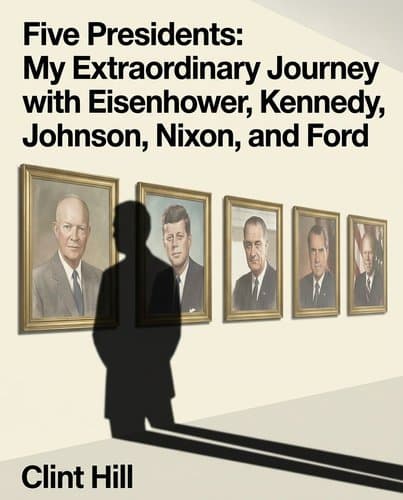
Five Presidents: My Extraordinary Journey with Eisenhower, Kennedy, Johnson, Nixon, and Ford
By Clint Hill & Lisa McCubbin Hill
10 min read
Why does it matter? Because the people who kept five presidents safe paid a price history never recorded.
There's a version of this book where a former Secret Service agent gives you the inventory — seventeen years, five presidents, a front-row seat to everything from Khrushchev's forty-minute tirade at the 1960 Paris Summit (the moment that collapsed Eisenhower's last shot at Cold War diplomacy) to the moment Nixon's call sign changed from "Air Force One" to a plain registration number over the American heartland. That version is real and it's remarkable. But the book that required fifty years to speak aloud is about something no citation could contain: what it costs to close the gap in under two seconds and still arrive after the third shot. Hill was trained to make himself invisible so that power could function, to be the mechanism and not the man — and when the mechanism finally failed, he had no language for the damage. This is the story of how he eventually found some.
The Job Paid You to Disappear at the Exact Moment That Mattered Most
Autumn 1958, Denver. Clint Hill is a month into his first Secret Service assignment — the midnight shift at 750 Lafayette Street, a three-story brick house where Eisenhower's eighty-year-old mother-in-law, Elvira Doud, lives with a maid and a nurse. He hears Mrs. Doud calling from upstairs. Once, twice, three times. No nurse answers. Hill goes up. In the nurse's room, he places his hand on her shoulder and she doesn't move — her body rigid, long dead, probably a heart attack some hours before his shift even started. Mamie Eisenhower had left Denver that very morning by train, headed back to Washington. If the press spotted anything unusual at 750 Lafayette in the small hours, they'd assume the wrong woman had died.
He calls his supervisor, Earl Schoel, from the kitchen phone. Schoel knows the local coroner, who happens to own a modified sedan: backseat removed, passenger-side doors engineered to swing open in opposite directions, creating just enough of an aperture to slide a body inside. The coroner backs the car silently into the driveway. Hill and the coroner wrap the nurse in a blanket, haul her stiff deadweight down a narrow staircase, and ease her into the car. They do it without waking Mrs. Doud. No neighbors see. No reporters ever find out. The problem, as far as history is concerned, never happened.
This is the actual job. Not standing at the president's elbow while he signs legislation. Not the motorcades in front of cheering crowds. The job is a 3am phone call and a body you can't acknowledge, moved out a side door before dawn. Hill would later call this particular night the minor leagues — and he wasn't being modest. But the skill it required — solve it invisibly, hold the shape of normal, absorb what can't be seen — that was exactly what the next seventeen years would demand of him.
Every President's True Character Lived in Moments He Never Knew He Was Being Read
The leaders Hill served gave their most revealing performances when they forgot he was there. Not in their speeches or policy decisions. Those were constructed for an audience. In the unscripted seconds: the gesture before cameras arrived, the order issued when no constituent was watching. Hill's position put him inside those seconds. He was never at the table, always outside the door, which turned out to be the better vantage point.
The Kennedy example comes from Hill's first weeks on the First Lady's detail, in Palm Beach, 1960. An agent named Harry Gibbs had just flown in from Washington without time to pack for Florida heat and was standing post in a wool suit when John Kennedy, still president-elect, noticed him from the patio. Kennedy walked over, asked his name, asked why he was wearing wool in eighty-degree weather. Gibbs explained. Kennedy suggested he move to a shaded spot; Gibbs explained why that wasn't possible. Kennedy went inside and returned carrying a stack of short-sleeved golf shirts in several colors, set them on the ground, and told the agents to take one. The gesture was practically useless (agents can't abandon designated posts for their own comfort), but that wasn't the point. Kennedy noticed Gibbs's discomfort before Gibbs said a word, and his first move was to fix it. Hill read the whole thing as a signal: this was going to be a different kind of administration.
That clarity — what a man reaches for when nothing is required of him — is the test. Nixon clarifies it by inversion.
In the fall of 1972, the White House pressured Hill to place a specific agent on Senator Ted Kennedy's protective detail. The ask came through a Nixon aide, then hardened when a senior Treasury official made clear that Hill's resistance wasn't going to be tolerated. This was an order, not a request. Hill understood immediately what was being demanded: the Secret Service conscripted as a surveillance operation against a political rival. He complied under duress, then found a workaround: the assigned agent was briefed on what was happening and began feeding the White House useless information, privately treating the whole arrangement as something closer to a joke than a betrayal.
What stayed with Hill wasn't the mechanics. It was what the demand revealed. Kennedy's golf shirts cost him nothing and benefited someone with no leverage over him. Nixon's order weaponized the institution that kept him alive and turned it toward his own political survival. Hill didn't dress it up: the demand had degraded the institution, and told him what he needed to know about the man issuing it.
The Directive That Put Kennedy at Risk Came from Kennedy Himself
Who decided that Secret Service agents shouldn't be riding the rear step of the presidential limousine as it moved through Dallas? The answer isn't a bureaucratic failure or a threat assessment that got the math wrong. The standing order came from Kennedy himself, issued during a motorcade in Tampa weeks earlier, and Hill spent the rest of his life inside those consequences.
The directive reached Hill through Floyd Boring on the morning of November 21, the day the Texas trip began. During a long motorcade in Tampa, Kennedy had noticed two agents standing on the rear step of the presidential limousine, SS-100-X, and asked them to come off. The reason wasn't security-related. With the 1964 campaign getting underway, Kennedy didn't want to look boxed in: agents bracketing him in every photograph sent the wrong message. Boring relayed the updated standing order: don't ride the rear of the car unless circumstances absolutely demand it. Hill said he understood and moved on.
The next morning in Dallas, the motorcade drew crowds ten and twenty people deep on both sides of the street. Motorcycles fell back. The pace slowed. Hill, riding in the follow-up car behind SS-100-X, read the crowd density and repeatedly jumped forward to grab the rear handhold, then stepped back, then jumped forward again, caught between Kennedy's directive and his own read of the situation. When the motorcade turned into Dealey Plaza and the crowds thinned, he let go and returned to the follow-up car. Nothing yet absolutely warranted it.
Then a sound from behind and to the right — something he took at first for a firecracker — and Kennedy grabbing at his throat. Hill jumped off and sprinted. The car kept moving forward. He was almost to the handhold when the third shot landed: the sound of something dense striking hollow, then blood, bone, brain matter across the car, the trunk, him. He hauled himself up while the driver accelerated, feet hitting the pavement as he pulled his body onto the trunk. Mrs. Kennedy was already there, reaching for a fragment of her husband's skull she'd seen land behind her. He pushed her back into the seat. The president's body fell into her lap.
The whole sequence, first shot to last, took fewer than six seconds. Hill counted them, named them, and carried them for sixty years. He never stated it directly, but the book's structure makes it impossible to miss: the distance between himself and the rear step of SS-100-X at the moment of the first shot existed because the man he was sprinting toward had ordered it maintained.
They Were Trained to Protect Everyone Except Themselves
The job required physical proximity to the worst moments in the lives of the people he protected. When Patrick Kennedy was born premature in August 1963 and died thirty-nine hours later, Hill was in the hospital the entire time. He paced the floor, took the 4:15 a.m. call from Boston, and stood in a corridor listening through a closed door as President Kennedy and his wife wept for their dead son. His only permissible gesture: knock, open the door, say "My condolences, Mr. President," close the door again. There was no protocol for anything else, because the agency had no framework for what repeated presence at grief of this magnitude does to the person assigned to witness it.
What the institution did with that wound is the thing Hill names most plainly and most belatedly. Sometime after Kennedy's assassination, the Secret Service began incorporating the Zapruder film into training classes for new agents, the amateur footage taken in Dealey Plaza that captured the moment of Kennedy's death. After Hill was promoted off the detail to headquarters, he was periodically called in for these sessions. He would sit in the room and watch himself — a figure on film, sprinting toward a car, climbing onto a trunk — while trainers ran it back, slowed it down, ran it again. The film showed him what he had done and what he had not done, in a loop with no exit. He was seeing a gastroenterologist, a neurologist, and an internist. He came home from work and poured a Scotch because that was the only thing that helped. No one in the institution had a diagnosis for this, because the diagnosis (post-traumatic stress disorder) didn't formally exist yet. The culture's working definition of a good agent was someone who held it together, which meant the visible cost of not holding it together was professional failure, and the invisible cost of appearing to hold it together was everything else.
He retired at forty-three. The military doctor who delivered the news called it "a multitude of things." The honest name for it is that the job required him to absorb everything and release nothing, for seventeen years, and his body eventually declined to continue the arrangement.
For Twelve Years, Clint Hill Had Never Told Anyone What He Saw
December 1975, a ballroom at the Madison Hotel in Washington. Clint Hill sat across from Mike Wallace — cameras rolling, Don Hewitt lurking somewhere behind the lights — and thought he'd agreed to talk about his career spanning five presidents. That's not where the interview went.
Wallace moved to Dallas within the first minute.
Hill had testified before the Warren Commission in March 1964, the first time he'd ever said the sequence aloud, and that was it. Not with his wife, Gwen. Not with the agents in the follow-up car. Twelve years, one conversation, under oath. Then this room, this camera.
Wallace made a factual error. He said Mrs. Kennedy had climbed out of the trunk. Hill interrupted: it was the backseat. Then he had to explain what she was actually reaching for. He told Wallace that pieces of the president's skull had come off into the road, and she had gone back for them. Wallace looked incredulous. Hill couldn't look back.
The breaking point came when Wallace asked the question Hill had been asking himself since November 22, 1963: was there anything he could have done differently? Hill answered in the third person, which is its own kind of tell. "Clint Hill, yes." Half a second faster, five tenths or a full second, and he would have been on the rear step of the limousine when the third shot came. He would have taken it. When Wallace pressed him on whether that would have been all right, Hill said it would have been fine. He meant it.
Wallace read from Hill's Treasury Department citation: "extraordinary courage and heroic effort in the face of maximum danger." Hill cut him off. "I don't care about that, Mike." The citation described what Hill had done. Hill was describing what he had not done. Those were two different things.
In the hallway after the cameras stopped, Hill told Wallace what he'd told no one else: in all the time since Dallas, he had never once discussed it with another person. Not Gwen, not the other agents. Wallace was the first. The show aired December 7, 1975, under the title "Secret Service Agent #9."
The years that followed were bad. He withdrew to the basement of his house in Alexandria, drank to get through the nights, stopped seeing people. A doctor told him in 1982 he would die if he didn't change. He stopped drinking, stopped smoking. In 1990 he returned to Dealey Plaza for the first time. He spent two hours walking the ground, stood at Oswald's sixth-floor window, and arrived at something that resembled peace with his own actions, if not the outcome.
Recovery came through words. In 2009, a writer named Lisa McCubbin began calling with questions about the Kennedy Detail. He noticed that the more he talked, the better he felt. He had spent twelve years proving the opposite. They eventually co-wrote two books about what he'd witnessed. He says now he would choose the Secret Service again without hesitation: it was the best job he ever had.
The citation called it extraordinary courage. Hill said he didn't care about that. Both were accurate: the same six seconds, two different facts, neither canceling the other out.
The Citation and the Guilt Are the Same Fact
The institution that trained Hill had no language for what happened to him — only for what he failed to do. He'd carried it the way you carry a debt no one acknowledges — growing interest you can't calculate. When he finally said it out loud to Mike Wallace, under lights, on camera, something broke open. Not fixed. Opened. That's the distinction the book earns. Hill would choose the Service again. He'll carry Dallas to his grave. Both are true, and neither cancels the other. The lie wasn't Dallas. It was the pretense that staying silent was the same as being okay.
Notable Quotes
“My God! They have shot his head off!”
“Get us to a hospital! Get us to a hospital!”
“Mrs. Kennedy, please let us help the president,”
Frequently Asked Questions
- What is Five Presidents about?
- The book draws on Secret Service agent Clint Hill's seventeen years guarding five presidents to offer a ground-level account of American power in crisis. It examines how leaders behave under private pressure, what institutional stoicism costs those who serve, and why proximity to traumatic history without agency to shape it leaves lasting damage. The narrative spans from Eisenhower through Ford, offering intimate insights into the personal and professional toll of serving the presidency during critical moments in American history.
- What are the key takeaways from Five Presidents?
- The book reveals crucial insights about leadership and institutional culture. Cover-ups compound original mistakes more devastatingly than the mistakes themselves. Eisenhower's own post-presidency verdict on the U-2 affair was that "the lie destroyed his greatest diplomatic asset (his reputation for honesty), which the spying itself would not have done." How leaders treat powerless people reveals character more reliably than speeches. Proximity to traumatic events without agency to shape them creates lasting psychological wounds. The Secret Service culture of enforced silence produced agents carrying severe unprocessed trauma without diagnosis or support structures.
- What does Five Presidents reveal about leadership character?
- Hill's observations demonstrate that "how a leader treats people who have no power over him is the most reliable character signal available." Kennedy exemplified this principle: "Kennedy's instinct to bring golf shirts to sweating agents revealed more about who he was than any speech he gave." These simple gestures toward those with no institutional power expose authentic character. The book argues that genuine leadership character emerges not in public moments or formal speeches, but in private interactions with those who cannot advance or harm a leader's interests.
- How does Five Presidents explain the cost of institutional silence?
- The book exposes the devastating human cost of institutional stoicism. "Institutional stoicism is not the same as resilience — the Secret Service culture that treated silence as professionalism produced a generation of agents who carried severe unprocessed trauma with no support structures and no available diagnosis." Hill exemplifies this cost: medically retired at 43 without counseling or language for PTSD. "Hill's twelve years of silence about Dallas made the damage worse, not better." The book argues that proximity to traumatic events without agency or language to process them constitutes its own wound.
Related Book Summaries
Read the full summary of 27214080_five-presidents on InShort