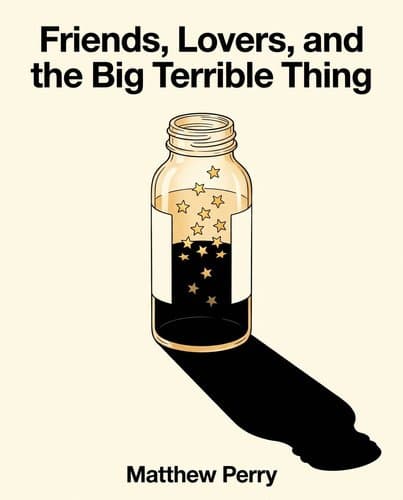
59641216_friends-lovers-and-the-big-terrible-thing
by Matthew Perry
Matthew Perry earned $1 million per episode and his addiction accelerated—because the dream arriving only made the void more visible.
In Brief
Matthew Perry earned $1 million per episode and his addiction accelerated—because the dream arriving only made the void more visible. A brutally honest account of why fame, self-knowledge, and even love cannot fix what only the courage to be truly known can.
Key Ideas
Success cannot heal the deeper wound
Getting what you want does not fix the underlying wound. Perry earned $1 million per episode, was recognized everywhere on earth, and his addiction accelerated. The arrival of the dream can make the void more visible, not less.
Addiction starts as self-medication for pain
Addiction often begins as accurate medicine for a real condition. Perry's first drink genuinely relieved a pre-existing inability to feel normal. Treating addiction as moral failure misses what it was originally solving — and why it's so hard to give up.
Self-knowledge alone cannot cure addiction
Insight without connection changes nothing. Perry diagnosed his own addiction — anhedonia, abandonment wound, fear-of-intimacy relapse trigger — with clinical precision for thirty years while it nearly killed him six times. Self-knowledge is necessary but nowhere near sufficient.
Support systems differ from true healing
External scaffolding (a great job, a sponsor, a spiritual experience) can support sobriety without healing it. When the scaffold falls, so does the person. The scaffold and the cure are not the same thing.
Fear of intimacy triggers relapse cycles
For Perry, the specific mechanism of relapse was the terror of being truly known. Every significant relapse traces to a moment when closeness became threatening. Naming your own trigger does not neutralize it — but it points toward what recovery actually requires.
Who Should Read This
Readers who connect with first-person stories about Memoir and Mental Health and want to see the world through someone else's eyes.
Friends, Lovers, and the Big Terrible Thing
By Matthew Perry & Lisa Kudrow
10 min read
Why does it matter? Because getting everything you ever wanted can be the beginning of the fall.
Perry prayed for fame three weeks before his Friends audition. God delivered — exactly as ordered, on schedule, without irony. That is when things got worse.
The structure isn't struggle, rock bottom, recovery. It's dream, arrival, discovery that the dream was the wrong answer. At $1 million per week, Perry was taking 55 Vicodin a day. He had the girl, the view, the show — and none of it touched the hole. He survived a colon explosion. He woke up and asked for opiates for the pain.
What this book actually argues is harder and stranger: that addiction cannot be outspent, outtherapied, or outloved — only outlasted, one day at a time, alongside someone else who knows exactly what it costs.
You Have to Get Famous to Know It's the Wrong Dream
Two years after actor Craig Bierko stopped speaking to him, he showed up at Matthew Perry's apartment on Sunset Boulevard. The tension was immediate. Bierko had been Perry's closest friend — the man whose punchlines could make Perry pull over on the drive home, still laughing, fifteen minutes after lunch. Two years earlier, standing outside a Fred Segal store in 1994, Bierko had been handed the role of Chandler Bing directly. He turned it down to headline his own show instead. Perry, blocked from auditioning by a contract to play a baggage handler in a sci-fi comedy set in the year 2194, eventually got the part through a bedroom conversation between an NBC producer and her network-executive husband, who could override the casting block Perry's contract had created. By the time Bierko walked back into Perry's life, Friends was the most-watched show on television. Perry was earning $1 million per episode. In London, fans screamed outside hotel windows the way they once screamed for the Beatles.
Bierko apologized. He said he could not handle that Perry had gotten rich and famous doing a role he had personally turned down. Perry listened. Then he said the thing he hated having to say: "It doesn't do what we all thought it would. It doesn't fix anything."
Bierko stared at him. Perry could see he didn't believe it.
That disbelief is the book's first argument. Perry had prayed for fame. Three weeks before his audition, on his knees, he asked God to make him famous and told him to take whatever else he wanted. God took both sides of that bargain seriously. The fame arrived on schedule. The holes it was supposed to fill — the loneliness that persisted whether he was alone or surrounded, the dread that came every Friday night when a live audience might not laugh — stayed. What actually filled the holes was vodka. Perry understood this clearly enough to say it to Bierko's face. Bierko, who had not gotten famous, could not take it in.
"I think you actually have to have all of your dreams come true," Perry writes, "to realize they are the wrong dreams."
Nobody who hasn't gotten everything they prayed for will ever believe it was the wrong prayer. Perry says so himself, and this book is his evidence.
The First Drink Felt Like a Cure, Not a Poison
On a summer evening in Ottawa, fourteen-year-old Matthew Perry and two brothers named Murray drank everything they had in about fifteen minutes: a six-pack of Budweiser and a bottle of white wine called Baby Duck. The Murrays got sick. Perry lay on his back in the grass, looked up at the moon, and felt something he had never felt before: nothing was wrong. Not one thing. He wasn't abandoned, wasn't fighting with his mother, wasn't failing school, wasn't wondering what the point of any of it was. For the first time in his life, the world made sense. He used the word bliss, and meant it precisely.
Read that carefully. He isn't describing the thrill of getting away with something. He's describing relief from a permanent suffering he didn't know other people didn't share.
Clinicians call it anhedonia. Perry called it being fourteen years old and discovering for the first time that the world could stop feeling wrong. He spent years in therapy before he had that word, but the condition reaches back before his first word. At thirty days old, he was colicky, inconsolable; a doctor solved it with phenobarbital. A distressed infant, answered with sedation. Perry would recognize that transaction decades later. For fourteen years after, nothing worked: not classroom disruptions, not the speech pattern he and the Murray brothers invented that would eventually define Chandler Bing. Take tennis. Perry could only win when he was already down 5-1 and sobbing — the stakes had to be catastrophic before anything in him woke up. You could call it competitive spirit. You could also call it anhedonia. The world stayed wrong.
The drink didn't.
Perry didn't repeat it the following night. The disease hadn't gripped him yet. But the moment in the grass was diagnostic: he had found a substance that treated a condition he had been living with his entire life. The question the memoir asks — and actually answers — is not why someone becomes an addict. It's what they were trying to cure.
There Was a Specific Moment When the Door Locked Behind Him
The night of the accident, Perry's neck was bad. He'd been thrown from a Jet Ski on Lake Mead (the entire film crew had watched him ride the thing past its limit, go airborne, and not come back up with it), and now, hours later, he was still filming the birth-of-the-baby scene, the emotional centerpiece of Fools Rush In, on no sleep and a body that hurt everywhere. When they finally wrapped before dawn, a doctor handed him a single pill in a plastic wrapper and told him to take it when he was done. Perry pocketed it.
Then he asked to drive the character's red Mustang convertible back to his rented house in Las Vegas. Somehow they said yes. The desert was turning pink. He put the top down and swallowed the pill.
Here is what he says happened next: something clicked. That's his word — clicked, like a lock. The pill did something no drink had ever done, no applause, no famous girlfriend, no million-dollar movie deal. Total physical warmth, every anxious wire in him suddenly gone quiet. Better than the grass in Ottawa. Better than any late-night audience laughing. And his first thought wasn't relief. It was a decision: even if this killed him, he was doing it again.
He knew. That's the thing. He recognized the door locking in real time, named it, and drove home anyway. The next morning, forty more pills arrived at his house. Eighteen months later, he was taking fifty-five a day, down to 128 pounds, checking into Hazelden.
Addiction is usually explained as a slow accumulation of bad choices. Perry offers a different account: one specific moment when the neurology changed permanently — and knowing it changed nothing at all.
His Father Quit on a Walk. Perry Spent $7 Million and Almost Died Six Times.
Does wanting sobriety badly enough eventually buy it? Perry's father answered that in about forty minutes. After a bad night on the drink, he talked to his wife the next morning, went for a walk, and never drank again. That's the entire story.
Perry's version took $7 million, fifteen rehab stints, six thousand AA meetings, therapy twice a week for thirty years, a coma, and a colostomy bag that broke more than fifty times. He names the thing separating these two outcomes the Big Terrible Thing — something categorical in his neurology that his father simply doesn't carry. The walk worked because his father didn't have it.
He had watched his father pour six vodka tonics every evening, declare the drink the best thing to happen to him all day, then wake at seven the next morning, showered, functional, never missing a thing. Perry adopted the ritual, the drink, the thought. But his father could stop at six. Perry couldn't stop at any number. Something lurked in his genes that only declared itself over a decade of escalation — and once it had, stopping meant medical emergency, not a walk.
Four days into a New York detox (private facility, attentive staff, every resource deployed), off opiates and cigarettes simultaneously, Perry walked into a stairwell in a fugue state and began slamming his head against the wall. Eight times, hard enough to draw blood. He narrated it to himself like a tennis match, his head the ball, the cement the court. When someone stopped him and asked why, he said he couldn't think of anything better to do.
That's not someone who hasn't tried. That's someone who tried everything available and arrived at a stairwell anyway. The therapy, the rehab, the AA meetings were all in play. So was the head against the wall. None of it changed what his brain demanded in that corridor.
His father took a walk. Perry bled on a wall. The difference isn't desire, effort, or money. It's what they were born carrying.
Friends Kept Him Alive — Then It Ended, and He Fell Off a Cliff
Friends didn't cure Perry's addiction. It held his addiction in a shape that could still show up for work. When the show ended, the thing containing the collapse for a decade was gone.
Perry says so without softening it: without Friends, staying off heroin wouldn't have been worth the sacrifice. Not treatment, not recovery. Just a reason to keep the drugs at a level that still permitted functioning, because the job was too good to blow up for narcotics. On the worst days, Cox and Aniston installed a Lifecycle exercise bike backstage so he could ride between takes, burning off enough hangover to speak his lines. He fell asleep on the couch during a scene; LeBlanc nudged him awake one beat before his cue. The audience never noticed. He called himself the injured penguin: someone the flock was holding upright not because he was healing, but because there was still a flock.
January 23, 2004: six keys placed on an empty counter one by one, Chandler's final line delivered — Where? — wrap called after 237 episodes. Everyone wept. Perry felt nothing. Not relief, not the particular sadness of a decade ending, not even the clean numbness that comes from knowing you should feel something. He took a slow walk around Stage 24, the set he'd crossed thousands of times, and waited for something to land. It didn't. He got in his car and drove home past a fifty-foot billboard of his own face. Rich, famous, finished. The man in the car looking up at the man on the billboard felt nothing either. "With no ridiculously high-paying, dream-come-true kind of job to go to," he wrote later, "things slipped fast — it was like falling off a cliff." Within months he was on drugs stronger than anything from the Friends years.
The cliff had been there the whole time. The show had been the ledge. And a ledge is only a problem once you have to step off it.
God Showed Up in His Kitchen — and Two Years Later He Was Back on Drugs
Three men waited by Perry's front door. His father sat in the living room. A sober companion was nearby. They were watching the clock because without the prescription medication his sober companion Moira was supposed to be delivering, Perry could seize and die. What they didn't know was that he had already swallowed eight Xanax the night before — four to chase sleep, then four more when those didn't work — while his father dozed in the next room watching television reruns. By morning the drug had rewired his vision: his gray drapes had turned deep purple, blues had gone electric blue, ordinary black had become the deepest black imaginable. He told his father, completely seriously, that a giant snake was about to arrive and take him away.
When the medication still hadn't come, Perry retreated to a small couch near the kitchen. The shame was physical. He had just relapsed after two years of sobriety, during which he had been sponsoring other men, telling them how to stay clean. He had nothing to give them now. He was staring at the floor when he noticed something: a small crinkle in the air, a shimmer like heat rising off pavement. He prayed the way a drowning man grabs anything solid — asking God to show himself, to confirm he was there.
The crinkle became a light. The light expanded until it filled the entire room. Perry describes what followed as more complete than any drug he'd ever taken: a warmth that started at the crown of his head and moved slowly downward through his entire body, as though something inside him had finally stopped bracing. For the first time in his life, he felt safe. Genuinely safe. He wept for several minutes afterward, not from grief but from the shock of it. He stayed sober for two years on the strength of that single experience. He spent those two years sponsoring other men, standing in church basements, telling them exactly what had happened to him in that kitchen. He thought he finally understood.
The book doesn't let you stop there. Two years later, Perry relapsed again, then again, fourteen rehab stays in total. The golden light was real; Perry is certain of it. He compares it to the founding experience of AA itself: Bill Wilson, the program's co-founder, had his own sudden white-light moment in a New York hospital, and it became the mythology the program was built on. Perry never walks it back. But a peak experience, however genuine, changes what you believe. The mechanism underneath addiction doesn't care what you believe.
The Only Thing That Actually Works Is the Thing He Was Most Afraid Of
Imagine a man allergic to the cure. Not to the medicine itself — to the mechanism: the part where someone gets close enough to see what's actually in there. That terror is the thread connecting every relapse in this book.
He commissioned a painting for the woman he'd been texting for four years — 1,780 messages total, each one rendered as a heart by the artist, all pressed into one enormous heart surrounding the two of them. He planned to give it and propose. She received it, teared up, said something about her little heart. The moment was right. He opened his mouth. Fear arrived: he snapped into his Chandler Bing bit (the overemphatic joke voice he defaulted to whenever something real threatened to land), made a joke about the painting, and the question never came. The relationship lasted two more years after that, sexless and hollow, until he understood why. The closer she got, the more certain he was she'd eventually see the real version and leave. He decided to lose her first. A man who had spent what an artist charges to encode every message into a single image still couldn't say four words out loud.
That mechanism — intimacy breeds terror, terror produces sabotage — runs unchanged from his first relationship to his last.
What broke the cycle, when it finally broke, had nothing to do with insight, the right medication, or the woman from the painting. After the colon rupture that almost killed him — two percent survival odds, five months in the hospital — a woman from his recovery circle named Erin stayed at his bedside the entire time. He had whispered "don't leave me" early in his recovery. She took that seriously. She knew what she was looking at and stayed anyway.
That is the only thing that has ever worked. Not a treatment — a person willing to be present to the worst of it and remain. Perry ends the book saying no one defeats addiction alone. The way through is with people who know what they're looking at and choose to stay. The thing he spent thirty years running from was the only cure.
What Survival Looks Like When It Isn't Triumph
There is a version of this ending where Perry rises above it all — the surgeries, the sobriety, the spiritual awakening, the hard-won lessons. That version is not this book. This one ends on a patio facing the Pacific, a man with a stomach that looks like a relief map and fourteen surgeries behind him, still negotiating with cigarettes, still genuinely uncertain about tomorrow. He survived a disease that killed his friend Chris Kessel at 34, that nearly killed him six separate times, that took $7 million and still wasn't satisfied. He did not beat it. He is outlasting it, one day, then another. That is the distinction Perry earns the right to make across 300 pages: not triumph, but persistence chosen daily against something that would genuinely prefer you dead. You have probably heard cleaner endings. Almost none of them are as honest as this one.
Notable Quotes
“It's amazing that you're alive,”
“Your resiliency is incredible. And with some life changes, you're gonna be OK. And they can remove the colostomy bag in about nine months.”
“Are you ready to hear what happened?”
Frequently Asked Questions
- What is Friends, Lovers, and the Big Terrible Thing about?
- Matthew Perry's memoir traces forty years inside addiction, showing how fame, wealth, and romantic love all failed to fill an underlying wound. The book demonstrates why self-knowledge alone cannot produce recovery and explores what role genuine human connection plays as the cure. Perry earned $1 million per episode and achieved worldwide recognition, yet his addiction accelerated. The memoir argues that getting what you want does not fix the underlying wound — the dream can make the void more visible, not less. Through his journey, Perry reveals how addiction often begins as accurate medicine for a real pre-existing condition.
- What are the key takeaways from Friends, Lovers, and the Big Terrible Thing?
- The memoir presents several crucial insights about addiction and recovery. First, achievement doesn't resolve underlying wounds; Perry's million-dollar salary and global fame accelerated his addiction. Second, "addiction often begins as accurate medicine for a real condition" — Perry's first drink genuinely relieved an inability to feel normal. Third, "insight without connection changes nothing" — Perry diagnosed his condition with precision for thirty years while it nearly killed him six times. Finally, recovery requires genuine human connection rather than external scaffolding like jobs or spiritual experiences. The specific mechanism of his relapses was "the terror of being truly known" — when closeness became threatening, relapse followed.
- Why does Matthew Perry say self-knowledge alone cannot fix addiction?
- Perry diagnosed his addiction — anhedonia, abandonment wound, and fear-of-intimacy — with clinical precision for thirty years while it nearly killed him six times. Despite this detailed self-knowledge, insight without connection changes nothing. The book argues that external scaffolding like a great job, sponsor, or spiritual experience can support sobriety without healing it. When the scaffold falls, so does the person. Perry's recovery required more than understanding his triggers; naming your own trigger does not neutralize it. True recovery points toward what Perry actually needed: genuine human connection. Self-knowledge is necessary but nowhere near sufficient for overcoming addiction.
- What role does human connection play in recovery according to Friends, Lovers, and the Big Terrible Thing?
- Genuine human connection emerges as "the one thing addiction cannot survive" in Perry's memoir. For Perry specifically, the terror of being truly known — of allowing closeness — was the mechanism driving relapse. Every significant relapse traced to a moment when closeness became threatening. This reveals that recovery requires more than external supports or self-awareness; it demands the vulnerability of being genuinely known by others. Perry shows how the specific fear of intimacy must be overcome through actual connection rather than managed through isolation. The book argues that addiction thrives in secrecy and disconnection, making authentic human relationships essential to sustained recovery.
Related Book Summaries
Read the full summary of 59641216_friends-lovers-and-the-big-terrible-thing on InShort