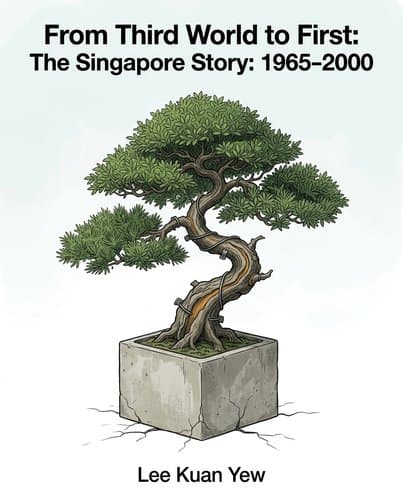
144409_from-third-world-to-first
by Lee Kuan Yew, Henry Kissinger
A founding father's unflinching account of transforming a resource-less island into a global economic powerhouse through calculated pragmatism, ruthless…
In Brief
From Third World to First: The Singapore Story: 1965-2000 (2000) is Lee Kuan Yew's firsthand account of building Singapore from a resource-poor post-colonial island into one of the world's wealthiest nations. It traces the strategic decisions, alliances, and hard trade-offs behind that transformation, offering readers a masterclass in pragmatic governance, institutional discipline, and the realities of statecraft under constraint.
Key Ideas
Dependencies undermine structural safety assumptions
Security is always borrowed — Singapore's post-independence stability rested on a British military presence that was itself conditional on an American currency subsidy. Map your actual dependencies before assuming your safety net is structural.
Real costs persist beyond outcomes
Moral compromise in service of stability is still moral compromise — LKY supported the Khmer Rouge at the UN, caned an American teenager, arrested newspaper editors, and merged a university against its community's will. The book asks you to evaluate outcomes, but it doesn't let you pretend the costs weren't real.
Ritual precedes institutional relationships
Trust between leaders is personal and ritualistic before it is institutional — the most durable relationship LKY built (with Suharto) began not with a treaty but with a Javanese graveside gesture. The format of the empat mata meeting — no interpreters, no note-takers, in Malay — was as important as its content.
Irreversible commitment forces successful execution
Set the objective, then make the irreversible decision — the Changi gamble, the SIA founding dinner, the Suppiah confrontation all share the same structure: LKY stated the outcome required, appointed executors who believed it, and made a commitment that foreclosed retreat.
Ally-judgment exposes hidden ideology
The standard you apply to your allies reveals more than the standard you apply to your enemies — LKY's more forgiving read of Tiananmen versus his critique of Japanese historical revisionism is the book's most instructive blind spot. Realism has its own ideological commitments.
Institutional culture enables pragmatism's survival
Pragmatism without a successor is just a personality — LKY's core cabinet team staying together for 20 years and telling him when he was wrong was essential to avoiding megalomania. The harder question the epilogue raises is whether that culture survives after the founding generation.
Who Should Read This
History readers interested in Political Figures and Memoir who want a deeper understanding of how we got here.
From Third World to First: The Singapore Story: 1965-2000
By Lee Kuan Yew & Henry Kissinger
10 min read
Why does it matter? Because the Singapore you think you know — the clean streets, the Changi terminal, the economic miracle — was built on choices that liberal democracies would never survive making.
Most people who cite Singapore as a success story can't tell you exactly how it succeeded — only that it did, and that there's something distinctly Asian about the discipline involved. What Lee Kuan Yew actually did, from 1965 to 2000, was make a sequence of specific, ugly, often unpopular choices — about which language a nation would speak, which unions would be broken, which military withdrawal could be survived, which democratic norms were luxuries a city-state without a hinterland simply could not afford. None of it was cultural destiny. All of it was decision. This is the account of a man who was genuinely in the room when those decisions were made, and who has, at last, stopped pretending any of it was comfortable.
The British Shield Was a Currency Trade, Not a Commitment
Singapore's independence in 1965 looked like a political achievement. It was really a financial arrangement that could have collapsed with the next British election. George Brown, Britain's Foreign Secretary, made this plain to Lee Kuan Yew over lunch at a Socialist International conference in Stockholm: the Americans were propping up an overvalued pound on the explicit condition that British troops stayed east of Suez. Remove the troops, lose the dollar support, watch the pound fall. Harold Wilson's decision to keep 50,000 soldiers in Singapore and Malaysia wasn't strategic calculation — it was a currency trade, brokered by Lyndon Johnson, dressed up as commitment.
Brown told Lee he was personally in favor of pulling out, that he was in the minority but intended to keep pushing. He was right on both counts. When Britain's domestic budget pressures eventually won, Wilson announced a phased withdrawal — 25,000 troops first, the rest by 1971 — framed as fiscal responsibility, not strategic retreat. For Lee, this wasn't an abstraction. British military spending accounted for roughly a fifth of Singapore's entire GDP. The bases weren't just a security guarantee; they were the economy.
What Lee did with that knowledge matters as much as the knowledge itself. When a British official suggested that abandoned military airfields might revert to agriculture, Lee rejected it without hesitation. He chose industrialization — converting the Sembawang naval dockyard into civilian use through a partnership with the British shipbuilder Swan & Hunter. The British shield had always been Johnson's financial convenience, Wilson's budget arithmetic. The only durable security was making yourself too economically useful to abandon.
You Can't Build a Nation While the Unions Are Running It
K. Suppiah told Lee Kuan Yew to let the union be broken by Mr. Lee if that's what it came to. He said it in 1967, in the middle of a 40-minute argument that Singapore's prime minister knew could not end in compromise. Suppiah ran a federation representing 15,000 daily-rated government workers, most of them Indian nationals who'd arrived on work permits. Lee told him directly: if your people strike, those 7,000 permit-holders lose their jobs and go back to Madras. Suppiah said he'd counted heads and only 2,000 or 3,000 were on permits, then called the strike anyway. On February 1st, 2,400 sanitation workers walked off the job. The government's response was immediate and surgical: the strikers had, the official declaration said, sacked themselves. Anyone wishing to be reemployed could apply the next morning. By the following day, ninety percent had lined up to ask for their own jobs back.
What Suppiah had misread wasn't Lee's willingness to fight. It was the underlying arithmetic. Singapore in 1967 had 30,000 school-leavers entering the job market every year [verify against source]. The government needed foreign investment, and foreign investment needed certainty that the rules wouldn't change when a union boss felt stubborn. The Employment Act of 1968 codified the result: hiring, firing, and promotions became management prerogatives. Unions lost the ability to treat those decisions as bargaining chips.
But the move that turned out to matter more wasn't the confrontation — it was what came after. Rather than leaving the unions gutted and resentful, Lee pushed to transform the National Trades Union Congress into something stranger: a business. Under new leadership, the NTUC launched cooperatives in taxis, supermarkets, and insurance. A union leader running a taxi cooperative doesn't want instability any more than a foreign investor does. The genius of this is that it didn't defeat labor as an interest — it changed what labor's interests were. He hadn't negotiated a truce between development and organized labor. He'd redefined which side the union was on.
The Language You Choose Is the Future You're Building
When Nanyang University opened in 1956, funded partly by trishaw riders who donated a day's wages, it represented something genuinely moving: a working-class Chinese community building its own institution, preserving something it feared would be erased. By 1978, Lee had merged it into the University of Singapore over the community's anguished objections. The reason was almost banal in its practicality: Nantah graduates couldn't find work. Their Mandarin education had produced people the English-speaking economy had no use for. When Lee surveyed the students themselves — asking whether they wanted a Nantah degree, a University of Singapore degree, or a joint credential — the overwhelming majority chose the University of Singapore. The community that had wept over the merger was not, it turned out, representative of the students it claimed to protect. The market had already rendered its verdict. Lee just made it official.
He performed a more deliberate kind of theater at home. All three of his children attended Chinese-language primary schools, which he used as a public shield against accusations that English-first policy meant cultural extinction. Meanwhile, English was the language of his household. The point wasn't hypocrisy — it was that he understood the difference between cultural symbol and economic instrument, and he was managing both simultaneously.
This is where the model becomes genuinely uncomfortable to defend. It worked — Singapore's bilingual graduates are among the most economically mobile people on earth, and the resentment over Nantah has faded into history. But what made it work was a government willing to override a community's stated preferences about its own culture, confident it knew better than that community what its children would need. In a liberal democracy, that confidence gets checked by elections, by courts, by newspapers. Lee had all three institutions and he managed all three — the arrests of editors, the constituency boundaries redrawn before inconvenient votes. That's what the success story skips.
A Gesture at a Graveside Was Worth More Than Any Treaty
In May 1973, Lee Kuan Yew walked through a military cemetery in Jakarta, paid his respects at the graves of generals killed in a 1965 coup attempt, then did something that had been negotiated almost as carefully as a trade agreement: he stopped at two other graves and scattered flowers on them. The men buried there were Indonesian marines Singapore had hanged in 1968 for a bombing they'd carried out during Sukarno's campaign to strangle the young nation. The executions had been legally defensible and diplomatically catastrophic — Jakarta's mobs sacked the Singapore embassy, and the bilateral relationship nearly bled out. What Lee's advisors told him, relaying the view of Indonesian generals, was that before any genuine friendship with President Suharto was possible, the episode needed to be closed through a gesture that addressed Javanese beliefs about souls and conscience. You couldn't resolve it with a communiqué. You had to show up at the grave.
The flowers worked. Within that same visit, Lee sat alone with Suharto for more than an hour — no interpreters, no note-takers, just the two of them talking in Malay, what Suharto called empat mata: four eyes. Lee found him the precise inverse of Sukarno. Where Sukarno had been theatrical and oratorical, Suharto was quiet and consistent, a man who projected humility while making clear he would not be moved from anything he'd decided. Lee trusted him immediately. The private meetings became the structural foundation of a relationship that would last decades, because what Suharto wanted to know — and what the ceremony at the cemetery had communicated before a word was spoken — was whether Singapore would deal with him as an equal or operate as a calculating outsider who needed to be watched.
The Changi Gamble: How a Hunch Became Asia's Largest Airport
In April 1975, Lee was in Washington when a letter reached him from his acting prime minister Goh Keng Swee. The committee had concluded that Singapore's new airport should be built at Changi, on reclaimed land, at a cost of S$1.5 billion. British aviation consultants had already recommended the cheaper option: a second runway added to the existing Paya Lebar facility. Lee had seen Logan Airport in Boston and noticed how its flight paths ran over water, not over the city. A second Paya Lebar runway would direct aircraft straight over Singapore's urban center. He'd asked for Changi to be reconsidered, and now the answer was on his desk.
Also on his desk that same week: the fall of Saigon. South Vietnam had just collapsed. Growth across Southeast Asia was expected to slow. The case for a S$1.5 billion bet on reclaimed swampland — requiring the demolition of hundreds of structures, the exhumation of thousands of graves, and the write-off of over S$800 million already sunk into Paya Lebar — had just gotten harder to make. Lee sent back one word of direction: proceed.
Changi opened in 1981, six years after that message, against a standard construction timeline of ten years. Lee had picked two men — Howe Yoon Chong and Sim Kee Boon — and given them an objective with no negotiable finish line.
The model wasn't bravado. It was a specific theory of how decisions actually get made: you set the objective with total clarity, you appoint someone who won't stop, and you accept that the uncertainty you're waiting to resolve will never fully arrive. Changi became Asia's largest airport. The consultants' runway would have become a noise problem.
America Was Indispensable, Which Made It Dangerous
Singapore's non-alignment was a costume, not a conviction. Lee needed his neighbors to believe Singapore wasn't an American client state, which meant the actual architecture of security had to stay out of view. Managing that gap — between the performed independence and the real dependence — required the same cold skill as managing a patron capable of either protecting you or consuming you.
The danger announced itself early and undiplomatically. In 1961, CIA operatives approached a Singaporean Special Branch officer with an offer calibrated to be irresistible: an extraordinary salary, guaranteed extraction for his entire family if anything went wrong, and a future secured in America. The officer spent three days thinking it over before deciding to tell his superiors. Lee's response was immediate — set a trap. When agents showed up at an apartment on Orange Grove Road to run a polygraph test on their new asset, Singapore's security forces were waiting. Three Americans were caught with enough evidence to put them away for a dozen years. One claimed diplomatic immunity. The others were quietly expelled.
Lee sat on the private apology letter Dean Rusk sent afterward, then deployed it years later as a public weapon when relations soured again over something else entirely. What stayed with him wasn't the embarrassment of the incident — it was what it revealed about how Americans thought. They had been purchasing officials across Vietnam and elsewhere with such regularity that they'd stopped questioning whether the method applied everywhere. A patron who can't distinguish between clients it buys and partners it needs will eventually misuse both.
And yet — this is the part that has no comfortable resolution — Lee concluded that the United States was irreplaceable. Only Washington had the reach and will to slow communist expansion across Southeast Asia. The Vietnam War, which most of the world read as American aggression or folly, Lee read as time purchased for the rest of the region to stabilize. Singapore's prosperity was built inside that window. Non-alignment wasn't a lie exactly; it was a signal sent to neighbors who needed to believe Singapore wasn't already spoken for. The Americans provided the umbrella. Lee's job was to stand in the rain just convincingly enough that no one asked to look up.
Tiananmen Tells You Everything About How LKY Reads Power
Lee Kuan Yew was watching satellite television when he made up his mind about Tiananmen. The scene that did it wasn't the tanks — it was the students. There they were in jeans and T-shirts, crowded into the Great Hall of the People, openly mocking Premier Li Peng, who sat across from them in an immaculately pressed Mao suit. They were scoring points off him. Lee watched this and concluded immediately: it would end in tears. Not because he was rooting for Li Peng, but because he understood the internal logic of the system he was watching. No ruler of China survives that kind of public humiliation and continues to rule. The only variable was what form the ending would take.
When the tanks came on June 4th, Lee issued a statement calling the force used 'disproportionate.' He never went further than that. The West expected absolute condemnation. Lee's defense of Deng Xiaoping has since been read as an authoritarian's sympathy for another authoritarian. The actual argument was narrower and more interesting: Deng had lived through revolution twice, had been purged twice, and knew from experience — not from books — what the early signs of collapse looked like. When Deng looked at students mocking government officials on national television, he saw something specific: a danger that could paralyze China for another century. Gorbachev, Lee argued, had only read about revolution. He didn't recognize the same signals when they appeared in Moscow, and the Soviet Union dissolved around him.
But the book buries the contradiction it doesn't name. Elsewhere, Lee criticizes Japanese leaders for leaving the years 1937 to 1945 essentially blank — treating wartime atrocities as something to be quietly omitted rather than confronted. He argues this creates a permanent curtain of suspicion across Asia, the kind the Germans dissolved through public reckoning and explicit apology. The standard he applies to Tokyo is unforgiving. The standard he applies to Beijing is not. Whether that difference reflects strategic necessity, genuine conviction, or something Lee declined to examine in himself, the book doesn't say. He never quite explains the gap.
The Nation Is More Fragile Than the Island
What happens to a system built around one man's judgment when that man is gone?
Lee's own epilogue doesn't dodge this. He admits that if he and his colleagues had understood the real difficulty of what they were attempting in 1954 — the hazards, the odds, the sheer complexity — they would never have started. What pushed them forward wasn't calculation. It was something more visceral than cerebral: they wanted the British out, and the want was stronger than the fear. That confession sits strangely at the end of a career defined by cold-eyed realism. The man who applied an acid test to every theory, who sent teams abroad before building an airport or redesigning a school curriculum, who almost never made the same mistake twice — that man is admitting that the whole enterprise began in something closer to passion than analysis. The acid test, it turns out, came second.
The Suharto arc runs across the same pages like a shadow epilogue Lee never names as such. He spent twenty-five years building personal trust with Indonesia's strongman through private meetings, careful ceremony, and a shared grammar of Malay pragmatism. Then Suharto's children moved through the economy like a wrecking crew, and the edifice came down. What broke market confidence during the 1997 crisis wasn't any structural flaw in the bilateral relationship Lee had built. It was the logic of paternalistic power itself: authority that was real but whose inner circle was answerable to no one. Lee watched it collapse and diagnosed the disease with precision. The question he leaves unasked is whether his own Singapore — shaped so thoroughly by his singular judgment and force of personality — carries the same vulnerability. The island will not disappear, he writes. The sovereign nation could. He means external pressure. The reader is entitled to wonder if he also means what happens when the person who held it all together by the force of his own clarity is simply gone.
What the Island Cannot Guarantee
Here is what stays with you after 600 pages: Lee Kuan Yew, the man who bent institutions to his will and called it necessity, ends not with a declaration but with a condition. The island persists. The nation is another matter. He built something extraordinary out of raw pragmatism and personal force — and then, in the epilogue, quietly admits that force was the foundation, not the structure. The unease under that admission is specific: the rules that made it work were never written down. They lived in him. Every irreversible decision he made assumed a successor who would know, without being told, which rules were load-bearing and which were theater. He never quite solved for that. Neither has anyone else. The if at the end of his memoir isn't a rhetorical flourish. It's the one variable he couldn't control, and he knew it.
Notable Quotes
“The Howard Doctrine—the PM himself embraces the term—sees Australia acting in a sort of 'deputy' peacekeeping capacity in our region to the global policeman role of the U.S.”
“There is no need for any country to play a role as leader, commander or deputy. They [Australians] are not sensitive to our feeling.”
Frequently Asked Questions
- What is From Third World to First: The Singapore Story about?
- This 2000 memoir is Lee Kuan Yew's firsthand account of transforming Singapore from a resource-poor post-colonial island into one of the world's wealthiest nations. It traces the strategic decisions, alliances, and trade-offs that shaped Singapore's rise. The book examines pragmatic governance, institutional discipline, and the realities of statecraft under severe constraints. Rather than presenting an idealized narrative, it candidly discusses the moral compromises made in pursuit of stability—from caning an American teenager to supporting the Khmer Rouge at the UN. The work offers readers essential insights into how countries navigate geopolitical vulnerability through hard strategic choices.
- What does the book teach about the nature of national security?
- Security is always borrowed—Lee Kuan Yew emphasizes that Singapore's post-independence stability rested on a British military presence that was itself conditional on an American currency subsidy. The lesson is stark: map your actual dependencies before assuming your safety net is permanent or reliable. This insight extends beyond Singapore's specific circumstances to challenge readers to examine hidden vulnerabilities beneath apparent stability. Nations must understand the conditional nature of their security arrangements and build resilience accordingly. The book reveals that geopolitical security depends on fragile chains of allied interests rather than ironclad commitments, fundamentally reshaping how we assess national vulnerability.
- How does Lee Kuan Yew address the moral costs of Singapore's development?
- The book doesn't claim that Singapore's rise was achieved through purely ethical means. Lee Kuan Yew supported the Khmer Rouge at the UN, caned an American teenager, arrested newspaper editors, and merged a university against its community's will—all in service of what he deemed necessary for stability. The memoir asks readers to evaluate outcomes against intentions without pretending the costs weren't real. This moral ambiguity is central to understanding pragmatic governance: LKY presents his choices as necessary trade-offs rather than vindicated decisions. The book challenges readers to grapple with whether stability achieved through repression constitutes legitimate statesmanship.
- What does the book reveal about personal relationships in statecraft?
- Personal trust between leaders matters more than formal institutions in international relations. Lee Kuan Yew's most durable relationship—with Indonesian President Suharto—began not with a treaty but with a Javanese graveside gesture. The format of their empat mata meetings proved as important as the content: no interpreters, no note-takers, conducted in Malay rather than English. This intimacy created trust that transcended official channels. The book suggests that great statesmen succeed partly through ritual, personal rapport, and the ability to operate outside bureaucratic structures. These informal bonds often prove more reliable than formal agreements.
Related Book Summaries
Read the full summary of 144409_from-third-world-to-first on InShort