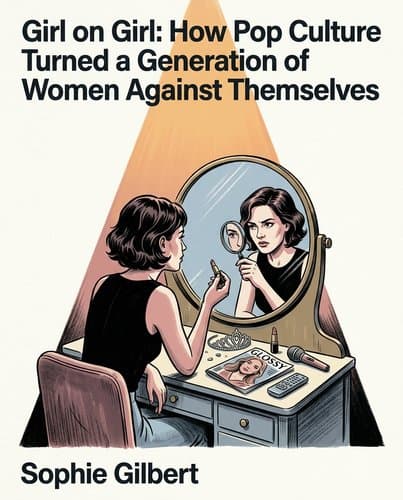
216970860_girl-on-girl
by Sophie Gilbert
Pop culture didn't just objectify women between 1999–2024—it conscripted them into objectifying themselves, hijacking feminist language like 'empowerment' and…
In Brief
Pop culture didn't just objectify women between 1999–2024—it conscripted them into objectifying themselves, hijacking feminist language like 'empowerment' and 'choice' to neutralize collective action. Gilbert exposes how makeover shows, girlboss culture, and Instagram filters are political instruments designed to keep women monitoring themselves instead of organizing.
Key Ideas
Commercial Feminism Replaces Political Organizing
When feminist language (empowerment, choice, liberation) appears in a commercial product — a pop group, a self-help book, a reality show — ask what political demand it is replacing, not what it is expressing. Gilbert's through-line is that postfeminism doesn't oppose feminism; it mimics it well enough to make organizing feel unnecessary.
Self-Monitoring Appearance Reduces Political Participation
Self-objectification is not a private psychological quirk — research cited by Gilbert shows it directly reduces political participation. The more women are trained to monitor their own appearance, the less bandwidth they have for collective action. This makes the makeover show and the Instagram filter political instruments, not just aesthetic ones.
Humor Deflects Critique, Harm Accumulates
The 'it's just a joke' defense — deployed by Terry Richardson, American Pie, The Swan's producers, Perez Hilton, and the Spice Girls alike — is a mechanism for making critique feel humorless while the harm accumulates. Gilbert's method of taking the joke seriously is itself a form of resistance.
Individual Hustle Marketed as Structural Solution
The girlboss framework and the MLM pitch share a structure: they locate the problem of structural inequality inside the individual woman (she needs to lean in, hustle harder, build her downline) and sell the solution back to her as a product. When a feminist argument ends in a purchase recommendation, follow the money.
Pop Culture Predicts, Not Mirrors, Politics
Pop culture is not a mirror of politics — Gilbert argues it is a predictor. The hostility directed at women who claimed space in music, film, comedy, and fashion between 1999 and 2016 made the political outcomes of those years legible in retrospect. Watching how culture treats women who want power tells you something about what elections will do with them.
Who Should Read This
History readers interested in Social Issues and Cultural Studies who want a deeper understanding of how we got here.
Girl on Girl: How Pop Culture Turned a Generation of Women Against Themselves
By Sophie Gilbert
12 min read
Why does it matter? Because the culture that shaped you was running a con — and the con was designed to look like liberation.
Three images from 1999: a sixteen-year-old Britney Spears on pink satin, clutching a Teletubby like a permission slip for what was being done to her. A woman's naked body projected sixty feet high onto the seat of government, without her knowledge, as a joke. A film about a man's lust for a teenage girl winning every prize culture had to offer. If you were a girl watching, the lesson wasn't subtle — power was sexual, temporary, and belonged to whoever was looking. Sophie Gilbert's Girl on Girl asks the harder question underneath that lesson: what happens when women don't just accept that arrangement, but begin enforcing it on themselves and each other? When choice becomes the alibi, irony becomes the anesthetic, and the language of liberation gets repackaged and sold back to you as freedom? That's the reckoning this book is after.
Power Was Sexual, Youth-Dependent, and Ultimately a Punchline You Were In On
In 1991, Kathleen Hanna and Tobi Vail were sitting together in Olympia, Washington, brainstorming a name for their next punk zine. Hanna had been reading Carol Gilligan's research on how adolescent girls lose confidence under social pressure and wanted a phrase that collided girlhood with something it wasn't supposed to touch. Vail said: "Power." Girl Power. The phrase went into their zines, into their shows, into a manifesto demanding safe spaces for women at live events and visibility for women artists — at a time when Hanna was drawing on experiences that included an abusive father, a rape by a trusted friend, and years spent watching her peers absorb violence in silence. The politics were not decorative.
By 1997, the same two words appeared on the cover of a glossy book published by the Spice Girls, a group assembled by a father-and-son producer team through a trade-paper audition call. Inside, Victoria Beckham announced that the group's ambition was to become "a household name. A Fairy Liquid or Ajax." Sociologist Jessica K. Taft, studying the phenomenon in 2004, found that the Spice Girls' version of Girl Power had been deliberately constructed to replace feminism with something that would make no movement toward social or political change — built on individual choice, consumer spending, and an ideology as malleable, in Taft's description, as Play-Doh.
Gilbert frames these substitutions as deliberate — and uses 1999, the year she turned sixteen, as the proof of concept. At sixteen, she didn't read any of it critically. What she absorbed instead was the lesson these texts were collectively teaching: that power for women was sexual in nature, youth-dependent, and contingent on being willing to play along with the joke, even knowing you were the punchline.
That absorption had measurable consequences. The more women engage in self-objectification — treating themselves as bodies to be assessed by others — the less likely they are to pursue activism or collective change. What passed for empowerment, in other words, was precisely calibrated to neutralize the thing it claimed to celebrate.
The Same Trick, Repeated Across Every Medium: Co-opt, Commercialize, Redirect
In music, it runs from Hanna's zines to the Spice Girls in roughly five years. In fashion, it runs from Madonna's 1992 book Sex — a genuinely disruptive work where a woman controlled the terms of her own sexualization — to Terry Richardson's 2004 Terryworld, a sixty-dollar Taschen coffee-table book whose most reliable subject was the photographer's own erect penis, sometimes pressed against the hair of a seemingly unconscious model. Richardson described his mission openly: he didn't want to work in porn because fashion let you reach a mainstream audience. That was 'the most subversive thing,' he said — 'to be out in the mainstream and get away with it.' What he was getting away with, he also told a magazine, was shooting campaigns where 'every person there fucked someone.' He said it like a brag. Condé Nast kept hiring him for thirteen more years.
The cover the industry kept reaching for was irony. Terryworld wasn't porn or fashion photography, its promotional material insisted — it was a 'hybrid of all three that kept insisting it was also a big joke.' The same defense ran through Abercrombie and Fitch's 1999 Christmas catalog, which packaged softcore imagery, oral-sex references, and an interview with a porn actress for a consumer base aged thirteen to eighteen — and watched sales increase sixfold. The joke framing did specific work: it made critique seem humorless, made the people who objected look like they didn't understand art, and kept the actual commercial transaction — women's bodies converted into product revenue — invisible inside the punchline.
What changed between Hanna's zines and Richardson's coffee-table book wasn't the underlying power structure. The same people retained control over how images of women were made and sold. What changed was the packaging: transgression became the brand, and the brand became the point. By the early 2000s, as Gilbert observes, sex wasn't subcultural anymore — it was culture. The women who'd briefly occupied space in it, demanding it operate differently, had been replaced by a version of themselves that was easier to monetize.
The mechanism is always the same: radical female energy appears, commercial interests recognize its power, and it gets converted into a product that sells objectification back to women as liberation. Once you see it, you can't stop seeing it.
American Pie Invented Nonconsensual Image Sharing Before Anyone Had a Name for It
What the movie doesn't want you to dwell on: Nadia never knew she was being watched until it was too late, faced zero consequences from the boys who filmed her, and was immediately shipped back to the Czech Republic in disgrace — while Jim, who set up the webcam, sent the link, and invited her into his room under false pretenses, was considered to have suffered enough through his own public embarrassment. The humiliation was his story. Her destroyed reputation was the punchline.
Gilbert's reading of this scene is precise and unsettling. Kevin is the one who leans forward when Jim asks rhetorically whether he could broadcast a girl's naked body over the internet, eyes lighting up: "You can do that?" The logic that follows is peer pressure dressed as courage — if you can't photograph a girl without her knowledge, how do you expect to sleep with one? The webcam gets set up. The link gets forwarded. And then, through a mailing-list error, Nadia undresses in front of the entire high school rather than just the boys who'd appointed themselves her secret audience. The movie treats this as Jim's catastrophe. Nadia vanishes from the narrative.
What Gilbert identifies is something the filmmakers couldn't have fully named in 1999: an unwitting origin story for revenge porn. The idea that private images could detonate publicly, spreading across networks with no possibility of recall, hadn't crystallized yet as a concept. The genre of websites that would later monetize exactly this violation — intimate images shared without consent, organized around male grievance — was still a few years away. But the underlying doctrine was already fully formed on screen: girls are the gatekeepers of sex, withholding what men are owed, and their private bodies are therefore fair game for surveillance. The boys suffer social embarrassment. The girl bears the actual cost.
That doctrine had a terminus point: Elliot Rodger's 2014 manifesto reads like a catalog of everything mainstream cinema had promised him, and when the world didn't deliver, he killed six people in Isla Vista. The fuller accounting of how that promise metastasized into political reality belongs later. But it starts here, in a dorm room, with a webcam and a mailing list and a girl who had no idea she was already inside someone else's story.
Reality Television Didn't Show You Women — It Trained You to Surveil Them
Start with Jennifer Ringley: a nineteen-year-old computer science student who in 1996 pointed a webcam at her dormitory room and uploaded the footage every few minutes to her website. Her intention was radical in its ordinariness — just a life, unfiltered. She ate, slept, worked, occasionally had sex. She told Ira Glass she felt most alone when the camera was off. By the time she was pulling in several million daily visitors, roughly ninety percent of them were men, hundreds writing every day to solicit her hair clippings or private photographs. The parasocial relationship her audience had built around her wasn't sustained by the banal footage she was proud of. It was sustained by the long-odds possibility that she'd do something sexual while they watched. When she did sleep with someone — a man engaged to someone else, as it happened — the Washington Post called her a "redheaded little minx" and an "amoral man-trapper." She kept the relationship going longer than she wanted to, terrified of what ending it publicly would cost her. The woman who had spent years performing radical authenticity was, for the first time, performing for the cameras.
That arc — woman seeks visibility on her own terms, discovers the terms were never hers — became the operating logic of an entire industry. What Ringley pioneered accidentally, reality television industrialized deliberately. And its most insidious move wasn't showing women at their worst. It was teaching women to watch themselves through the same appraising lens.
Gilbert names this through her own life. Working restaurant shifts while saving for graduate school, she noticed something she couldn't unfeel: the smaller she got, the more tips she received. Being thin seemed to summon rewards from the universe, she writes, "even if none of them was happiness." Reality TV was running that same logic as programming — makeover shows and cosmetic-surgery pageants delivering one message on loop: your exterior is your economic asset, and it requires constant, costly maintenance. The Swan told women that undergoing a dozen procedures and months of isolation from their families might still leave their bodies "found lacking" by a panel of judges.
What you were being trained to do, without anyone announcing the curriculum, was surveil yourself the way the camera surveilled others — to internalize the gaze so thoroughly that it felt like your own judgment. Gilbert's argument carries real grief: the audience wasn't passive. We watched, and we adjusted, and we called it self-improvement.
When the Pornographic Gaze Became the Default Lens, Abu Ghraib Was the Result
In 2004, photographs from Abu Ghraib began circulating — hooded Iraqi prisoners stacked in human pyramids, a female soldier pointing and grinning at a man forced to masturbate, Charles Graner kneeling over a tortured corpse with a cheerful thumbs-up. That's when Terry Richardson named, without meaning to, what had actually happened. His response wasn't revulsion. It was recognition. Writing in Terryworld, he observed that the images from Iraq, with a twenty-year-old woman directing prisoners for the camera, came from porn. This, he argued, was simply the new normal: people with cameras documenting control, circulating the evidence among friends, regardless of what cruelty the images revealed.
He wasn't wrong about the visual grammar, even if he was catastrophically wrong about its implications. The soldiers at Abu Ghraib weren't consciously making pornography. They were expressing dominance in the only visual language their culture had thoroughly taught them — the language in which bodies exist to be arranged, humiliated, and photographed as proof. Gilbert's argument is that a grammar this pervasive stops feeling like a grammar. It just feels like reality.
One prisoner got nicknamed after a porn legend. An army captain was caught secretly filming female subordinates in the shower. The entire atmosphere, investigators found, was chaotic, aggressive, and wildly sexualized. A culture that had spent a decade mainstreaming the visual dehumanization of bodies — through gonzo porn's 'how far we can take it' aesthetic, through fashion photography's ironic degradation — had trained people in exactly this: that sexualized cruelty is a register of power, and power is its own justification. Abu Ghraib wasn't an aberration. It was a fluency test.
The Celebrity-Destruction Machine Ran on Female Suffering and Called It Entertainment
The gossip machine didn't run on celebrity scandal. It ran on something more specific: the spectacle of famous women visibly falling apart, delivered in real time, framed as entertainment you'd earned the right to consume. That framing is the thing worth sitting with.
In 2007, the photo agency X17 was generating an estimated three million dollars a year from Britney Spears coverage alone — roughly a quarter of the company's entire revenue. Their photographers would lie on the ground outside nightclubs to capture upskirt images of women stepping out of cars, then sell what amounted to nonconsensual pornography to blogs that published it without pixelation and without consequence. When Perez Hilton — whose site logged sixty million page views the month Lohan was arrested — was asked whether the stars were being violated, he insisted they enjoyed the attention. The people pointing telephoto lenses at women's genitalia were just giving the public what it wanted. And here's what makes this so difficult to look at directly: they were right. The clicks were real. The appetite was real. You and I were part of it.
What that appetite had been conditioned by matters. After 9/11, Americans needed somewhere to put their anxiety, and the media industry was ready with a product: beautiful, famous women publicly disintegrating. Not as tragedy — as content. When Amy Winehouse died in 2011, after years of her addiction photographed, monetized, and dissected as though it were a performance she was giving badly, the dominant cultural reaction wasn't grief. A VH1 talking-head special was in production before the week was out. The same note was struck when Whitney Houston drowned in a hotel bathtub the following year — coverage that had spent so long turning their suffering into spectacle that by the end, their deaths read less like losses than like season finales.
That's the condition you were in by the time it was over: trained to experience a woman's destruction as narrative payoff. The training was deliberate. The product worked exactly as intended.
When Women Got to Tell Their Own Stories, the Culture Called It Narcissism
What does it actually look like when women are allowed to tell their own stories? It looks like Lena Dunham filming herself in her mother's actual apartment, having sex in a construction pipe, and producing a show where a second-season editor reads a female protagonist's draft and barks: 'Where's the pudgy face slicked with semen and sadness?' It looks like a scene where a female protagonist performs post-sex reassurance she doesn't feel. Dunham was working a deliberate counter-argument to the Sex and the City universe, where sex was anthropological sport collected alongside vintage clothing. In her version, sex was uncomfortable, unglamorous, shot without the flattering shimmer that signaled aspirational consumption. Nothing was being sold here — not bodies, not New York, not the fantasy of female empowerment as a byproduct of good shoes.
The culture's response told you everything. Howard Stern declared that watching Dunham's nude scenes felt 'like rape' — his outrage revealing not just personal distaste but a structural expectation: bodies on television exist to serve male desire, and a body that declines that assignment is an act of aggression. Meanwhile, when male writers like Karl Ove Knausgård or Philip Roth wrote about their domestic humiliations and sexual experiences, critics reached for Proust. When Emily Gould or Marie Calloway did the same, one book critic spent eleven thousand words describing Gould as 'a mangy dog about to be gassed at the pound,' and the broader critical establishment called them literary oversharers. The charge was always some variation of narcissism. But narcissism, applied this way, was never a clinical term. It was border control. It told women that self-expression was permitted only when it made the culture feel good about looking at them — decorative, aspirational, calibrated to someone else's fantasy. The moment it became honest, abject, or simply unbeautiful, it stopped being art and started being a problem.
'Lean In' Told Women to Fix Themselves. The Real Problem Was the Building.
Imagine a building with a broken elevator — no ramps, narrow doorways, staircases designed for people who've never carried a child on one hip and a laptop bag on the other. Now imagine a consultant arriving to tell the people stuck on the ground floor that the real issue is their attitude toward climbing. That's what Sheryl Sandberg offered in 2013, and the culture accepted it like medicine because the package was so persuasive.
Lean In arrived wrapped in something that looked like feminist anger — Sandberg was right that corporate America was failing women — but its eleven-point prescription pointed entirely inward. Ask for the raise. Sit at the table. Form a circle of like-minded women and coach each other upward. Nancy Fraser called this 'trickle-down feminism,' and the phrase stings because it's accurate: even if individual women clawed their way into corner offices, the building stayed broken for everyone who couldn't reach the upper floors in the first place.
The mechanism Gilbert traces through every previous chapter — take feminist energy, strip it of structural demand, repackage it as personal optimization, sell it back — showed up here wearing a blazer and a TED Talk. And it found its most revealing endpoint not in a boardroom but in a living room at 10 p.m., after the kids were finally asleep. Gilbert's own twins started daycare in New York in 2021 at a combined cost of $5,400 a month — a figure that makes the arithmetic of working versus not working genuinely excruciating for many families. Into that gap, multi-level marketing companies inserted themselves with surgical precision, targeting what their own founders openly called 'an underutilized resource': mothers, military wives, and women whose communities made them easy to recruit and hard to say no to. Ninety-nine percent of MLM participants lose money over time. But the pitch was fluent in exactly the language the girlboss decade had normalized — hustle, empowerment, flexibility, choice — so it felt less like exploitation than like an opportunity you'd be foolish to pass up. The structure never changed. They just sold you shoes that didn't fit and told you the climb was the point.
Pop Culture Told Women What Power Looked Like — Then Punished Them for Wanting It
Popular culture doesn't just reflect the political status of women — it predicts it. Gilbert's deepest argument is that if you'd been paying attention to the right screens, the outcome of 2016 was already written. Not as coincidence, but as curriculum.
The proof arrives in 2008. Within days of Sarah Palin addressing the Republican National Convention as the first woman on a GOP presidential ticket, a production company posted a Craigslist casting call for a Palin look-alike to film a porn parody — shot in ten days, released before Election Day, starring a character who has sex with Russian soldiers, a professor, and satirized versions of the two other most powerful women in American politics. The message encoded in that structure was precise: there was no public arena — foreign policy, education, the White House — where a woman couldn't be reduced to a sexual prop. When Palin tried to preempt this by performing femininity relentlessly, calling herself a hockey mom and a mama grizzly, it wasn't enough. The sexualization and the diminishment were never really about her behavior. They were about the threat her presence represented.
Clinton got a different version of the same trap. Rush Limbaugh asked in 2007 whether Americans would want to watch a woman age in real time. Trump called her bathroom break disgusting and her debate performance the work of a nasty woman. One path led to objectification; the other led to disgust. Neither led to power. The same pattern reprised itself in 2024, with Kamala Harris facing coordinated sexual smears on social media while young male voters shifted fifteen points rightward compared to 2020 — primed by years of voices telling them that female authority was an affront requiring correction.
That shift didn't begin on a campaign trail. It began on the screens where boys learned what women were for. Gilbert's final image is not of a ballot box but of a remote control: the hand that changes the channel, and the person who finally notices what keeps playing.
The First Step Is Just Being Able to See It
The sixteen-year-old who looked at Britney on those pink satin sheets and felt something she couldn't name yet wasn't stupid or weak — she was fluent in a language she hadn't chosen to learn. That's the particular cruelty Gilbert is pointing at: the system didn't need your consent, only your participation, and it made participation feel like freedom. What changes when you can finally read the grammar isn't that the images disappear or the machinery stops. The makeover show is still running. The MLM pitch still lands in someone's inbox tonight. But something shifts when you can hold up the joke and say clearly what it was protecting — who benefited from your self-surveillance, your silence, your ironic half-shrug. Not rescued, not finished. Just no longer a passive student in someone else's curriculum.
Notable Quotes
“distended by her ample chest”
“total absence of impulse control.”
“You believe in yourself and control your own life”
Frequently Asked Questions
- What is Girl on Girl about?
- Girl on Girl examines how mainstream culture from 1999 to 2024 appropriated feminist language—choice, empowerment, self-expression—to neutralize collective feminist politics. Sophie Gilbert's central argument is that postfeminism doesn't oppose feminism; it mimics it effectively enough to make organizing feel unnecessary. She analyzes how reality TV, social media, celebrity culture, and girlboss ideology systematically turned women into instruments of their own oppression. When feminist language appears in commercial products, Gilbert suggests asking what political demand it replaces, not what it expresses. The book provides critical tools for identifying how liberation-coded marketing masks control and subordination.
- How does self-objectification impact women's political participation according to Girl on Girl?
- Sophie Gilbert argues that self-objectification is not a private psychological matter but a political one. Research she cites demonstrates that constant self-monitoring of appearance directly reduces women's political participation—the more women are trained to focus on their appearance, the less bandwidth remains for collective action. Gilbert identifies makeover shows and Instagram filters as political instruments, not merely aesthetic tools. By demanding women's constant self-surveillance, these cultural products systematically diminish women's capacity to organize and participate politically. Understanding self-objectification as political strategy, not personal choice, reframes beauty culture as a deliberate mechanism of control designed to prevent organizing.
- What does Sophie Gilbert argue about the 'it's just a joke' defense in Girl on Girl?
- Gilbert identifies "it's just a joke" as a mechanism protecting harmful content while harm accumulates. She traces this defense across diverse figures—Terry Richardson, American Pie, The Swan's producers, Perez Hilton, and the Spice Girls—showing its structural consistency. The defense makes critique feel humorless even as exploitation continues. Gilbert's method of taking jokes seriously becomes itself a form of resistance, refusing the pressure to laugh along. By analyzing what the joke accomplishes (deflecting responsibility, normalizing harm) rather than accepting its framing as harmless play, readers gain tools to identify when humor masks control. Taking the joke seriously is political work.
- How does Sophie Gilbert connect pop culture to political outcomes in Girl on Girl?
- Gilbert argues that pop culture is not a mirror of politics—it is a predictor. The hostility directed at women claiming space in music, film, comedy, and fashion between 1999 and 2016 foreshadowed political outcomes of those years. By tracking how culture treats women seeking power, readers can anticipate what elections will do with them. This framework inverts the common assumption that culture reflects politics; instead, cultural treatment of ambitious women signals emerging political threats. The misogyny directed at female musicians, comedians, and public figures wasn't merely cultural—it was a leading indicator of political violence to come against women's advancement.
Related Book Summaries



Read the full summary of 216970860_girl-on-girl on InShort