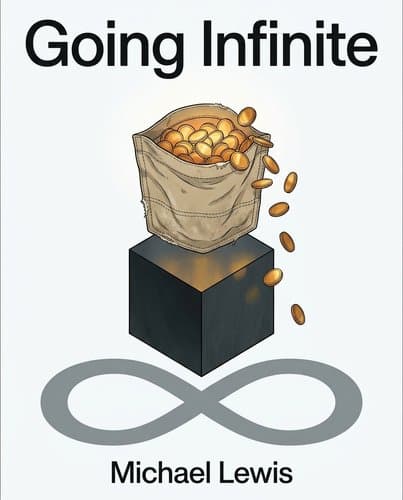
149105520_going-infinite
by Michael Lewis
Sam Bankman-Fried didn't think he was stealing—his utilitarian brain made wrongdoing structurally unthinkable. Lewis reveals how a philosophy designed to save…
In Brief
Sam Bankman-Fried didn't think he was stealing—his utilitarian brain made wrongdoing structurally unthinkable. Lewis reveals how a philosophy designed to save the world became the perfect alibi for losing billions, and why no one looked because his moral charisma made looking feel unnecessary.
Key Ideas
Expected value logic as moral alibi
A coherent moral framework — even a genuinely held one — can function as a perfect alibi; Effective Altruism's expected-value logic made every decision feel justified and made the concept of 'wrongdoing' structurally unavailable to Sam
Probabilistic ethics erases moral boundaries
Probabilistic ethics has a hidden failure mode: if you never make binary moral judgments, you can treat missing millions the same way you treat a coin flip — the same cognitive tool that creates brilliant arbitrage trades makes it impossible to call anything definitively wrong
Charisma prevents scrutiny of dysfunction
Organizational chaos isn't always hidden — FTX had no CFO, no risk officer, and 24 people thinking they reported to Sam, all visible to anyone who looked; the moral charisma of the leader made looking feel unnecessary
Calculation replaces compassion in leadership
Anhedonia plus utilitarian calculus is a dangerous combination in a leader: Sam couldn't feel pleasure or connection, so he optimized for expected value instead — which meant people around him were always variables in a calculation, never ends in themselves
Follower purpose collapse outlasts financial loss
The people most thoroughly captured by a charismatic leader's worldview don't just lose their jobs when it collapses — they lose their sense of purpose; the existential damage outlasts the financial one
Who Should Read This
Business operators, founders, and managers interested in Business Leaders and Organizational Behavior who want frameworks they can apply this week.
Going Infinite
By Michael Lewis
12 min read
Why does it matter? Because the most dangerous fraud is the kind the fraudster can't see either.
Michael Lewis told his friend to go all-in on Sam Bankman-Fried. Not naively — Lewis had spent a career watching financial con artists perform their charm, and he walked away from that first Berkeley conversation genuinely convinced. That detail should unsettle you, because if Lewis couldn't see it, the question worth asking isn't how Sam fooled everyone. It's whether "fooled" is even the right word when the person making the pitch is also its most devoted believer. The story Lewis tells is of a man who substituted a rigorous, internally consistent moral framework for conscience — and couldn't feel the difference. Effective Altruism gave Sam Bankman-Fried a reason to accumulate billions, a language to explain away every warning sign, and a mirror that only showed a savior. The eight billion dollars disappeared because no one — including Sam — could tell the worldview from the con. That's the perfect alibi: the defendant never knew there was a crime.
The Cargo Shorts Billionaire Who Wanted to Buy a Country
A stranger shows up at your front porch in cargo shorts, ratty sneakers, and a wrinkled T-shirt, steps out of an Uber, and within twenty minutes is explaining that he needs $150 billion — and that this is actually a conservative figure, because what he really requires is infinity dollars. Michael Lewis, a writer not easily startled by extravagant personalities, found himself nodding. The revenue numbers alone made nodding feel rational: FTX, the crypto exchange Sam Bankman-Fried had built from scratch, had grown from $20 million to $100 million to $1 billion in three consecutive years. Sam was twenty-nine.
But the money was almost incidental to the stranger's actual point. He didn't want $150 billion for a yacht or a compound. He wanted it to neutralize existential threats — rogue AI, nuclear war, future pandemics deadlier than Covid — and to shore up American democracy against what he saw as an ongoing assault. He was also weighing, more or less casually, whether to pay off the entire $9 billion national debt of the Bahamas, where he'd recently relocated FTX, so the island nation could afford to build roads and schools. The new Bahamian prime minister, freshly elected, had made Sam the first person he wanted to meet.
Lewis, after their walk, called his friend and said: go all in, what could go wrong?
What nobody quite grasped yet was that neither the outfit nor the ambition was a performance. The cargo shorts were real. The planetary math was real. Sam wasn't cosplaying modest genius or approachable billionaire. He was simply a person whose internal calculus operated at a different scale than everyone around him, and who had never found a compelling reason to update his wardrobe while running the numbers on buying a country.
He Didn't Learn to Feel — He Learned to Calculate
The detachment was not a pose. It was the factory setting.
Sam Bankman-Fried grew up inside one of America's most intellectually alive households — Stanford law professors for parents, Sunday dinners crowded with judges and philosophers arguing about aesthetics and politics — and absorbed almost none of the social software everyone else was installing by osmosis. He wasn't rebelling against convention. Convention simply didn't register. His family forgot to celebrate Hanukkah one year, noticed that nobody cared, and stopped celebrating anything. His parents had never legally married, quietly protesting marriage inequality through a civil union, and never told their own children. Nothing in the Bankman-Fried house was performed. Everything was reasoned.
The moment that set Sam's worldview in concrete arrived when he was eight. A few classmates brought up Santa Claus — not as mythology, but as fact — and Sam experienced something close to vertigo. He had filed Santa alongside cartoon characters: present in culture, not present in reality. The discovery that virtually every kid his age treated Santa as genuinely real sent him home to his room to think it over for the rest of the afternoon. He found temporary relief in an escape clause: children were deluded, adults were not. A year later, a classmate announced that he believed in God, that his parents believed in God, that lots of grown-ups did. Sam had lived nearly a decade inside the United States without noticing this. The two of them, by Sam's recollection, both freaked out. What Sam took from the experience was not spiritual curiosity but a statistical conclusion: mass delusion is simply a feature of the world. The majority can be entirely, demonstrably wrong. And they will stay wrong. You can acknowledge this and move on.
The emotional architecture underneath that conclusion was stark. At twenty-five, collecting a million-dollar bonus at Jane Street, Sam was writing privately that his highest moments came and passed and left behind nothing but an aching vacancy where satisfaction was supposed to live. He felt no pleasure, no pride, no gratitude — at least nothing he could locate. He had taught himself to smile by practicing in the same deliberate way someone might drill free throws, and described the process as physically uncomfortable, the muscle equivalent of learning a foreign language in adulthood. He genuinely questioned the premise of facial expressions: if you have something to say, say it. Why does the message need a wrapper?
When the Oxford philosopher Will MacAskill laid out Effective Altruism to Sam, the pitch was this: figure out which charities save the most lives per dollar — a bed net that prevents malaria for $4,500 per life saved versus a guide dog program that costs $40,000 to restore partial independence — then give there, not where it feels good. Maximize lives saved, measured rigorously, at scale. Sam didn't feel inspired. He recognized it. The framework was already the shape of the space inside him. Not a philosophy he chose, but math that fit exactly where feelings were supposed to go.
Expected Value Is a Superpower Until It Becomes an Alibi
Think of expected value as a scalpel. In a surgeon's hands it saves lives. The same blade, handed to someone who has decided that all outcomes are merely probabilities awaiting resolution, can cut without the user ever registering that something is bleeding.
Sam understood this tool earlier and more completely than almost anyone his age. At Jane Street, during his summer internship, a fellow intern named Asher Mellman wandered up one morning and proposed a bet: how much would any single intern lose gambling that day? The daily cap was a hundred dollars, the floor was zero. Sam immediately spotted what Asher had missed — the person most eager to offer you a bet is usually the one who hasn't thought it through. He offered to buy at fifty dollars; Asher countered at sixty-five; Sam accepted. Then Sam turned to the room full of other interns — all of them conditioned by Jane Street to treat positive expected value as practically a moral obligation — and offered each of them a dollar to flip a coin with him for ninety-eight dollars. Every coin toss left one party ninety-eight dollars lighter, which meant Sam collected thirty-three dollars from Asher regardless of how any flip landed. He ran the machine four times. Asher had no mathematical exit. He just sat there losing.
Ask Sam whether he knew what he was doing, and he will tell you, without any particular shame: yes, completely. He knew he was being a piece of shit to Asher. He simply decided that proving the point mattered more than protecting Asher's feelings. His Jane Street bosses thought he had failed to read the room. Sam thought they had failed to read him. He had read the room perfectly. He had weighed the options, assigned relative values, and chosen. The calculus was clean.
This is the flaw built into the scalpel. When every situation becomes a probability and every outcome becomes an expected value, the category of "wrong" quietly dissolves. Wrong requires a verdict. Probability only requires a percentage. When four million dollars in Ripple tokens vanished from Alameda Research's accounts, Sam assigned the missing money an eighty percent chance of turning up — comfortable booking eighty cents of every missing dollar as still present. His partners warned him that if the money never came back, no one would call that reasoning sound. Sam found the objection almost philosophically irritating.
The scalpel had become the alibi. The same mental architecture that let him see through Asher's bet in three seconds — that made him brilliant, genuinely brilliant, at games designed to reward clear thinking under uncertainty — made it structurally impossible for him to call anything wrong while it was still unresolved.
A $22 Billion Company With No CFO and 24 People Who Thought They Reported to the Boss
How do you lose track of a billion dollars? The honest answer, at FTX, is that nobody was assigned to track it.
When the psychiatrist George Lerner — hired by Sam partly to manage other people's problems, since Sam found his own intractable — drew up an org chart of FTX, he made a discovery that stopped him cold. Twenty-four different people believed they reported directly to Sam. The list included Sam's father and a childhood friend whose video game studio Sam had purchased, apparently on a whim. What it did not include was a chief financial officer, because FTX had none. No chief risk officer. No head of human resources. Gary Wang, the engineering genius who had written the code the entire exchange ran on, was the nominal chief technology officer but sat in a box entirely by himself, with no one beneath him. "It seems like a clubhouse more than a corporation," Lerner concluded — which was generous, because most clubhouses have treasurers.
Sam's desk confirmed the diagnosis. Four fidget spinners, two still-boxed iPhones, a canister of Morton salt, a white-painted Rubik's Cube with all its information erased, a ceremonial medal from the mayor of Miami. Four folders of documents requiring his signature were buried somewhere in the pile. This was the nerve center of a company processing billions in daily trades.
The desk chaos was almost a distraction from what was happening at the level of capital allocation. Over three years, Sam deployed roughly five billion dollars across three hundred separate investments — one decision every three days. He put half a billion into an AI startup called Anthropic without mentioning it to anyone beforehand. That stake would later matter enormously, though not in ways anyone at FTX was positioned to plan for.
The people around Sam found it hard to complain too loudly, because the money appeared to be his. Inside a moral framework where maximizing expected value was the only real obligation, scrutiny felt almost petty — the kind of thing grown-ups worried about while the actual work went undone. Sam had said as much directly. Grown-ups, in his experience, mostly just worried. They couldn't distinguish serious risks from unserious ones. They were terrified of regulators, obsessed with taxes, distracting. The org chart had no boxes for them.
What Lerner saw, from his red sofa in the jungle hut, was a structure organized entirely around proximity to Sam — status measured in how close your desk sat to his, governance measured in how often he glanced your way. Nobody had full visibility. Nobody had the job of having full visibility. The dread wasn't in what was hidden. It was in what was simply never looked at.
The Same Logic That Made Him Plausible Made Catastrophe Inevitable
On the night the crisis began, with roughly a hundred million dollars fleeing FTX every hour, Sam retreated to his bedroom. Not to make calls, not to review spreadsheets — to play Storybook Brawl, the video game whose studio he had purchased on a whim. At one point Nishad Singh, watching the exchange dissolve in real time, turned on him and screamed to stop. Sam, apparently, required a moment.
That image is easy to read as a villain's indifference. It isn't. It's something stranger and more clarifying: the same mind at work. Sam had spent years treating every decision as a probability calculation, every outcome as a number awaiting resolution. He had built an empire on the premise that uncertainty was not a reason to pause but a domain to be optimized. When the run began — when the eight billion dollars that was supposed to be sitting safely inside FTX turned out to be inside Alameda Research instead, deployed into illiquid crypto tokens and venture bets and Bahamas real estate — Sam did not experience this as a moral catastrophe. He experienced it as a math problem he hadn't finished solving yet.
Caroline Ellison, beaming in from Hong Kong on a video screen while her colleagues tried to locate missing hundreds of millions the way you find misplaced keys, told her staff she felt weirdly relieved. She had dreaded this day for a long time, she said, and now that it was here the weight was gone. She confirmed that the hole was closer to six billion dollars than one, and that Alameda had been drawing on customer funds to repay its lenders as far back as June. She seemed to regard this as a disclosure rather than a confession — information finally surfacing, not a crime finally named.
The same probabilistic ethics that made Sam brilliant at trading, persuasive to investors, and genuinely effective at identifying where a dollar could do the most good in the world — the same framework that let him see through a rigged bet in seconds and build a billion-dollar exchange in three years — contained no mechanism for registering the moment a risk became a harm. Wrong, in Sam's architecture, was just a probability that hadn't closed. And so customer funds moved to cover Alameda's losses the way any other capital allocation moved: as a calculation, not a theft. The collapse was not a separate event that happened to a good company. It was the same logic, running to its conclusion.
When the Framework Collapses, the People Inside It Have Nothing Left
The bankruptcy trustee assigned to dismantle FTX, an Enron veteran named John Ray, looked at Sam Bankman-Fried and filed him immediately into a mental folder labeled 'crook.' The story Ray needed — culpable villain, defrauded victims, recoverable assets — required that simplicity. But the evidence kept complicating his narrative. To argue the company had been insolvent all along, Ray had to treat Sam's crypto holdings as valueless when denouncing him and valuable when suing his former executives (a stake in Anthropic alone helped push the total recovery to $7.3 billion). The crook story demanded a coherent fraudster, and what the evidence kept returning was something messier.
The more honest verdict lives in a crate in a Bahamian storage shed. Six months after the collapse, Lewis returned to the jungle and found one of the FTX warehouses still sealed. Just inside the entrance — too heavy to drag any farther — sat a wooden crate addressed to Ryan Salame, one of Sam's deputies. Inside: a tungsten cube, the dense decorative block that had circulated as a totem among crypto enthusiasts, prized for its satisfying, inexplicable weight. No yield. No utility. Just mass. Here was the whole empire made tangible: something heavy, expensive, and purposeless, sitting in the mud while the billions it was purchased with had already dissolved into the jungle air around it.
Constance Wang, one of FTX's most dedicated early employees, put the human version of that feeling into a single question before she left the island: 'Do I need a purpose? Sam made me feel like I have a purpose.' She wasn't mourning a salary. She was mourning a framework — the sense that her work was closing the distance between the world as it was and the world as it could be. When the framework collapsed, the purpose went with it, and what remained wasn't cynicism so much as vertigo.
The Cube in the Mud
The question Lewis keeps circling — fraud or delusion? — may be the wrong one. What you're really asking is whether a belief system that makes doubt impossible from the inside is meaningfully different from a lie. When the tools you use to see the world are also the tools that prevent you from seeing what you've done to it, the word "belief" starts to sound indistinguishable from the word "alibi."
Notable Quotes
“You don’t tell someone a price level like $22 unless you have a lot of confidence that you need that price,”
“Will you please fucking stop playing Storybook Brawl?!”
“You have a close friend, Bob,”
Frequently Asked Questions
- What is Going Infinite about?
- This examines how Sam Bankman-Fried and FTX rose and then collapsed through Michael Lewis's close access to the man himself. The book explores how a utilitarian moral framework, organizational dysfunction, and unchecked charisma combined to produce one of the largest financial frauds in history. It reveals how rationalist ideology can make wrongdoing structurally invisible to everyone, including the wrongdoer. Through detailed narrative, Lewis shows how Effective Altruism's expected-value logic made every decision feel justified and made "the concept of 'wrongdoing' structurally unavailable" to Sam. The book ultimately demonstrates how even a coherent, genuinely held moral framework can function as a perfect alibi for deception.
- How did Sam Bankman-Fried justify his actions?
- Sam's justifications came from Effective Altruism's expected-value logic and probabilistic ethics. According to Lewis's analysis, "Effective Altruism's expected-value logic made every decision feel justified and made the concept of 'wrongdoing' structurally unavailable to Sam." The problem with probabilistic ethics is it has a "hidden failure mode: if you never make binary moral judgments, you can treat missing millions the same way you treat a coin flip." This cognitive tool that enables brilliant arbitrage trades also makes it impossible to call anything definitively wrong. Combined with Sam's anhedonia—his inability to feel pleasure or connection—he optimized purely for expected value, treating people around him as variables in calculations rather than ends in themselves.
- What organizational warning signs were visible at FTX?
- Multiple structural problems at FTX were actually visible to observers but largely ignored. The company had no CFO, no risk officer, and 24 people who thought they reported directly to Sam—all of which was observable by anyone who looked. Yet "the moral charisma of the leader made looking feel unnecessary." This reveals how organizational dysfunction isn't always hidden; rather, the charisma of a leader can make investigating such obvious problems feel optional or even disloyal. The book shows how leadership credibility and moral authority can prevent people from acting on visible evidence of serious structural weakness in an organization.
- What was the lasting human impact of FTX's collapse?
- Beyond the financial losses, the collapse caused profound existential damage to the people in Sam's inner circle. Those most thoroughly captured by a charismatic leader's worldview don't just lose their jobs—they lose their sense of purpose. As the key takeaways note, "the existential damage outlasts the financial one." Many followers had built their entire identities around the mission and logic Sam presented, optimizing their lives for goals he defined. When the fraud collapsed, they faced not just financial ruin but an identity crisis, as the framework that had given their lives meaning was revealed as fundamentally corrupt.
Related Book Summaries

Read the full summary of 149105520_going-infinite on InShort