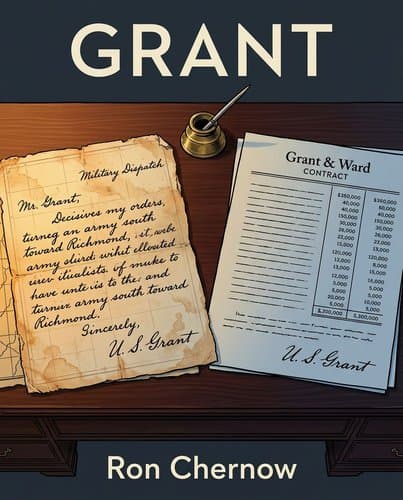
34237826_grant
by Ron Chernow
The same iron loyalty that made Grant the Union's greatest general handed corruptors the keys to his presidency—and the "failure" myth that followed was built…
In Brief
The same iron loyalty that made Grant the Union's greatest general handed corruptors the keys to his presidency—and the "failure" myth that followed was built by the very men dismantling Reconstruction. Chernow reveals a tragic paradox: one man's defining virtue was indistinguishable from his fatal flaw.
Key Ideas
Strengths Transform Into Weaknesses Across Contexts
The traits that make someone exceptional in one context often become catastrophic liabilities in another — Grant's unconditional loyalty was his greatest military asset and his worst civilian weakness, and the mechanism was identical in both cases. Identify your own version of this before it finds you.
Trust Blindness More Dangerous Than Stupidity
The most dangerous form of naïveté is not stupidity but an inability to imagine that people you trust could betray you. Grant's failures were failures of suspicion, not integrity — and they look the same from the outside, which is why his reputation was destroyed.
Defeat Teaches Resilience Success Cannot Provide
Prewar failure can be a specific kind of education that no success can provide. Grant's intimate familiarity with defeat — pawning his watch, sleeping on an office lounge chair, selling firewood — meant he could never be psychologically broken by battlefield setbacks, because he already knew what the bottom looked like.
External Checks Essential For Character Flaws
A person's most important character trait needs an external check. Rawlins functioned as Grant's conscience-keeper precisely because Grant's loyalty reflex had no internal brake. When Rawlins died, Grant had no mechanism to replace that check — and every subsequent scandal followed the same structural pattern.
Reputations Are Political Constructions, Not Truth
Reputations are not neutral historical verdicts — they are political constructions. The Grant-as-failure myth was built by exactly the people trying to destroy Reconstruction, and their success in discrediting him is part of the story of how the South won the peace despite losing the war.
Self-Awareness Alone Cannot Break Patterns
Self-awareness about a failing is not the same as overcoming it. Grant joined a temperance lodge at 26, extracted a war-long pledge from Rawlins, and told a general he 'sometimes could drink freely without unpleasant effect; at others could not take a single glass' — and still relapsed. Knowing the pattern and breaking it are different skills.
Excellence Emerges From Persistence Through Hardship
The best writing often comes from the same place as the best soldiering: the refusal to stop when stopping would be easier. Grant's Memoirs, produced in agony, are ranked alongside the finest American military prose — written by a man history dismissed as a philistine.
Who Should Read This
History readers interested in Political Figures and Military History who want a deeper understanding of how we got here.
Grant
By Ron Chernow
10 min read
Why does it matter? Because the man history calls a failure was destroyed by his greatest strength.
You know the rough shape of Chernow's argument: Grant wasn't really a drunk, a butcher, or a crook. The myths are wrong. But that's not exactly the story Chernow tells, and the difference matters. The myths aren't just inaccurate — they misidentify the tragedy. The actual Grant is stranger and more instructive. His catastrophic failures weren't caused by weakness. They were the shadow cast by his most genuine strength: an absolute, unguarded loyalty to the people in his orbit — the same quality that made him the most committed defender of Black civil rights between Lincoln and LBJ, that pushed a demoralized army south when every predecessor had turned it north, and that handed Ferdinand Ward the perfect cover for the most colossal swindle of the age. Same man. Same virtue.
Every Failure Before the War Was Preparing Grant for the One Thing a General Cannot Lose
In the summer of 1854, Ulysses Grant was living in San Francisco's cheapest miner's hotel — a room with a cot, a pine table, and one chair. The West Coast quartermaster chief Robert Allen, an old friend, tracked him down there. Grant had resigned his commission, he explained. He was broke. He had no way to get home.
He was thirty-two.
To book passage to New York, Grant needed a government travel certificate redeemed at a quartermaster's office. When he shuffled in, the clerk told him the paperwork was wrong and there was no cash on hand. Grant's expression, the clerk would later remember, collapsed into total despair. He asked if he could sleep on the office lounge chair. The clerk offered a dollar for a room. Grant said he'd use the dollar for food. The lounge would do.
That clerk eventually arranged a free stateroom through the steamship line. Without that favor, Grant had no plan. He still had $15 when he docked in New York.
Chernow lingers with unusual care in Grant's 1840s and 1850s — not to explain these years away, but to track what they built in him: an unshockable familiarity with the bottom that no military education could provide.
That resignation had a specific shape. At Fort Humboldt earlier that year, his commanding officer had threatened court-martial after Grant appeared drunk at the pay table. Grant wrote his resignation rather than let Julia find out he'd been tried — he never told her why he left. After that came a farm he'd cleared by hand and lost to flooding, a banking partner who defrauded him, Christmas with his gold watch pawned for $20, and a job as subordinate clerk under his younger brother in Galena. He arrived there nearly forty.
A general who has already slept on an office lounge chair because he couldn't afford a room has one immunity the battlefield cannot strip away. He already knows what ruin looks like. He already knows he can survive it and keep moving. The war would test Grant constantly. It could not surprise him with a worse outcome than he had already lived through.
Grant Didn't Win by Outnumbering Lee — He Won by Being Psychologically Unbreakable
The common account of Grant's victory treats the Union's advantage in men and manufacturing as the explanation: Grant simply had more of everything and was willing to spend it. Six Union commanders before him had the same advantages and still lost. What they lacked, Grant had: an intimate knowledge of fear, which gave him an ability to read enemy psychology that no military theory could manufacture.
In the summer of 1861, still commanding a single regiment in Missouri, Grant approached a hill where Confederate General Thomas Harris was reportedly encamped with twelve hundred mounted soldiers. The closer Grant got, the higher his heart climbed into his throat. He would have turned back, he later wrote, except he lacked the moral courage to stop. When he crested the hill, Harris was gone; his troops had fled at Grant's approach. That thought shaped everything that followed: "It occurred to me at once that Harris had been as much afraid of me as I had been of him."
A man who has never been genuinely afraid thinks of the enemy as fearless. Grant had been afraid (before Harris, before the war, before a clerk's desk in his father's leather shop), and so he could see the enemy's fear with a clarity unavailable to officers who had glided from West Point into comfortable careers. Every Confederate retreat, every cautious defensive posture, every delay: Grant read these not as enemy strength but as evidence of the other side's anxiety. He projected himself into opposing commanders' minds.
The Wilderness in May 1864 shows this at the war's largest scale. After two days of the most brutal fighting the continent had ever seen (17,500 Union casualties, forests literally burning around the dead and wounded), the Army of the Potomac waited for the order every previous commander had eventually given: retreat north across the Rapidan. Instead Grant wheeled the whole army south, toward Richmond. When soldiers realized they were turning toward the enemy rather than away, they erupted in cheers so overwhelming Grant had to quiet them to avoid revealing the movement to Lee. Robert E. Lee, told by one of his generals that Grant must be retreating, corrected him: "Grant is not retreating; he is not a retreating man."
That quality — the refusal to read setback as defeat — wasn't a tactic Grant applied to war. It was what he was. It had kept him moving through the 1850s when any reasonable man would have stopped. In the 1860s it won the war. The problem, visible in hindsight, is that a character trait doesn't retire when the fighting ends.
Between Lincoln and LBJ, No President Did More for Black Americans — So Why Does Nobody Know It?
Why does Ulysses Grant rank near the bottom of most presidential polls? He secured Black voting rights, built the legal infrastructure to enforce them, and fought the largest wave of domestic terrorism in American history to protect them. He gets filed under "corruption" and moved past. The answer to why tells you something ugly about who writes history.
Grant's presidency was defined by his war against the Ku Klux Klan. After the Civil War, the Klan spread through every southern county as a quasi-military network of former Confederate soldiers terrorizing Black voters, burning churches and schools, murdering witnesses before they could testify. Governors wrote Grant describing victims dragged from their beds at midnight, flesh "hanging in shreds." One Mississippi district attorney reported five key witnesses killed: no one would testify anymore, because testifying was a death sentence.
Grant's response was the Ku Klux Klan Act of 1871, signed at the Capitol in person, a California trip canceled so he could be there. The law created federal criminal penalties for violating constitutional rights, authorized Grant to suspend habeas corpus, and gave the Justice Department power to prosecute when state courts refused to act. Grant used every piece of it: suspending habeas corpus in nine South Carolina counties, deploying troops, placing Attorney General Amos Akerman in personal command.
Akerman, a Dartmouth-educated New Hampshire native who had lived in Georgia, served in the Confederate quartermaster corps, and switched sides after Appomattox, prosecuted the Klan with moral fury. Federal grand juries brought 3,384 indictments under his direction. More than 1,100 ended in convictions. By 1872, the original Klan was broken. Frederick Douglass put it simply: "Peace has come to many places as never before. The scourging and slaughter of our people have so far ceased."
The sharpest detail in Chernow's account comes not from a courtroom but from Secretary of State Hamilton Fish's diary. After cabinet meetings where Akerman described Klan atrocities in forensic detail (castration, wounds large enough to insert a finger), Fish recorded his private reaction: Akerman had the subject "on the brain," the briefings had become "a bore." Grant sat through every one of those meetings and kept requesting more.
That contrast — Fish's exhaustion versus Grant's sustained attention — previews what comes next. The North's moral fatigue preceded the political retreat. The people who wanted Reconstruction to fail didn't have to defeat Grant directly; they just had to wait for everyone around him to stop caring. When Reconstruction finally collapsed, its opponents didn't stop at reclaiming the South. They reclaimed the story too, discrediting Grant's presidency as corrupt and incompetent so thoroughly that his civil rights record vanished with it. His personal secretary Orville Babcock was indicted in the Whiskey Ring scandal; Secretary of War William Belknap was impeached for bribery. The corruption was real. It was also weaponized. And it worked.
The Same Trust That Won the War Was What Ward, Babcock, and Belknap Exploited
Ferdinand Ward kept detailed notes on his famous partner. Twenty-five of Grant's preferred cigars waited at the office whenever the ex-president arrived. Ward showed up twice a week for poker. He noted Grant's church attendance, near-total abstinence from alcohol, and cheerful acceptance of every monthly statement placed in front of him. Ward's private conclusion: Grant was "a child in business matters."
What Ward had mapped, without knowing it, was the same boy who walked into a farmer's yard at eight and blurted out all three price points his father had given him — $20, then $22.50, then $25 if necessary — before the man even countered. The farmer named his price and the story circulated through Georgetown for years. Grant later said it "cost me more heartburning than almost any transaction in my life." He had no mechanism for concealing what he knew. He assumed the other party was acting in good faith.
At Grant & Ward, he never reviewed transactions. He signed letters without reading them. He never asked to see the government contracts Ward claimed to have secured, the one thing Grant had explicitly told Ward he would not tolerate. Ward paid 15 to 20 percent monthly returns on those fictional contracts, telling investors that Grant's quiet influence explained the numbers. Grant was entirely unaware.
On May 6, 1884, Grant arrived at 2 Wall Street on crutches with the settled confidence of a man worth a million dollars. His son Buck intercepted him: "Father, you had better go home. The bank has failed." Grant was worth $80. Julia had $130. The firm owed investors nearly $17 million against assets of $68,000. In the days that followed, Grant sat in his armchair driving his fingernails into the hard wood: "I would kill Ward, as I would a snake."
The mechanism was not corruption but the precise inversion of what made Grant a great general. In the field, he could project himself into enemy commanders' minds because he understood fear from the inside: he demystified men others found terrifying. Ward turned this around. He studied Grant with the same care Grant once applied to Robert E. Lee. He found the seam, and he worked it.
Grant Told a Black Congressman in 1875 Exactly What He Was Giving Away — and He Was Right
Grant told a Black congressman in 1875 exactly what he had done and exactly what it would cost, then watched every prediction come true.
The story came out nearly four decades later, when John Roy Lynch, the sole Black Mississippi congressman to survive the 1875 Democratic sweep, recalled a private White House conversation that November. Lynch asked Grant directly why he had refused troops. Grant's answer was precise: he had drafted a proclamation in early September, ready to act on Governor Ames's plea for federal intervention. Before signing it, he consulted Ohio Republicans. They told him sending troops to Mississippi would cost them the October state elections. He chose Ohio. Republicans won Ohio. In Yazoo County, Mississippi, where the Black population topped twelve thousand, exactly seven Republican votes were cast on Election Day.
Grant didn't pretend to Lynch that he had done the right thing. "I should not have yielded," he said. "I believed at the time I was making a grave mistake." He named the choice plainly: duty on one side, party obligation on the other. He picked party. Then he went further. Grant told Lynch that Mississippi was only the beginning — that the national government would soon find itself at a severe disadvantage and the war's results had been "in a large measure lost." The general who received Lee's surrender at Appomattox told a Black congressman that terror tactics had effectively nullified what that surrender meant.
You can look for extenuating circumstances: exhaustion, bad advisers, a Republican coalition fraying in the North. They're all real. But the Lynch conversation leaves you with something harder to absorb — a man who saw the abyss clearly, described it in advance to the person most affected by his choice, and flinched anyway. He spent the rest of his life knowing it.
A Tumor the Size of a Baseball, a Throat Sprayed With Cocaine Water, and 336,000 Words in One Year
By the spring of 1885, Grant could no longer swallow. He compared water to "molten lead" going down. His throat tumor had grown to the size of a baseball, hidden under a silk muffler knotted around his neck. His valet Harrison Terrell — born into slavery, now devoted to this particular dying man — sprayed the area with a cocaine solution to buy Grant a few working hours. Grant sat in an overstuffed leather armchair, legs stretched onto a facing chair, a wool cap pulled over his gray-streaked hair, and wrote.
He had been doing this for months. Ward's fraud had destroyed everything: the fortune, the reputation, the comfortable end he had imagined. Grant needed to leave Julia something. But the writing was never only about money; it was the same mechanism that had moved him through every previous catastrophe. You keep moving. You don't turn back.
Mark Twain, who published the book, watched Grant dictate the chapter on Lee's surrender at Appomattox: nine thousand words in a single sitting, never pausing, never searching for a word, never self-correcting. When the stenographer's copy came back, it required almost no changes. Twain had spent his career building sentences. "It kills me these days to write half of that," he said. Grant produced ten thousand words on his best days while barely able to speak them aloud.
The man who wheeled the entire Army of the Potomac south after the Wilderness, toward the enemy and not away, was incapable of a different response. The constitutional unwillingness to stop when stopping was understandable: that was Grant's flaw and his virtue running in the same channel. It had cost him in peacetime. Ward had found the seam in it and exploited it completely. But here, applied to sentences instead of armies, it produced a masterwork.
He finished on July 16, 1885, and died one week later. Julia eventually received $450,000 in royalties. Whatever else could be taken from Grant had been taken. This, nobody could.
The Verb and the Man
Near the end, Grant scrawled to his doctor: I am a verb instead of a personal pronoun. To be, to do, to suffer. He named all three because he had lived all three — sometimes in the same week. The note is the most self-aware thing Grant ever wrote, and also the most characteristic: he reached for grammar instead of confession, for function over feeling. Chernow's real argument is that you cannot separate these. The iron that kept an army moving south after the Wilderness is the same iron that finished 336,000 words with a tumor beneath a muffler — and made him sign whatever Ward put in front of him without reading a word. The will had no internal governor. It just ran, toward the enemy or toward the page or toward the wrong man, with identical momentum. What it produced depended entirely on the terrain.
Notable Quotes
“Then there is nothing left me to do but go and see General Grant,”
“and I would rather die a thousand deaths.”
“I have probably to be General Grant's prisoner, and thought I must make my best appearance.”
Frequently Asked Questions
- Why did Grant's unconditional loyalty become his greatest weakness in civilian life?
- Grant's defining character trait—unconditional loyalty—functioned as his greatest military asset because it allowed him to maintain unwavering focus on strategic objectives. However, in civilian and political life, this same trait made him catastrophically vulnerable to betrayal by people he trusted. Chernow argues that "the mechanism was identical in both cases"—Grant simply could not imagine that those he trusted could betray him. His greatest vulnerability wasn't stupidity but "an inability to imagine that people you trust could betray you." When he lacked an external check on his loyalty reflex, particularly after Rawlins died, his naïveté opened him to exploitation.
- Is Grant's historical reputation based on objective facts or political manipulation?
- According to Chernow, Grant's reputation as a failure is primarily a political construction rather than a neutral historical verdict. "The Grant-as-failure myth was built by exactly the people trying to destroy Reconstruction," and their campaign succeeded in discrediting him as part of the broader effort to undermine the postwar peace. The irony is profound: the same character traits that enabled Grant to defend Black civil rights and pursue just policy during Reconstruction became liabilities that his political enemies exploited to destroy his credibility. Understanding his reputation requires recognizing how historical narratives serve political interests.
- What does Chernow identify as Grant's most dangerous vulnerability?
- Chernow identifies Grant's most dangerous vulnerability as a specific form of naïveté: "the inability to imagine that people you trust could betray you." This wasn't intellectual stupidity but rather a failure of suspicion—an over-extension of his defining trait of loyalty. "Grant's failures were failures of suspicion, not integrity—and they look the same from the outside, which is why his reputation was destroyed." What appeared to observers as moral corruption was actually a structural flaw in his personality: he had no internal mechanism to question the trustworthiness of people in his circle, making him susceptible to those with ulterior motives.
- How did Grant's early failures before the Civil War shape his military resilience?
- Grant's prewar failures—pawning his watch, sleeping in an office, selling firewood—provided a specific form of education that success could never have offered. These experiences made him intimately familiar with rock-bottom circumstances, which proved psychologically invaluable during the war. As Chernow explains, "Grant's intimate familiarity with defeat meant he could never be psychologically broken by battlefield setbacks, because he already knew what the bottom looked like." His previous failures created an internal resilience that allowed him to absorb military setbacks without despair, giving him a psychological advantage his competitors lacked.
Related Book Summaries
Read the full summary of 34237826_grant on InShort