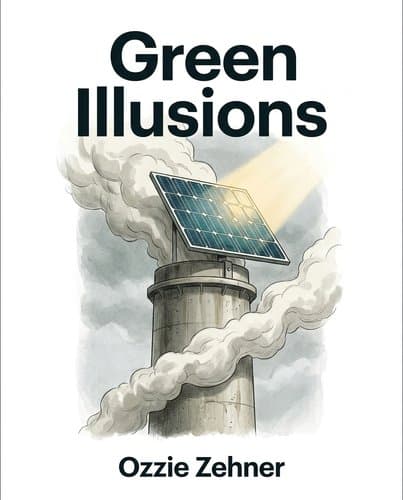
12804425_green-illusions
by Ozzie Zehner
The solar panels and wind turbines we celebrate as salvation are built on the same extractive, consumption-driven logic that caused the climate crisis.
In Brief
The solar panels and wind turbines we celebrate as salvation are built on the same extractive, consumption-driven logic that caused the climate crisis. Zehner reveals why addressing energy supply without confronting demand is environmental theater—and which overlooked social investments actually move the needle.
Key Ideas
Full supply chain analysis reveals true environmental cost
Before celebrating a renewable energy investment, trace its full supply chain — the mining, the smelting, the manufacturing gases — and ask whether the 'clean' label reflects lifecycle reality or just point-of-use optics
Efficiency gains paradoxically increase total energy consumption
Treat the Jevons Paradox as a default assumption: whenever energy becomes cheaper or morally lighter, expect total consumption to rise, not fall — efficiency gains are not the same as reduction
Opportunity cost matters more than intervention type
Evaluate environmental interventions by opportunity cost, not category: a dollar spent on girls' education, walkable neighborhood design, or universal healthcare may reduce emissions more reliably than the same dollar spent on solar deployment
Five preconditions evaluate renewable energy project viability
Use Zehner's five preconditions as a filter before endorsing renewable energy projects: per-capita consumption, human rights record, efficiency standards, walkability ranking, and energy backstops — if a region meets none, more energy (clean or otherwise) likely makes things worse
Question why we need so much power
Shift your question from 'how do we generate enough clean power?' to 'why do we need this much power?' — demand is a social and political variable, not a fixed constraint that technology must serve
Who Should Read This
Science-curious readers interested in Climate Change and Sustainability who want to go beyond the headlines.
Green Illusions
By Ozzie Zehner
11 min read
Why does it matter? Because the solar panel on your roof might be doing less good — and more harm — than you think.
Here's something you probably believe: renewable energy is the right fight. Solar panels, wind turbines, the accelerating transition away from fossil fuels — obviously good, obviously necessary, accelerate it however possible. The framing is so settled it barely feels like a position anymore. It just feels like physics.
Ozzie Zehner thinks that consensus is the most expensive mistake the environmental movement ever made. Not because clean energy is bad, exactly — but because agreeing to fight only on the supply side guaranteed we'd lose. Every solar array built without addressing why we need so much power in the first place is, on his accounting, an extension of the problem wearing the problem's solution as a costume. The argument this book makes — which you will resist more than once before it sticks — is that the most powerful environmental acts available to us have nothing to do with technology at all.
Every Solar Panel Is a Fossil Fuel Product in Disguise
Every solar panel begins its life as a fossil fuel product. Not a metaphor — a supply chain. Before a photovoltaic cell can harvest a single photon, quartz must be mined, hauled, and smelted in high-temperature furnaces at industrial scale. The silicon that emerges gets processed in clean rooms that maintain precise temperatures and air purity around the clock, drawing enormous electricity from the same fossil-fuel-dependent grid the finished panel is supposed to replace.
Here's the detail that tends to stop people cold: the gases used during photovoltaic manufacturing include fluorinated compounds with a global warming potential roughly 20,000 times greater than CO2. That number isn't a rounding error — it means a small release during production can erase the climate benefit of years of clean generation. The 'clean energy' label is doing ideological work. It describes the output — electricity with no exhaust pipe — while staying silent about the mines, the furnaces, the shipping containers, the chemicals.
This is Ozzie Zehner's foundational provocation in Green Illusions. Renewables are not an alternative to the fossil fuel industrial system. They are products of it, requiring the same extraction networks and high-heat manufacturing logic, just pointed in a new direction. The distinction between a coal plant and a solar array is real but narrower than the marketing suggests — one burns fuel to generate power, the other burns fuel to build the device that generates power, then presents the device as proof that burning is over.
The Cleaner the Technology, the More Energy We Use
Picture a man in, say, 2007, sitting in a Toyota dealership, making the responsible choice. He buys a hybrid. His monthly fuel costs drop. And then, almost imperceptibly, his decisions shift. He starts accepting the job offer forty minutes further from home. Why not? The commute is practically free compared to what it used to cost. His total miles driven over the next year climb well past what he logged in his old gas-only sedan. He bought efficiency. He got more consumption.
The Jevons Paradox has been humiliating energy optimists for over a century and a half. In the 1860s, William Stanley Jevons noticed something counterintuitive happening during Britain's industrial expansion: as steam engines became dramatically more efficient at converting coal into work, coal consumption didn't fall — it exploded. Efficiency had made coal cheaper per unit of output, which made it attractive to power not just existing operations but an enormous range of new ones. The efficiency gain was real. The net result was the opposite of what you'd expect.
Ozzie Zehner's argument is that we're running the same experiment again. When we label an energy source 'clean,' we don't just change the chemistry — we change the psychology. The hybrid driver's logic isn't irrational; it's sensible given the information he's been handed. He's been told his energy choices are now environmentally neutral, so the moral friction that might have kept him closer to home evaporates. Clean energy functions as a permission slip. The guilt that once acted as a soft brake on consumption gets replaced by a feeling of license.
This is why supply-side fixes run into a wall that goes beyond engineering. Even if every efficiency improvement worked exactly as advertised, calling something 'green' lowers the perceived cost of using it — and lower cost reliably means more use. You cannot outrun the paradox by building better turbines, because the problem isn't the turbine. Cheap, guilt-free energy, however you produce it, will be consumed expansively. The most efficient possible clean grid, fully deployed, still collides with the same fact: we use what we can afford, and we use more of it when using it stops feeling bad.
Every kilowatt-hour that gets cheaper or cleaner is a kilowatt-hour someone will find a new use for. The efficiency strategy has a ceiling the strategy itself creates. The hybrid in the driveway isn't a failure of individual character — it's a predictable outcome of a framework that defines the problem as 'not enough clean supply' rather than 'too much demand.'
The Solar Panel Is a Magic Pill That Lets You Keep Smoking
Imagine your doctor hands you a prescription that lets you keep smoking without getting lung cancer. You'd take it, obviously. What you probably wouldn't do is examine the logic too carefully — because the logic is that you've solved the problem, and examining the logic risks discovering the cancer is still there.
That's Zehner's most uncomfortable image: the solar panel is that pill. We purchase it, mount it on the roof, and in doing so purchase something else — relief from the more difficult question of why we need so much power at all. The panel is real, the electrons are real, but what it's actually doing in our psychology is functioning as a commodity that dissolves guilt without requiring us to change anything fundamental. We've treated an industrial product as a moral absolution.
Zehner borrows a term from social theory for this: fetishism. In the original sense, a fetish is an object onto which we displace a force that actually lives somewhere else. The force here is guilt about demand — the discomfort of confronting a world that requires enormous energy inputs just to live an ordinary life. The wood carving doesn't contain the spirit; the solar panel doesn't contain the solution. But both let us stop looking at the harder thing: the dispersed suburbs, the car-dependent city, the assumption that growth is the default condition of a healthy economy. The solar panel lets us preserve all of that and call ourselves green.
The Jevons Paradox says cheap energy gets consumed more. Zehner's fetish argument goes one level deeper: even if consumption stayed flat, labeling the supply "clean" forecloses the conversation about demand. You can't interrogate a problem you've declared solved. Every wind turbine built is a small argument that the question of how much energy we need has already been answered — and the answer is: however much we want, as long as it comes from the right machines.
The alternative Zehner proposes is not austerity. It's a different question. Instead of asking how to generate the next terawatt cleanly, ask why the terawatt is necessary. Redesign a neighborhood so that destinations are walkable and transit is frequent enough to make car ownership economically pointless, and you've eliminated more emissions than a solar array would offset — without building anything. The most sustainable unit of energy, he argues, is the one no one ever needed to produce. That's not a romantic abstraction. It's a recognition that demand is not a law of nature. It's a set of decisions, mostly architectural and political, that were made by people and can be made differently. The panel on the roof leaves those decisions untouched.
The Real Environmental Levers Aren't Technological at All
What if the most powerful environmental intervention available right now has nothing to do with energy at all?
Zehner's answer is that the question already contains the wrong assumption. His sharpest provocation in Green Illusions is a simple contrast: today's environmentalism is technical and productivist, organized around what we generate and how. The environmentalism that might actually work is social and rights-based — organized around how people live, how cities are built, and who gets access to education and healthcare. The move from one column to the other isn't a tweak. It's a different theory of where environmental problems come from.
The clearest version of this argument is the opportunity cost. Every dollar directed toward a solar array is a dollar not available for something with better returns. For what the Million Solar Roofs program cost, utilities could have avoided twice the carbon emissions simply by converting one coal plant to natural gas. The solar option was more expensive, more complicated, and less effective — but it felt like environmentalism, so it got the funding. Meanwhile, programs for girls' education, which reliably reduce population growth and resource consumption across generations, compete for scraps.
Demand for energy isn't a natural constant, like gravity. It's a product of decisions — about where we build housing, whether streets are walkable, whether healthcare is available so women can control family size, whether wealth is distributed narrowly enough that status competition doesn't drive consumption upward without limit. These are political and architectural facts. Change them and you reshape the underlying appetite for energy. Leave them intact and no array of panels will be large enough.
The US spends roughly $80 billion annually on military research and development, and as a result it is extraordinarily good at killing people. You get what you pay for. Zehner's point — and Gates made it first — is that the same logic applies to environmental spending. Direct money toward deploying today's flawed energy technologies, and you get those technologies, along with their embedded emissions, rebound effects, and opportunity costs. Direct it toward human rights infrastructure and you get the preconditions that make any energy system perform better.
Zehner's checklist of those preconditions reads less like a wish list than a description of what wealthy democracies have already built — and a measure of how far the US falls short. Deploying more alternative energy into the American context, as it currently exists, isn't a solution. It's an expensive way to avoid one.
The United States Meets Zero of the Five Conditions Under Which Clean Energy Actually Works
Clean energy works. Just not here, not yet, and possibly not for a long time. That's the specific, uncomfortable claim Zehner lands at the end of Green Illusions, and it comes with a checklist precise enough to be falsifiable.
Here's what Zehner actually asks a country to prove before it earns the right to deploy alternative energy. Per-capita energy consumption should be below the OECD average. The country should have a strong human rights record — low wealth inequality, universal healthcare, low rates of crime and incarceration. Buildings, vehicles, and industrial processes should be more efficient than the OECD average, with binding targets to keep improving. Cities should rank in the top half of the developed world for walkability and cycling infrastructure. And there should be rising energy taxes or equivalent policy mechanisms that prevent efficiency gains from being absorbed by new consumption. Meet all five, and deploying alternative energy makes sense. Miss any one, and you risk pumping more energy into a system that will simply expand to use it.
The United States meets none of them.
Not close on some and short on others — zero. American per-capita energy consumption sits near the top of the developed world, not the bottom. Wealth inequality is severe enough to place the US alongside developing nations on some measures. Building and vehicle efficiency trails most of Western Europe. American urban design remains organized around the car, with walkable neighborhoods as the exception rather than the template. And there is no national energy tax, no binding backstop against the rebound effects that reliably follow cheaper or cleaner power.
This is why Zehner describes alternative energy as a sandcastle built at the waterline. The sandcastle is real — the panels work, the electrons are genuine. But the tide is the structural appetite for consumption baked into how American cities are built and how American life is organized, and it doesn't recede because you added a solar array. It keeps rising. The sandcastle holds for a moment, then the tide takes it, and you're left with the same shoreline plus the cost of construction.
The checklist reframes the entire debate. The question stops being whether solar or wind or geothermal is technically ready. Technically ready is the easy part. The question is whether the social infrastructure exists to capture the benefit rather than recycle it back into expanded consumption. Education, zoning, healthcare, wealth distribution, urban design — these aren't soft background conditions. They're the mechanism. Without them, more energy capacity of any kind is more rope.
What makes this genuinely unsettling isn't the list itself. It's that the list is short, the items are measurable, and a country that has positioned itself as a global leader in climate action can't check a single box. Which raises a question worth sitting with: if the list is this legible, and the gap this wide, what exactly are we celebrating when we celebrate progress?
The Most Radical Environmental Act Is Refusing to Ask the Wrong Question
Here is where the book leaves you: not with a shopping list of better technologies, but with a question that makes the shopping list irrelevant. The five preconditions aren't a high bar — they're a basic description of a society that has arranged itself to need less. The United States hasn't met one of them. Which means every rooftop array, every wind contract, every press release about gigawatts installed is feeding energy into a structure specifically designed to consume whatever arrives. You can't outrun that with better hardware. So the real question — the one Zehner is actually asking — is what you do with your attention now that you know where the leverage is. Not which panel to buy. The most powerful thing you can do for the climate might be showing up to a city council meeting about parking minimums — not because it's romantic, but because that's where the actual structure of demand gets built or dismantled.
Notable Quotes
“We spend $80 billion a year on military r&d and we’re good at shooting people. You get what you pay for.”
Frequently Asked Questions
- What is Green Illusions about?
- Green Illusions challenges the assumption that renewable energy technologies can solve the environmental crisis, arguing they extend rather than replace the fossil-fuel industrial system. The book traces full supply chains—examining mining, smelting, and manufacturing gases—to determine whether the 'clean' label reflects true lifecycle reality or merely point-of-use optics. Rather than celebrating renewable energy investments, Zehner redirects attention toward demand reduction, urban design, and social policy as more reliable paths to sustainability. The work equips readers to evaluate energy claims critically and question whether investments truly reduce environmental impact across their entire lifecycle.
- What is the Jevons Paradox and why does it matter?
- The Jevons Paradox explains why efficiency gains don't reduce total energy use. Zehner treats it as a default assumption: whenever energy becomes cheaper or morally lighter, expect total consumption to rise, not fall—efficiency gains are not the same as reduction. This paradox is central to understanding renewable energy's limitations, because cheaper or cleaner energy typically triggers increased consumption. Rather than assuming renewables will reduce overall energy demand, we should expect greater consumption to offset efficiency improvements. This understanding is crucial for realistically assessing whether renewable deployment achieves emissions reduction or simply enables more energy use at lower perceived cost.
- How should I evaluate renewable energy projects?
- Zehner recommends filtering renewable energy projects through five preconditions: per-capita consumption, human rights record, efficiency standards, walkability ranking, and energy backstops. If a region meets none of these, more energy—clean or otherwise—likely makes things worse. This framework reframes evaluation away from the technology itself toward its broader context and enabling conditions. The opportunity cost principle matters equally: a dollar spent on girls' education, walkable neighborhood design, or universal healthcare may reduce emissions more reliably than the same dollar spent on solar deployment. Before endorsing a renewable project, assess whether these preconditions exist to support its benefits.
- What does Green Illusions say about energy demand?
- Zehner argues that the fundamental question should shift from 'how do we generate enough clean power?' to 'why do we need this much power?'—demand is a social and political variable, not a fixed constraint. Rather than treating energy demand as inevitable, the book frames it as something shaped by policy choices, urban design, and consumption patterns. Demand reduction, walkable neighborhoods, and social programs offer more reliable sustainability paths than renewable energy alone. Renewable deployment doesn't question whether underlying demand is justified or sustainable. The core argument is that reducing demand through social policy and urban design more effectively addresses the environmental crisis than simply replacing fossil fuels with clean energy alternatives.
Related Book Summaries


Read the full summary of 12804425_green-illusions on InShort