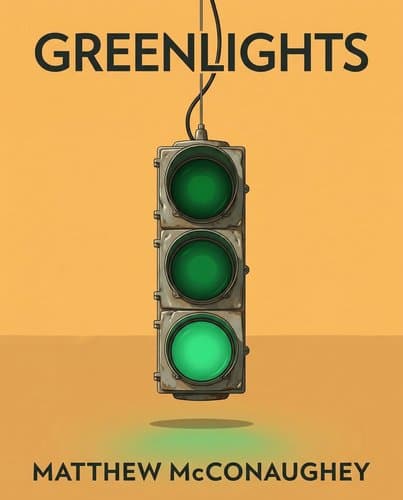
52838315_greenlights
by Matthew McConaughey
The red lights in your life aren't obstacles — they're navigation data pointing you toward who you're meant to become. McConaughey's raw, unfiltered memoir…
In Brief
The red lights in your life aren't obstacles — they're navigation data pointing you toward who you're meant to become. McConaughey's raw, unfiltered memoir reveals how constraint, failure, and detour expose your identity more honestly than any success ever could.
Key Ideas
Decode obstacles for hidden direction
When something hard happens, resist the instinct to categorize it as a setback and move on. Ask instead: what direction is this pointing? Red lights contain navigation data — but only if you stay long enough to read them.
Identity forged through non-negotiable choices
You learn who you are through constraint, not through freedom. Notice what you refuse to give up even under maximum pressure — that refusal is your anchor, and it is more revealing than any choice made from comfort.
Become what you want to attract
Some greenlights can be engineered through deliberate effort. But the most significant ones often arrive only when you stop chasing and become worth finding. The question isn't always 'how do I pursue this?' — sometimes it's 'am I someone the thing I want would be drawn toward?'
Depth creates impact beyond visibility
Wider reach costs you scent. Presence — staying rooted in a place, a craft, a relationship long enough to matter — creates a different kind of impact than visibility does. Ask whether you are building depth or distributing thinly.
Notice when masks feel more alive
If the roles you play — at work, in a relationship, in a group — feel more alive than your actual life, that gap is a red light. Name it clearly before it runs you. The discomfort of noticing is cheaper than the cost of not noticing.
Write your legacy through today's choices
Stop treating your legacy as something to hand off later. The résumé is still being written right now. Make the choices today that the person on your eulogy's page would recognize.
Who Should Read This
Readers who connect with first-person stories about Memoir and Resilience and want to see the world through someone else's eyes.
Greenlights
By Matthew McConaughey
10 min read
Why does it matter? Because the hard things in your life have been doing something for you all along.
Most people are trying to reduce friction. Fewer hard conversations, faster recoveries, smoother roads ahead. The working theory is that a good life, properly managed, eventually stops ambushing you.
McConaughey spent fifty years arriving at the opposite conclusion. The collapses weren't detours from his real life — they were the construction. The arrest, the years of refusing every offer that came his way, the father dying mid-climax the exact way he always said he would. Each one looked, at the time, like a roadblock. Each one, in retrospect, was a reroute toward something he couldn't have chosen for himself.
That's the uncomfortable offer this book makes: your hard moments weren't interruptions. They were data. Navigation. And once you learn to read them that way, you'll start to wonder what signal you've been ignoring.
A Red Light Isn't a Stop Sign — It's a Reroute with a Longer Lag
The hardest thing to accept about a bad stretch is that it might be working for you. Greenlights opens with a taxonomy of misfortune so ordinary it stings: roadblocks, fuckups, sickness, unmet wants. It refuses to comfort you about any of it. What it offers instead is a reframe: adversity isn't a parenthesis around your actual life. It's part of the route.
The traffic metaphor is the book's load-bearing structure. Greenlights are easy: approvals, windfalls, health, a fresh start. They say yes and give you what you want. But McConaughey's real argument lives in what happens at a red light. A red light is a greenlight with a longer lag. Cautions, detours, failures, suffering — they say no, but sometimes give you what you need. The light doesn't stop you permanently. It redirects you. The direction contains information.
Catching more greenlights is partly skill: mapping where the red lights cluster in your life and routing around them. When you're stuck at one, you have three moves: persist toward the original destination, pivot and try a different angle, or concede and walk away. McConaughey spent years in the romantic comedy lane before he conceded — turned down a $14.5 million TV deal, went dark for nearly two years, and came back with Mud, True Detective, and Dallas Buyers Club. The satisfaction, he argues, lives not in which move you choose but in reading the moment well enough to choose the right one.
McConaughey calls this an "approach book," not a memoir or an advice guide. Life is something you navigate, not something that happens to you while you're waiting to feel okay again.
You Only Find Yourself in the Situations You Cannot Escape
By Day 148 in Warnervale, Australia, Matthew McConaughey was down to 140 pounds. Every night after dinner he ran a hot bath, put on his Walkman, wrote sixteen-page letters to himself in minute handwriting, and repeated the same three words he'd been saying since he arrived: cultural differences.
The plan had been Sydney: beaches, surfing, Elle Macpherson. Instead, his host family had driven him past the coast towns, past the roundabouts, down a dirt road to a settlement of 305 people where the pavement ran out. His host, Norvel Dooley — five-foot-four, 220 pounds, fake English accent — sat on a raised platform behind his desk to appear taller and lectured McConaughey for saying the cheeseburger inventor was a genius ("merely your opinion"). He shut off the Olympics mid-broadcast to deliver a history lesson about a British equestrian bronze medalist from 1960. McConaughey called all of it a cultural difference and kept his head down.
What he couldn't explain away arrived on Day 148, when Norvel announced at dinner that for the duration of the stay, McConaughey would call them Mum and Pop.
McConaughey said nothing. He cleared the plates, washed them, said good night to each Dooley by name (Norvel, Marjorie, Michael, Meredith), and walked back to his room. For the first time in five months, he didn't need to reason toward it. The no was already there, coming from everywhere at once. Not a negotiated no. Not a cultural-difference no. A no that came from somewhere underneath all the coping, underneath the vegetarianism and the six-mile runs and the monk fantasies. He had a mom and a dad who were still alive.
That refusal is where the book's central argument shows up in practice. McConaughey arrived in Australia with a full identity kit: a truck, girlfriends at two different schools. The year stripped every piece of it away. No phone, no curfew, no friends, no truck. What remained was something. Not a concept of himself, but a line he could actually feel.
He had made a handshake deal with the Rotary Club: no coming home before the year was up, barring a family death. That promise, made casually by a confident eighteen-year-old, held him in place long enough to find out. You do not find the floor of yourself on a good day in your hometown. You find it when you're down to iceberg lettuce and ketchup, ten thousand miles from anyone who loves you, and a man on a raised platform tries to reroute who you belong to.
The constraint wasn't incidental to the self-knowledge. It was the mechanism.
Some Greenlights You Engineer. The Ones That Matter Most Draw You.
Can you plan your way into the life that actually fits you, or do you have to stop planning to let it arrive?
McConaughey builds his answer in two moves. The first is active: map where the red lights cluster, route around them, do the work, hold the line. The second surprises him as much as anyone — the greenlights he remembers most clearly weren't engineered. They arrived after he stopped reaching.
By 2008, after a decade as Hollywood's reliable romantic lead, McConaughey was going to sleep unsatisfied and waking up the same way. He wanted dramatic work: characters and stories that matched the noise of the life he was actually living. So he drew a line. He told his agent he was done with rom-coms, checked that he had enough saved to wait, and sat on his hands.
The offers kept coming, just the same kind. Five million dollars for a script he didn't want to make. He passed. Eight million. Ten. Twelve and a half. At fourteen and a half million he reread the script and noticed, with some amusement, that it had become markedly more sophisticated — same words, same story, just a bigger check attached. He passed again. If the work he wanted wasn't available, he wasn't going to fill the gap with work he didn't want, no matter the price.
Then everything stopped. A year of passing gave way to another year of silence: no calls, no offers, nothing. In the absence, something shifted. Casting the former rom-com king as the lead in a defense attorney thriller was suddenly a novel idea. Scripts arrived from directors he respected: Richard Linklater, Jeff Nichols, Steven Soderbergh. By refusing to be what he'd been, he'd cleared enough space for casting agents to imagine him as something else.
The mechanism wasn't pursuit. It was refusal held long enough to hollow something out, then letting the right thing rush in to fill it. Stop long enough, and what you want starts moving toward you.
"Alright, alright, alright" arrived the same way. Those weren't scripted words. On the first night of his first film role, before the camera rolled, Wooderson just took stock of what he already had (the Chevelle, the Ted Nugent 8-track, the company) and started driving toward what he wanted. Three counts of what already exists. The line that would follow him for decades wasn't planned. It was what showed up when he wasn't reaching for effect or trying to manufacture anything.
Presence Has a Scent. Reach Too Far and You Lose It.
Four days up the Niger River in a four-horsepower dugout canoe, and McConaughey finally found the man he came for — Ali Farka Touré, the African Bluesman, at his second wife's house in Niafunké, Mali. He'd made the trip as "David the writer-boxer," anonymous, chasing the geography of a recurring dream. Ali had no idea who he was. They ate rice from a communal bowl and Ali played some songs.
Then McConaughey asked: why only West Africa and France? Why not tour globally?
Ali answered with a scatology lesson. Dried shit, he said, has no scent — preserved for travel, optimized for distance, it leaves nothing behind. Wet shit marks. It sticks. That's what he was here in Mali: wet. Present enough to have an odor. Anywhere else he'd arrive already dried out, already scentless.
The question Ali was answering wasn't about touring schedules. It was about whether the thing you make can survive being exported, or whether it only exists in the conditions that produced it.
The morning after the wrestling match in the Dogon village of Begnemato, Michel, champion of four villages and a stranger until the night before, stood at the settlement's edge waiting. He fell in beside McConaughey without a word, held his hand for fifteen miles to the next village, then turned around and walked fifteen miles back alone. No explanation. No performance. He didn't need to be anywhere else.
Watching Michel walk back alone, McConaughey could name what those earlier years had cost him.
He'd arrived in Mali after years of exactly the wrong kind of ambition — eighteen months of leather-pants hedonism at the Chateau Marmont, rom-coms that printed money, a career built for wide reach and light touch. The Africa trip didn't produce a strategy. It produced a recognition: the moments in his life that had actually moved people happened when he was rooted, not broadcast. The refusal to call the Dooleys Mum and Pop. The screen test where he threw away the script and imagined his own daughter. Three unrehearsed words on a film set that followed him for decades. All of it happened in rooms small enough to smell him.
You can't leave a scent at scale. You leave it one place, in one moment, and let it stick.
The Moment Your Own Success Becomes the Red Light
McConaughey's deepest red light arrived after he won the Oscar.
The two-year Hollywood exile was hard but readable — he knew what he wanted and held the line. The crisis that actually rerouted him came from the opposite direction: after Dallas Buyers Club, after True Detective, after a decade of exactly the work he'd fought to create, he noticed he was laughing louder, crying harder, wanting and losing more completely inside the characters he played than in the days between filming. The fiction felt more lived-in than the life.
That inversion is the book's real turning point, and it arrives through the material he used to prepare for Ron Woodroof.
Before filming began, McConaughey obtained the personal journals of the Texas electrician-turned-AIDS-activist he'd be playing. One entry finds the man lying in bed on a weeknight, running the numbers on a small job — the charge minus gas and parts, a few dollars' profit penciled in. He had plans for afterward: somewhere familiar, someone waiting. He ironed his slacks the next morning. The customer canceled. He scaled back, showed up anyway, made do with what was left.
Four paragraphs. A complete human being — someone who kept making plans that never quite landed, kept ironing his slacks, kept showing up despite the losses. McConaughey spent months inside that man: ten hours of cassette recordings, visits with his sister and daughter, a physical transformation that ended at 135 pounds. He inhabited Woodroof so fully that the character's inner life became more textured than his own.
There's a floor to that kind of inhabiting — the specific yearnings, the small defeats, the way a few dollars' profit can feel like enough. McConaughey eventually named the problem plainly: his characters felt essential and consequential in ways his own days had stopped feeling.
His response was to take thirty-five years of personal journals to five isolated places and read himself back — the desert where he was conceived, a river, a piney-woods cabin, the Mexican border, a sealed New York apartment. What he found, going back through those decades, was a younger man who still believed his own life was the point.
This time, the subject was himself.
The Résumé Is Still Being Written — Start Acting Like It
A three-year-old named Levi cornered his father one afternoon with a question sharp enough to cut: his mother had a different last name — why didn't she share theirs? McConaughey explained they weren't married. Levi pressed: why not? McConaughey gave the honest answer — he wanted to, but didn't yet feel the need to. Then Levi's final question stripped it bare: was his father afraid?
Yes. Afraid of losing himself.
The next day McConaughey went to his pastor, who reframed everything with a piece of arithmetic. Two whole people entering marriage don't halve themselves — they triple. Wife, husband, and the covenant between them: three where there were two. That math recast the whole question. Staying separate wasn't safety. It was subtraction. Then came the dare: what was the bigger risk, going on this new adventure or staying on the one he was already running?
McConaughey proposed that December. They married June 9, 2012. But that dare reached further than marriage.
He'd operated for years on the assumption that legacy builds atmospherically: career, reputation, critical vindication accumulating in the background while you do the work. The crisis that came later, when his film characters felt more fully inhabited than his own days, showed what that model costs. You become more spectator than author. So he went looking. He sat down with the person he'd actually been, all fifty years of him. What he found surprised him: the best company he'd ever had.
Death is fixed, McConaughey writes — unanimous, inevitable, a noun with no argument attached. The eulogy closes the moment you stop. Life is the verb: the daily choosing, the story still mid-sentence. The résumé is yours, and you're still writing it right now, before the light changes.
The Eulogy Is Fixed. The Résumé Is Still Yours.
The eulogy is already written. Not the words — those come later — but the destination. Everyone gets one. It's a noun: fixed, unanimous, indifferent to what you thought you were doing while you were doing it.
The real question is what you're in the middle of right now — which hard stretch feels like a red light, which refusal you're holding past the point of comfort, which version of yourself you're considering walking away from. The rearview mirror only shows greenlights. From inside the moment, it's just you, at the wheel, still deciding.
The light will change. Keep writing toward something you'd recognize.
Notable Quotes
“Why isn't Momma a McConaughey?”
“I'm Levi McConaughey, Vida's Vida McConaughey, but Momma is Camila Alves. Why doesn't she have our last name?”
“Because we're not married yet.”
Frequently Asked Questions
- What is Greenlights about?
- Greenlights is Matthew McConaughey's memoir-as-philosophy presenting a framework for interpreting life's adversities as navigational guidance. The core concept is that setbacks, failures, and hard stops—called "red lights"—contain valuable directional data that become "greenlights in hindsight." Drawing from decades of personal journals, McConaughey teaches readers to ask what direction each difficulty points toward rather than dismissing challenges as mere obstacles. This practical lens helps readers reinterpret adversity as directional information, enabling them to build lives of greater depth, presence, and intentional identity.
- What does Greenlights teach about overcoming adversity?
- When facing hardship, McConaughey advises resisting the impulse to quickly categorize it as a setback and move on. Instead, pause and ask what direction the difficulty is pointing. As he writes, "Red lights contain navigation data — but only if you stay long enough to read them." This requires patience and reflection to extract meaning from challenges. Rather than minimizing difficult experiences, the book encourages readers to examine what each teaches about their path forward. By sitting with discomfort long enough to understand it, readers transform apparent obstacles into genuine guidance.
- How does Greenlights define authenticity?
- Greenlights teaches that authentic self-knowledge emerges through constraint and pressure rather than freedom. McConaughey emphasizes noticing what you refuse to give up even under maximum pressure—this refusal anchors your identity and reveals your true self more clearly than any comfortable choice. The book frames identity as something discovered through life's friction points rather than something already fixed. By observing what you genuinely protect when tested, you locate your core values and understand what truly matters. This framework invites readers to view constraints as essential tools for discovering who they actually are.
- What does Greenlights say about depth versus visibility?
- McConaughey distinguishes between building genuine depth and distributing yourself thinly across many platforms. He argues, "Wider reach costs you scent. Presence—staying rooted in a place, a craft, a relationship long enough to matter—creates a different kind of impact than visibility does." The book challenges modern assumptions about success, suggesting that lasting impact comes from sustained focus rather than broad visibility. McConaughey encourages readers to evaluate whether they're developing real mastery and presence in their commitments or spreading themselves across multiple pursuits. This distinction fundamentally reframes what meaningful success looks like.
Related Book Summaries
Read the full summary of 52838315_greenlights on InShort