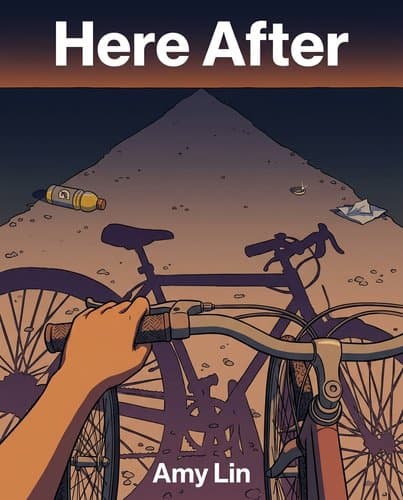
182095845_here-after
by Amy Lin
The grief timeline you've been given is fiction—and the map being wrong explains why you feel so lost. Amy Lin dismantles the myths that isolate the bereaved…
In Brief
The grief timeline you've been given is fiction—and the map being wrong explains why you feel so lost. Amy Lin dismantles the myths that isolate the bereaved and offers a ruthlessly honest guide to building a real life inside loss, not beyond it.
Key Ideas
Five Stages Model Never Designed for Bereaved
The Five Stages of Grief were developed from Elisabeth Kübler-Ross's work with the terminally ill — people facing their own deaths — and were never designed to describe the experience of the bereaved. If you have felt 'stuck' or 'behind schedule' in your mourning, the map was wrong, not you.
Grief Creates Measurable Physiological Health Crisis
Grief is a measurable physiological threat, not just an emotional state. The 'widowhood effect' includes a 2.5x higher risk of suicide in year one and elevated mortality from cardiac events, stroke, and accidents. The people around the grieving often have no idea this is happening.
Visible Recovery Often Masks Internal Grief
The 'Good Signs' that reassure observers — smiling, returning to work, going on dates — are often strategic performances by the bereaved to prevent the social abandonment (over 50% of support networks gone within a year) that actually makes grief worse. Visible functioning is not evidence of internal healing.
Empathy Requires Actually Imagining Their Pain
When someone who is grieving says 'I can't imagine what you're going through,' they are often asking the bereaved to perform their pain as something incomprehensible, which forecloses the only thing that actually helps: being witnessed. You can imagine it. Try.
Grief Brain Persists Beyond Scientific Timelines
Grief does not have a four-to-six month arc or a linear progression toward acceptance. Counselors and therapists cannot cite a research source for these timelines because there isn't one. What Lin calls 'grief brain' — the neurological impairment of acute mourning — can persist for years, and the second year is often worse than the first.
Shared Language System Becomes Permanently Silent
The private language of a long-term partnership — the shorthand, the inside jokes, the specific way someone shakes their head — dies with the person. Mourning is not just the loss of the individual; it is the extinction of a shared system of meaning that no one else in the world can speak.
Who Should Read This
Readers who connect with first-person stories about Memoir and Mental Health and want to see the world through someone else's eyes.
Here After
By Amy Lin
13 min read
Why does it matter? Because everything you think you know about grief is built on a mistake.
The cultural script for grief has a beginning, a middle, and an end. Denial, anger, bargaining, depression, acceptance — a clean five-act structure, a wound that closes. What almost no one knows is that this framework was never designed for the bereaved at all. It was designed for the dying. For decades, we've been handing the wrong map to people standing in the wrong country. Amy Lin's husband collapsed on a bridge at thirty-two, his heart stopping without explanation, his autopsy returning the word undetermined. What followed was not a journey toward acceptance. It was a permanent restructuring — of her body, her identity, her relationship with time itself. Here After is the document of someone who stopped waiting for the wound to close and learned, instead, to build a life inside the loss. It will change how you understand grief — and, more uncomfortably, how you've been reading the people living inside it.
A Stranger in a Blue Blazer Crosses the Street, and Everything After Depends on It
Amy Lin is idling at a crosswalk when a man strides through the frame of her windshield. Dark blue blazer. Long legs. Something in the way he moves — a particular ease — that makes her think, with real longing, why can't I ever meet a man like that? She is on her way to a blind date. So is he. He is the blind date.
The crosswalk scene earns its meaning slowly. In Amy Lin's memoir Here After, it works less as romantic comedy setup than as a time bomb. We know, from the first pages, that this man she watched crossing the street will become her husband, and that she will lose him. Every detail of how they found each other carries extra weight because of that.
The detail that carries the most: before their second date, Kurtis reads a blog Lin wrote while studying abroad and calls her. She'd told him she was a substitute teacher. He isn't buying it. 'You're a writer,' he says. She says she isn't. He says she is. What makes the exchange devastating isn't the romantic sweetness of it — it's that Lin had never said those words about herself out loud. Not once. She'd kept the label at arm's length the way you keep something fragile from surfaces that might break it. He simply walked past her defenses and named what he saw.
Grief, Lin's book argues from its earliest pages, is the absence of a specific person — the one who knew which version of you was real when you didn't. Kurtis wasn't the man who happened to show up in a blue blazer and fall in love with her. He was the first witness. That is a different, and much harder, thing to lose.
That Night Is His Last Night
The night before the half-marathon, Kurtis wraps a blue gel band around his wife's head to help with her headaches. They lie in bed scrolling through Vancouver apartment listings — she has agreed to move there, agreed to try writing full-time, though both agreements terrify her. He is certain she will write a bestseller. She points out that he cannot possibly know that. He grins, shakes his head, changes the subject: does she want to hear some hot gossip? She is already falling asleep. Tell me in the morning, she says. Yes, he says.
That night is his last night.
The next morning, August 15, 2020, he eats half a plain bagel and drinks half a yellow sports drink — the worst color, as Lin notes, but his favorite. He swings his long arms loose at his sides, doing the pre-race fidget of someone whose body knows what it's doing even when his mind feigns doubt. I'm a little scared, he tells her, grinning. He ran track through all four years of university; she knows he isn't scared. Before he walks out the door, she tells him not to go too hard. She tells him she loves him.
At the eleven-kilometer mark, her family is still running toward ten. He is already past them, laughing and calling out each of their names as he passes. This is the last time any of them see him moving through the world.
Lin doesn't linger on what happened next — not here. She doesn't have to. The hot gossip never gets told. The Vancouver apartments stay on a screen. The phrase 'don't go too hard' sits in the reader's chest like a splinter, because the reader now understands what Lin could not have understood when she said it: that those were among the last ordinary words she would ever say to him. She kept the label at arm's length the way you hold something you're not sure belongs to you yet. The yellow sports drink. The lanky arms. The name she said at the door. This is what grief's archive looks like — not the dramatic moments, but the ones you didn't know to pay attention to.
He was the first witness. And that is a different, and much harder, thing to lose.
The World Immediately Tries to Measure What Cannot Be Measured
The world's first response to catastrophic loss is bureaucratic. Before Lin has finished absorbing the fact that her husband is dead, the systems around her begin their work of measurement — producing scores, scales, and checklists that insist grief is something that can be graded.
Somewhere in the early weeks after Kurtis dies, Lin takes a standardized grief assessment for her family doctor. She scores 74.4 percent. Her doctor's reaction is that the score is very high. Lin's internal reaction is not gratitude for the validation — it's the bleak satisfaction of proof: see, she wants to say, it really is this bad. That response tells you everything about the secondary wound the medical system opens without meaning to. She has lost her husband. She is now also in the position of needing a score to confirm that her suffering registers. The test was presumably designed to help, and it does help, in the narrowest sense — it hands her a number she can show someone else. But it also reframes her grief as a condition to be measured rather than a reality to be witnessed. The 74.4 becomes a strange artifact: clinical enough to legitimize, insufficient enough to humiliate.
The pain scale administered at another appointment goes further. Lin is handed a list of descriptors — throbbing, stabbing, fearful, punishing-cruel — and asked to rate each on a four-point scale from none to severe. The words blur on the page. She has to press her finger beside each one to hold her place. Then her doctor mentions that confusion about what happens next is a common symptom of grief, and Lin stops. What does happen next? she asks. The doctor means it as reassurance — this disorientation is normal, it has a name, it will resolve. Lin means it as the actual question of her life.
The Five Stages of Grief Were Never Meant for You
Lin is trying to read grief research with a brain that keeps losing the thread mid-sentence. Not the argument — individual words. She has to reread the word 'death' before it will stay put. And in that state, laboring over Kübler-Ross, she finds it: the Five Stages were developed from observations of people who had been given terminal diagnoses. Denial, anger, bargaining, depression, acceptance — these described what it felt like to face your own death. They were never designed for the person left behind. Lin reads this, is certain she has misunderstood, reads it again. Her grief brain is not the problem. The framework was built for a different kind of pain and handed, without correction, to an entirely different group of sufferers.
The damage this does is specific. When mourning doesn't resolve on schedule — when there's no clear arc toward acceptance, when you are still wrecked at month seven or year two — the culturally available explanation is that you are doing it wrong. The stages imply a finish line. They imply forward motion. They make grief look, from the outside, like a project that a competent person would eventually complete. Inside it, Lin finds, grief looks nothing like that. It is not sequential. It has no obvious endpoint. The map and the terrain are completely different places.
What Lin comes to is blunt: she is not failing at grief. The framework failed her first.
'Good Signs' Is Just Another Word for Performing Recovery for an Audience
Imagine a smoke detector with a dead battery. You'd never know the difference until the fire started. This is roughly what the social grammar of recovery asks of grieving people: look functional, and you will be treated as functional, which is the only way to keep the people around you from leaving.
Amy Lin learns the math of this early. Her grief counselor shares a number that reorders everything: most widows and widowers lose more than half their support network within the first year, worn down by the relentless weight of someone else's mourning. Around six months after Kurtis dies, Lin's counselor warns her that grief often sharpens rather than softens at this stage. Lin takes both pieces of information together and draws the only rational conclusion available to her: if she lets people see how bad it actually is, they will go. So she begins curating. She smiles. She showers. She asks friends how their kids are doing. She eats vegetables. She becomes, in the vocabulary of her social circle, someone who is 'in good spirits.' Alone in the bathroom, she is sobbing into a towel.
The cruelty of this is structural, not personal. The friend who tells Lin 'I have to protect my light' — that she cannot keep hearing about the grief if it is always going to be this sad — is not a villain. She is just someone who has been handed a situation with no exit and chosen the one available to her. But that choice turns Lin's grief into a secret she must actively maintain. The performance of recovery stops being a coping mechanism and becomes a full-time job, one that consumes exactly the energy she does not have.
Lin and her friend Rebecca — also a young widow, about a year out from her own loss — walk a sleek black dog through a park and catalogue the markers outsiders read as healing: landing a job, booking a solo trip, going on a date, brushing your hair. They have both done some of these things. Neither of them goes a day without wondering whether life is worth continuing. The checklist and the interior are completely unrelated. That is the gap the reader has to sit with: the people who look the most recovered are often the ones working the hardest to keep you from seeing that they aren't.
Her Body Began Failing the Same Week She Was Asked to Plan His Funeral
Grief will kill you. Not metaphorically — statistically. Widows and widowers face roughly a 22 percent higher mortality rate in the period following their spouse's death, and the mechanism isn't always despair. Sometimes it is the blood itself, thickening under the chemical storm of acute stress until it pools and clots in veins that were, days earlier, working fine.
Ten days after Kurtis dies, Lin is at a cemetery with her parents, choosing the site for his memorial bench, when her father — a physician — notices something wrong with her leg. The skin is discolored. There is a pain radiating from her groin into her inner thigh. He insists on the emergency room immediately. At the hospital, the nurse's eyebrows lift when he names his suspicion: deep vein thrombosis almost never presents in someone Lin's age. Most patients are over forty. Lin, meanwhile, is running her own counter-argument in her head — a logic that feels airtight in grief-brain and sounds delusional outside of it: she cannot have a blood clot, because her husband just died. Surely, she thinks, that is enough.
It isn't. The ultrasound finds large clots in her femoral vein. More clots in the veins of her abdominal cavity. More still in her lungs. When the ER doctor asks whether she's had rib pain or trouble breathing, she says yes — but she has an explanation ready: grief, all that crying, the physical wreckage of mourning. The doctor listens and gives her two words in response: yes, clots. Her body had been miming the symptoms of bereavement while quietly staging a medical emergency, and she had no framework for telling the difference, because the cultural script for grief treats it as emotional weather, not organ failure.
The procedure required to save her — a mechanical thrombectomy, performed while she remains half-conscious — is followed by twenty-four hours flat on her back in the ICU, her back muscles seizing from enforced stillness. When the vascular surgeon comes to say the thinners haven't fully dissolved the clots higher in her chest and recommends a second procedure, he frames it as the sensible choice for the long run. Her response is not hysterical. It is precise: her husband died at thirty-two. She has nothing to say to the long run.
The widowhood effect is real. Lin's collapse isn't a coincidence or a metaphor. It is what happens when the body takes loss at its word.
The Ring in the Tissue, the Wedding Suit That No Longer Fits, the Green START Button
Her father places a folded tissue in her hand before she leaves the hospital. When the paper relaxes open, Kurtis's wedding ring is inside. Lin slides it onto her middle finger — the only one where it will stay — and it fits loosely. That is the first time she cries.
The ring is the same one she watched him photograph on his own hand, the one he never took off, the one he treated as evidence of something he couldn't believe was real. He used to sit on their bed admiring the framed vows, the stacked wedding cards, the Polaroids arranged around them. He photographed his own hand. He told her, more than once, that he loved being her husband. Now the ring is in her father's pocket because someone had to remove it from a dead man's finger, and the looseness of it on her hand is the first physical fact of her new life: she is now the wrong size for everything they built together.
At the crematorium, there is a green button on the side of the chamber, oversized and labeled START in white letters. The casket has already been lifted on a hydraulic platform and transferred through a corrugated metal door, which has rolled down and locked. The woman operating the equipment asks if Lin wants to push the button. Lin walks toward it. This is the furthest I can go with him, she understands. She pushes it. The chamber roars — filling the concrete room, her ears, her head, everything — and there is nothing left to do but stand there and let it.
That is what the cultural script for grief leaves out: it has no word for what Lin is doing. Not mourning, exactly. Not coping. Something more like accompaniment — the determination to remain present for every impossible act rather than let them happen to you. She put on his ring. She went down in the elevator. She pushed the button. None of these things healed her. That was never the point. The point was to keep going toward him until the door closed, and then to keep standing.
She Didn't Want to Survive. She Wanted a Deadline.
Suicidal ideation after catastrophic loss is, in Amy Lin's telling, the most rational thing in the world. Not a symptom to be managed. Not a crisis to be talked down from. A logical conclusion reached by a person who has run the numbers on unbearable pain and an unknown quantity of years still to go.
The psychiatrist at the urgent psych intake center is the first person who seems to understand this. He is physically too large for his chair, and he doesn't work from a checklist. When he asks if she feels like she's been run over by a train, Lin corrects him: you hear a train coming. The distinction matters — it describes not sudden devastation but prolonged, helpless anticipation. He listens. He doesn't argue. He asks about the stent recently placed in her body to prevent another life-threatening clot, and Lin tells him what she hasn't told anyone else: she didn't consent to that procedure to live longer. She consented so that a random second clot wouldn't rob her of the choice of where her life would end. The stent was about agency, not survival. When the psychiatrist responds — 'You are clearly the kind of person who will decide for herself' — Lin feels her shoulders relax. Not because she's been saved. Because someone has finally acknowledged that she is the one in charge of this decision, and treating that as pathology would be the wrong move.
This is what Lin's book argues that the crisis-hotline framing cannot accommodate: the desire to die, at this depth of grief, is not irrational. It is a person insisting on a limit. By eight months out, she has named it formally — 'Freedom 35,' a plan she discloses to her parents, her closest friends, her therapist, because she needs them to understand she is serious. Not that she intends to act immediately. That she needs a horizon. The pain has to lessen, she tells her therapist, one way or another. The plan is not fixed. It is a ceiling on suffering.
What makes this so hard to sit with is that Lin's logic is coherent. The psychiatrist's gift as he sends her away — a small silver turtle, with the instruction to go slowly — is not a cure. It's a counter-proposal. Not 'you're wrong to feel this way' but 'try the slowest speed available to you.'
The Only Language She Spoke With Him Is Now Dead
An elderly woman posts on a widows' forum about a husband who died more than forty years ago. She has remarried since, more than once. But she is one of the last people still alive who knew him, and so she catalogs him the way you catalog something you're afraid of forgetting: his love of turkey dinners, his warmth with children, his private name for the ritual of getting into bed — 'opening the mail,' a phrase that existed only inside their life together and died when he did. 'He was always my favorite,' she writes. Lin reads this in the dark and understands something precise: a spouse's death is also a linguistic event. The words, the gestures, the whole private code two people build across years — it all goes with them, except for one speaker, left holding a language with no one left to speak it to.
The evidence is everywhere in Lin's account, but it accumulates most painfully in a dream she has only once. Kurtis appears with his hair long, the way it was when they first met, leaning in a doorway. They sit side by side, and she does what she always did — tells him the unspeakable, the heavy thing she could only ever say to him. He responds with a small, familiar shake of his head, lips pressed together, the corners turned up just slightly. She has seen that expression a thousand times. She knows exactly what it means. The specific words he speaks dissolve before she can catch them, but the gesture carries everything. Their language didn't require the words to work. That was the point. And when she wakes, she is the only person in the world who knows what that headshake means, or meant, or will never mean again to anyone.
The last speaker. It is an accurate description of what survives when a marriage ends in death. Kurtis called her 'baber.' He placed spunky pauses between the last three words of a voicemail. He had a light, bouncy cadence that she replays from a recording until her vision blurs, saying into the phone: please come back. He doesn't. The voice loops. She keeps going anyway, carrying a language only she can hear.
Grief Does Not End. You Learn to Carry It Into the Dark.
What does it look like when grief is over? You probably have some image — tears less frequent, mornings manageable, a version of yourself that has moved through the stages and arrived somewhere calmer. Amy Lin's memoir quietly dismantles that image over the course of its final chapters, and replaces it with something more honest and more durable.
Somewhere during the months after Kurtis dies, Lin scrolls through an online post asking followers: what's one thing you wish people understood about grief? She reads the first twelve responses out of several hundred. Every single one says the same thing in different words: it doesn't end, it never goes away, it is always there, it is forever. Hundreds of people, at different stages of loss, all arriving at the same chorus — not because grief is uniformly unending in its intensity, but because it does not resolve into the absence of itself. It becomes part of the terrain.
But carrying the grief forward is not the same as being paralyzed by it. Late in the book, Lin follows a near-stranger — a peripheral friend of Kurtis's — up a height above a lake and jumps. The fall is long enough that she has time to think: afraid to live, afraid to die, afraid of how much there is to fear. All of it arrives at once, rushing through her body. Then she hits the water and surfaces, and for the first time since Kurtis died, she actually laughs. She notes the laugh carefully: it is not the old one. It is new. The old laugh belonged to someone whose husband was still alive. This one belongs to whoever she is now.
That distinction — not recovered, but genuinely, newly laughing — is what the book finally offers. On the memoir's last night, Lin cycles an unpaved path she has avoided all month, riding through the dark, the earth still radiating the day's heat beneath her wheels. She looks for her shadow. There is no single dark shape trailing behind her — the light is coming from everywhere, or nowhere, and her shadow has fractured across the gravel and the scrub on both sides of the path. Kurtis is not behind her or ahead of her. He is the ground she moves across. The loss does not end. She rides anyway, into the dark, forward.
What 'Love Is Longer Than Time' Actually Means
Here is what the book leaves you with: survival is not the same thing as recovery, and pretending otherwise dishonors what it actually costs. Lin does not arrive, at the end, at acceptance or peace or any of the destinations the cultural script promises. She arrives at motion — hands shaking, riding into dark she cannot see through. That is the honest version. The person who made ordinary life feel worth the effort is gone, and she goes forward anyway, not because the going feels good, but because stopping would mean something she is not ready for it to mean. You probably know someone who looks, from the outside, exactly like Lin did — showering, answering emails, asking about your kids. The question the book leaves open is whether you are willing to imagine what it actually takes to do those things when the private language of a whole life has gone silent, and the only direction left is forward, into the dark, with everything she carries.
Frequently Asked Questions
- What is Here After by Amy Lin about?
- Here After challenges the standard model of grief by exposing its scientific, social, and neurological realities. Drawing on her own experience of loss, Amy Lin dismantles myths like the five stages model and grief timelines. The book shows readers how to build an honest, sustainable life inside loss rather than treating mourning as a problem to be solved. Lin combines research on physiological impacts—including the 2.5x higher suicide risk in year one and elevated mortality from cardiac events—with practical guidance for navigating authentic grief while maintaining social connection.
- Does the Five Stages of Grief apply to bereaved people?
- No. The Five Stages of Grief were developed from Elisabeth Kübler-Ross's work with the terminally ill — people facing their own deaths — and were never designed to describe the experience of the bereaved. If you have felt 'stuck' or 'behind schedule' in your mourning, the map was wrong, not you. This distinction is critical: many grieving people internalize shame for not following a framework never intended for them, creating unnecessary guilt when their grief trajectory simply doesn't match a model designed for the dying.
- What is grief brain and how long does it last?
- Grief brain is the neurological impairment of acute mourning, and it can persist for years—not the four-to-six months commonly claimed. Amy Lin notes that counselors and therapists cannot cite a research source for popular grief timelines because there isn't one. Critically, the second year is often worse than the first, contradicting the assumption that time automatically brings healing. Understanding grief brain as a neurological phenomenon rather than emotional weakness helps grieving people recognize cognitive struggles and memory loss as normal physiological responses.
- Why do grieving people appear to be functioning well?
- The 'Good Signs' that reassure observers — smiling, returning to work, going on dates — are often strategic performances by the bereaved to prevent social abandonment. Visible functioning is not evidence of internal healing. Over 50% of support networks disappear within a year, so grieving people perform recovery to survive socially. Meanwhile, grief triggers measurable physiological threats including a 2.5x higher suicide risk in year one and elevated mortality from cardiac events, stroke, and accidents—dangers invisible to those witnessing the performance.
Related Book Summaries

Read the full summary of 182095845_here-after on InShort