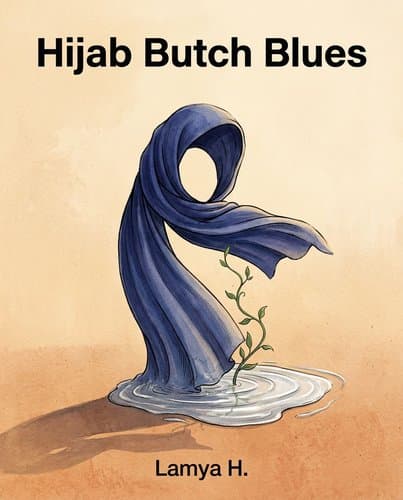
61111274_hijab-butch-blues
by Lamya H.
When the tradition you love is weaponized against you, reading it yourself becomes the most radical act available. Lamya H. finds Maryam's rage, God's…
In Brief
When the tradition you love is weaponized against you, reading it yourself becomes the most radical act available. Lamya H. finds Maryam's rage, God's genderlessness, and room for her own queer Muslim existence inside the same scriptures used to exclude her.
Key Ideas
Direct Scripture Reading Resists Weaponization
When a tradition is used against you, reading it yourself — on its own terms, without intermediary — may be the most radical act available. The author found Maryam's rage and God's genderlessness inside the same text being used to exclude her.
Doubt and Faith Coexist Divinely
Faith and doubt are not opposites. Even Ibrahim, who spoke directly to God and received miracles, said 'my heart hesitates' and was not condemned. Treating doubt as the enemy of belief is a human addition, not a divine one.
Visibility Matters More Than Palatability
The 'good queer' performance — palatable, private, non-disruptive — serves the people who want you quiet, not the community that needs you present. Suppressing your anger to stay acceptable to powerful people is what God reprimanded Muhammad for in Surah Abasa.
Strategic Withdrawal Builds Future Strength
Strategic withdrawal from unwinnable fights is not cowardice. It is how you conserve the energy to build something real. The whale is where Yunus prays, recovers, and emerges into a world his absence made ready.
Chosen Family Sacred in Exile
Chosen family built in exile has a theological precedent: Hajar built a civilization from nothing, in the desert, with a nursing baby, and it became one of the holiest sites on earth. The sacrifice that goes uncelebrated is still a sacrifice God sees.
Who Should Read This
Readers who connect with first-person stories about Memoir and Spirituality and want to see the world through someone else's eyes.
Hijab Butch Blues
By Lamya H.
11 min read
Why does it matter? Because the choice between queerness and Islam is a lie someone else invented.
Most books about being queer and Muslim begin at the rupture — the moment the two identities collide and something has to give. This one begins somewhere else: with a prophet who speaks directly to God, receives miracles, hears revelations — and still asks for proof. Ibrahim wants his heart satisfied. God doesn't condemn the question. The argument is already complete before a single scene of the narrator's life begins. If Islam has always made room for a prophet who says I believe, but my heart hesitates, then the violence Lamya H. faces is a distortion of the tradition, not a feature of it. She builds her case from scripture itself: a suicidal Maryam, a God whose 99 names carry no gender, a Black enslaved woman left in the desert with a nursing infant, whose uncelebrated faithfulness built the holiest city on earth. The choice between queerness and Islam was never hers to make. Someone else invented it.
Before She Had a Name for What She Was, She Found Herself in the Quran
Lamya's hand goes up before she knows why. She's fourteen, in the back row of a Quran class in an Islamic school in the Gulf, half-listening while composing a coded note on her scientific calculator. Then a classmate reads verse 19:19 aloud — Maryam telling the angel who appeared at her door: no man has ever touched me — and something trips in Lamya's chest. "Miss," she hears herself say, voice higher than usual. "Did Maryam say that because she didn't like men?"
The class laughs. She needs the laugh to cover the urgency. She plays it as another of her infamous class derailments, accepts the high fives in the hallway afterward. The Quran teacher gives the orthodox answer: Maryam had taqwa, God-consciousness; she turned the angel away because she knew God was watching. Lamya nods along while privately cataloging something else: a woman who lived alone by choice, who preferred solitude to a handsome man's company, who said no man with emphasis, not not yet. By the time she reaches the school bus, Lamya has a verdict: Maryam is a dyke.
The elation is physical. The bus ride home is joyous. Her mother's meatless nihari, a spiced stew she saves for celebrations, is joyous.
At fourteen, Lamya has been quietly wanting to die for months. Not dramatically, but specifically: she wants to erase herself retroactively, to have never been born. She practices this. At a dinner party, she edges herself out of a mirror's reflection inch by inch until the scene looks intact without her. At the mall she lowers her voice by fractions of a decibel until she is saying nothing. Friday sermons have given her only one framework for this feeling: suicide is cowardly, punishable by hell, the work of the devil. She has no language for the thing living inside her, just a constant craving to disappear. She also has a consuming crush on her Irish economics teacher, a feeling she can't name. In her world, "gay" exists only as an insult.
A week before the dyke revelation, a different verse had already stopped her cold. Maryam — in labor, alone under a palm tree in the desert, with no midwife, no mother, no one — screams to God that she wishes she had died, that she wants to be in oblivion, forgotten. Maryam, the only woman in the Quran with a chapter named for her, the mother of a prophet, is saying exactly what Lamya has been saying to herself for months. The thing without language has a precedent now, in scripture, spoken by someone God loved.
What Lamya finds in the text is recognition: women who didn't want men, who raged to God about wanting to die, and whom God did not abandon. At fourteen, that's enough to choose to stay alive.
God Has 99 Names and Not One of Them Is a Gender
Islam's own grammar makes the argument. Arabic has gendered nouns, and the Quran's account of the first human being contains a deliberate paradox: Adam is a masculine name, but nafs — the soul God breathed into that clay body — is grammatically feminine. The Quran says God created humanity from a single soul, and from her, her mate. That first person carried both genders before there were garments to mark the difference. Gender rigidity arrived later, as punishment for exile from paradise — the consciousness of your own body, the weight of being sorted. In the original design, there was no sorting.
The 99 names of Allah contain no gendered attributes. The names describe God in terms that exceed every binary — Al-Rahman, the Most Merciful; Al-Wadud, the one who loves more intensely than a mother; Al-Ghafoor, the Forgiver. None of them require a pronoun.
What happens when you bring this argument to a Muslim study circle — a halaqa — on a New York rooftop, the lit crown of the Chrysler Building close enough to illuminate your book, first-generation immigrant women with professional degrees and new babies. A visiting cousin starts using "she" for God. Lamya objects: that just swaps one end of the binary for the other. She proposes "they." The cousin calls it blasphemous — they is plural and Allah isn't plural. Lamya invokes the Quran's own royal "we." The cousin says that's what the transgenders use. Lamya offers the word that makes the cousin's face go red. The rest of the women flip ahead in their books and begin discussing yoga. The idea evaporates as completely as if she hadn't spoken.
She leaves the halaqa for the last time carrying one conviction: to use "they" for God, and to leave any space that isn't interested in the question. The argument that began when she was six — when her Quran teacher said God was neither man nor woman and her first unarticulated thought was is it possible that I, too, might be this something else? — has its answer. God exists outside the binary as template, not exception. The first human held both genders at once. Lamya, existing somewhere in between, is not a mistake. She has been living inside this description her whole life and only now has a sentence for it.
The Prayer Against Evil She Learned to Say About Herself
But gender is only one of the things her body has been taught to apologize for.
Rasha brings her pogo stick to the Gulf-state apartment playground an hour before Maghrib prayer every afternoon, and for weeks Lamya and her brother watch her from a corner, too shy to ask. When their mother finally marches them over, Rasha teaches them gladly. They spend one afternoon building an obstacle course together, Arab kids joining in, someone's pink Casio timing the jumps. Then Rasha's blond mother arrives, reads the scene without a word, snatches the pogo stick from the brother's hands, and walks back to the car.
The next day Rasha's brother delivers the verdict from his bike: curry people. He tells them the color on their skin will never wash off.
Lamya's first response isn't grief — it's a classification question. Are my brother and I jinn? She means it literally. She's grown up hearing jinn described as beings who appear and disappear, invisible yet suddenly present, disgusting, capable of contaminating whatever they touch. Now here's the same language applied to her brown body. She says audhubillah, the Islamic prayer for protection from evil, against her own existence.
The jinn framework threads through the next decade. In New York, a mosque friend named Rashid names the mechanism plainly: the invisibility, the fear, the contamination logic — none of it comes from her race. White supremacy created the jinn. He prescribes the Black feminist essayists Audre Lorde and bell hooks, and Frantz Fanon's writing on race and colonialism. The anger that follows is clarifying: for the first time, she can name what was done to her rather than wonder what's wrong with her.
The reversal comes on a subway during Ramadan, reading Surat al-Jinn. She's avoided this chapter her whole life. But here the text says nothing about evil: a group of jinn overheard the Quran and believed. Some of us are righteous, some less so. They're not contaminating creatures. They're complicated beings trying to find their way, same as anyone. The prayer she'd learned in self-protection turns out to have no referent in scripture. She can stop fearing jinn first, she realizes. Herself second.
The Same Verse That Freed Her Was Used to Cage Her Friends
The Quran gave Lamya a Maryam who lived alone by choice and a jinn chapter that reclassified her own existence. What does it do when that same book, in someone else's hands, becomes the argument for staying in a marriage with a man who hits you?
The figure at the center of that argument is Asiyah, one of the four women the Islamic tradition calls perfect in faith, wife of the Pharaoh of Egypt, the cruelest man God ever created. Lamya's mother deployed her constantly: to quiet bickering children in a car, to counsel a grieving cousin, to defend staying in troubled marriages at women's lecture circles. At one of those circles, a teacher made the application explicit: Asiyah is the template. Divorce, she said, is the act Allah despises most of all. The women nodded.
That template turns concrete when a friend from law school calls from a work phone (her husband controls the personal one) after two years of silence. She's a lawyer who secretly married a long-term boyfriend named Bilal. He moved her across the country, cut off her old contacts, blocked a job promotion, monitored her passwords. Then, haltingly, she says: the night before, he hit her. He cried afterward, she explains, so ashamed to have left a bruise. He told her the Quran had given him permission, but he promised he wouldn't do it again. Lamya tells her the Quran gives no such permission, that none of this is okay. The friend cries: she knows, she wants to leave. But where will she go? She hangs up. Lamya cries into a folded towel.
When she tells her mother, the response is three words: Think of Asiyah.
The same pages Lamya used to build her case are the pages Bilal cited for permission to hit someone he loved. Her mother arranged them into an argument for endurance. The scripture is not the problem. The interpretation is. Lamya's answer is not to abandon the text but to rewrite the commentary from inside it.
She imagines Asiyah leaving. Not after Pharaoh drowns — before that, in the night, on horseback, with help from the many people she had been kind to over the years. Building a life in a small house with a garden. Meeting someone who handles her hurt with care. Dying peacefully in old age. Allah gives her the paradise she asked for. Patience was never the only reading. The exit was always there. Someone just had to say it.
Coming Out Is a Prophetic Act. So Is Staying Hidden. Both Are True.
Imagine two maps of the same territory, drawn by different prophets. On one, the route is marked by the moment you speak: you tremble, you pray, the words come out, and the impossible becomes real. On the other, the route runs through silence — you stay, you endure, you build something permanent out of nothing, and no one tells the story afterward.
Lamya is traveling both maps at once.
The Quran gives her Musa (Moses, in Islamic tradition), who stood before a burning bush and was told to pick up a live snake. He hesitated. He asked God to quiet the stammer and let his words reach. Then he did it. The miracle held. Lamya maps this prayer onto a balcony in rural Southeast Asia, where she and a friend named Cara are the only two people in the world for a moment, the sky inky blue above them. Cara asks whether the person Lamya likes is a girl. Lamya cannot speak. She recites the prayer silently and nods. Cara's response is immediate and offhand. She mentions a girl she had a crush on last year. Lamya names the relief in one word: everything. The thing she'd been carrying alone wasn't hers alone anymore. Coming out, here, is a prophetic act. You tremble, you pray, the stick becomes a snake.
But the Quran also gives her Hajar, an enslaved Black woman left in the desert with a nursing baby, no water, dry breasts, no one for miles. Hajar did not speak her sacrifice into existence. She simply stayed. She ran between two hills looking for anything, and a spring burst from the ground where her son's feet had been pounding it. She named the spring Zamzam. A caravan stopped. A city grew. Makkah rose from an untold act of faithfulness.
Eid al-Adha commemorates Ibrahim's willingness to kill his son. But the city the feast is celebrated in exists because of Hajar, because of what she bore without a story to honor it. Lamya puts it plainly: Ibrahim is praised for trusting God. What about Hajar's trust in God?
That question surfaces on a bus to upstate New York, where Lamya and her partner Liv spend an hour devising rules before meeting her family as just friends. No touching. No sitting on the same couch. No inside jokes. No stories that use "we." Definitely no high-fives — those count as PDA. Her family already knows her hijab. They cannot know her queerness. She thinks of her hijab the way a gay man might think of a beard: it marks her as recognizably Muslim and reveals nothing about who she loves. The rules are an act of love: Liv becoming just a friend for a weekend, Lamya hiding what they've built, both choosing it because losing the family (the Urdu, the cricket, the biryani, the grandmother) is incalculable.
This is also a prophetic act. You stay. You trust. You build a city the story doesn't tell.
The Whale Is Not Punishment — It Is Where She Builds Her City
On a trail in the American West, seven friends hiking to a glacier, Lamya is mid-argument about prophets. The game is "favorites" — no points, except Lamya has been playing it her way. Mitra's pick: Yunus, the prophet who boarded a ship and left when his people wouldn't listen. Lamya's case against him is simple: he gave up. The whale was his punishment.
Mitra slows, links her arm through Lamya's. He was also a fighter, she says gently — he preached, argued, begged. He knew when continuing was destroying the message rather than spreading it. Leaving wasn't failure. It was protecting himself so he could keep believing in what he was fighting for.
The words find something specific. Three years before this hike, Lamya had argued with a racist coworker until he was more entrenched and she was empty. The next morning she sat fully dressed watching buses move past her window without standing to catch one. Her chest hurt. Her limbs wouldn't move. That paralysis produced a set of rules: only fight people you genuinely care about who are genuinely open. Replace rage with questions and quiet. Leave when the conversation is taking more than it gives.
She had thought of the rules as retreat. On the trail, Mitra offers her a different word.
In the Quran, the whale isn't a punishment. It carries Yunus to a remote shore, deposits him gently, and God grows a vine to shelter him while he recovers. He returns to find his people converted in his absence — they needed time and space without him. The whale was where he prayed and came back ready.
Lamya's whale is her pseudonym, her writing, her chosen family — the protection that lets her fight without exposing the people she loves to those who would find her address. Inside it: Mitra, Liv, and the others she names throughout the book. A seemingly inhospitable shelter that has produced, as Hajar's exile in the desert produced Zamzam, a spring around which a city grows. Standing at the trailhead, the glacier behind her, her people around her, blueberry pie and s'mores ahead, she can see the city. She has been living in it for years.
The World That Fourteen-Year-Old Lamya Couldn't Begin to Imagine
The fourteen-year-old edging herself out of a dinner party mirror wasn't missing a piece of herself that would one day arrive. She was missing readers — people who had been inside the same text and found different things. The Quran she'd been given had been explained before she could read it herself. When she finally did, it was full of women who raged to God about wanting to die, jinn who simply wanted to believe, a prophet in a whale who emerged not punished but ready.
That's the book's argument. Not that she survived the distance between the mirror and the glacier, but that carrying the tradition on her own terms collapsed it. The friends at the trailhead, the blueberry pie ahead: that's Zamzam. You don't have to abandon anything to build something real. Hajar didn't know a city was coming. She stayed, and one came anyway.
Notable Quotes
“Indeed, I seek refuge in the Most Merciful from you, [so leave me], if you should be fearing of Allah.”
“I am only the messenger of your Lord to give you [news of] a pure boy [Isa].”
“How can I have a boy while no man has touched me…”
Frequently Asked Questions
- What is Hijab Butch Blues about?
- Hijab Butch Blues (2023) is a memoir-essay tracing a queer, nonbinary Pakistani Muslim immigrant's journey through Islamic scripture to reclaim a tradition used against her. The author reads the Quran on its own terms, finding within it a genderless God, a doubting Ibrahim, and the exiled Hajar, demonstrating that the text already holds radical human experience. She argues that exclusion comes from human interpretation, not divine intent. By engaging directly with scripture without intermediaries, she reclaims Islam as a resource for her own liberation and identity, challenging the gatekeeping interpretations that have marginalized her.
- What does Hijab Butch Blues say about doubt and faith?
- Hijab Butch Blues argues that faith and doubt are not opposites but compatible experiences. Even Ibrahim, who spoke directly to God and received miracles, said "my heart hesitates" and was not condemned for this uncertainty. The author demonstrates that treating doubt as the enemy of belief is a human addition, not a divine one. By centering scriptural examples of doubt, she challenges Muslim communities to create space for questioning believers, suggesting that doubt itself can be a form of spiritual engagement within Islamic tradition.
- What does Hijab Butch Blues say about the 'good queer' performance?
- Hijab Butch Blues argues that the 'good queer' performance — palatable, private, non-disruptive — serves the people who want you quiet, not the community that needs you present. The author contends that suppressing anger to stay acceptable to powerful people is what God reprimanded Muhammad for in Surah Abasa. By examining how communities demand assimilation from queer members, the work suggests that such pressure undermines rather than strengthens faith. Instead, the author advocates for authenticity, visibility, and emotional honesty as expressions of religious commitment.
- What does Hijab Butch Blues teach about chosen family and exile?
- Hijab Butch Blues provides a theological foundation for chosen family and survival through exile. The author traces Hajar's story as precedent: "Hajar built a civilization from nothing, in the desert, with a nursing baby, and it became one of the holiest sites on earth." She argues that sacrifices made outside institutional recognition and celebration are still witnessed and valued by God. For queer Muslims and other marginalized believers who build community outside traditional structures, this narrative offers spiritual validation. The work suggests that creating chosen family is not merely survival strategy but sacred practice with deep Islamic precedent.
Related Book Summaries
Read the full summary of 61111274_hijab-butch-blues on InShort