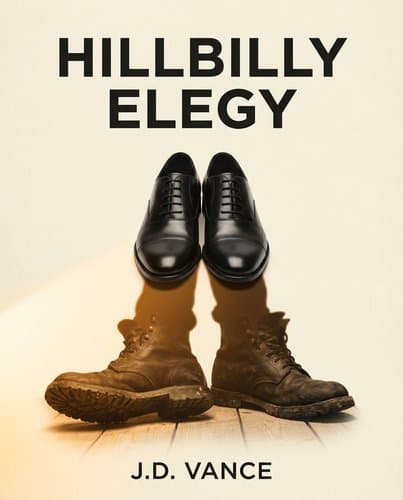
27161156_hillbilly-elegy
by J.D. Vance
A Yale-educated veteran looks back at the Appalachian culture that raised him and finds it encoded in his own rage, distrust, and survival instincts—revealing…
In Brief
Hillbilly Elegy (June) traces J.D. Vance's path from Appalachian poverty to Yale Law School to examine why working-class communities struggle even when opportunity is available. It reveals how survival behaviors absorbed in chaotic childhoods become lasting neurological patterns, and shows why escaping poverty demands more than economic access — it requires confronting the psychic cost of leaving your culture behind.
Key Ideas
Mindset and culture trump opportunity
Economic opportunity is necessary but not sufficient — a culture that teaches learned helplessness will underperform even when good jobs are available and actively offered, because the problem is a stance toward agency, not a shortage of chances.
Childhood trauma creates permanent neural patterns
The survival behaviors absorbed in a chaotic childhood — hypervigilance, honor-based rage, distrust of institutions — aren't character flaws. They were adaptations. But they are neurologically encoded and persist long after the original danger is gone, which is why 'just leaving' doesn't work.
One stable adult outweighs economic factors
For a child in poverty, the single most powerful predictor of a different outcome isn't school quality or household income — it's having one stable adult who won't leave, one address that doesn't change, one set of rules that holds across years.
Success requires abandoning cultural identity
Upward mobility requires moving away from the cultural identity that protected you, which is why many working-class people stop short of the exit — not from lack of ability but from the psychic cost of feeling like a traitor to the people and places that made them.
Only communities reshape poverty narratives
The poverty trap is sustained not only by lack of opportunity but by a cultural narrative that converts legitimate grievance into a refusal of agency. Changing that narrative is the one thing outside institutions — schools, governments, employers — cannot do for a community. Only the community can.
Who Should Read This
Readers who connect with first-person stories about Memoir and Social Issues and want to see the world through someone else's eyes.
Hillbilly Elegy
By J.D. Vance
11 min read
Why does it matter? Because the thing keeping people trapped isn't what the policy debate thinks it is.
In a D.C. hotel room, mid-argument with the woman he loved, J.D. Vance realized he'd brought the whole thing with him. He was at Yale Law School by then, years out of Appalachian Ohio — and it had followed him anyway.
The standard story about places like Middletown, Ohio goes: factories closed, jobs vanished, towns hollowed out, people fell behind. An economics story, told with numbers — trade deficits, wage stagnation, the collapse of manufacturing. Fix the economy, fix the people.
Vance grew up inside that story. Watching his mother cycle through addiction and men, watching neighbors refuse decent jobs and blame the government, he found the economics story missed the deeper one. The factory closings were real. But something else had gotten into the people too: behaviors, reflexes, and beliefs absorbed in chaos that don't dissolve when the circumstances improve.
A Good Job Won't Save You If the Culture Teaches You Nothing Is Your Fault
A warehouse in southwest Ohio, the summer before J.D. Vance left for Yale Law School: a nineteen-year-old named Bob has just been fired from a floor tile job that paid good wages, offered health insurance, and even arranged a clerical position for his pregnant girlfriend when she needed work. His response to the manager is to demand an explanation — not for his own months of chronic lateness and hour-long bathroom breaks, but for how someone could fire a man with a baby on the way. He didn't see a consequence. He saw a betrayal. That's the conviction, and it's the engine of everything Vance sets out to explain.
The job matters. Thirteen dollars an hour in Middletown, Ohio, where a decent apartment ran five hundred a month — real money, with raises to sixteen for anyone who stayed a few years. One of Bob's coworkers used a second shift at the warehouse to fund flying lessons; the job was a vehicle, and he drove it. The position wasn't a last resort. Yet by the time Vance left, the warehouse had cycled through a string of young workers, and Bob's bathroom breaks had grown so reliably long, sometimes over an hour, that his coworkers timed them with a stopwatch and shouted milestones across the floor like spectators at a race.
The real problem is a conviction that your life happens to you rather than because of you — and Bob is its purest expression. Pew survey data gives this shape beyond any single story: working-class whites are the most pessimistic group in America, less hopeful about their children's futures than Black Americans or Latino immigrants who face materially steeper odds. Only 44 percent expect their kids to outperform them economically. That's not just responding to hard times. That's a community that has stopped believing effort and outcome are connected. When a man spends an hour in a bathroom stall, his coworkers don't complain to management. They get a stopwatch.
The Culture That Wounds You Is Also the One That Holds You Together
When a truck driver pulled up to one of Uncle Pet's timber businesses and told the old hillbilly to unload his delivery, calling him a son of a bitch as punctuation, Pet took the phrase literally. That word, he explained calmly, was a direct comment on his mother. He asked the driver to watch his language. The driver repeated the insult. Pet pulled him from the cab, beat him unconscious, and dragged an electric saw across the man's body until he nearly bled out. He survived. And when the police came asking, the truck driver, himself from Appalachian country, refused to say a word. He knew exactly what it meant to insult a man's mother.
What looks from the outside like derangement is, from inside the code, entirely proportionate. Breathitt County ("Bloody Breathitt") earned its nickname because the formal legal system had barely reached these hills, and where it had, it served coal companies before it served miners. Justice came from the community instead: a man accused of raping a young girl turns up in a local lake, sixteen bullets in him, days before his trial; the newspaper records only "foul play expected" and the matter closes. You might call that vigilante horror. People inside the culture called it the code filling the gap that law left open.
Vance grew up absorbing this through the Blanton men — his grandmother's mountain family — who passed their stories down as history rather than warning. The violence had rules: defend your kin, punish betrayal without mercy, and never take family business to an outsider. Loyalty wasn't a value alongside other values. It was the whole structure.
The structure traveled north. The conditions it was built for didn't. When Mamaw and Papaw settled in Middletown, Ohio in the late 1940s, they brought the code into a world of HR departments, zoning boards, and police who expected disputes to move through formal channels. The Vances hadn't internalized that expectation. When a pharmacy clerk scolded young Uncle Jimmy for handling a toy he couldn't buy, Papaw didn't ask to speak with a manager. He smashed the toy on the floor, hurled another across the store, threatened to break the clerk's neck, and then, with Mamaw, his grandmother, still throwing merchandise and shouting, continued Christmas shopping as if a light rain had passed.
They were following a code that said respond to disrespect with force, protect yours, take the shame out of the equation immediately. It had worked in the hills where it was forged. In Middletown it registered as violence, as mental illness, as the behavior of people who couldn't function in polite society. The culture that had held these families together for a century was now the thing that made their kids look broken to anyone watching from outside.
The Real Intervention Wasn't School or Motivation — It Was the Same Address Three Years in a Row
The single variable that changed J.D. Vance's life was the one nobody talks about in policy debates: he stopped moving.
From third grade through ninth, Vance lived at nine different addresses across seven years, cycling through five of his mother's boyfriends and stepfathers, a domestic violence case, children's services, and his grandfather's death threaded through it all. Reading the catalog produces a kind of vertigo. Preble County with Bob. The 200 block of McKinley Street. The 300 block of McKinley Street. Dayton with Matt. Back to Middletown with Ken and his three kids, strangers. Each time his mother entered a new relationship, J.D.'s world reorganized itself around someone else's problems.
Then the moves stopped. His mother's addiction finally crossed a line even Mamaw — his grandmother, the woman he was about to move in with — couldn't excuse: a morning scene involving a demand for clean urine, a nursing board drug test, and the eruption of years of held-back fury from a teenager who had contained it too long. Mamaw asked J.D. to move in permanently. He did.
What followed was nothing dramatic. The same house, the same woman, the same three rules: get good grades, get a job, help around the house. Gin rummy games where Mamaw accused him of cheating just to lose that badly. His grades improved immediately. He tested into honors math, aced the SAT, found teachers who made him want to learn. In the memoir, he renders the three high school years with almost clinical understatement. Each grade gets a single identically worded sentence: he lived with Mamaw, in her house, with no one else. Tenth grade. Eleventh. Twelfth.
That's the whole argument. Not inspiration. Not a scholarship or a program. The thing that worked was the removal of the condition that had been destroying him: the constant uncertainty about where he'd live next month, who would be in the house, whose emotional crisis would restructure his week.
Mamaw could provide stability because she was alone, disciplined, and committed. Most kids around J.D. had nothing like that waiting for them. The culture — serial relationships, financial chaos, children absorbing the shock of each new disruption — was producing the same instability for the next generation. Mamaw scraped together $180 for a graphing calculator he needed for honors math, every penny she had. Only someone who knew she'd still be there in two months could plan like that. Stability costs nothing. It just requires everything the culture makes hardest to hold onto.
You Can Leave the Town. You Cannot Leave the Wiring.
Near Ford's Theatre in Washington, D.C., there is a corner store that sells Lincoln memorabilia. The centerpiece is an inflatable Abraham Lincoln with an enormous grin — which struck Vance, standing outside it on a winter evening, as one of the stranger jokes the universe had arranged. He had just stormed out of his hotel room after exploding at his girlfriend for trying to comfort him after a bad law firm interview. Lincoln, frozen forever in good cheer a half-block from the place where someone shot him in the head, seemed to be mocking him specifically.
Vance had, by any measure, made it. Yale Law student, summer at the U.S. Senate on his résumé, prestigious firm job almost in hand. When Usha gently suggested he'd probably done better than he thought in the interview (and if not, there were other options), his response was to inform her he hadn't gotten this far by making excuses for failure, and then leave.
Standing outside in the dark, he placed the moment in its genealogy. His mother had fled to a Comfort Inn with a toy poodle after a screaming match with one of her boyfriends. Her mother had run out the back door with her children to escape an alcoholic father on a rampage. He was the third generation to respond to conflict by escaping it. The geography had changed. The reflexes hadn't.
When he turned back, Usha was sitting on the steps of Ford's Theatre. She had followed him into the cold, worried. He apologized expecting retaliation: in his experience, an apology was a surrender, and when someone surrendered, you pressed the advantage. Usha didn't. She said, through tears, that running away was never acceptable, that she'd been worried, that he needed to learn to talk to her. Then she hugged him and said she accepted the apology. That was the end of it.
He had never seen anything like it. Conflict in his world ended with winners and losers, or didn't end at all. The first time he visited Usha's family for Thanksgiving, he kept waiting for the backstabbing, the accusations between in-laws, the stored grievances. They never came. Her father, asked about a distant relative, offered sympathy and a quiet observation: you don't abandon family members because they pull away. You keep calling. That worldview was structurally incomprehensible to him.
Harvard pediatric researchers put a name to what Vance had already lived: adverse childhood experiences. He gave his family the ACE quiz, a ten-question checklist of childhood trauma developed by CDC researchers. His aunt Wee scored a 7 out of a possible 10; his sister Lindsay and J.D. each scored 6. Usha and her uncle each scored 0. The people who seemed almost unnaturally stable were simply the ones who had never experienced what Vance considered ordinary childhood. Those same researchers found that chronic stress physically rewires the brain's threat response, keeping it permanently activated. The fight-or-flight reflex that helps a mother lift a car off her child becomes a constant companion with no off switch. For kids like Vance, something was always about to go wrong at home, and their bodies never got the signal that it had stopped. That wiring remains long after the danger is gone.
This is what escape from poverty actually looks like: the address changes, the school changes, the salary changes. The nervous system doesn't get the memo.
"We Created This" — But That Means Something Harder Than Blame
At a fast-food restaurant in rural Kentucky, Vance sits across from Brian, a teenager whose mother lost custody to opiates, who ends every sentence with "please" or "thank you," who eats quickly and watches the room with anxious eyes. Vance can read the signals; he grew up with the same reflexes. When he wraps an arm around the boy and asks if he needs anything, Brian whispers, refusing eye contact: he wonders if he could maybe get a few more french fries. He is hungry. In 2014 America, he cannot bring himself to ask for food.
Months later, his mother dies. What Brian loses isn't just her — it's the hope that things might still turn.
Every clean answer about poverty breaks here. The structural case is real and documented: deindustrialization, welfare traps, geographic isolation explain things personal-responsibility rhetoric never can. But Brian grew up inside all of that structural damage and still managed to say "please" to every sentence. The problem isn't that no one told him to work hard. Brian has no Mamaw at home, no single person for whom his outcomes matter more than their own chaos.
Vance refuses the comfortable synthesis. Government can adjust how foster care recognizes extended family, reform how housing vouchers concentrate poverty instead of dispersing it, fund the early interventions that Middletown teachers say come twenty years too late. All of that is real. And none of it touches a neighbor on his street who sold her son's Christmas gifts for drug money, or a man he worked alongside who quit because he was tired of mornings and then blamed the economy. Governments didn't build those habits. Communities did.
For twenty years, Vance had a recurring nightmare: trapped in a tree house, his mother charging through as a screaming robotic monster, Mamaw always slipping out the exit just ahead of him. After law school, the dream returns, but now he is the monster. Chasing his dog through the tree house, intending harm. He catches the dog. Then gives it a hug instead.
He wakes feeling relief. Not triumph, not resolution. Just relief at having controlled the reflex. The book leaves you here: not with the question of whether the system failed the hillbillies or the hillbillies failed themselves, but with a smaller, harder one. When the inherited behavior rises — the flight, the rage, the damage handed down like furniture — can you stop? That question doesn't have a policy answer. It barely has a personal one. But it's the only question left, and Vance is the one person who might know how much it costs to ask it honestly.
The Monster Who Learned to Stop
Usha Vance scored zero on the ACE quiz. Her husband scored six. The gap isn't abstract: a six correlates with roughly twenty times the risk of IV drug use and a life expectancy measurably shorter than a zero's. They share a house, a marriage, children. One of them carries the whole weight of Middletown into every difficult moment. The other doesn't. The book is what that arithmetic looks like from the inside.
Vance wrote it while running for Senate, which is its own kind of statement. Whatever he's working through privately, he chose to do it publicly — here is what happened to me, here is the score, here is where I still feel the pull. That choice doesn't resolve anything. But it enacts the argument: you can't interrupt what you haven't named.
Notable Quotes
“Off-load this now, you son of a bitch.”
“When you say that, you're calling my dear old mother a bitch, so I'd kindly ask you speak more carefully.”
“There is nothing lower than the poor stealing from the poor. It's hard enough as it is. We sure as hell don't need to make it even harder on each other.”
Frequently Asked Questions
- What is Hillbilly Elegy about?
- Hillbilly Elegy traces J.D. Vance's personal journey from Appalachian poverty to Yale Law School while examining why working-class communities struggle even when opportunity is available. The memoir deeply explores how survival behaviors absorbed in chaotic childhoods become lasting neurological patterns, revealing that escaping poverty demands far more than economic access—it requires confronting the psychic cost of leaving your culture behind. Vance uses his own compelling experience to illustrate broader truths about class mobility and cultural identity in contemporary America.
- What are the key takeaways from Hillbilly Elegy?
- The memoir reveals that economic opportunity is necessary but not sufficient—a culture teaching learned helplessness underperforms even with available jobs. Survival behaviors from chaotic childhoods (hypervigilance, honor-based rage, institutional distrust) persist as neurological patterns long after original dangers fade. The single most powerful predictor of escaping poverty isn't school quality or income but having one stable adult who won't leave. Upward mobility requires abandoning the cultural identity that once protected you, explaining why many resist advancement. Finally, poverty traps persist through cultural narratives converting legitimate grievance into refusal of agency.
- How does Hillbilly Elegy explain why poverty persists despite available opportunities?
- Vance argues the problem isn't a shortage of chances but a cultural stance toward agency. "A culture that teaches learned helplessness will underperform even when good jobs are available and actively offered, because the problem is a stance toward agency, not a shortage of chances." Survival behaviors from poverty—hypervigilance, honor-based rage, institutional distrust—become neurologically encoded patterns persisting long after original dangers disappear. These adaptations were necessary survival mechanisms but now sabotage opportunity-seizing, demonstrating that escaping poverty requires psychological and cultural transformation alongside economic access.
- What does Hillbilly Elegy identify as the key to escaping poverty?
- Vance identifies one stable adult as the most powerful predictor of different outcomes. "For a child in poverty, the single most powerful predictor of a different outcome isn't school quality or household income — it's having one stable adult who won't leave, one address that doesn't change, one set of rules that holds across years." This insight challenges conventional assumptions about poverty interventions focusing on schools or income alone. Emotional security and consistent relationships appear more transformative than material resources, suggesting belonging and stability fundamentally matter to breaking poverty cycles.
Related Book Summaries

Read the full summary of 27161156_hillbilly-elegy on InShort