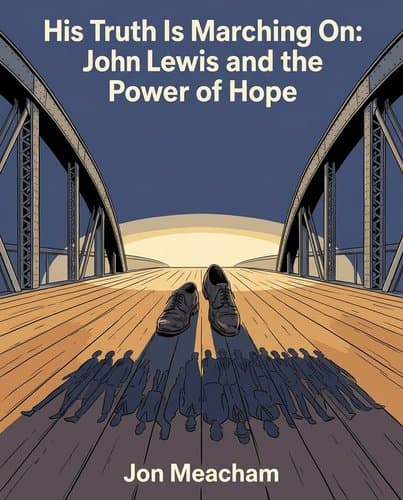
53431510_his-truth-is-marching-on
by Jon Meacham
John Lewis didn't stumble into courage — he trained for it, treating nonviolent resistance as a precision discipline forged from scripture, Gandhi, and…
In Brief
John Lewis didn't stumble into courage — he trained for it, treating nonviolent resistance as a precision discipline forged from scripture, Gandhi, and rehearsed confrontations with violence. Learn how deliberate suffering, witnessed by millions on television, became the most effective political weapon in American history.
Key Ideas
Nonviolence requires deliberate training and preparation
Nonviolent resistance is a learnable discipline with a specific curriculum — scripture, Thoreau, Niebuhr, Gandhi, and repeated role-playing of physical confrontation before it happens. Lewis trained for years before he was ever arrested.
Training transforms suffering into meaningful witness
The psychological mechanism of civil disobedience works by reframing arrest and suffering as evidence that the cause is right. Lewis called his first arrest 'coming home' — not because he suppressed fear, but because the training gave suffering a meaning that sustained him through it.
Public visibility powers moral witness leverage
Moral witness becomes political leverage only when it forces the powerful to choose sides publicly and visibly. The Selma footage on ABC, not the march itself, is what moved LBJ. The method requires an audience.
Systems neutralize pressure through limited concessions
The same political system that can be moved by moral witness can also absorb and neutralize it. Atlantic City showed that the system will offer just enough to defuse the pressure without changing the structure — and that no movement can avoid this reckoning.
Nonviolence and self-defense are coherent alternatives
The debate between nonviolent witness and armed self-defense is not a debate between wisdom and error. It is a debate between two coherent responses to state terror, and the movement's own fracture in 1966 makes clear that Lewis's path did not automatically prevail even within the movement.
Hope is daily practice, not optimism
Hope, in Lewis's framework, is not an emotion you feel when things are going well. It is a daily practice of attending to what is right — transmissible across generations, teachable to strangers, and distinct from optimism about outcomes.
Who Should Read This
History readers interested in Political Figures and Memoir who want a deeper understanding of how we got here.
His Truth Is Marching On: John Lewis and the Power of Hope
By Jon Meacham & John Lewis
11 min read
Why does it matter? Because John Lewis wasn't brave — he was trained.
March 2020. John Lewis is eighty years old, frail from pancreatic cancer, walking back across the Edmund Pettus Bridge in Selma — the same bridge where, fifty-five years earlier, state troopers fractured his skull while he was trying to pray. He is not returning to bear witness. He is not performing nostalgia. He is, as he has always been, marching. The question isn't "how was he so brave?" Bravery is too thin a category for what Lewis was doing. What Lewis carried with him was something more specific and more useful: a method. A trained theological discipline — drawn from scripture, sharpened by James Lawson's workshops, tested on the bodies of college students in Nashville lunch counters and on an Alabama highway — that turned suffering into leverage. The astonishing claim is that it worked. And that it can be learned.
Lewis Wasn't Naturally Brave — He Was Trained to Transform Suffering into Power
In the basement of Clark Memorial United Methodist Church in Nashville, a group of young Black students sat across from one another and practiced being beaten. One person would lean forward and blow cigarette smoke directly into another's face. Someone else would simulate a punch. The point was to drain the reflex. James Lawson, a Methodist minister who had studied Gandhi's methods in India, told them: it is not enough to refuse to strike back. The urge itself has to disappear. You have to love the person hitting you.
John Lewis sat in those Tuesday night workshops in 1958 and 1959 and absorbed it completely. He was nineteen, the son of Alabama sharecroppers, a farm boy who had grown up preaching to the family chickens in Pike County. In Lawson's basement sessions, he found the technical instruction for something he already believed but had no method to enact.
Lewis's capacity for nonviolent witness was a constructed thing, built layer by layer. The foundational premise came from Walter Rauschenbusch, the Social Gospel theologian Lewis first heard through King's sermons on WRMA Montgomery in 1956: Christian duty demands direct action against unjust institutions. "Whoever uncouples the religious and the social life," Rauschenbusch wrote, "has not understood Jesus." Lawson provided the method: Gandhi's synthesis that "Christ furnished the spirit and motivation, while Gandhi furnished the method," translated into exercises rehearsed in a church basement.
By 1960, that training was ready to be used.
His First Arrest Felt Like Liberation, and That Was the Whole Point
Lewis's first arrest was not the price he paid for his principles. It was proof the strategy was working.
On February 27, 1960, Lewis walked into Nashville's Woolworth's knowing white attackers would come. A local minister had warned the students that morning, and the police had been told to stand aside. When Lewis was knocked to the floor, cigarettes pressed into his back, and handcuffed while his attackers watched and cheered, the outcome looked, from the outside, like defeat. The police were arresting the wrong people. Lewis described the paddy wagon — grimy, wire-caged, packed with students — and then called it a chariot.
That turn is the whole argument. Lewis and his fellow students had been trained in Lawson's workshops to understand that arrest was not failure but threshold. The state's machinery of punishment, deployed against people who had committed no moral wrong, revealed the injustice it existed to conceal. The strategy only worked if you could hold the moment — which is why the workshops existed, why students practiced absorbing smoke blown in their faces, why Lawson insisted the urge to strike back had to be eliminated entirely, not merely suppressed.
Lewis compared crossing into jail to Christian conversion. He wasn't describing his emotional state. He was describing the outcome Lawson's curriculum was designed to produce: a clarity of commitment so complete that the cage felt like freedom and the charge of disorderly conduct felt like a badge.
The students sealed the logic by refusing bail. They sang in the cells, chanted "Jail without bail," and chose thirty-three days in the workhouse over a fifty-dollar fine. Three thousand people gathered at the courthouse. The arrests had converted a lunch counter dispute into a spectacle of moral accountability: the state detaining Black students for the crime of sitting quietly while white men who had beaten them walked free. That contradiction, once fully staged, could not be unseen.
Suffering, willingly accepted and publicly witnessed, does not merely endure injustice. It illuminates it.
The Method Demanded You Accept What Was Being Done to You
At the crest of the Edmund Pettus Bridge on March 7, 1965, John Lewis looked down at the Alabama River and across at a wall of state troopers blocking Highway 80. Hosea Williams, leading the column alongside him, leaned over. "John, can you swim?" Lewis said no. Williams said a little. "Well, there's a lot of water down there," Lewis replied. "We're going to have to keep marching."
That exchange, dry and almost comic, is the human scale of what came next. Within seconds of Major Cloud's final warning, the troopers advanced. Lewis was the first person hit. A billy club connected with his skull; seventeen-year-old Charles Mauldin, three rows back, heard the impact and said he would never forget the sound of it. Lewis went down. He vomited. He tried to get up and was struck again. His skull fractured. His vision blurred. The troopers ignited twenty canisters of tear gas; the first had failed to scatter the column. He could hear horses, screams, slurs.
Lying on the asphalt, as Lewis later wrote, he thought: People are going to die here. I'm going to die here.
Then: It's OK. It's all right. I am doing what I am supposed to do.
That peace is the most unsettling thing in this book. Not the violence — Justice Department observers documented that nightsticks were deployed before any resistance occurred, swung indiscriminately at men and women alike, with a mounted posseman chasing a fourteen-year-old girl on horseback. The violence is appalling but explicable. What requires explanation is the inner state of the man on the ground. Lewis did not panic. He did not rage. He felt, in the moment he believed he was dying, something closer to completion than terror.
Those Tuesday night workshops in Lawson's church basement had been designed to drill out the retaliatory reflex and replace it with something practiced and deliberate. Bloody Sunday reveals what the training had actually produced: not suppressed fear but the absence of it. The Sermon on the Mount blesses the peacemakers, but Lewis had internalized something more demanding: the willingness to be destroyed by the forces he refused to become.
Worth Long, a former Air Force medic, improvised a stretcher from a chair and strips of tablecloth and persuaded the mounted possemen to let Lewis through the cordon by speaking the only language he calculated they might honor: "We have a soldier who's down." It worked. Lewis was loaded into a bread truck, taken to Good Samaritan Hospital, diagnosed with a fractured skull, and asleep by ten. While he slept, ABC broke into the broadcast premiere of Judgment at Nuremberg to air the footage.
The method demanded you accept what was being done to you. At Selma, Lewis showed what that acceptance cost — and what it made possible.
Blood Became Political Leverage — But the System Learned to Absorb It
Think of it as a lever, not a conscience. The movement's nonviolence generated moral force not by awakening guilt (period surveys showed 60 percent of Americans disapproved of the March on Washington in 1963, and by 1966 fully 85 percent of white Americans said demonstrations hurt the cause) but by forcing decision-makers to take a position in front of an audience. When footage of state troopers beating nonviolent marchers at the Edmund Pettus Bridge aired on national television, cutting into the broadcast premiere of Judgment at Nuremberg, Lyndon Johnson was not moved — he was pressured. Eight days after Bloody Sunday, he stood before Congress and ended his speech by borrowing the movement's own anthem. Watching from a Selma dentist's living room, King wept. The lever had worked.
But levers have an absorptive limit. Atlantic City, in August 1964, is where the movement discovered it.
Fannie Lou Hamer, a sharecropper from Mississippi and part of an integrated delegation challenging the state's all-white party machine for seats at the 1964 Democratic convention, testified before the credentials committee about being arrested on her way home from a voter registration workshop, dragged to a county jail, and then, at officers' direction, forced to lie face-down on a bunk while fellow Black prisoners were ordered to beat her with a blackjack until they collapsed from exhaustion. A white man pulled her dress up while she was being beaten. She closed simply: Is this America? Those three words, broadcast nationally, became the movement's indictment of itself.
The testimony was devastating. Johnson knew it the moment she began. So he scheduled a sudden presidential press conference (billed as a briefing on Democratic governors) to pull cameras away before she finished. The networks cut to the White House.
It was worse than that. The FBI had been monitoring the delegation's hotel rooms throughout the convention, feeding transcripts directly to the White House. When Lewis and his colleagues rejected the offered compromise (two ceremonial at-large seats rather than recognition as Mississippi's legitimate delegation), they were not merely losing a floor fight. The private debates in which they had weighed that offer had been read in real time by the administration making it.
Lewis called Atlantic City the turning point of the movement. The method depended on making the powerful choose sides in front of an audience. Atlantic City showed the powerful had learned to manage the audience: program competing events, listen through hotel walls, offer just enough to claim good faith. The suffering was no less real than at Selma. But it generated no footage anyone was permitted to see.
Malcolm X Had a Point, and the Book Doesn't Pretend Otherwise
What does Meacham do with Malcolm X? The easy version would be to present him as the cautionary contrast, the violent alternative that Lewis wisely rejected. Meacham doesn't do that.
He frames Malcolm's "any means necessary" as drawing on the same American Revolutionary tradition as George Washington and Patrick Henry: both had resorted to arms against an oppressive government to claim rights the powerful refused to grant. If that logic justified the founding generation, Malcolm argued, it should justify Black Americans facing state-sanctioned beatings, bombings, and murder. Meacham doesn't call this a moral error. He calls it a moral argument, one grounded in the same founding canon as the republic itself.
Once Malcolm's logic lands, the easy contrast is gone. If you've been reading the prior sections and feeling settled in Lewis's method — trained suffering, deliberate witness, the lever of public shame — you have to reckon with what happened at Atlantic City: the lever broke, and the people absorbing the violence were losing patience with being asked to stand still for more of it. David Dennis eulogized James Chaney in Mississippi in 1964. Chaney was one of three civil rights workers murdered that summer in Neshoba County; Dennis, a CORE organizer who had worked alongside him and survived, was asked to speak at the funeral. He didn't preach love. He screamed: Stand up! Don't bow down anymore. We're the ones who go to funerals. Meacham includes that cry without calling it a mistake.
Joseph Lowery, a King lieutenant, says it plainest. Time had named Lewis a saint. Lowery said he'd never heard anyone in the Black community use that word for him. White people, he observed, tend to approve of Black people who present as humble. Meacham quotes this, does not answer it, and proceeds with the saint argument anyway. The reader sits with both. And with what Lowery's critique implies: if he's right, the saint frame made Lewis's method legible and even reassuring to white observers, which is part of why it worked. Lewis's nonviolence moved the people it needed to move partly by not threatening them. That is not a verdict against him. It is an uncomfortable truth about what moral leverage costs.
Lewis's answer, the one the whole book builds toward, is that hope is not optimism, not a wager on outcomes, but a practice. Sustained through training and community and deliberate repetition, the way a musical form gets carried from one generation to the next. Lewis was still picking his feet up and putting them down in 2020, eighty years old and weakened by cancer, on the same bridge where his skull was fractured.
Hope Is Not a Feeling — It Is a Practice You Can Transmit
Dying of pancreatic cancer in 2020, John Lewis kept describing the same dream to Jon Meacham. He was marching, hearing singing, feeling his feet on the pavement. What he did not dream about was the beatings — not Selma's fractured skull, not Rock Hill's mob, not the nightsticks on the Pettus Bridge. His sleeping mind chose the music, not the blows.
That is his final definition of hope: not an emotional state he maintained through exceptional faith, but a practice so deeply embedded it reorganized even his unconscious. His last line to Meacham: "You have to believe it can be real, that it can be more than a dream." Not a consolation. A method.
Lewis identifies three links in the chain. James Lawson learned Gandhi's synthesis in India and carried it to a church basement in Nashville. Lewis sat in those Tuesday night workshops. After Bloody Sunday — after footage of marchers being beaten on the Pettus Bridge aired on national television — Robert Kennedy told movement leaders, "We now understand," proof that sustained nonviolent witness could reach even powerful people who had resisted it. Each link held because someone transmitted it deliberately: Lawson not merely preaching nonviolence but drilling it into young bodies, week after week.
Lewis's formula is three-part: faith in the dignity of every human being, persistence in pressing the cause, hope that restless souls will eventually bring things right. But faith and persistence are active. They are things you do, repeatedly, in community, the way a musical tradition gets carried from one generation to the next.
The chain ran from Gandhi to Lawson to Lewis to Kennedy. It moved through bodies in church basements, through songs on bridges, through the patience of people willing to absorb violence without returning it. Lewis believed it could move that way again.
The March That Does Not End
Lewis died in Atlanta on July 17, 2020, dreaming of the march — the singing, the light, the weight of feet on pavement. Not the blows. His sleeping mind had found a way to keep what sustained him and set down what it cost.
His final line to Meacham was an assignment, not a comfort: You have to believe it can be real, that it can be more than a dream. He was naming a practice — something built in church basements, drilled into bodies, carried across generations by people willing to pay the tuition.
The question he left is harder than admiration: whether you would enter the room. The workshops. The texts. The Tuesday nights. The bridge. Whether you would submit to a curriculum whose first lesson is that the cost is real and the outcome is not guaranteed.
That question has no graceful exit. He knew that. He kept asking anyway.
Notable Quotes
“I must educate, arouse, and mature a public opinion….This I do by frankly and candidly criticizing its present policy….My criticism is not, like that of the traitor presses, meant to paralyze the administration, but to goad it to more activity and vigor.”
“men—actual men, possessing all the turbulent passions belonging to that animal.”
“Like everyone around me, I was basically playing it by ear,”
Frequently Asked Questions
- What is nonviolent resistance in John Lewis's framework?
- Nonviolent resistance is a learnable discipline with a specific curriculum, not an intuitive response to injustice. In His Truth Is Marching On, Jon Meacham shows how John Lewis trained extensively in scripture, Thoreau, Niebuhr, and Gandhi—studying philosophy and repeatedly role-playing physical confrontation before experiencing arrest. Lewis practiced this discipline for years before his first arrest. The psychological mechanism works by reframing suffering as evidence that the cause is morally right, giving pain a redemptive meaning. Lewis called his first arrest "coming home"—not because he suppressed fear, but because training had transformed how he understood his own suffering.
- How did moral witness become political leverage in the civil rights movement?
- Moral witness creates political leverage only when it forces the powerful to choose sides publicly and visibly. In His Truth Is Marching On, Meacham argues that the Selma footage on ABC News, not the march itself, moved President Johnson to act. The method requires an audience and depends on visibility. However, the political system proved capable of absorbing and neutralizing this pressure. At Atlantic City, the system offered just enough concessions to defuse pressure without changing its underlying structure, revealing a fundamental challenge: no movement can entirely avoid this reckoning with systemic accommodation.
- What does John Lewis mean by hope as a daily practice?
- In His Truth Is Marching On, John Lewis redefines hope as a daily practice of attending to what is right, not an emotion tied to optimistic outcomes. Hope is teachable across generations and transmissible to strangers—a discipline sustained through action rather than feeling. This framework emerged from Lewis's spiritual formation and his understanding that hope must survive disappointment. Unlike optimism, which depends on external circumstances improving, Lewis's hope persists regardless of whether outcomes succeed. It grounds moral action in present commitment rather than future certainty, making it resilient to defeat and sustainable across decades of struggle.
- What does His Truth Is Marching On reveal about limitations of nonviolent protest?
- His Truth Is Marching On shows that nonviolent resistance and armed self-defense represent two coherent responses to state terror, not a debate between wisdom and error. The civil rights movement itself fractured in 1966 as debate intensified over whether Lewis's nonviolent path was sufficient or necessary. Meacham presents this not as a failure of Lewis's vision but as an unresolved tension within the movement. The book acknowledges that moral witness, while powerful, can be defused through strategic concessions that preserve systemic inequality. This honest assessment complicates triumphalist narratives and reveals why the movement could not achieve consensus on its central strategic question.
Related Book Summaries
Read the full summary of 53431510_his-truth-is-marching-on on InShort