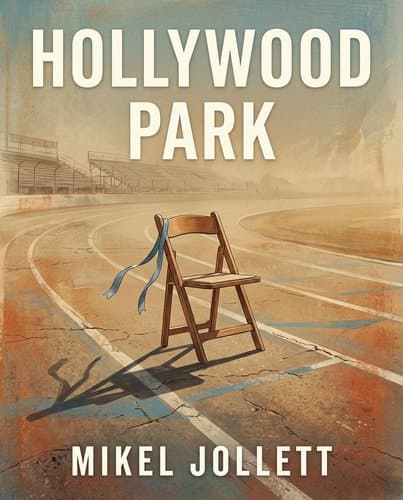
49235526_hollywood-park
by Mikel Jollett
Born into a cult where love was indistinguishable from control, Jollett spent decades unlearning the survival strategies that protected him as a child but made…
In Brief
Hollywood Park (2020) is a memoir examining how childhood trauma — cult upbringing, parental abandonment, and chronic emotional neglect — shapes identity and makes adult intimacy difficult.
Key Ideas
Warmth was real; so was damage
When abuse is designed to feel like belonging, the victim often spends years defending the very institution or person that harmed them — not because they're confused, but because the warmth was real. Identifying the damage doesn't require erasing what was genuine.
Unwitnessed loss becomes untrusted reality
A loss that goes unwitnessed doesn't get processed as grief — it gets metabolized into a belief. If no adult acknowledges what you saw, what you felt, or what happened to you, the mind doesn't file it under 'sad thing that happened.' It files it under 'I can't trust my own perception of reality.'
Childhood emotional roles don't expire
Parentification isn't primarily about adult tasks. It's about being recruited into a psychological role — managing a parent's emotions, confirming their worldview, being the cowboy who never leaves — that requires suppressing your own interior life. The job description doesn't expire when you grow up.
Protection strategies sabotage adult intimacy
The adaptive strategies that protect a child in a chaotic household — dissociation, emotional performance, building an interior hiding place — are precisely the strategies that make adult intimacy feel impossible. They have to be consciously unlearned; they don't dissolve on their own just because the danger is gone.
Knowing damage differs from healing it
Understanding the source of your damage intellectually is not the same as healing from it. Jollett could name every mechanism — the attachment disorder, the parentification, the NPD framework — for years before anything changed. The comprehension had to arrive somewhere more embodied before behavior shifted.
Making love useful requires new learning
There is a difference between making your pain useful and making your love useful. The first is a survival skill. The second is a different skill entirely — and the memoir's final instruction is that once you've mastered the first, you have to learn the second from scratch.
Who Should Read This
Readers who connect with first-person stories about Memoir and Mental Health and want to see the world through someone else's eyes.
Hollywood Park
By Mikel Jollett
10 min read
Why does it matter? Because the first thing you learned about love is probably still running your life.
Synanon called itself a cure. Former addicts, true believers, people who genuinely wanted a better world — they built a commune in California and separated babies from their parents at six months, on the theory that Dope Fiends would only pass their damage on. The first thing Mikel Jollett ever learned about love was that it lived somewhere else and came to visit. He didn't know that was damage. It felt like the shape of the world. Which is how the deepest damage works — it doesn't arrive as pain. It arrives as reflexes. As duty. As the bone-deep certainty that your job is to manage the feelings of the people who should be managing yours.
The Most Effective Abuse Is the Kind That Looks Like Belonging
A small boy wakes in a dark dormitory to his mother's face: shaved head, nervous eyes, blue overalls. She tells him they have to leave right now, quietly, without waking anyone. He blinks at her. She is the woman he's been told to call "Mom," the one who visits sometimes and cries. He knows her from those visits the way you know a photograph.
His first question is not "Are we safe?" or "Where are we going?" It's: "What about Clubby and Bonnie?"
That question is the founding wound of Hollywood Park, Mikel Jollett's memoir about growing up inside Synanon, a California drug-rehabilitation commune that had, by the time of his childhood, become a full-fledged cult. Jollett was six months old when the commune's founder decreed that addicts would damage their own children, so all the kids would be raised together in a group home called "the School." Parents cycled in for a morning or an afternoon, then disappeared again for months. The women who actually raised him were Bonnie and Clubby, who cooked, played games, held him after bad dreams, and called him "Suuuun" in a low baritone that made the word feel like a small warm room.
So when his mother comes to take him away, Jollett doesn't experience rescue. He experiences loss. Bonnie and Clubby are his parents in every way that matters to a four-year-old's nervous system, and his mother is a kind stranger with sad eyes who squeezed him during visits. The cult's cruelest engineering wasn't the surveillance, the punishment squads, or the leader's furious radio broadcasts. The harm was administered in the form of warmth. Genuine warmth, from real people who loved him. Bonnie actually loved him. That's what makes the chapter unbearable: he wasn't wrong to love her back.
He has never ridden in a car. He wonders, as she carries him through the dark, whether it will feel like flying.
Years later, when a girlfriend's mother asks him methodical questions — Were the caregivers fingerprinted? Was there oversight? Any certifications? — he reaches for the only phrase Synanon gave him: "We were children of the universe." He hears it come out of his own mouth and understands, maybe for the first time, that a phrase designed to sound like belonging was always just a way of filling the space where a name for the wrong should have been.
It Wasn't the Loss — It Was That No One Saw It Happen
Phil pulls his orange camper van into the Berkeley driveway and reaches for the groceries. He looks up at Mikel on the porch and smiles. Before Mikel can make a sound, two men in skin-colored masks appear from behind the van and start swinging narrow clubs. Phil collapses all at once — the way a stack of blocks tips over — puts his face in his arms, and screams for help into the street. Mikel presses against the porch column, frozen. If he stays still enough, maybe he disappears. Through the crook of his arms, Phil looks straight at Mikel, almost apologetic, like he's sorry Mikel has to see this. The men pause, scan the neighborhood kids gathered across the street, and ask whether anyone knows where Tony and Mikel are. Nobody speaks.
That night, Mikel tells his mother he's scared. She says he isn't. He's happy to be with his mother now, away from Synanon. When he insists, she delivers the verdict: "But you weren't even there." She says it twice, in two separate conversations. Mikel wonders if she's right. Maybe fear that goes unseen isn't real. He starts wetting the bed. She scolds him for it.
The trauma isn't Phil getting beaten. It's what his mother does to the event afterward. She doesn't deny it happened; she denies that Mikel witnessed it. A more precise erasure: your experience is not evidence. He starts asking what he shouldn't have to. Whether something can be real if no one sees it. Then he does what she modeled. He learns to put things away.
Shelf space was becoming scarce. Paul, the stepfather who'd offered fishing trips and warm silence, would disappear and reportedly die — delivered to Mikel as an offhand rumor, "something I heard," with no funeral and no real explanation. Just another entry on the list of things that don't exist: Synanon, the men with clubs, Mom's long depressions, Dad, and now Paul.
The lesson accumulates without being stated: love arrives, love leaves, and neither event gets named. Which leaves you holding something real with nowhere to put it and no one to confirm it's there.
His Job Was to Be the Cowboy Who Never Leaves
Think of parentification and you probably picture something logistical: a ten-year-old translating immigration forms, a kid cooking dinner because no one else will. The harm is visible because the task is legible: adult labor in a child's hands. What's harder to see is the other kind, where there's no task list, only a role: keep her from going under. That role has no hours, no quitting time, and the person filling it often can't name it as a job until decades later, because it never felt like work. It felt like love.
After Synanon, back in Berkeley with their mother, Mikel gets the second kind. When her depression — the family calls it the "deep-russian" — pulls her under, the boys don't just manage the household. They manage her inner weather. If she zones out staring at the ceiling, Tony shakes her shoulder. If she cries, Mikel soothes her until she stops. When he repeats the slogan from the Al-Anon poster in their kitchen, "one day at a time," she marvels that he speaks like a wise old man. She doesn't register that he learned it from watching her lips move.
His mother calls him into her bedroom, lies face-down with her pants pulled below her waist, and asks him to rub ointment on her back. Then she hands him a vibrator and tells him to hold it against her skin. He doesn't refuse. He tried once: "Do I have to?" What came back was wounded silence and the accusation of being an Ungrateful Son. So he holds the device until his fingers go numb and feels himself rise through the ceiling into a space behind a wall fifty feet thick, where he becomes, in his own accounting, two inches tall of empty invisible nothing. That's not adaptation. That's dissociation as survival. The self exits the room because the room doesn't allow a self.
The boys watch from the window as their mother dresses for dates: lipstick, gold earrings, green shoes. Mikel understands, without having words for it yet, the transaction he's been enrolled in. Bonanza plays every night after day care, and the men on horseback who either stay or get driven out are his only model of what men do. He is being asked to be the cowboy who never leaves — his mother's answer to the men who did. No gun, no horse, no way to quit. Just the job of filling a shape that was never his to fill, and a self that has learned, very young, to go somewhere else when it is.
The Father You Dread Becoming Is Also the Father Who Saves You
On interval workout days at the high school track in Los Angeles, Mikel Jollett runs with an image fixed in his mind. As the burn sets in, lactic acid pulling at his legs like taut cords, he summons an empty room: blue floor, shaft of light from a high window, three wooden chairs. His father sits in one. His brother Tony sits in another. The third is empty, waiting, and the room is a jail cell.
He pumps his arms and drives toward the line. Not me. Not that.
Jim Jollett, his father, became the fuel. He had materialized on Mikel's sixth birthday smelling of Old Spice, done time at Chino prison under the number A-73581, and sworn with such effortless music that his six-year-old son spent weeks practicing the cadence under his breath. Every interval, every burning final straightaway, Mikel is running from the empty chair.
Then on his sixteenth birthday, at the L.A. City mile finals, his father is in the stands.
Jim has been there all season, sitting alone, waving as Mikel rounds the final curve, warming him without knowing he's the reason Mikel runs at all. Now the whole family is assembled: grandmother, aunts, stepmother, girlfriend. His father too, sitting on his hands with a smile. The race starts. By the third lap Mikel is fighting the sensation that nothing will ever change, that the empty chair will catch him. At the bell lap he stumbles, nearly falls, catches himself, pulls wide into the outer lane — where, he later thinks, dreamers run — and comes through first. He goes down on the track when he crosses the line.
Afterward, his father finds the blue ribbon and turns it over in his hands, studying it the way you'd study something you can't quite believe. He reads the name embossed on the medal (a name they share) and murmurs, half to himself, that certain people have not managed to bury them yet.
Mikel wants to tell him. He never does. There's no language for the thing he'd need to say: that the man he loves most is the same man whose fate he's been using as a ghost to haunt himself forward. The wound and the cure are the same person. The father who was absent long enough to become a cautionary tale inadvertently handed over the only fuel that worked. You can't say thank you for that; you can barely hold both things in your mind at once. So he just carries their shared name across the finish line and watches his father hold it like a trophy he didn't know he'd earned.
The Stage Saved His Life and Kept Him Alone
Making pain into art was the skill that kept Mikel Jollett alive — and the one that kept everyone else at arm's length.
The pilgrimages make this clear. Working as a music journalist, he secures a late-night interview with Robert Smith, the Cure's singer, still in smeared red lipstick, hair a rat's nest, pacing a Manhattan hotel room at two in the morning with a beer in his hand. Jollett doesn't want to talk about guitar tones. He wants the secret: how do you take longing and fear and shame and turn it into something? Smith says it plainly: some songs exist for no reason except the act of screaming at the world. Then at the door he leans in. He's always hated the idea of normal. Normal is everything deadening about being alive.
Jollett carries this through years of playing to doorstaff in empty clubs, through first shows in Echo Park, and eventually onto the Coachella main stage two acts before Morrissey, looking out at a crowd spread across five football fields. The screaming works.
What he can't say for a long time is the sentence that surfaces during the touring years: he couldn't be in the relationships. He could only write songs about them. "Sometime Around Midnight" — played five times daily between the White Stripes and the Red Hot Chili Peppers — exists precisely because Amber was in a bar with someone else. The stage is the fortress where he feels safe, safe from intimacy most of all. Earlier, David Bowie had told him to write about the contradiction. He did. He just didn't understand yet that a survival philosophy and a relationship philosophy are different things.
The Understanding That Has to Arrive in the Body
The thought arrives without warning. His son is six months old — alert now, focused, beginning to reach — and Mikel Jollett is holding him when the realization lands: this is exactly how old Synanon children were when they were handed to strangers.
Years of therapy had given him the vocabulary for what was done to him. He knew what attachment disorder meant, knew why closeness triggered panic and solitude triggered a different kind of panic, knew the clinical contours of his mother's disorder and the precise name for the role she'd drafted him into. Misha had mapped it all until Jollett could see where the swamps were before he fell in. He understood it all — the way you can understand that a burn is going to hurt before you've touched the stove.
Then he's holding this specific weight, and understanding becomes something else. Someone had decided, through a loudspeaker, that parents were the problem and handed a child this age to strangers. That lands as wrong, the way a broken rib announces itself when you breathe. He'd known for years it was abuse. Now he felt it in his arms.
The final chapters turn on a single move. Therapy was necessary: you can't cross ground you haven't mapped. But Jollett spent years carrying the knowledge of his wound without ever feeling it in his body. It took a specific physical fact to close that gap: his own son, his own arms, the exact age when the harm began.
Jollett imagines a room buried a thousand feet beneath a demolished racetrack, where his grandfather Frank asks whether the ache in his chest has changed. Jollett says there's something new there, love maybe, in the place where the pain used to live. Frank presses a hand to his shoulder and tells him to make that useful too. Small distinction, but exact. Pain-as-fuel had gotten him to the finish line, through empty clubs and track intervals and years of songs about people he couldn't stay with. Love-as-material is what you build after the running stops.
The Room a Thousand Feet Down
The physical places that held your most important moments eventually get sold. Hollywood Park — where Jollett's grandfather once watched horses run, where the whole family still assembles in his imagination — was purchased three weeks after his father died and cleared for something the future needed more. You can't demolish what's already been moved underground. The memoir ends in a room a thousand feet beneath the rubble, where Frank presses a hand to his grandson's shoulder and delivers the final instruction: take what's now in the place where the pain used to live and make that useful too. It's the same invitation the book extends to you. Not to perform recovery or manufacture meaning, but to notice — once the running stops, once your arms are holding something real — that love has quietly moved into the place where the ache used to live.
Notable Quotes
“We have to go, we have to go now. You have to be quiet, honey.”
“What about Clubby and Bonnie?”
“Shhh … We can write to them, I promise.”
Frequently Asked Questions
- What is Hollywood Park about?
- Hollywood Park is a 2020 memoir by Mikel Jollett examining how childhood trauma—cult upbringing, parental abandonment, and chronic emotional neglect—shapes identity and makes adult intimacy difficult. The book explores the critical gap between intellectually understanding damage and actually healing from it. Jollett traces how survival strategies that protect children in chaotic environments (dissociation, emotional performance, psychological hiding) become obstacles that sabotage adult relationships. Through his personal story, he demonstrates that these protective mechanisms don't automatically dissolve when danger ends; they must be consciously unlearned. The memoir illustrates how trauma survival patterns persist into adulthood unless actively addressed.
- What are the key takeaways from Hollywood Park?
- Hollywood Park reveals that intellectual understanding fundamentally differs from emotional healing. "When abuse is designed to feel like belonging, the victim often spends years defending the very institution or person that harmed them—not because they're confused, but because the warmth was real." Equally important: unwitnessed losses become embedded beliefs rather than processed grief. The memoir explains how childhood parentification—being recruited to manage a parent's emotions—continues affecting adult patterns. Most critically, "The adaptive strategies that protect a child in a chaotic household—dissociation, emotional performance, building an interior hiding place—are precisely the strategies that make adult intimacy feel impossible. They have to be consciously unlearned; they don't dissolve on their own just because the danger is gone."
- How does childhood trauma affect adult relationships in Hollywood Park?
- According to Hollywood Park, the survival strategies children develop in chaotic environments directly sabotage adult intimacy. "The adaptive strategies that protect a child in a chaotic household—dissociation, emotional performance, building an interior hiding place—are precisely the strategies that make adult intimacy feel impossible." Jollett emphasizes that parentification particularly damages relationship capacity by training children to manage caregivers' emotions rather than access their own needs. The book demonstrates these patterns persist because they were once necessary for survival; the nervous system doesn't automatically recognize environmental safety when danger passes. Healing requires consciously recognizing these learned patterns and actively retraining psychological responses to permit genuine connection.
- What does Hollywood Park teach about healing trauma?
- Hollywood Park emphasizes that intellectual understanding of trauma mechanisms—naming attachment disorders, parentification, and narcissistic patterns—doesn't automatically produce healing; comprehension must become embodied. A critical distinction Jollett makes: "There is a difference between making your pain useful and making your love useful. The first is a survival skill. The second is a different skill entirely." Once trauma survivors master converting pain into survival functionality, they face a new learning stage: deliberately building love and connection from personal agency. The memoir suggests healing requires moving beyond understanding damage to developing skills for authentic connection, which must be learned deliberately.
Related Book Summaries
Read the full summary of 49235526_hollywood-park on InShort