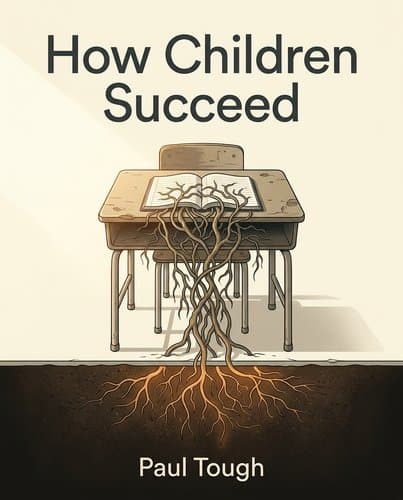
13435889_how-children-succeed
by Paul Tough
Poverty doesn't fail children by limiting what they learn—it floods their bodies with chronic stress that physically erodes the brain architecture needed for…
In Brief
Poverty doesn't fail children by limiting what they learn—it floods their bodies with chronic stress that physically erodes the brain architecture needed for self-control, resilience, and grit. Paul Tough reveals these character skills are teachable, not inherited, and explains exactly what relationships and environments build them.
Key Ideas
Noncognitive Traits Predict Outcomes Better Than IQ
The GED finding is the clearest evidence: what predicts life outcomes is not IQ but noncognitive traits — persistence, self-regulation, and social agility — which means any educational strategy focused primarily on cognitive drilling is targeting the wrong variable
Chronic Adversity Damages Brain Physiology Not Psychology
Chronic adversity damages children physiologically, not just psychologically — the HPA axis and prefrontal cortex are the specific mechanisms — which means asking why poor children 'don't try harder' is a category error, not a moral observation
Resilience Built Through Relationships at Any Age
Resilience is not a personality trait children either have or don't; it is built through specific relational experiences (attentive caregiving, responsive mentoring) that regulate the stress-response system — and this can happen at any age, not just in infancy
Character Skills Are Teachable Through Deliberate Practice
Grit, self-control, and optimism can be measured, taught, and tracked — KIPP's character report cards and Duckworth's Grit Scale both demonstrate this — but they need to be treated as skills requiring deliberate practice, not virtues that emerge from discipline alone
Grit Cannot Overcome Gaps in Core Knowledge
Character skills have a real ceiling when foundational knowledge is missing: James Black's chess grit didn't translate into Stuyvesant admission; building metacognition without closing content gaps produces capable people who are still shut out of selective institutions
Integrated Support Systems Required Beyond Teacher Quality
Teacher quality is a small part of the equation for the most disadvantaged children; what they need is a coordinated system — integrating pediatric care, parenting support, and character-building — that addresses the physiological effects of poverty before academic instruction can take hold
Who Should Read This
Curious readers interested in Child Development and Learning and the science of how the mind actually works.
How Children Succeed
By Paul Tough
12 min read
Why does it matter? Because the skills that separate children who make it from children who don't have nothing to do with IQ.
Here's a question worth sitting with: if you took two teenagers with identical IQ scores, one who finished high school and one who dropped out, what would their lives look like at forty? Logic says roughly the same. Research says exactly the same — as in, indistinguishable from each other. The dropout didn't fail because he lacked the brainpower. He failed because he lacked something else entirely. Something schools ignore, parents rarely name, and most parenting advice gets completely wrong. What Paul Tough does in this book is track down what that something is — through neuroscience labs, chess tournaments, charter school lotteries, and the prefrontal cortexes of stressed children — and make a case that will permanently rearrange the way you think about intelligence, poverty, and what it actually takes for a kid to make it.
The GED Exposes the Real Engine of Success
James Heckman spent years tracking GED holders — people who passed a single test and walked away with the same official credential as high school graduates. On IQ tests and cognitive measures, the two groups were indistinguishable. Same scores, same performance. Then he tracked what happened to them in life, and the picture collapsed. GED holders' incomes, divorce rates, and drug use all mirrored those of high school dropouts — people who'd never earned any credential at all. The diploma wasn't certifying intelligence. It was certifying something else: the capacity to show up, persist through boredom, and delay gratification long enough to finish what you started.
Heckman followed this thread to a 1960s preschool experiment in Ypsilanti, Michigan — the Perry Preschool Project — that had long been written off as a disappointment. The program boosted low-income children's IQ scores while they attended, but the gains evaporated by third grade. Failure, most researchers concluded. Except Heckman kept looking. Decades later, the Perry children were more likely to be employed, more likely to have graduated high school, and less likely to have been arrested than peers who hadn't attended. Something the program did had bent the arc of their lives — and it wasn't the cognitive training. Buried in the original data were teacher ratings of students' curiosity, self-control, and social skills. When Heckman analyzed those scores, he found they explained roughly two-thirds of Perry's long-term benefit. The IQ gains were a red herring. The character gains were the whole story.
The Baby Einstein videos and Kumon worksheets were chasing the wrong variable. The skills that actually move the needle aren't measured by any test schools administer.
Poverty Doesn't Starve Children's Minds — It Floods Their Bodies With Stress
Why do children from poor neighborhoods struggle in school? The obvious answer — that poverty deprives kids of books, stimulation, and engaged parents — points toward an obvious fix: flood the zone with resources and enrichment. But researchers who looked more carefully found that the deficit isn't primarily informational. It's physiological.
In the mid-1990s, a Kaiser Permanente physician named Vincent Felitti mailed questionnaires to seventeen thousand health plan members asking them to report on ten categories of childhood adversity: abuse, neglect, household violence, parental addiction. Then he matched those responses to his patients' medical records. What he found was almost mechanical in its precision: each additional category of childhood trauma bumped the risk of nearly every bad outcome upward. People with four or more adverse experiences were twice as likely to develop heart disease and roughly twelve times more likely to have attempted suicide. These weren't people who had grown up in deep poverty — three-quarters were white, three-quarters had attended college. The childhood stress was doing the damage regardless.
The mechanism runs through the HPA axis, the hormonal cascade that begins in the brain and ends with the adrenal glands flooding the body with stress hormones. That cascade evolved to handle short-term physical threats, the kind where you sprint and then recover. Chronic stress keeps the alarm ringing without relief. Bruce McEwen at Rockefeller University called this accumulation "allostatic load" — the physical cost of an overworked stress-response system. Blood pressure that spikes during emergencies is useful; blood pressure chronically elevated builds arterial plaque. The same process that protects you once erodes you over time.
The part of the brain most vulnerable to this erosion is the prefrontal cortex, which governs exactly the capacities a student most needs: working memory, impulse control, the ability to redirect attention. When Gary Evans at Cornell tested working memory in teenagers using a simple pattern-matching game, poor children scored lower than their wealthier peers. But when he measured allostatic load separately and factored it out statistically, the gap vanished. Completely. It wasn't that low-income children were less intelligent or less motivated. Their stress-response systems had been worn down by years of chronic adversity, and that erosion had degraded the very neural machinery that learning depends on. Asking those children to simply try harder was a category error — like demanding more output from an engine running without oil.
A Rat Study Quietly Overturned the Nature vs. Nurture Debate
Picture a neuroscientist pressing his face against a sheet of Plexiglas, watching rat mothers for hours at a stretch. That is essentially what Michael Meaney's lab at McGill University did for years — observing which mother rats licked and nuzzled their newborn pups frequently and which barely bothered. The variation seemed trivial. It turned out to be everything.
When Meaney's team tested the grown offspring, the differences were stark. Rat pups raised by attentive, high-licking-and-grooming mothers grew up calmer, more curious, more willing to explore open spaces, quicker to eat in unfamiliar environments. The low-LG offspring were skittish, hesitant, easily rattled. More striking still: the researchers swapped newborn pups between high-LG and low-LG mothers at birth. Biological parentage didn't matter. Whatever mother did the rearing determined the outcome. A pup born to an anxious, inattentive dam but raised by an attentive one developed the confident temperament of the high-LG group. The effect was environmental, not genetic — written not in the pups' inherited DNA but in how that DNA expressed itself, specifically on the gene segment governing how the brain processes stress hormones in adulthood.
What Meaney had found was a biological mechanism for resilience. Early comfort and attunement — a mother physically signaling safety — calibrated the offspring's stress-response system toward equilibrium rather than chronic alarm. Resilience wasn't a fixed trait some animals were born with. It was something built, during a narrow window, through specific relational experiences.
Human research pointed the same direction. A long-running study at the University of Minnesota found that infants whose parents responded sensitively to their cues — not perfectly, just consistently and warmly — developed more regulated stress responses and, years later, were more socially capable, more persistent under setbacks, less likely to drop out of high school. Then there was the finding that stopped researchers cold: the attachment a child formed with a caregiver in the first year of life could be measured in a lab at twelve months and used to predict graduation rates better than IQ scores could. The biology of comfort, it turned out, was also the biology of capability.
Grit Is a Skill, Not a Virtue — And It Can Be Taught With a Report Card
In the spring of 1999, thirty-eight students from the South Bronx middle school KIPP Academy posted the fifth-highest eighth-grade test scores in all of New York City. They were nearly all Black or Hispanic, nearly all from low-income families. Newspaper profiles followed. Philanthropic millions poured in. The school had cracked the code, or so it seemed. Then David Levin, KIPP's co-founder, started watching what happened next. Six years after high school, only eight of those thirty-eight students had finished a four-year college degree — a 21 percent rate that matched national averages for low-income students, not the promised escape from them.
What made it stranger was which students survived. The dropouts weren't the ones who had struggled academically at KIPP. The graduates were the students who had recovered from bad grades and tried again, who had talked professors into extra help, who had chosen studying over a night out when nobody was checking. Academic firepower alone hadn't carried them. Something else had — something KIPP had never explicitly set out to teach.
Levin eventually put a name to it, borrowing from psychologist Angela Duckworth: character strengths. Duckworth had spent years trying to identify what actually predicts long-term achievement, and the answer she kept arriving at was traits like grit and self-control — not as personality quirks you either had or didn't, but as measurable, improvable skills. Her twelve-item Grit Scale, asking respondents to rate themselves on statements like "Setbacks don't discourage me" and "I finish whatever I begin," turned out to predict which cadets would survive West Point's brutal first summer better than the military's own elaborate screening system — the one built from academic records, fitness scores, and leadership ratings accumulated over years. Three minutes of self-report beat all of it.
The logical next step was treating grit the way schools already treated algebra: track it, grade it, work on it deliberately. Levin and Duckworth, collaborating with a private school headmaster named Dominic Randolph, identified seven character traits they believed could be taught and measured — grit, self-control, zest, social intelligence, gratitude, optimism, curiosity — and built a report card around them. Students at KIPP began receiving decimal-point scores on each trait twice a year. A teacher reviewing a student's 3.42 for self-control could point to specific behavioral indicators — "pays attention and resists distraction," "keeps temper in check" — and have a targeted conversation about what to work on next.
The bet underneath all of this is that character isn't a verdict on who you are. It's a description of habits you've built. And habits, unlike temperament, bend.
James Black Can Beat a Chess Master and Still Not Know What 'Infant' Means
James Black was twelve years old the morning he sat across a board from Yuri Lapshun, a Ukrainian-born international master ranked among the top forty players in the United States. Lapshun outweighed James by a hundred pounds and outrated him by nearly five hundred points. He spent most of the four-hour game leaning back in his chair, arms folded over his belly, stroking a thick Soviet mustache. James spent it hunched forward in an oversized hoodie, occasionally wandering away from the board to check other games — the kind of restless kid who drove coaches to distraction. Then, on move fifty-nine, Lapshun resigned. James had not merely beaten an international master; he had outplayed him from the opening, building a suffocating wall of defense that shut down every escape route until Lapshun had nowhere left to go. Elizabeth Spiegel, James's coach at Brooklyn's IS 318, called it 'exceptionally deep chess.'
That same period, Spiegel was working with James to prepare for the Specialized High School Admissions Test — the exam that determines access to schools like Stuyvesant and Bronx Science. What she found stopped her cold. He couldn't locate Africa on a map. He didn't recognize the words 'infant,' 'communal,' or 'beneficial.' His math sat at roughly a second-grade level. The boy who had just dismantled a grandmaster-level player couldn't identify a single European country.
What James's story makes uncomfortably clear: the grit, metacognition, and optimism that chess had built in him were real and hard-won — but they were domain-specific. Spiegel had spent years teaching her students to separate failure from identity, to treat a blunder as something you did rather than something you were, to slow down and falsify their own assumptions rather than charging toward the comfortable answer. Those habits made James a national chess master at twelve. They could not, in six months of cramming, substitute for the foundational knowledge that a well-resourced education accumulates invisibly over years. He didn't get into Stuyvesant.
James's story isn't a failure of character — it's a demonstration of character's limits. Grit transferred from chess to test prep, but only in the way grit does: he showed up, he worked. What he couldn't do was invent the foundational knowledge that was never taught to him. Chess had given him a formidable mind and nothing to fill it with. Closing a vocabulary gap requires something else entirely — years of immersion, starting early, that no six-month intervention can replicate.
Kewauna Chose a Pastry She'd Never Tasted — and Earned a 3.8 GPA Doing It
Imagine you're choosing between a marshmallow right now and a sophisticated French pastry in four years — except you've never tasted the pastry and never met anyone who has. Most people take the marshmallow. Kewauna Lerma chose the pastry.
When researchers William Bowen and Matthew Chingos analyzed graduation records for roughly two hundred thousand students at public universities, they found something that unsettled everyone invested in standardized testing: high school GPA predicted whether a student would finish college far better than SAT or ACT scores did. The reason, they argued, is that GPA measures something tests don't — the daily habits of showing up, organizing your time, and persisting when the material stops being interesting. Those habits are what a four-year degree actually demands.
Kewauna is a case study in exactly that. She arrived at Western Illinois University with an ACT score at the fifteenth percentile, taking biology alongside upperclassmen who had seen this material before. Her professor lectured in terminology she had never encountered. So she built a system: any unfamiliar word got a red star in her notebook. After class, once every other student had finished their questions, she walked the professor through each starred word until she understood it. She visited office hours. She emailed about unclear assignments. She found a writing tutor and ran every paper past him before submitting it. At semester's end, she had an A-plus in biology and a cumulative GPA of 3.8.
But the details that stay with you aren't the grades. They're the two days she didn't eat because her meal card ran out. The three consecutive near-sleepless nights before finals. The boyfriend kept carefully at a distance so he wouldn't derail her plans. Kewauna's resourcefulness was real — the red-star strategy was genuinely ingenious — and it worked. The structure surrounding her was also real, and it cost her in ways that no amount of conscientiousness could fully absorb. Character got her the 3.8. Character alone didn't pay for dinner.
The Ivy League Produces Its Own Kind of Helplessness
The cognitive hypothesis doesn't only fail poor children. It also fails the children it was supposedly designed to serve. James Kwak, an economist and law professor who attended Harvard and afterward went straight into management consulting, noticed something uncomfortable about the career choices of his Ivy League peers: most of them weren't choosing so much as following a groove worn smooth by everyone who came before them. In 2010, 36 percent of Princeton's graduating class took jobs in finance and another 26 percent in consulting — figures that barely budged even after the financial crisis nearly collapsed the global economy. Kwak's diagnosis was that the typical elite undergraduate is 'driven more by fear of not being a success than by a concrete desire to do anything in particular.' The recruiting pitch that Wall Street and McKinsey make isn't really about the work; it's about the process. The applications are structured, the criteria are legible, and getting in is a familiar test to ace. For students whose entire identities were built on acing the next test, this is irresistible. They're not choosing a life — they're deferring the choice while doing something prestigious in the meantime. You could call it learned helplessness with an excellent résumé.
Dominic Randolph, the headmaster of the Riverdale Country School in New York, watched exactly this dynamic produce students who were competent but oddly lost — and he named what he saw. They had been protected from every genuine failure, by tutors and careful course selections and parents who smoothed every rough edge, and so they had never been forced to develop the capacity to recover from falling down. Randolph's word for it was deprivation: they'd been shielded from every genuine failure, and so they'd never had to become the kind of person who recovers from one. Character, the book argues, isn't just a problem for children in poverty. It's what the cognitive hypothesis hollows out, at every income level, wherever success is defined as never losing.
Better Teachers Won't Fix What Stress Has Already Broken
What would it actually take to close the gap for the children most damaged by poverty — not the family earning $41,000 a year, but the one earning $11,000? That question exposes the limit of every major education reform of the past two decades.
The current consensus, backed by the Obama administration and the Gates Foundation's $300 million research project on teaching effectiveness, holds that teacher quality is the central lever. Assign better teachers consistently, the argument goes, and low-income students accumulate enough academic gains to catch their wealthier peers. The research that launched this consensus estimated that teacher quality explains roughly ten percent of the gap between high- and low-performing students. Ten percent. That means ninety percent of the gap lives somewhere else — in the biology traced in earlier sections. A more skilled teacher cannot metabolize a child's cortisol.
The children most likely to sit in those underfunded classrooms are the roughly ten percent of American kids growing up in households earning less than $11,000 a year — families where stable employment, consistent caregivers, and protection from violence are all simultaneously absent. The high-performing charter school model works best for children from low-income but relatively stable homes — not for the deeply disadvantaged. The deeply disadvantaged tend to cycle instead through a patchwork of emergency responses: Medicaid clinics, foster placements, juvenile detention, alternative schools that issue diplomas without teaching the skills they certify. The system is expensive, incoherent, and nearly useless.
What Nadine Burke Harris discovered in her Bayview clinic, what Michael Meaney found in his rat studies, and what the Minnesota attachment researchers confirmed over decades all point toward the same architecture for a real alternative: pediatric care that screens for trauma and treats its biological effects; parenting interventions that rebuild the attachment relationships buffering children against stress; preschool programs building executive function; and, later, the kind of character-focused academic support that OneGoal and KIPP Through College provide. Each piece exists. None of them are connected. Deploying them as a coordinated system rather than a scattered set of good intentions is not a self-help prescription for individual families — it is a political choice about what we're willing to build.
The Question the Data Can't Answer for You
Here is what the book finally asks you to hold: we are not waiting on a breakthrough. The biology is mapped, the interventions exist, the programs that work have names and addresses. What's missing isn't a smarter charter school or a better-designed trial.
Take the policy pieces the research points toward: better pediatric care means intervening before a child's stress-response system gets locked into a threat posture. Parenting interventions mean teaching what Meaney's rat mothers did instinctively — the nuzzling, the grooming, the bodily calm that tells a pup the world is manageable. Preschool programs mean getting to children before the prefrontal cortex falls too far behind to catch up. And character-focused academic support means building the thing Kewauna built with her red-starred notebook: a self who expects to recover from failure, not one who treats failure as evidence. None of these are exotic. None require a discovery we don't yet have.
James Black's chess board, Kewauna's red-starred notebook, the 111 children on that Harlem lottery list — none of them are making an argument about willpower. They are making an argument about architecture. A child's stress-response system can be regulated. Her prefrontal cortex can be protected. His sense of himself as someone who recovers from failure can be built. But not by a single inspired teacher, not by one well-funded clinic, not by grit alone. By a system someone decided to build. That decision isn't scientific. It's political. And the book leaves you with the uncomfortable knowledge that the only thing standing between what we know and what we do is whether we collectively decide these children are worth the effort.
Notable Quotes
“We thought, ‘Okay, our first class was the fifth-highest performing class in all of New York City,’”
“‘We got ninety percent into private and parochial schools. It’s all going to be solved.’ But it wasn’t.”
“We are calling our school Promise Academy because we are making a promise to all of our parents,”
Frequently Asked Questions
- What does How Children Succeed argue determines whether children thrive?
- How Children Succeed argues that the skills determining whether children thrive—grit, curiosity, and self-control—are learnable capacities shaped by stress, relationships, and environment rather than fixed traits. Drawing on neuroscience, economics, and education research, the book demonstrates these noncognitive foundations predict long-term success more reliably than traditional academic measures. Rather than intellectual deficit, Tough shows poverty affects children physiologically, impacting their stress-regulation and brain development. The book emphasizes parents, educators, and policymakers can build these capacities through specific relational experiences: attentive caregiving and responsive mentoring that help children regulate their stress responses and develop resilience.
- What does the GED finding reveal about what predicts life outcomes?
- The GED finding reveals what predicts life outcomes is not IQ but noncognitive traits including persistence, self-regulation, and social agility. According to Tough, this demonstrates educational strategies focused primarily on cognitive drilling target the wrong variable. Research shows high school dropouts who pass the GED often achieve better long-term outcomes than students with higher measured intelligence, suggesting character traits like grit and resilience are far more predictive of success. This insight challenges conventional assumptions about ability and achievement, redirecting educational efforts toward systematically building foundational character capacities rather than pursuing test score improvements as schooling's primary goal.
- How does poverty affect children's development according to the book?
- According to How Children Succeed, poverty affects children physiologically rather than intellectually. Chronic adversity damages specific neurological structures—the HPA axis and prefrontal cortex—responsible for stress regulation and impulse control. This explains why asking why poor children 'don't try harder' represents a category error rather than a moral observation: their physiological stress-response system becomes dysregulated through prolonged adversity. The damage occurs at the biological level, limiting capacity for self-regulation regardless of motivation. Tough emphasizes this finding shifts responsibility from individual willpower to environmental design, requiring coordinated systems integrating pediatric care, parenting support, and character-building.
- Can character traits like grit and self-control actually be taught?
- Yes, How Children Succeed argues grit, self-control, and optimism can be measured, taught, and tracked. Evidence includes KIPP schools' character report cards and Angela Duckworth's Grit Scale, both demonstrating systematic development of these capacities. These must be treated as skills requiring deliberate practice rather than virtues emerging from discipline alone. However, the book identifies a critical limitation: character skills reach a ceiling when foundational knowledge is missing. James Black's chess grit didn't translate into Stuyvesant admission, and building metacognition without closing content gaps produces capable people who are still shut out of selective institutions, illustrating that character development requires coordinated support across academics, content knowledge, and stress reduction.
Related Book Summaries
Read the full summary of 13435889_how-children-succeed on InShort