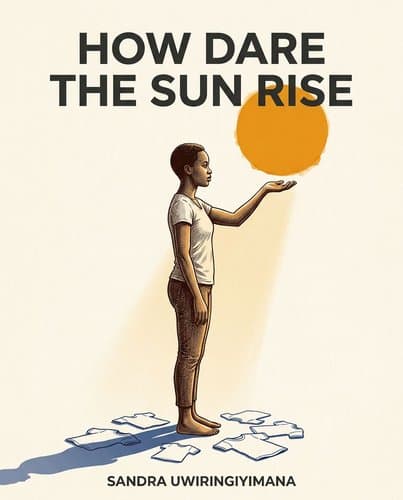
31751594_how-dare-the-sun-rise
by Sandra Uwiringiyimana
Sandra survived a Congolese massacre, got resettled in America, and then collapsed — because safety and wholeness are not the same thing, and deferred grief…
In Brief
Sandra survived a Congolese massacre, got resettled in America, and then collapsed — because safety and wholeness are not the same thing, and deferred grief waits for the first quiet moment. A memoir that counters every casualty statistic by naming one girl: her curls, her jersey, her eyelashes.
Key Ideas
Delayed trauma emerges in moments of safety
Resettlement moves bodies, not trauma — refugee communities need mental health support, cultural mentorship, and space to grieve, not just housing and job placement. Sandra's PTSD collapse came years after arrival, precisely when the world began recognizing her.
Missing language protects perpetrators, silences survivors
When a culture has no word for an experience — rape, survivor's guilt, PTSD — silence becomes the structural default, and that silence protects perpetrators, not survivors. Speaking requires building new conditions that didn't previously exist.
America overwrites personhood with racial categories
American racial identity is not intuitive for Black immigrants: Sandra had never had to think of her skin color as a social position until America assigned her one. 'I was Black first, and then I was Sandra' is not a complaint — it is a precise description of how identity gets overwritten.
Trauma surfaces in safety, not crisis
Deferred grief doesn't disappear — it waits for the first moment of safety to arrive. The collapse often comes not in the worst moments but in the first quiet ones, which is why it can look like failure from the outside and feel like it from the inside.
Specificity witnesses what statistics erase
Specificity is the only witness that resists reduction to statistics. Naming Deborah's curls, her Brazil jersey, her eyelashes that unlocked parents' hearts — that is political work. The portraits, the corrections, the memoir itself are Sandra's counter to the UN casualty count that the world didn't read.
Justice and openness to others coexist
Demanding justice from named perpetrators and refusing to let hatred replicate itself in the next generation are not opposites. Sandra's openness to other cultures and tribes is not forgiveness — it is the argument that embracing division would be the second, spiritual death of Deborah.
Who Should Read This
Readers who connect with first-person stories about Memoir and World History and want to see the world through someone else's eyes.
How Dare the Sun Rise
By Sandra Uwiringiyimana & Abigail Pesta
10 min read
Why does it matter? Because surviving atrocity is only the beginning — and the decade that follows is where the real war is fought.
Most refugee stories end at the airport. The family lands, someone cries, America opens its arms — resolution. But Sandra Uwiringiyimana's story is barely getting started at JFK, where she's wearing someone else's coat, mistaking ground beef for pink worms in the fridge, and genuinely baffled that people with real beds choose to sleep outside and call it camping. She survived a massacre that killed her six-year-old sister. She survived the years after — Rochester middle school hallways where girls mocked her accent to her face, PTSD that shook her whole dorm awake until 4 a.m., and the family silence around her sister's name, the wall no one named. How Dare the Sun Rise is about the gap between being moved to safety and actually arriving, and why that second journey was the harder one.
You Cannot Mourn a Statistic — You Can Only Mourn Deborah
Deborah waited by the front gate every time Sandra came home from a swim she wasn't supposed to take. The two sisters had a system: Sandra and the older kids would slip out of their big yellow house in Uvira, Congo, scale the dark-green gate quietly enough not to make it creak, and spend hours in Lake Tanganyika despite their parents' warnings about malaria, crocodiles, and drowning. Afterward, the water left Sandra's skin ashy — obvious evidence. So Deborah, too young to make the climb herself, would stand outside with a jar of Vaseline and rub it over every inch of her older sister until the residue disappeared. She never told. She never even threatened to tell.
Sandra Uwiringiyimana's memoir about surviving the 2004 Gatumba massacre (in which roughly 160 refugees were killed in a single night) could have begun with statistics. It doesn't. It begins with Deborah: the sister with curls so perfectly coiled that rain and a full day outside couldn't touch them. The sister whose eyes were so large and soulful that when the family needed a favor from their parents, they sent Deborah to ask. The sister who kept every secret and wanted, more than anything, to be old enough to swim.
This is the memoir's first move. A number in a UN report asks nothing of you. But Deborah — Deborah with the Vaseline, Deborah who could produce a bucket of tears from eyes that size — is someone you know. Sandra makes her sister real before the losses arrive, because grief only works on specifics. You cannot mourn a headcount. You can only mourn Deborah.
The Killers Were Singing Church Songs
The night begins with what sounds like rain.
Sandra is ten years old, hiding under a thin mattress in a burning tent with her mother, her six-year-old sister Deborah, an aunt whose arm has nearly been ripped from its socket, and two small cousins. Outside, men are moving through the Gatumba refugee camp in Burundi, killing her people. She hears liquid hitting the tent canvas and thinks: a storm is coming. Then the smell arrives: kerosene. The splashing she took for raindrops was the tent being doused for burning.
What she hears next is worse than the kerosene. The attackers are singing. In Kirundi and Swahili, languages Sandra knows from Sunday services, they chant: Imana yabatugabiye. God has given you to us. These are hymns Sandra has sung herself, in church, sitting on dewy grass with Deborah sleeping in their mother's lap. The same melodies. The same God. The killers believed they were on a holy errand.
Men appear at the tent entrance claiming to be rescuers. Her mother moves toward them, carrying Deborah. Sandra hangs back, hearing something that tells her don't go, but she can't leave her mother. At the door, the men open fire. She watches the muzzle flashes hit her mother, each one bright and brief in the dark, then runs back into the burning tent, blacks out, wakes to find the camp reduced to bodies and flames. A man grabs her shirt and presses a gun to her temple. She says Mbabarira — forgive me. Her parents had always taught her to apologize when she'd done something wrong. She is ten, and she believes she must have done something terrible to bring this on herself.
The gun doesn't fire. She runs.
The morning after, Sandra's mother lifts what remains of Deborah near the ashes of their tent and says five words: That's her skull. Deborah died in Sandra's old blue Brazil jersey, number nine — the shirt Sandra made her mother wash constantly until it became Deborah's favorite too. A UN report recorded 166 dead at Gatumba. Not the jersey. Not the number on the back. Not what it meant that she was wearing it. Only Sandra can tell you that.
Making It to America Was Not the End of the Story
After years in refugee camps, resettlement came: Rochester, New York, April 2007. The problem with America wasn't cruelty. It was incomprehensible in every direction at once.
Sandra's family arrived with almost nothing and a mental image drawn from UN briefings and TV: America was rich, snow-covered, and safe — a place where nothing bad happened. That image lasted until Sandra opened the refrigerator in their refugee housing and hollered for her mother: the people here ate worms. The worms were ground beef. Her mother stared at the package, equally baffled.
The food failures accumulated in a pattern. Their caseworkers — genuinely kind people — kept trying and kept missing. Sandra's mother asked for tomato paste; they brought canned tomatoes. She needed particular spices; they arrived with onions and salt she'd never cooked with. Heavy cream appeared when the family wanted whole milk. Her mother held up the unfamiliar ingredients and asked what she was supposed to do with them. They tried again. It still didn't work. Sandra stopped eating meat entirely — hormone-treated American chicken bore no resemblance to the fresh birds back home.
From inside, the gap wasn't hostility, but a thousand small misses between people trying to help and a family whose whole life had happened somewhere the caseworkers couldn't follow. The refugee housing had a microwave Sandra couldn't understand, a TV she couldn't understand, a country she couldn't understand. Back in Congo, her mother had run her own business. Her father had held good jobs. Her older sister Princesse had a college degree in international relations and a government position in Rwanda. None of it counted here. In America, they were starting from zero. Sandra filled out a school lunch application that wanted her family's income, her father's employer, her address before this one. There was no box for any of it.
She Had Never Had to Think About What Color She Was
What did Sandra know about being Black before she came to America? Exactly as much as a girl growing up in Congo would know — nothing useful. In Uvira, her skin color was a fact like her height: everyone around her was Black, and the question never arose.
America asked the question constantly, and she kept getting it wrong.
At Our Lady of Mercy, the private Catholic school she lands in for eighth grade, she notices the cafeteria has organized itself by race, and no one seems to find this strange. When Black classmates tell her she "sounds white," she can't parse the accusation; she has no framework for it. She adjusts how she speaks depending on who she's talking to, barely aware she's doing it. Two identities, neither of them quite hers.
Then she goes shopping with her white friend Leah at Banana Republic, and a clerk tells them there's nothing there for them. They leave. Outside, Leah is furious: the clerk assumed Sandra would steal because she was Black. What Sandra says next stops you: the thought hadn't even occurred to her.
Not because she was naive. Because she had survived a massacre, crossed a continent, landed in America, and been handed a caseworker, an apartment, and an English class. Nobody gave her a map of American racial semiotics. Nobody warned her that her skin color would be read before her name. When Leah names it on the sidewalk, Sandra doesn't feel anger; she feels the vertigo of realizing a system has been operating on her the whole time, and no one thought to mention it. Leah's father had given her money for the trip. They were ready to spend it.
In Congo she was Sandra — a student, a daughter, a sister. In America she was Black first, Sandra second. She had grown up in a war zone, she writes. She'd just discovered America was a different kind.
Her Community Had No Word for What Had Happened to Her
The silence Sandra kept for nearly a decade wasn't cowardice. It was the only rational response to what her community had built around speaking.
Her native language has no word for rape. The closest phrase translates roughly as he forcibly took me — the act rendered as something that happened to a body, not a crime committed against a person. She is twelve. She has gone to her cousin's household to recover from the Gatumba massacre, where her sister was killed, when the husband attacks her. She fights him off and immediately tells his nine-year-old daughter, Ganza, what he did. Ganza's response: "Sandra, my father would never do anything like that." Not angry. Not horrified. The way you'd correct a small misunderstanding.
That is the last person Sandra tells for nearly a decade.
Because Ganza's five seconds had laid out the entire cost. In Sandra's culture, a raped girl risks being discarded by her family and forced to marry. Shame migrates from perpetrator to victim. The man warned her to stay quiet. She didn't need the warning. She already had the data.
The same silence closes around her grief. After the massacre, Sandra's family never speaks about Deborah. They never say her name. Not because they don't love her — there is simply no container for it, no language, no ritual. At thirteen, at a slumber party with her American friend Mabel, Sandra says aloud for the first time that Deborah was killed. She starts crying and cannot stop. She had been carrying, without knowing it, a half-formed belief that Deborah had gone somewhere and would come back. Saying the words makes the death permanent.
She Was Addressing the UN Security Council While Failing to Get Out of Bed
You cannot grieve in a burning building. The adrenaline keeping you moving through the smoke isn't healed trauma; it's managed trauma. The difference matters when the fire goes out.
Sandra's photo exhibit at a Rochester gallery led to Lincoln Center, which led to the Women in the World Summit, a one-on-one interview with Charlie Rose in front of thousands, and then to introducing Angelina Jolie (unannounced, seconds before it happened) to a theater full of people. The Diane von Furstenberg Awards. Oprah's name on a place card. The United Nations Security Council, where Samantha Power introduced her and Sandra described the Gatumba massacre as sounding like popcorn popping. All before she was twenty.
What she didn't tell any of those audiences was what happened when she got back.
Sophomore year at Houghton College, she began falling apart in a way that looked, from the outside, like nothing at all. She slept through classes. When her roommate Shannon returned from lectures, Sandra would be in the same position — lights off, no movement. She stopped going out. Friends took turns staying with her at night. One day she told Shannon she didn't understand why she was alive, and Shannon, terrified, reported her to the dormitory director. Sandra was furious. She also knew Shannon was right.
The collapse came after the world started paying attention, not before, because safety is the first condition grief requires to surface. While she was fleeing, resettling, learning English, and then performing her people's survival at public forums, there was no room for it. The machinery of crisis keeps the body occupied. But Houghton was stable. She had friends who loved her. The immediate danger had passed. And so the nightmares arrived: her sister's death, the smell of kerosene, an aunt's blood on her leg. Flashbacks don't warn you. They appear in classrooms and hallways and leave her on the floor with her limbs aching and her ears ringing.
She told the Security Council: until there is justice, the nightmares will never stop. Then she went back to school. Back to the nightmares.
The path out ran through the people she most feared telling. She would eventually speak it directly to her mother (mediated by an uncle, formally arranged) for the first time naming survivor's guilt, the flashbacks, the unbearable weight of being called the family's youngest child as if Deborah had never existed. The truth came tumbling out — things she had never said to her mother before. No one had a ready answer. But it had been said aloud in the family for the first time, and that was the shift.
Embracing Division Would Be a Second Death for Deborah
Francine is thirteen years old and has spent more than half her life in a Rwandan refugee camp. Sandra meets her years after her own resettlement in America. She's here voluntarily, riding a motorbike three hours up a rocky mountain to reach a girl she will speak with for maybe twenty minutes. She finds Francine sweeping outside her family's tent: quiet, dutiful, while other children swarm Sandra like a celebrity. Sandra asks what she wants to be when she grows up. Francine goes silent. After prompting, she offers a single horizon: maybe a nurse, here in the camp. Sandra tells her: your life doesn't have to end here. Francine watches her as though she's spoken a foreign language. She isn't being evasive. A life beyond the fence has simply never existed in her world, so it doesn't exist in her mind.
That look stays with her for all three hours back down the mountain. Her family was resettled in America because of the Gatumba massacre. Without that night, she might still be behind the same fence as Francine. But without that night, Deborah would still be alive. The book names this and refuses to resolve it.
Which makes the final argument harder to reach, and more necessary. Agathon Rwasa, the man whose group carried out the attack, confessed to killing 166 people on public radio, then ran for president of Burundi. The official justice Sandra was owed is not coming. Given that, what remains?
Her answer: what killed Deborah was the belief that her people — the Banyamulenge, her specific community, her bloodline — had no right to exist alongside theirs. To harden, to close, to retreat into the tribe and refuse connection with anyone outside it, would be to let that logic win. Not in Burundi. In her. To embrace the ideology that murdered her sister would be to kill Deborah twice: once by machete, once by the grief calcifying into hatred. The refusal to harden is not forgiveness. It is a wager: the only form of justice still available is to make sure hatred doesn't reproduce itself in the survivor.
She Still Corrects People When They Call Her the Youngest
Every time someone introduces Sandra as the youngest in her family, she corrects them. "I'm the second youngest. We lost my little sister." That correction is not grief on display — it is Deborah, kept alive in the only vessel still available. No grave. No funeral. A mass grave with 165 others, and the man who ordered it subsequently ran for president. Nobody was charged.
What Sandra chose instead was refusal: refusal to let the ideology that killed Deborah replicate itself in her. To harden would be to kill Deborah twice. So the correction, the portraits, the memoir, We Are Not Invisible, the advocacy organization she co-founded — these are not comfort. They are argument.
What the book asks isn't pity. It's to know this story well enough that when someone calls her the youngest, you'd want to say: she isn't.
Notable Quotes
“God has given you to us.”
“God has given you to us. God has given you to us.”
“We've come to rescue you.”
Frequently Asked Questions
- What is How Dare the Sun Rise about?
- Sandra Uwiringiyimana's memoir documents her survival of the 2004 Gatumba massacre in Burundi, where she lost her sister. The book explores what resettlement in America leaves untouched: "grief, PTSD, racial bewilderment, and silence." It demonstrates how "bearing witness to specific lives is both a personal and political act of resistance against erasure." Through detailed remembrance—naming Deborah's curls, her Brazil jersey, her eyelashes—Sandra resists the reduction of victims to statistics, asserting each person's irreplaceable humanity.
- What are the main themes in How Dare the Sun Rise?
- The book argues that "resettlement moves bodies, not trauma"—refugee communities need mental health support, cultural mentorship, and space to grieve beyond housing and job placement. Sandra's PTSD collapse came years after arrival, "precisely when the world began recognizing her," showing trauma follows its own timeline. The memoir also reveals that when "a culture has no word for an experience—rape, survivor's guilt, PTSD—silence becomes the structural default, and that silence protects perpetrators, not survivors." Speaking requires building new conditions.
- How does Sandra describe her racial identity in America?
- American racial identity is not intuitive for Black immigrants who never considered skin color as a social position. Sandra describes this as: "I was Black first, and then I was Sandra," clarifying this is not a complaint but "a precise description of how identity gets overwritten." The memoir demonstrates that forced racial recategorization is one of multiple displacements—geographical, emotional, and psychological—that standard resettlement policies cannot address. This perspective challenges assumptions about immigrant experiences.
- Why does Sandra's trauma response occur years after her resettlement?
- Deferred grief doesn't disappear; it waits for the first moment of safety to arrive. "The collapse often comes not in the worst moments but in the first quiet ones, which is why it can look like failure from the outside." Sandra's PTSD crisis came years after her American arrival, "precisely when the world began recognizing her," revealing trauma's independent timeline. The book argues this reflects complex processing rather than weakness, preventing misinterpretation of symptom reemergence as setback.
Related Book Summaries
Read the full summary of 31751594_how-dare-the-sun-rise on InShort