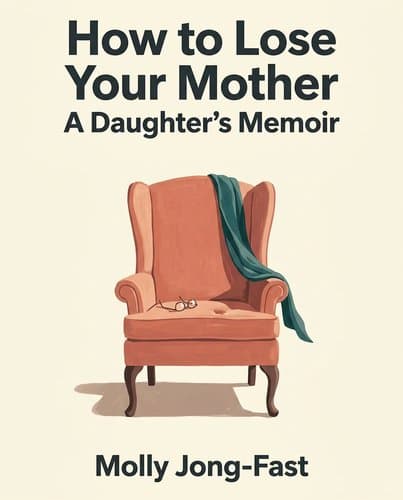
221772304_how-to-lose-your-mother
by Molly Jong-Fast
Molly Jong-Fast spent her childhood chasing a mother who was never truly there—and now must grieve losing someone she never fully had.
In Brief
Molly Jong-Fast spent her childhood chasing a mother who was never truly there—and now must grieve losing someone she never fully had. A razor-sharp memoir about the double grief of burying an absent parent and the families that keep whitewashing the truth until the very end.
Key Ideas
Two Griefs: Absence and Final Loss
The grief of losing an emotionally unavailable parent is double: you mourn first for the parent you never had, then again when the last chance for that parent to materialize is finally extinguished. Naming this double grief is the first step toward surviving it.
Old Patterns Predate the Dementia Diagnosis
Dementia in a parent who was always somewhat absent or dishonest is particularly destabilizing because the line between their personality and their pathology is impossible to locate. Trust your pattern recognition — if the behavior was there before the diagnosis, the diagnosis didn't cause it.
Breaking Generational Cycles of Denial
Families organized around denial don't change their coping strategy when the crisis is undeniable — they apply the same whitewashing to new material. Recognizing the pattern across generations is what allows you to opt out of it.
Your Story Deserves to Be Told
The compulsion to make sense of your own life through storytelling — whether in a memoir or in conversation — is not a betrayal of the people in it. The discomfort with that compulsion is worth sitting with, but it isn't a reason to go silent.
Showing Up Practically Is Enough Love
'Showing up' does not require emotional availability you don't have. Hiring the aide, signing the form, walking the dogs — these are acts of love even when they don't feel like it. The boring stable one is doing the actual work.
Who Should Read This
Readers who connect with first-person stories about Memoir and Family and want to see the world through someone else's eyes.
How to Lose Your Mother: A Daughter's Memoir
By Molly Jong-Fast
12 min read
Why does it matter? Because you can grieve a parent who is still alive — and you've probably already started.
Picture the childhood: Concorde flights, Erica Jong's face on the cover of everything, Henry Miller next door in Malibu. The kind of upbringing that sounds, in summary, like an outrageous privilege. Then picture what actually punctuated it — a Baggie of diet pills clutched in a therapist's office, a mother too drunk to notice a grown man's hands on her teenage daughter's face. Molly Jong-Fast grew up inside a performance of motherhood so convincing that even she spent decades auditioning to be in it. By the time her mother's dementia made the curtain impossible to keep up, Jong-Fast had been managing the situation since she was old enough to know there was a situation to manage. This book is about what it costs to grieve someone who was never quite there — and what it means when the last possible chance for them to show up finally, quietly, closes.
The Virus of Fame Left No Room for a Daughter
Fame is not a gift passed down to children — it's a pathogen that infects the carrier and leaves everyone around them slightly sick. Molly Jong-Fast grew up as the only child of Erica Jong, who wrote a novel in 1973 that sold twenty million copies, coined a phrase for casual sex that entered the language, and appeared on the cover of Newsweek. The setup sounds like privilege. It was, in certain material ways. What it was not was a childhood with a mother who was actually present.
Erica Jong told anyone who would listen that Molly was her greatest accomplishment. Molly knew this was a performance, not a truth. The book was always the greatest accomplishment. The fame was always the organizing principle. What fame does to a person is ring a bell that cannot be un-rung — a rewiring so complete that even after the famous person fades from public consciousness, they remain permanently unable to inhabit ordinary life. Years after nobody stopped Erica Jong on the street anymore, she still could not process not being stopped. Molly watched this from close range and became something like a fame naturalist: studying the species without ever being one.
The cruelest part of the inheritance is that the child gets the disorientation without the high. Molly spent school breaks in a trailer park in Tampa with a nanny while her mother traveled to every book festival that would have her. When Erica was home, she was performing — running her fingers through Molly's red hair, asking whether Molly knew how brilliant she was, reciting a script of devotion that felt scripted precisely because it was. The daughter would stare into her mother's glassy blue eyes and wonder if she was being seen at all, or just incorporated into the next performance. The famous person lives in a simulation built around their own importance. Everyone else — including the child — is set dressing.
A Child Who Parents Herself Learns Not to Trust Anyone
The therapy session was supposed to fix things. Molly was somewhere around eleven, sitting on a sofa next to her mother in the Manhattan office of a celebrity psychiatrist who collected famous patients and wore flowing muumuus covered in jewelry. The doctor had cookies, which Molly ate while crying. Erica was holding a plastic bag of diet pills — not at home, not in secret, but right there in the room where the intervention was happening. Molly reached over and tried to pull the bag from her mother's hand. She said she felt terrible when her mother was on the pills. Erica began to cry and promised, with feeling, that she would stop.
She did not stop.
You learn very early, growing up with an addict parent, that the performance of remorse is not the same as change — and that the gap between those two things is where children lose their faith in adults. Molly already knew, even at eleven, that begging wouldn't work. She knew because she had watched this movie enough times to recognize the ending. When the session was over and the doctor asked how she felt, she had one real answer and one polite answer. The real answer was that this was a waste of time. The polite answer is what you give when you've already learned that saying the true thing only gets you another round of the same useless conversation.
Then came Tuscany, a few years later, which is the story that does something different. A family friend — a former studio executive — stroked fourteen-year-old Molly's face at dinner and told her she was beautiful, and kept doing it all weekend. When Molly finally pulled her mother aside and asked her to make him stop, Erica was very drunk. She told Molly she was beautiful, actually, and that she needed to loosen up. The man was not touching her because he found her beautiful. He was doing something predatory and strange, and Molly knew it, and her mother either couldn't see it or chose not to. What that weekend installed in Molly was a specific, durable knowledge: her mother would not come when called. Not for this. Not for anything that required Erica to put down her glass and pay attention to a danger that wasn't happening to Erica.
The accumulated weight of these moments — the unkept promises, the drunk non-responses, the years of Margaret the nanny answering doors and fielding calls from a stalker while Erica was at a book festival — is what Jong-Fast means when she says her heart hardened. It was not one catastrophe. It was the slow experiment of a child who kept running the same test and getting the same result, until she stopped running it. You protect yourself from people who have proven they will not protect you by deciding, at some foundational level, that no one will. This is survival. It is also the kind of wound that doesn't announce itself — it just quietly reorganizes everything.
The Family's Real Religion Was Lying to Itself
The family's real religion was not feminism, or literature, or even fame. It was denial, practiced with the discipline of a lifelong faith. And the dementia crisis exposed nothing new — it simply ran the same liturgy one more time.
When Molly started hearing from neighbors, hairdressers, and dinner companions that something was seriously wrong with Erica, she called her stepfather Ken. His response was immediate and familiar: hearing aids. Erica just needed hearing aids. Or else she was quietly composing her next book. Ken deployed the same confident misdirection he had used thirty years earlier, when a thirteen-year-old Molly begged him to intervene in her mother's pill habit and drinking. Back then, the explanation was that Erica was under pressure, that once the current book was finished she'd return to normal. The book always finished. She never returned to normal. The explanations just rotated.
A child who cannot trust the family's narration of reality eventually stops trusting her own. She becomes prickly, isolated, unable to connect. Molly grew up in what she calls a post-truth ecosystem — a household where her mother's account of any given event shifted depending on the day, where the story of the divorce changed so many times that Molly couldn't locate a stable version of her own childhood. She didn't learn to be a person, she says, until she got sober at nineteen and had to build one from scratch.
So when the dementia diagnosis finally arrived — confirmed by a neurologist, then lied about by Erica, then dismissed by Ken as a second opinion they simply disagreed with — the family had not failed some new test. They had aced the only test they'd ever been given. The disease changed. The response did not move an inch.
When Everything Collapses at Once, There Is No Script
The previous section ends mid-crisis, both parents newly incompetent, the dog seizing on the bed — and then, at three in the morning, Matt calls from the emergency room. The doctors have found something on his pancreas. The phrase he uses, relayed directly from the doctors, is 'maybe probably possibly cancer.' By morning, Molly and her husband are deep in a semantic negotiation about which word to use when they tell the children. Not 'tumor,' they decide — a tumor sounds medical and final. A 'mass' could be anything: a crowd, a knot of blood vessels.
What makes this moment hers is that she doesn't dissolve. She catalogs. She notices a faint sour smell on Matt that showers won't remove and concludes, with the flat certainty of someone who has been reading rooms since childhood, that the smell means something bad. She stays awake running actuarial calculations about living alone. She is forty-four years old and has never been an adult without this man. None of this is resilience in the poster-on-the-wall sense. It's something older and colder — the competence of someone who grew up in a house where emergencies were the baseline and you either learned to function inside them or you didn't function at all.
The terrible irony is the timing. Molly spent her twenties getting sober, rebuilding, constructing by hand the stable life her childhood never modeled. She built a marriage, raised three children, made a career. Then, in a single week, the scaffolding comes down at once: the dog seizes on her bed; she signs power of attorney for two parents who can no longer manage their own affairs; her husband calls from an ER at three in the morning. She had prepared for adulthood as a kind of refuge from her childhood. What she got instead was her childhood, scaled up.
The preparation turns out to be useful anyway — just not in any way anyone would choose. When the oncologist tells them the cancer may have spread to the liver, Molly is simultaneously managing the liquidation of her parents' entire estate, having just fired their housekeeper of twenty years in a stained apartment. She receives the call, processes it, and keeps going, because stopping was never really one of the options she learned. You either find a dark joke or you find another dark joke. The mass could be anything. She lands on the absurd detail because the real one is still too large to hold.
The Dementia Didn't Create the Loss — It Just Made It Official
What exactly is Molly Jong-Fast grieving in this memoir? If your answer is dementia — a mother disappearing into cognitive fog — you're reading the surface story. The dementia is almost incidental. It is a legal declaration of something that was always true.
The most devastating evidence comes not from a doctor's office but from a phone call Molly makes to her biological father after moving her mother into the nursing home. Guilt-ridden, she admits she can't bring herself to stay longer during visits, that she's always rushing back to her own life. Her father, trying to comfort her in his own crooked way, offers this: when Molly was a little girl, he and her nanny used to engineer situations to get Erica to spend an hour a day with her daughter. Just one hour. And Erica couldn't do it. The most she could manage was thirty minutes. He says this as reassurance — see, you don't owe her more than she gave you — but what it does is timestamp the loss. Molly was not abandoned by a woman who then got sick. She was abandoned by a woman who stayed well and chose, every day, thirty minutes or less.
This is why the scene with the New York Times Book Review lands so hard. When Fear of Flying turns fifty, the paper puts Erica on the cover — the scholarly validation she had spent decades insisting she was owed. Molly brings the issue to the nursing home, waving it like a gift. Erica, deep in dementia, looks at her own face on the cover and complains that the Times didn't even call her. She cannot register pleasure, cannot register presence. But here's what Molly understands, sitting in that pine-scented room with the wall-to-wall carpet: this is not new behavior produced by a diseased brain. This is the same woman who, even in her prime, related to the world primarily as an audience that was or wasn't giving her sufficient attention. The mother who cannot register her own cultural vindication is the mother who could spare thirty minutes. The diagnosis didn't change the person. It just removed the last pretense that a different person was coming.
That's the wound at the center of this book. Not the loss of a mother to illness, but the confirmation that the mother Molly was waiting for — attentive, present, capable of setting down the performance for an hour — never existed to lose.
The Truth-Teller Who Uses All the Same Euphemisms
When Matt comes home from the emergency room in the middle of the night, the couple's first sober-morning conversation is a semantic negotiation. Not 'tumor,' they decide — too clinical, too final. A 'mass' could be anything: a crowd, a cluster of blood vessels, a gathering of dogs in a park. And the nursing home her mother will spend her remaining years in? Molly won't call it that either. She calls it a hotel. She brings her parents a glossy hardcover catalog of the place's five restaurants and saltwater pool and espresso lounge, and she runs this same pitch every morning — 'It's like the Four Seasons!' — knowing that by evening they'll have forgotten the entire conversation and she'll have to do it again tomorrow. She calls herself a 'double-betrayer' for turning both her mother's decline and her husband's cancer into literary material, and then she writes the memoir anyway. She is doing exactly what her family always did: finding the word that makes the unbearable slightly more bearable, and calling it honesty.
The book is most interesting when it refuses to treat this as a simple contradiction. Molly isn't a hypocrite who got caught. She's someone who learned the coping mechanism so thoroughly that it runs even when she's watching herself run it. The same childhood that taught her to name things accurately also taught her that naming things accurately doesn't always help you get through the next hour. A mass. A hotel. The Four Seasons. You say whatever keeps you in the taxi.
Showing Up Is the Whole Job, Even When You're Too Late
At Frank Campbell funeral home on Madison Avenue, Molly stands at a small podium next to her diminished mother, watching Erica search the room for a microphone that isn't there. Once a performer always a performer. The audience is full of people Molly has known her whole life, and what she fears — based on family legend — is that her mother will deliver a forty-five-minute ramble ending with the declaration that the deceased is going to burn in hell, as she reportedly did at her beloved grandfather's funeral decades earlier. Instead, Erica Jong says something brief and coherent and true: that Ken was the kindest man, that she loved him, that he took care of her. Then she sits down.
That's when it breaks open for Molly. Not her mother's speech, but her own. Standing at that same podium, telling a story about Ken's small plane and a wallet sucked out a window at altitude, she hears herself describe a man she spent thirty years judging and realizes the judgment was always the problem — hers, not his. He was a decent stepfather. She had been a bad stepdaughter.
A few weeks later she walks to the funeral home in brutal January cold to collect his ashes. The attendant asks for ID before releasing human remains to anyone. Molly understands the regulation, hands over her license, and when the form asks for her relation to the deceased, she writes 'daughter' instead of 'stepdaughter.' Nobody sees it happen. There is no music. She carries the box home and puts it on a shelf next to her dead dog's urn.
Resolution, in a book that spent every page refusing to promise one, looks like this: not a healed relationship, not a mother restored to presence, not even fully forgiveness. Just a woman who showed up — imperfectly, late, sometimes paying someone named Comfort to show up in her place — and who wrote 'daughter' on a form because that turned out to be what she was. The boring stable one, still standing. It's not a consolation prize. It's the whole job.
The Mother She Was Waiting For Was Never Coming
There is a child sitting outside a closed door, waiting for it to open. You probably know that child. Molly Jong-Fast was that child for decades — waiting for the mother who was always just finishing something, always about to become available, always one book or one tour or one standing ovation away from walking out and being present. The door never opened. And then one day it couldn't, and then one day it never would again. She signed a form as 'daughter.' The door is closed. She is still here.
Notable Quotes
“I saw your friend Judy at an event.”
“Your friend Judy. The singer?”
“I don’t remember who that is.”
Frequently Asked Questions
- What is How to Lose Your Mother about?
- Molly Jong-Fast's 2025 memoir explores the layered and complex grief of losing an emotionally absent parent. Through her own experience with her mother's cognitive decline, she examines the intersection of family denial, caregiving responsibilities, and the unique pain of mourning someone who was never fully present or emotionally available. The book provides essential frameworks for understanding this double loss—grieving both the parent you never had and the final extinction of hope that they might someday change or become whole.
- What does Molly Jong-Fast say about the "double grief" of losing an emotionally absent parent?
- "The grief of losing an emotionally unavailable parent is double: you mourn first for the parent you never had, then again when the last chance for that parent to materialize is finally extinguished. Naming this double grief is the first step toward surviving it." This framework, as presented by Jong-Fast, validates what many have experienced silently—the compounded loss of never receiving the emotional presence needed and the extinguishing of any possibility for transformation. Understanding and naming this double grief is essential for moving toward healing.
- How does dementia affect families where the parent was already emotionally absent?
- When a parent with dementia was always somewhat absent or dishonest, the line between their personality and pathology becomes impossible to locate, making the situation particularly destabilizing. Jong-Fast advises readers to "trust your pattern recognition — if the behavior was there before the diagnosis, the diagnosis didn't cause it." This wisdom helps adult children separate what's attributable to dementia versus what reflects longstanding emotional patterns, preventing them from incorrectly attributing lifelong dysfunction to a recent diagnosis and allowing for clearer, more accurate understanding.
- What does Molly Jong-Fast say about showing up for a parent during their decline?
- "'Showing up' does not require emotional availability you don't have. Hiring the aide, signing the form, walking the dogs — these are acts of love even when they don't feel like it. The boring stable one is doing the actual work." According to Jong-Fast, practical caregiving—the mundane, unglamorous, often invisible tasks—constitute genuine love and commitment. For adult children who lack emotional connection with their parents, this reframing is profoundly liberating: you can be an excellent caregiver through logistical support, financial responsibility, and dependable presence, regardless of your emotional capacity, past relational history, or personal feelings about the relationship.
Related Book Summaries

Read the full summary of 221772304_how-to-lose-your-mother on InShort