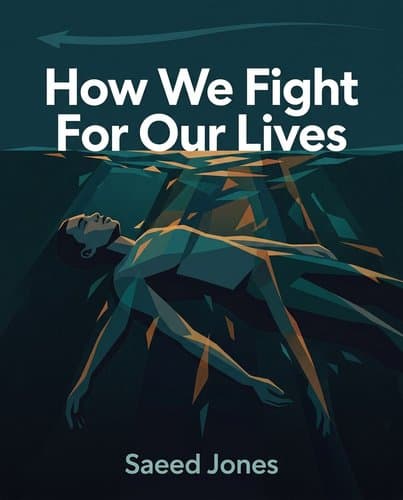
43682552_how-we-fight-for-our-lives
by Saeed Jones
A Black gay boy absorbs the world's hatred until it becomes his own voice—then spends decades fighting it. Jones's memoir is the raw, exquisite account of…
In Brief
A Black gay boy absorbs the world's hatred until it becomes his own voice—then spends decades fighting it. Jones's memoir is the raw, exquisite account of building a self when the people who love you most are also the ones erasing you.
Key Ideas
Internalized Shame Becomes the Bully
Shame doesn't stay external. Once absorbed — through a slur, through a library full of books that equate gay with dying — it moves in and starts doing the work of bullies without them. Jones shows that the most dangerous form of shame isn't what others do to you; it's the voice you eventually carry for them.
Categories Cannot Contain Full Identity
Coming out names a sexuality, not a self. Jones's sharpest insight: he came out to his mother as gay but hadn't come out as himself. The category 'gay' couldn't contain the Vegas showgirl performances, the shame-scrubbing showers, the things he'd been erasing mid-sentence for years. Naming the sexuality left everything else untold.
Loving Erasure Remains a Contradiction
The people who love you most can also erase you most completely. The memoir's most devastating acts of disappearance — the pulpit, the chat room confrontation, the Atlanta mid-sentence self-erasure — come wrapped in genuine love. This isn't a contradiction Jones resolves; it's one he insists you hold.
Retaliation Reproduces the Original Harm
Desire weaponized against the forces that diminish you is still a form of self-destruction. The logic of 'if America hates me for being Black and gay, I'll make men like this submit' is continuous with the shame it's trying to defeat. The memoir holds this as a question, not an answer — which makes it more honest than most.
Survival Means Noticing Existing Help
Survival isn't a destination — it's the ongoing discovery that the waves were pushing you toward shore even when you'd stopped swimming. The book's most quietly radical claim: sometimes staying alive isn't about will or strength. It's about noticing, just in time, what was already working on your behalf.
Who Should Read This
Readers who connect with first-person stories about Memoir and Social Issues and want to see the world through someone else's eyes.
How We Fight For Our Lives
By Saeed Jones
10 min read
Why does it matter? Because "coming out" is almost beside the point.
The story you expect: a Black gay poet finds himself, comes out, earns his freedom. The story you get: at twelve years old, Saeed Jones discovers desire and learns about AIDS in the same afternoon. They arrive together, inseparable — beauty and its punishment, already braided. How We Fight For Our Lives isn't really about the closet. It's about what happens after you leave it and find that the world outside has its own forms of erasure waiting — in a grandmother's church, in a white man's bedroom, in the gap between the life your mother's body bought you and the life she couldn't live. Jones is a poet, and this memoir reads like one: precise where sentiment would be easy, brutal where comfort would be cheap.
At Twelve, He Learned That Desire and Death Were the Same Thing
Saeed Jones is twelve, alone in a Lewisville apartment on a scorching Texas day, when he opens James Baldwin's Another Country and something happens to him. The novel — men sleeping with men, sleeping with women, then back again — holds him in a way he didn't know a book could. He takes it to his bedroom and closes the door.
About a third of the way through, he finds a Polaroid tucked between the pages. A man in Jackson, Mississippi, 1982: acid-washed jeans, knit sweater, red dust on his sneakers. The man leans against a car with a smile Saeed reads as intimate in the wrong way — knowing, as if it's looking directly at him across sixteen years. When his mother comes home from work, he asks who the man is. She stares at an oak tree outside the window for a long time — her way of gauging whether a question deserves an answer. A friend from school, she finally says. They went on road trips. Not long after that photograph, he found out he was sick. And then he killed himself. She's already walking back to the kitchen.
"Sick with what?" Saeed calls out.
"AIDS."
She closes her bedroom door. She never says the man's name.
The word "gay" never leaves her mouth. But Saeed hears the word hovering above every moment. Days later, he walks to the public library and finds a shelf of books on the subject. He keeps a decoy open in his lap and scans both directions before reading. His body responds to the material even when the prose is dry and clinical. Then it stops. Because every book about being gay is also a book about dying of AIDS — not as a risk, but as a sequence, the natural end of a progression. His hands are shaking when he stands to shelve them. Outside, the heat is almost a relief.
Desire and death don't arrive separately here. They show up together, fused, in a stranger's smile tucked inside a novel and in a single word dropped before a bedroom door closes. Jones doesn't spend the memoir untangling them. He spends it learning to survive inside that knot.
The Slur Doesn't Just Wound — It Moves In and Does the Work for Free
The slur is an installation. It arrives as a weapon, but it stays as architecture — colonizing the interior until shame does its own maintenance, long after the bully has walked away.
It happens at twelve. His neighbor Cody steals back the pornographic magazines the three of them had agreed to share, then locks the apartment door in Jones's face. Jones beats the door with a plastic baseball bat until it splits, then with his bare fists until they go numb. Through the door comes Cody's voice: faggot. He slides down to the doormat. Something close to relief: someone had finally said it. He sits there for the rest of the afternoon, back against the door, hands still throbbing. It had been circling him for years. Now it had landed.
Before, he was just scrawny; now he's scrawny because. Just bookish; now bookish because. The logic seals itself. And soon it goes fully internal: the bullies don't even have to appear anymore, because there's already a voice inside doing their work for free.
By high school, the proof of that internalization is in Jones's poetry. Every poem he writes is in the voice of a mythological woman — Medusa refusing to meet her own reflection. These are poems about desire, written through a borrowed body, female and ancient. Jones cannot yet write longing from his own name, his own skin. He can only imagine being desired by imagining himself as someone else entirely.
That is shame doing structural work. The bully's job is finished. The edifice holds.
The Most Complete Erasures Come Wrapped in Love
Midway through a Wednesday night service in Memphis, summer 1999, Saeed's grandmother reaches over and takes his hand. He's thirteen, sitting in the pew beside her for the third or fourth time that week, grinding his teeth through another sermon about damnation. Her eyes are shining. He assumes she's about to apologize for the weeks of pressure, the near-nightly visits, the word "worldly" she'd been pressing on him like a brand. He smiles.
She pulls him to his feet.
They walk to the front of the congregation — people craning to watch, murmuring approval — and kneel at the pulpit, where the visiting preacher begins to pray. He prays for God to send illness upon Saeed's mother, every ailment, every plague, until she breaks. Saeed's mother has a heart condition; when he was five, she was on a transplant list. His grandmother raised that woman. She knows. Her eyes stay closed.
The pattern arrives in its worst form in a Memphis church pew: the deepest erasures don't come from strangers. They come fastened to love. The grandmother who once introduced him warmly as her visiting grandson from Texas has spent all summer introducing him instead as a boy whose mother is Buddhist — the same sentence, flat and diagnostic, designed to electrify any Southern church sanctuary. The church visits multiplied to three or four a week. The magazine clippings of shirtless men he'd tucked inside a book of Greek mythology — she finds them, throws them away, drags him to his knees. Every act comes from the same impulse: she loves him, and love, for her, means pulling him back.
The same logic surfaces in college, on the phone with his mother. He comes out, the word "gay" finally loose, and she responds with blunt questions about protection, then calls back before sundown to say she loves him and just wants him happy. Then Jones writes the sentence that reframes everything before it: he had come out as a gay man, but almost immediately understood he had not come out as himself. The label cleared one obstacle and left the real one untouched.
The grandmother thought she was saving him. His mother thought she was accepting him. What neither could offer was what he'd been reaching for since he first closed that apartment door and picked up Baldwin: a name for what he actually was, given in a language big enough to hold it.
Your Body Can Be a Passport, a Key, or a Weapon — Until It Gets You Killed
What if the shame never actually stops — it just changes how it travels?
For a moment, the evidence suggests otherwise. At a speech-team party in Kentucky, on a backyard trampoline under a star-filled sky, Jones registers something unfamiliar: no penalty baked into wanting, nothing waiting on the other side. After years in Lewisville where desire and danger arrived together, it's the first time they come apart.
But Jones is already tracking something darker. The concept takes shape in the apartment of an older man he follows home from a Dallas bookstore: his body could function as a passport, a key, or a weapon — something capable of getting him through doors that would otherwise stay locked.
By Western Kentucky, that logic has darkened into something he runs toward. He adopts a hookup alias (Cody, monosyllabic, straight-acting) and engineers a silence that lets each man project his own private fantasy onto him. When a man he calls the Botanist, a Bowling Green thirty-something whose apartment is crowded with tropical trees and stone lions, eventually screams a racial slur during sex, Jones doesn't cut away. He admits he had been provoking it. Hating himself in his own head wasn't sufficient; he needed the verdict delivered in someone else's voice.
Jones doesn't settle this. He isn't arguing the Botanist wasn't racist, or that the slur wasn't violence. He's arguing something harder: he'd entered that apartment to summon exactly this. The Cody persona was partly a method for making men want him and partly a delivery system for a verdict he'd already rendered on himself. The shame hadn't stopped. It had found better infrastructure.
The endgame arrives on New Year's Eve in Phoenix, where Jones follows a man named Daniel out of a party and into an empty room, having theorized that pursuing men like Daniel, all-American and physically imposing, was conquest. If America hated him for being Black and gay, he would make a weapon of himself. Instead, Daniel beats him, chanting "you're already dead" between blows. Jones holds the man's fists and doesn't fight back. Looking up at him mid-assault, he sees it: Daniel believed he was fighting for his life too.
The memoir holds that symmetry without resolving it. Two men, each convinced he was the one surviving. From the inside, liberation and self-destruction had become the same motion.
A Mother and Son Who Kept Pushing to the Edge of What Needed to Be Said — Until She Died
In Jersey City on the night before Mother's Day 2011, Saeed is watching a TV show where a businessman gets shot and falls face-first into the mud. He finds this comforting: a story going according to plan. His uncle Albert keeps calling from Memphis; Saeed turns the phone facedown. When he finally answers, the call is brief: his mother is in the ER with breathing trouble. He goes to his altar, tries to chant, lasts five minutes. Goes back to bed. Watches the businessman die again.
The next morning his uncle delivers the full sentence: cardiac arrest, more than twenty minutes without oxygen, now in a coma. At the Memphis ICU, Saeed approaches the bed and genuinely cannot place the woman lying there. Poor woman, lonely stranger. Where is her family? His uncle smooths two fingers across her hair — and suddenly there she is. Saeed starts talking in the bedside voice he hates and eventually says: I'm here, Mama. I'm right here. Her eyelids flutter. He starts planning how many weekends he can fly back. Then the machines light up.
Two seizures. Saeed freezing, then running, then collapsing in the hallway, his uncle catching him. A nurse eventually guides the family into a windowless room, and Jones writes that he walked in as someone's son and left as an orphan.
The whole book converges here: every scene between them reached the edge of what needed to be said, and then one of them flinched. His mother knew, in some form, that he was gay; she met it with love, then let it drop. He came out over the phone; she was generous; the real name for who he was stayed unspoken. He flew home in 2004 after her first cardiac crisis clutching scholarship news, hoping it might somehow heal her. She squeezed his hand and closed her eyes. He later named what that moment was: he had wanted his success to undo the difficulty he'd caused her, as if an achievement could square a debt.
The life insurance check arrives in Jersey City a month after the funeral — more money than either of them had ever seen. Months earlier he had agonized over whether he could spare the eight hundred dollars she needed for car repairs, finally sending it after a coworker said, "You only have one mother." The check is that sentence with a number attached, postmarked too late. He doubles over screaming. Then come the counterfactuals: if she hadn't been living paycheck to paycheck, maybe fewer cigarettes, maybe earlier treatment, maybe the congestive heart failure never happens. The story wasn't inevitable. It could have gone another way.
"I would never get to bury her again," he writes. The money came after. But "you only have one mother" holds everything the memoir has said about time: it runs out before you've said the thing, and then the evidence of what the silence cost arrives in an envelope addressed to you.
Boys Like Us Never Really Got Away. We Just Bought Ourselves Time.
Survival, in this memoir, is never framed as a victory lap. Jones is explicit: boys like us never really got away. We just bought ourselves time.
The evidence accumulates in a Newark coffee shop, where Jones opens his notebook to find a graveyard. Melvin Dixon, Essex Hemphill, Joseph Beam, Assotto Saint, Reginald Shepherd — every Black gay poet he'd taken as a model, dead of AIDS or poverty or abandonment, dates appended like tombstones. Those dates don't read as history. They read as prophecy. A Reginald Shepherd essay triggers a full panic attack; Jones retreats to the restroom and collapses on the floor. The names had merged with his own name. History was chanting Daniel's phrase from that Phoenix room: you're already dead. Writing hadn't outrun it. Getting into the MFA program hadn't outrun it. You could survive one man's hands and still drown in what happened to men like you.
Which is why the Barcelona scene lands the way it does. Traveling in Spain, on a beach where the sand was imported from Egypt to make everything look prettier, drunk on warm sangria, Jones swims out until he's exhausted and makes a deliberate decision. He stops kicking. He stops pulling his arms through the water. He releases his last breath and begins to sink. And then his toes find sand. The waves had been pushing him toward shore the whole time. He hadn't noticed. He laughs.
That laugh is the memoir's emotional truth. Not triumph — Jones didn't will himself back. The ocean's physics did it for him while he was busy letting go. What remains is the bare fact of still being here: a life that kept going past every point where it had reason to stop.
Still worth it. That's the whole argument, stated without comfort.
The Waves Were Already Pushing You Toward Shore
What stays with you after this book is not the survival — it's the price tag. A graveyard in a Newark notebook. An insurance check that arrived too late to mean anything except what it cost. An ocean that kept pushing him toward shore while he'd already decided to let go. Jones doesn't frame any of this as triumph, and that's the gift: he won't let you read it that way either. What it means to still be here, shaped by every voice that told you what you were before you could figure it out yourself, carrying the name of the woman who made you and didn't live to see what you became — that question doesn't close. Jones just keeps asking it out loud, in print, in your hands.
Notable Quotes
“I'm here, Mama. I'm right here,”
“I can't go back to sleep,”
“I'm afraid that if I go to sleep I won't wake back up.”
Frequently Asked Questions
- What is How We Fight For Our Lives about?
- How We Fight For Our Lives is a 2019 memoir by Saeed Jones exploring his coming-of-age as a Black gay man in the American South. The work examines how shame becomes internalized and how even loving relationships can erase identity. Central to the memoir is Jones's insight that he came out as gay but hadn't come out as himself—the category couldn't contain the fuller complexity of his lived experience. Through exploration of desire, survival, and authenticity, the book traces what it costs and takes to build an authentic self, while insisting readers hold the contradiction that people who love you most can also erase you most completely.
- How does shame function in How We Fight For Our Lives?
- Jones argues that shame doesn't stay external. "Once absorbed — through a slur, through a library full of books that equate gay with dying — it moves in and starts doing the work of bullies without them." The most dangerous form of shame, Jones shows, isn't what others do to you; it's the voice you eventually carry for them. This internalized shame becomes an invisible presence that shapes behavior long after external sources disappear. By demonstrating how victims internalize their oppressors' voices, Jones reframes shame from an external force into an internal architecture that continues the work of those who hurt you.
- What does Jones mean by coming out as gay but not as yourself?
- Jones makes a crucial distinction: he came out to his mother as gay but hadn't come out as himself. "The category 'gay' couldn't contain the Vegas showgirl performances, the shame-scrubbing showers, the things he'd been erasing mid-sentence for years. Naming the sexuality left everything else untold." This insight challenges the assumption that naming your sexual orientation equals revealing your full self. For Jones, the category could only capture part of who he was, leaving vast territories of identity unexplored. The memoir suggests that categorical identity claims, however liberating, remain incomplete containers for the full complexity of human experience and desire.
- What does How We Fight For Our Lives reveal about love and erasure?
- Jones presents a paradox central to the memoir: the people who love you most can also erase you most completely. The most devastating acts of disappearance in the book—"the pulpit, the chat room confrontation, the Atlanta mid-sentence self-erasure"—come wrapped in genuine love. Rather than resolving this contradiction, Jones insists readers hold it, acknowledging that love and erasure aren't opposites but can coexist. This unsettling truth reflects the complexity of relationships within oppressive systems, where protection and suffocation, care and denial, become intertwined. The memoir refuses easy comfort, instead asking readers to recognize that beloved people can cause the deepest harm.
Related Book Summaries

Read the full summary of 43682552_how-we-fight-for-our-lives on InShort