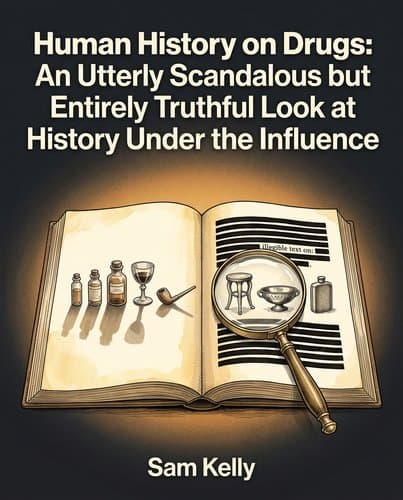
220239087_human-history-on-drugs
by Sam Kelly
From Alexander the Great's opium supply chains to Nixon's racially motivated War on Drugs, this scandalously honest history reveals how psychoactive substances…
In Brief
From Alexander the Great's opium supply chains to Nixon's racially motivated War on Drugs, this scandalously honest history reveals how psychoactive substances were never history's footnote—they were its hidden operating system, shaping empires, art, and politics in ways textbooks deliberately buried.
Key Ideas
Drug history erased from official narratives
Drug use has shaped major historical turning points — from military strategy (Alexander's opium supply chains) to political philosophy (Nixon's War on Drugs as racial weapon) — in ways that textbooks systematically omit. Understanding the real history changes how you read the present.
Knowledge fails against biochemical addiction
The biochemical trap of opioids and stimulants catches experts and laypeople alike: Freud understood pharmacology deeply and still destroyed patients; Hughes had unlimited medical access and still injected liquid codeine until needles broke off in his arms. Knowledge reduces risk but does not eliminate it.
Dosage discipline determines medical safety
The line between 'medicinal tool' and 'destructive addiction' often hinges on dosage discipline and external accountability — Marcus Aurelius's physician-supervised spoonful of opium enabled governance; Coleridge's self-regulated pint of laudanum ended his career. The substance is rarely the whole story.
Drug prohibition is political weaponization
Blanket prohibition of drugs has historically been a political instrument rather than a health policy — Nixon's adviser confirmed this on record — and the scheduling of substances like cannabis and psychedelics reflects that political history more than scientific evidence, which is why the DEA is only now rescheduling cannabis in 2024.
Context reshapes identical substance effects
The same substance can produce opposite outcomes in different people under different conditions: the CIA's LSD experiments created both the 1960s counterculture (Kesey) and a domestic terrorist (Kaczynski). Context, consent, and intent matter more than the molecule.
Who Should Read This
History readers interested in World History and Social Issues who want a deeper understanding of how we got here.
Human History on Drugs: An Utterly Scandalous but Entirely Truthful Look at History Under the Influence
By Sam Kelly
11 min read
Why does it matter? Because the history you were taught was chemically redacted.
Here's what your history teacher never mentioned: Alexander the Great died drunk and high. George Washington kept laudanum in his medicine cabinet. The Oracle at Delphi was huffing petrochemical fumes. Queen Victoria personally ran the largest drug trafficking operation in human history. The textbooks you grew up with didn't accidentally omit this stuff — it was a deliberate editorial choice, made by people who decided you couldn't handle the full picture. Human History on Drugs hands you back what was taken. Not to scandalize, not to excuse, but because the unredacted version is the only one that actually makes sense of how the world got built. Turns out the engine was a lot more chemical than the textbooks admitted — and once you see it, you can't unsee it.
The Oracle Was High, and That's Why It Worked
King Croesus, ruler of what is now western Turkey, marched his army into Persian territory in 550 BCE because a drugged-out woman sitting on a stool told him to. Sort of. She said 'a great empire shall fall' — and he heard what he wanted to hear. When Cyrus the Great captured him and ordered him burned alive, the official verdict wasn't that the oracle had lied. It was that Croesus hadn't been smart enough to understand her. She had technically been correct: an empire did fall. His.
That verdict held for a thousand years.
The Oracle of Delphi wasn't a mystical anomaly explained by faith. She was a drug delivery system dressed up as a religion. A research team spent the late 1990s analyzing rock samples beneath the temple and found a fault line directly under the chamber where the Pythia delivered her prophecies, leaking ethylene — a sweet-smelling petrochemical that produces dissociative euphoria roughly equivalent to huffing glue. She wasn't channeling Apollo. She was sitting on a three-legged stool above a natural gas vent, breathing it in.
That was layer one. Layer two: she ate oleander leaves, a toxic plant that grew near the temple. Small repeated doses built a tolerance while keeping her body in a state of visible tremors — which ancient visitors interpreted as the physical signature of divine possession. The twitching was poison, not prophecy.
The chemistry created the spectacle. The oracle's actual genius — conscious or not — was the ambiguity. She never gave a straight answer, which meant she could never be proven wrong. Whatever happened, her words could be made to fit it. When things went badly, the listener got the blame. The history you were taught treated her as a miracle. She was a system — chemistry, theater, and unfalsifiable language — that powerful men willingly walked a hundred miles through mountain passes to consult.
Greatness Has Always Needed a Chemical Assist
Here's a pattern no history teacher ever drew on the board: the figures we carve into monuments were, almost without exception, managing themselves chemically. Not despite their greatness. Alongside it.
Consider Marcus Aurelius. He kept an enslaved man whose only job was to follow him around whispering that he was just a mortal man. He wrote a private journal of daily self-examination that became one of the foundational texts of Western philosophy. This is not a man given to weakness or excess.
And every night, this same man drank a measured spoonful of opium.
His physician, the legendary Galen, prescribed it. The problem was clinical: Marcus's mind simply would not stop. He would lie down and keep adjudicating — replaying decisions, stress-testing his own reasoning — until dawn. He recognized, with characteristic logic, that a sleep-deprived emperor makes unjust decisions, and an unjust emperor is a failed one. So opium became a governance tool. A single controlled dose, taken under Galen's supervision, to hit pause on the machinery of his own intellect.
When he tried to stop, he couldn't sleep at all. What Galen diplomatically recorded as 'dry humors,' modern medicine would call withdrawal. The Stoic philosopher-king was, by most reasonable definitions, physically dependent on an opiate. He ruled for nineteen years, presided over a golden age of Roman prosperity, and never let it spill into his days.
The cultural story about drugs is that they reveal weakness — that the moment a great person reaches for a substance, you've found the crack in the facade. Marcus Aurelius suggests the opposite: sustained high performance sometimes demands chemical management, applied with the same discipline you'd bring to any other professional problem. The man who had a slave whisper 'you are mortal' in his ear every day understood something about managing your own machinery that most productivity culture still refuses to say out loud.
The Same Substance That Built an Empire Destroyed the Man Who Built It
Babylon, 323 BCE. Alexander has just spent twelve days dying in a palace, surrounded by soldiers who couldn't believe what they were watching. This was the man who had conquered two million square miles by the age of thirty. He'd never lost a battle. Now he couldn't lift his hand to acknowledge the troops filing past his bed. He slipped into a coma and never came back out.
The historians who followed spent centuries arguing about what killed him — poison, malaria, typhoid. But the timeline is hard to ignore: it started with a memorial feast at which he drank bowl after bowl of unwatered wine. This was his habit, taken straight from Macedonian custom, stored at up to 40 percent alcohol because there were no refrigerators and fermentation was the only preservative they had. You were supposed to cut it three parts water to one — but Alexander wasn't interested in supposed to. Add to that his long-running opium use, which he'd picked up from conquered territories and spread to his own troops like a wellness program, and what you have isn't a mysterious death. It's a body that finally handed in its resignation.
Here's what makes Alexander genuinely tragic rather than just cautionary: the same personality trait that built the empire killed the man. His 'always more' drive — the refusal to stop at Persia, the march through India, the inability to call the night over — was not separate from his drinking. It was the same impulse in different clothing. The bowls of wine didn't undermine the conqueror. They were the conqueror, off the clock.
Coleridge is the same story, less epic in scale, no less complete in devastation. Laudanum, an opium tincture, gave him 'Kubla Khan' — two hundred lines arriving in a vision so complete that he woke up and immediately started transcribing. Then a visitor from Porlock knocked on the door, kept him an hour, and when Coleridge returned to the page, the rest was gone. He spent the next eighteen years never finishing much of anything, drinking close to a pint of laudanum a day, his tolerance having outrun any possible effect except keeping withdrawal at bay.
The Most Powerful Narco-Trafficker in History Carried Cocaine in Her Hip Flask
The nineteenth century's most powerful drug operation wasn't run out of a jungle compound. It was run from Buckingham Palace.
Queen Victoria was personally enthusiastic about pharmaceuticals — cocaine chewing gum for confidence, liquid cannabis for cramps, chloroform during childbirth that she described as genuinely wonderful — but her personal habits are a footnote to the main event. The main event was economic. In the 1830s, Britain had a ruinous addiction to Chinese tea. Ordinary London households were spending five percent of their income on it — and China wanted silver, not British goods, in return. Britain was hemorrhaging silver to pay for it, so the East India Company found a more compelling export: Indian opium, addictive by design. The East India Company flooded Chinese ports with it. When opium became responsible for fifteen to twenty percent of the entire British Empire's annual revenue, it stopped being a trade policy and started being a structural dependency.
China's emperor assigned his best official to kill the trade. Lin Zexu tried diplomacy first — a letter to Victoria laying out the moral arithmetic: China sends you tea and silk, you send us addiction. Victoria didn't read it. So in 1839, Zexu seized a British shipment and destroyed two and a half million pounds of opium at sea. Victoria, twenty years old, responded by starting a war. The British military took apart the Chinese army, and the peace treaty that followed handed over Hong Kong, opened more ports to opium, and granted immunity to British citizens operating on Chinese soil. The century of humiliation China still references in diplomatic contexts began with a teenage queen protecting her drug revenue.
Meanwhile, in Rome, Pope Leo XIII was carrying cocaine wine in a hip flask to mass. The wine was Vin Mariani — a blend of Bordeaux and cocaine that, once metabolized, produced intense euphoria stronger than either ingredient alone. Leo reportedly told anyone who asked that he carried it to fortify himself when prayer fell short. He awarded its inventor a Vatican gold medal and appeared on the product's advertising posters. Those ninety encyclicals he wrote in twenty-five years were drafted by the most morally authoritative figure in Christendom, running on a controlled substance he personally endorsed.
The pattern is the point. These weren't dissolute outsiders. They were the institution.
Self-Medication Is Not a Personality Flaw — Until the Doses Become the Point
Can intelligence protect you from addiction? The intuitive answer is yes — surely someone who understands exactly what a substance does to brain chemistry can manage their intake with the same precision they'd bring to any other technical problem. Nietzsche would have bet on it. He understood the pharmacology of what he was doing. He chose chloral hydrate — chloroform in liquid form — as a sleep aid not out of ignorance but out of informed experimentation. Then he chose opium for the pain. Then, as the drugs made both the insomnia and the pain worse, he responded by increasing the doses, which is exactly what an addict does, not what a philosopher does, but by then the distinction had collapsed. By the time he was living in Italy, he was signing his own prescription slips as 'Dr. Nietzsche,' because the pharmacies didn't question credentials they couldn't verify. The man who filled notebooks with observations precise enough to still unsettle philosophy professors was inventing his own medical authority to feed a habit that was steadily dismantling his mind.
The end came fast once it came. On a Turin street in January 1889, Nietzsche watched a horse being whipped and ran to shield it with his body, sobbing. Then he collapsed and never really came back. From the asylum, he wrote letters to his remaining friends claiming to be, variously, Jesus Christ, Dionysus, Buddha, and Napoleon — sometimes all in the same letter, as if the question of which god you were was a matter of context. He signed one letter 'The Crucified.' The doctors couldn't even treat him properly because his years of self-administered opiates and sedatives had made the underlying cause impossible to isolate.
The hard thing about Nietzsche isn't the tragedy — it's the mechanism. He wasn't self-destructive in the way we usually mean. He had real migraines, real sleeplessness, real pain from diseases he'd contracted as a wartime medic. The drugs worked, until they worked too well, until the craving for relief became the organizing principle of his life and the reasoning that had built the philosophy was quietly reassigned to justifying the next dose. Intelligence didn't fail him. It served the addiction instead.
The War on Drugs Was Never About Drugs
American drug policy rests on a foundational lie, and the man who told it was drunk when he did it.
Nixon launched the War on Drugs on June 17, 1971, declaring drug use
The CIA Accidentally Invented the 1960s — and the Unabomber
Think of it as a government program with two outputs. Same funding, same personnel, same drug. One output: the most beloved countercultural revolution in American history. The other: a mail-bomb terrorist who killed people for seventeen years. The CIA ran both experiments. They just didn't plan either outcome.
MK-Ultra was already a decade old by the time Nixon declared his War on Drugs — which means the federal government spent twenty years dosing people before it decided the problem was the drugs.
Here's the version they didn't teach you. In 1959, a Stanford graduate student named Ken Kesey — farm-raised, championship wrestler, built like a truck — volunteered for what looked like a psychology experiment at a VA hospital. The actual sponsor was the CIA, which needed to know whether LSD could be weaponized as a truth serum. What the agency got instead was a man who loved the drug so much he took a graveyard-shift job mopping the psych ward just to stay close to the supply. Tripping on LSD and peyote through the night, he looked at the patients around him and realized the institution wasn't healing anyone — it was punishing people for failing to behave normally. He wrote that observation into a novel. One Flew Over the Cuckoo's Nest won him enough money to buy a school bus, paint it in every color simultaneously, load it with friends and free acid, and drive it coast to coast. Every visual signature we associate with the 1960s — the tie-dye, the long hair, the psychedelic explosion of color that replaced the beatnik's uniform black — traces back to that bus. The CIA handed Kesey the match and then watched the decade catch fire.
Three years before Kesey got on the bus, a sixteen-year-old Harvard prodigy named Ted Kaczynski walked into a different room inside the same program. He'd been promised an intellectual debate about his personal philosophy. Instead, the CIA-backed experimenter strapped electrodes to his chest, flooded the room with blinding light, and spent the session systematically destroying everything Kaczynski had written about. Then they secretly dosed him with LSD — which, for someone who didn't know he'd taken a psychedelic, would feel exactly like losing his mind. Then they filmed the whole thing through a one-way mirror and made him watch the replay. They repeated this every week for three years. Kaczynski retreated to a Montana shack with no electricity or running water and spent seventeen years mailing bombs to strangers.
Two years after the last MK-Ultra subject left the room, Nixon stood up and declared war on the drugs his own government had been deploying for twenty years.
The Question Is Never Whether — It's Always How
What separates someone who uses drugs successfully from someone who gets consumed by them? The book's final answer, when you press on it, is uncomfortable: the difference is character and circumstance — which are, famously, not things any policy can distribute.
Marcus Aurelius and Elvis Presley both had physicians, both had access to powerful opiates, and both believed they were using medicine rather than getting high. The outcomes could not be more different. Marcus took a single measured spoonful at night, treated the dose as a governance problem rather than a pleasure to be chased, and recognized when the drug was making him drowsy at useful hours and pulled back. He governed justly for nineteen years. His restraint wasn't available because he was educated about pharmacology — plenty of educated people have died addicted. It was available because his entire orientation toward life was the relentless subordination of appetite to purpose. The Stoicism wasn't decoration. It was load-bearing.
Elvis had the same access and genuinely believed the same logic: a doctor's signature made the danger manageable. In 1970, dressed in a purple velvet cape, high on the prescriptions his physician had been handing him by the thousands, he walked into the Oval Office and asked Richard Nixon for an antidrug badge so he could personally reform America's youth. He meant it sincerely. His doctor, in the final twenty months of Elvis's life alone, prescribed him more than twelve thousand pills. Elvis died at forty-two with fourteen drugs in his system. The photo of him beaming while shaking Nixon's hand is now the single most requested document in the entire National Archives — more popular than the Constitution or the Bill of Rights.
The book doesn't resolve this. It just puts Marcus and Elvis next to each other and lets the gap speak. Marcus Aurelius was exceptional — not in his access to opium, but in who he already was before he took it.
The Most Honest Thing History Can Teach Us
Here's what you're left with after all of it: the Oracle's gas vent was divine, Victoria's cocaine flask was sophisticated, Nixon's scotch was presidential, and your neighbor's joint was criminal. The molecule didn't change. The politics did. And underneath every era's particular line between civilized and degenerate runs the exact same human impulse — the Pythia managing her terror, Marcus managing his sleeplessness, Coleridge managing his pain, all of them reaching for something just slightly beyond what ordinary consciousness could provide. That impulse is not going away. It has never gone away. The question isn't whether people will use substances to cope, create, and govern. It's whether we'll treat them like the Pythia — necessary, a little frightening, worth building a whole temple around — or keep arresting the neighbor.
Notable Quotes
“Bomb the shit out of them!”
“Henry, we’ve got to nuke them.”
“If the president had his way, there would be a nuclear war every week.”
Frequently Asked Questions
- What role have drugs played in major historical events?
- The work examines how psychoactive substances have shaped pivotal moments in history — from military strategy (Alexander's opium supply chains) to political philosophy (Nixon's War on Drugs as racial weapon) — in ways mainstream history ignores. Drug use has driven major turning points that textbooks systematically omit. The work also shows how the same drugs that destroyed brilliant minds fueled philosophical and artistic breakthroughs, revealing that understanding real history fundamentally changes how you read the present.
- Why is addiction difficult to overcome even for experts?
- The biochemical trap of opioids and stimulants catches experts and laypeople alike. Freud understood pharmacology deeply and still destroyed patients; Hughes had unlimited medical access and still injected liquid codeine until needles broke off in his arms. Knowledge reduces risk but does not eliminate it. These examples demonstrate that understanding chemistry offers insufficient protection against addiction's mechanisms. The work argues that vulnerability transcends expertise, resources, and intelligence—addiction roots in how substances interact with human biology rather than personal weakness or ignorance.
- What determines if a drug is medicinal or addictive?
- The line between 'medicinal tool' and 'destructive addiction' often hinges on dosage discipline and external accountability. Marcus Aurelius's physician-supervised spoonful of opium enabled governance, while Coleridge's self-regulated pint of laudanum ended his career. The substance itself is rarely the whole story; context and control matter profoundly. The same drug can enable function or destroy it depending on how it's administered, who oversees use, and the individual's capacity for disciplined use. This framework suggests prohibition may be overly blunt.
- Is drug prohibition based on health science or politics?
- Blanket prohibition of drugs has historically been a political instrument rather than a health policy. Nixon's adviser confirmed this on record, and the scheduling of substances like cannabis and psychedelics reflects political history more than scientific evidence. The DEA is only now rescheduling cannabis in 2024, decades after research contradicted initial restrictions. The work reveals how substances were scheduled based on racial and political concerns rather than their actual pharmacological effects. Drug policy has served political goals more consistently than public health objectives.
Related Book Summaries

Read the full summary of 220239087_human-history-on-drugs on InShort