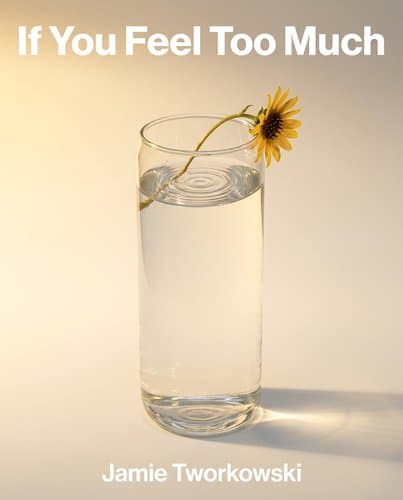
23846010_if-you-feel-too-much
by Jamie Tworkowski
Feeling everything too deeply isn't a flaw to fix—it's the exact capacity that makes love and genuine connection possible. Jamie Tworkowski shows up before he…
In Brief
Feeling everything too deeply isn't a flaw to fix—it's the exact capacity that makes love and genuine connection possible. Jamie Tworkowski shows up before he has answers, sits in unanswerable pain without offering solutions, and proves that showing up as your real self is the only response equal to a hurting world.
Key Ideas
Key Takeaway
Show up before you have a plan — the founding of TWLOHA happened because someone said yes to a midnight visit when it would have been easier to say no. The most important acts of love in this book are almost all accidental, contingent on someone not talking themselves out of it.
Grace must start with yourself
The same compassion you extend to strangers in crisis must eventually be turned inward — the book's hardest argument is that grace dispensed freely to others while withheld from yourself is not generosity, it's evasion.
Presence without answers is enough
Sitting with someone in unanswerable pain without offering answers is itself a complete act — Tworkowski sits beside Zeke's mother for two hours with nothing to say, and that is the story, not a failure of it.
Resolve conflict before time runs out
If there is conflict with someone you love, resolve it before you run out of time — McKenna's death two days after his last 'I love you' email is the book's most urgent practical lesson.
Deep feeling is strength, not weakness
Feeling things deeply — grief, longing, joy, the weight of other people's pain — is not a liability to manage. It is the mechanism by which real connection happens. The book asks you to stop apologizing for it.
Community requires intentional daily choice
Community is a choice, not a circumstance — Tworkowski has access to it and still has to choose it. Knowing you're not alone does nothing unless you act on it, like a check you have to take to the bank.
Asking for help saves your story
If you are in a place where you're considering giving up on your story, ask for help. Pain tells you to stay quiet. That is a lie. It is okay — the book says this directly, without softening it — to ask for help.
Who Should Read This
Readers who connect with first-person stories about Memoir and Mental Health and want to see the world through someone else's eyes.
If You Feel Too Much
By Jamie Tworkowski & Donald Miller
13 min read
Why does it matter? Because the person who feels too much isn't broken — they're the most alive person in the room.
Most of us have been quietly taught that feeling too much is a problem to solve — something to metabolize faster, keep below the surface, apologize for in the morning. The intensity that makes you cry at the wrong moment, love people with alarming completeness, lie awake carrying the weight of strangers — that's the thing to manage, the liability, the signal that you haven't yet figured out how to hold yourself together. Jamie Tworkowski, who built a mental health organization out of one improvised week with a girl in crisis, spent years showing up to exactly those moments — a midnight phone call he almost didn't answer, a mother throwing sunflowers into the sea — and what he found was the opposite of what the assumption promised. The same rawness that makes suffering nearly unbearable turns out to be the only equipment that makes genuine presence possible. You can't feel too much. You can only feel — and that capacity is the entire point.
The Whole Movement Was Built on a 'Yes' He Almost Didn't Say
It's past midnight in Orlando when the phone rings in David McKenna's kitchen. Jamie Tworkowski is standing there with three other people, watching his friend take the call. When David hangs up, he asks if anyone wants to drive across the city to meet a girl named Renee. Jamie almost says no. He has to be on the road early for work. He carries the kind of anxiety that makes every unplanned hour feel like falling behind. The invitation felt important — so he goes.
That barely-made yes is the hinge on which everything turns.
Renee Yohe is nineteen and hasn't slept in a day and a half. Cocaine, alcohol, pills — she's cycling through all of it. A treatment center would later turn her away, calling her too great a risk. With nowhere else to go, she ends up in Jamie's orbit for five days. What happens next isn't a program or a plan. It's a small group of people deciding to be a hospital when there isn't one. They take her to a live show — she ends up ten feet from the drummer of her favorite band, Thrice, smiling through the whole set. They get her into good seats for a basketball game, where she screams herself hoarse. Coffee, cigarettes for the coming down, books for the days ahead. On a Sunday night, strangers gather after church and pray for her. A guy named Ryan sits in the corner playing guitar, making songs out of what she's going through.
The formula that came out of those five days is almost embarrassingly simple: treat a broken person like a famous guest. Give them the best seat in the house. Tell them something true.
The emotional peak of the week arrives quietly. Before Renee leaves for rehab, she pulls Jamie aside and leads him through the crowded living room to the garage. She hands him a razor blade — the one she'd used five nights earlier to cut her arm. She's carried it with her the whole time. She tells him tonight will be the hardest night and she shouldn't have it anymore. Jamie holds it carefully and feels something shift in him, some recognition of what it means when a person hands over the thing that's been hurting them.
The story he wrote about that week circulated online and eventually became the seed of an organization, To Write Love on Her Arms, that would reach millions of people. But the seed was a midnight drive he nearly skipped. The movement wasn't designed — it was improvised by people who showed up when they could have gone to bed.
What a Man Doing Calculus on a Cot Can Teach You About Assumptions
A man the size of a linebacker is hunched over a cot in the Houston Astrodome, deep in a book. This is days after Hurricane Katrina has displaced tens of thousands of people from New Orleans, and Jamie Tworkowski is moving through the crowd of cots with no official role — he'd ditched his assigned post at the clothing table because he came for conversation, not folding. He spots the big man and his first guess is algebra. He says something about how that doesn't look like much fun. The man, Walter, smiles and says he loves it. Tworkowski looks closer at the cover. It's calculus. Walter explains what he wants to do with his life. Then Tworkowski makes the kind of joke you make when you're trying to be relatable — that calculus is useless outside a classroom. Walter doesn't argue. He just points up at the enormous domed ceiling arching over ten thousand displaced people on cots. 'That's calculus,' he says. 'Calculus built that.'
Tworkowski had flown in from Florida alone, not as part of any organization, with no particular expertise. He'd gotten a peach wristband and ten minutes of orientation. What he brought was time and a willingness to be corrected. The Walter exchange is small by almost any measure — a few sentences between strangers — but it's the chapter's hinge. Every assumption Tworkowski carried in was wrong before noon. The linebacker was a mathematician. The stadium full of suffering people was also full of card games, children playing football on a strip of turf, and a gospel choir singing without microphones loud enough to stop him mid-step and fill his eyes. He'd arrived thinking, on some level, that he had something to offer. What he found was that he had mostly things to learn.
Showing up without an answer turns out to be the whole point. The people in that building weren't waiting for someone to arrive with solutions. They were just living — brilliantly, painfully, ordinarily — and the only thing required was being present long enough to see it.
The Man Who Preaches Community Doesn't Actually Have Any
The irony at the center of this book is built right into the person who wrote it. Tworkowski runs an organization famous for telling people they need each other — and he spends his life alone in airports, sleeping on hotel pillows, answering the same small-talk questions at event after event, never quite arriving anywhere that feels like home. He has access to community. He just doesn't choose it. The book's authority doesn't come from someone who solved this problem. It comes from someone still living inside it.
That confession is what makes a single scene near the book's end so hard to shake. Tworkowski nearly skips the event — he's burned out, introverted, dreading another room full of people performing their own impressiveness. He goes anyway. And instead of a gathering of experts comparing credentials, he finds a man named David standing with his wife, talking about cancer. About seizures that ambush him without warning. About a five-year-old daughter and the questions her existence raises that no one in that room can answer.
When people are invited to pray for David, Tworkowski pushes through the crowd to reach him — close enough to touch his arm. He doesn't remember what anyone said. What he remembers is crying, and not feeling ashamed of it. That detail — crying in a room of strangers without embarrassment — is the whole argument in a single image. He'd been to MTV tapings, had his story covered in Rolling Stone and USA Today. None of it cracked him open the way this did. This moment, he writes, was the appropriate response to tragedy: not expertise, not a platform, just tears and a willingness to show up inside someone else's enormous question.
The exchange that follows between Tworkowski and David Kuo — a writer and political figure now sick and searching — is where abstraction becomes conversation. Kuo tells him he wears a TWLOHA shirt on his worst nights, as a way of remembering he's loved. He reads the blog Tworkowski wrote about the event and says it captured something true and intimate. Then, the next day, a different register entirely: 'Dude. You can really write. What are you gonna do with that gift?' Encouragement and challenge folded together, one person receiving another fully enough to push him forward. The man who preached connection had, finally, been known.
You Can't Give Grace Away and Refuse It for Yourself
What does it cost to spend years handing out lifelines if you've never learned to hold one yourself?
There's a letter in this book that Jamie writes to himself, probably during or after a broken engagement, in the aftermath of loss he doesn't name directly but can't stop circling. The format alone is the point — the same man who built a movement around telling people in crisis that they're loved is now sitting down to tell himself, because apparently nobody else has thought to. Or because he hasn't let them.
The letter opens with a thesis: the only justice is love. Everything that follows is an instruction to stop doing the thing he clearly keeps doing — replaying the argument, drafting the reply he'll never send, auditioning the version of events where he comes out right. He tells himself he's been like a broken attorney, rehearsing the same case on loop, always reaching for the rewind button. The specific temptations he names — the urge to explain, to be understood, to reclaim whatever name someone else took from him — aren't abstract. They're the texture of a real wound.
Then comes the passage that does the most damage, in the best sense. Jamie describes telling a stranger — a man carrying grief in his eyes and something heavier behind them — about grace. About the song that makes Jamie feel at home when nothing else does. He believed what he said to that man. He was certain of it. The letter turns that certainty back on him like a mirror: if it's true for him, then isn't it also true for you?
That question is the hinge. The book's hardest argument isn't about showing up for strangers in crisis. It's about receiving the same grace you've spent years distributing. About letting the logic you've pressed into the hands of grieving people actually apply to the person pressing it. The letter ends with a postscript about a diamond ring — wear it, throw it into the sea, it doesn't matter — and the final word is 'free.' The founder of a mental health nonprofit had to write himself a letter to say it. That's not a footnote. That's the whole thing.
Every Day Is Bittersweet: What Grief Actually Looks Like Over Time
A woman walks alone across a beach while two hundred children are screaming. She moves away from the tents and the noise — a surfing competition built in memory of her son, Zeke, who died by suicide five years earlier — and she carries sunflowers toward the jetty. Sunflowers, because those are the ones you give to people you truly love. She makes her way to the end of the rocks and throws them into the sea. The kids keep cheering. The announcers keep talking. She pauses for just a moment, then walks back and wipes her eyes.
Tworkowski watches this and later sits down beside her. He tries the only opener available: today must be bittersweet. She corrects him without cruelty. Every day is bittersweet. Not this anniversary, not the harder weeks — every single one. They sit together in the heat without talking much. He doesn't try to improve the situation. He has nothing to offer her that would make it better, and he knows it, and that knowledge is the whole point. The silence between them is not a failure of words. It's what presence looks like when the loss is too large for language.
Then there's David Kuo — writer, cancer patient, extraordinary friend — and the Easter Tworkowski spends with him at a hospice house in Charlotte. Driving to the airport that afternoon, he passes two rows of trees at the same moment. On his right: bare branches, nothing growing. On his left: dogwoods in full white bloom, every one of them. The road becomes a picture of the day itself — life and death, side by side, neither canceling the other out. He doesn't resolve the image into a tidy lesson. He just says he has to believe the dogwoods win in the end.
What these two scenes share is a refusal to make grief smaller than it is. Zeke's mother doesn't throw flowers once and move forward. She does it every year, and on his birthday, and on the day he died. The repetition isn't a failure to heal. It's a form of love that simply continues. And Tworkowski's response to both her and David isn't to explain or comfort or redirect. It's to stay close enough to matter without pretending he has the answer. That turns out to be enough. Not everything, but enough — which might be the most honest thing this book has to say about grief.
If You Love Somebody, Tell Them Before the Last Email
On November 24, David McKenna emails Jamie Tworkowski to say a blog post about gratitude moved him. They exchange a few messages. They agree they should get together soon. The last line David writes is that he loves him. Two days later he's dead — a car accident, late at night, driving fast. That's all Tworkowski knows about the death. What he knows about the life is the part that matters.
Before TWLOHA existed, before anyone had heard of Renee Yohe, McKenna was the reason the story was possible at all. His was the house where Renee stayed during those five crisis days. He'd been through his own version of her darkness, and she knew it — which is why she trusted him. He didn't just provide a roof. He was the person with lived knowledge of what addiction actually felt like from the inside. When the story Tworkowski wrote became a phenomenon, Tworkowski got painted as the hero. McKenna managed Renee's affairs and stayed out of frame. Tensions accumulated — money, attention, lawyers. Then years of silence.
The silence broke because of a movie about Renee's life that McKenna was driving forward. Tworkowski was terrified of it. His actual words: how can we make a movie when we can't even be in the same room? A five-hour conversation with a mutual friend in Atlanta cracked something open, and Tworkowski agreed to get involved. He showed up on set planning to stay one day before flying to Australia. Within a few hours, he canceled the Australia trip entirely. He and McKenna hugged, talked through the hard years, said sorry, said they loved each other. They got each other back.
That reconciliation happened in 2011. McKenna died in 2013. Two years — not thirty, not enough — but two years of peace, of occasional laughter, of knowing where they stood with each other. The last thing either of them heard from the other was love.
Tworkowski draws the lesson plainly: if there's conflict, stop rehearsing it and go get your person back. Not because life is short in some greeting-card sense, but because the last email can arrive before you've scheduled the visit you keep meaning to make. He almost didn't make it. He nearly let the distance become permanent. The only reason it didn't is that someone called, and he said yes before he could talk himself out of it.
The question the book leaves with you is whether you actually believe that — or just believe it for Renee.
Love Is Not Conditional on Innocence or Public Sympathy
The most demanding thing TWLOHA ever claimed isn't that help exists or that people deserve it. It's that love doesn't check whether you've earned it first.
In 2012, after the Aurora, Colorado theater shooting killed twelve people, a detail surfaced that could have wrecked the organization: a TWLOHA sticker was visible on a car in the driveway of the shooter's parents' home in San Diego. The instinct — the PR instinct, the self-protective instinct — would be to issue a disclaimer. To say: we don't know how that got there, we stand with the victims, please don't associate us with this family. Tworkowski does none of that. He says he doesn't know whose car it is or how the sticker got there. Then he moves in exactly the opposite direction from disavowal. That household, he writes — the one filled with shame and questions and grief that no one elected to feel — will not be excluded from the love TWLOHA exists to offer. The shooter's parents are named as recipients of the same compassion extended to victims. Not as equivalent. Not as innocent. Just as people inside something enormous they didn't choose.
This is either the whole philosophy or the part of it most likely to cost something. The founding story — Renee, five days of improvised care, the treatment center that turned her away and the friends who didn't — works partly because Renee is sympathetic. She's nineteen, she's been through a childhood haunted by abuse, she's trying. It's not hard to want good things for her. The Aurora statement strips that comfort away. It says the mission doesn't run on sympathy. It runs on the premise that pain is pain, that households full of shame are still households full of people, and that loving someone when it's awkward or uncool or deeply uncomfortable isn't a special case. It's the baseline.
The question the book leaves with you is whether you actually believe that, or just believe it for Renee.
Feeling Too Much Is Not a Flaw. It's the Only Way In.
Think of sensitivity as a tuning fork. Strike it and it resonates with everything — other people's grief, the song that undoes you in traffic, the moment when a stranger's face carries something you recognize. That responsiveness feels like a liability, like a design flaw. The whole book has been building toward the argument that it isn't.
The prose poem near the end of Tworkowski's collection opens and closes with the same two lines: there is still a place for you here, don't go. In between, it does something almost clinical in its precision — it names every station where culture tells you to perform rather than feel. Grades. Job. Promotion. Status. Appearance. It calls each one out and quietly removes it as a standard by which your presence here is justified. What's left, once all that scaffolding comes down, is the person underneath — the one who feels too much, whose heart is broken, who can't let go, who is stuck. The poem doesn't try to fix any of that. It just says: you're not alone in these places, and there is still some time.
That phrase does more work than it appears. It's a direct answer to the lie that suicidal pain tells most insistently: that the moment for change has passed, that the story is effectively over. The poem refuses that conclusion without arguing against it. It just keeps saying: time to be surprised, time to ask for help, time to start again, time for love to find you. The repetition is the point. It lands like a hand on the shoulder.
The final disclaimer the book offers is that none of these stories were ever really about Tworkowski. They were mirrors held up to the reader's own story — with its chapters you'd remove if you could, and its dreams not yet written, and its particular way of breaking. The sensitivity that made you absorb all of it, that made any of it land — that's not the problem. That's how you got in. It's how anyone gets in. You feel too much. Good. There is still some time.
The Note in the Shoe
Before he left, Don Miller wrote something down and tucked it into his friend's shoe. Not a speech. Not a plan. Just a sentence that said: your life is making something, and it matters. He didn't wait until he had the right words. He wrote the closest ones he had and left them where they'd be found after he was gone.
Just someone deciding, in a quiet kitchen, that another person was worth the trouble of being named.
The book is asking you to receive that. Not to earn it first, not to feel less, not to resolve the parts of your story that are still unresolved. You feel too much — fine, good, that's how any of this reaches you. The story isn't finished. There is still some time. Someone already wrote the note. It's in your shoe.
Notable Quotes
“The stars are always there but we miss them in the dirt and clouds. We miss them in the storms. Tell them to remember hope. We have hope.”
“We are all in this together.”
“She does this every year, and also on his birthday and on the day he died,”
Frequently Asked Questions
- What is If You Feel Too Much about?
- If You Feel Too Much is a memoir and essay collection by TWLOHA founder Jamie Tworkowski exploring mental health, grief, and human connection. The book argues that emotional sensitivity is not a weakness but the foundation of genuine relationships. It offers readers permission to ask for help, show up for others imperfectly, and extend to themselves the same compassion they give to those they love. Through interconnected stories, Tworkowski demonstrates how vulnerability and deep feeling create real connection, challenging readers to stop apologizing for their emotional sensitivity.
- What does If You Feel Too Much say about showing up for others?
- The book teaches that showing up matters most when you don't have all the answers. TWLOHA was founded because "someone said yes to a midnight visit when it would have been easier to say no." The most important acts of love are often accidental, contingent on someone not talking themselves out of it. Additionally, the book emphasizes that "sitting with someone in unanswerable pain without offering answers is itself a complete act." Presence without solutions, vulnerability without qualification, and imperfect love are what genuinely connect us to those we care for.
- Why does If You Feel Too Much emphasize turning compassion inward?
- The book's central argument about self-compassion is that "grace dispensed freely to others while withheld from yourself is not generosity, it's evasion." Tworkowski contends that the same emotional availability you extend to strangers in crisis must eventually be directed toward yourself. This isn't selfish; it's necessary for genuine well-being. By examining his own struggles alongside others' stories, Tworkowski demonstrates that withholding compassion from yourself while freely giving it to others represents a failure of internal generosity. The book calls readers to practice unconditional acceptance inward as naturally as they offer it outward.
- What does If You Feel Too Much teach about asking for help?
- The book directly states: "Pain tells you to stay quiet. That is a lie. It is okay to ask for help." This is a central message illustrated through Tworkowski's experiences and those of others who chose vulnerability. The book argues that staying silent in suffering is never right, despite what depression or grief insists. Community is meaningful only when you act on it—knowing you're not alone does nothing unless you choose connection. By asking for help, you break the isolation that pain demands and give others the gift of mattering.
Related Book Summaries
Read the full summary of 23846010_if-you-feel-too-much on InShort