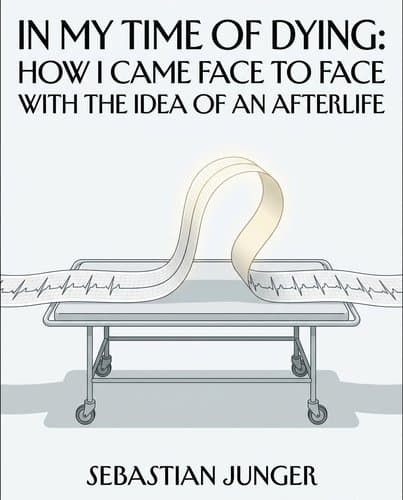
199798896_in-my-time-of-dying
by Sebastian Junger
A war journalist who survived certain death can't explain why he saw his dead father beckoning him into the void—and refuses to pretend science fully answers…
In Brief
A war journalist who survived certain death can't explain why he saw his dead father beckoning him into the void—and refuses to pretend science fully answers it. Junger holds neuroscience and genuine mystery in the same hand, forcing readers to confront what consciousness at the threshold of death actually reveals.
Key Ideas
Deceased relatives appear, not living ones
When the physiological explanations for near-death experiences are laid out — gamma wave surges, DMT-like neurochemicals, G-LOC parallels — they are genuinely compelling. But they do not explain why the dying consistently see deceased relatives rather than living ones. This single anomaly is the crack in the purely neurological account, and serious researchers treat it as unresolved.
Invisible blood loss crosses silent thresholds
The 'trauma triad of death' (hypothermia, acidosis, coagulopathy) can be triggered by blood loss that is invisible from the outside — Junger felt burning pain for months and dismissed it. Symptoms that seem manageable can cross a threshold silently.
Embracing contradiction is rigorous science
Holding two contradictory explanations simultaneously — 'this was brain chemistry' and 'this was something I cannot account for' — is not intellectual weakness. It is the most rigorous position available given what neuroscience and quantum physics currently know about consciousness at the threshold of death.
Individual psychology shapes near-death experiences
NDEs are not uniform: Tyler Carroll's produced total peace and acceptance while Junger's produced confusion and resistance. The experience may be shaped by individual psychology and the will to survive, which complicates any universal interpretation.
Strangers united through blood donation
Donating blood is one of the most direct ways to participate in the collective act of keeping strangers alive — it takes less than an hour, and Junger's survival required ten units from ten people he will never meet.
Who Should Read This
Readers who connect with first-person stories about Memoir and Neuroscience and want to see the world through someone else's eyes.
In My Time of Dying: How I Came Face to Face with the Idea of an Afterlife
By Sebastian Junger
15 min read
Why does it matter? Because the assumptions you have about death — and what happens in its final seconds — are almost certainly wrong.
Sebastian Junger has spent his career walking toward danger — war zones, rogue waves, collapsing industries — and reporting back with the precision of someone who trusts evidence above everything else. Then, at fifty-eight, he nearly bled out in a trauma bay on Cape Cod, and his dead father appeared above him and invited him into the void. Junger is the son of a physicist. He doesn't believe in ghosts. He couldn't explain it, couldn't dismiss it, and couldn't do what most people do — reach for a comfortable answer and move on. This book is what happens when an intellectually honest person refuses that exit. Not a conversion story. Not a debunking. Something harder: a man holding neuroscience and quantum physics in one hand, and an experience that neither fully explains in the other, and refusing to drop either one.
The Universe Kills People Casually, and Your Body Knows It
Sebastian Junger is thirty years old, alone on a January beach in New England, waxing his board before paddling out into surf he thinks he understands. He has surfed this spot since he was eight. What he doesn't know — and won't know until he's fighting for his life — is that cold, dense seawater breaks with more force than warm water, that winter sandbars are steeper and pitch waves forward more violently, and that a person can hold their breath for maybe twenty seconds in near-freezing water. He paddles out anyway.
When the set wave detonates directly on top of him, the leash snaps. The hydraulics spin him in every direction simultaneously, strip his hood, pack his wetsuit with sand. He loses track of which way is up. What happens next isn't panic — it's something more mechanical and more frightening. His field of vision, already black, begins collapsing to a single gray point. His throat starts to gag. He has never come close to drowning before, but his body runs through the sequence without consulting him: narrowing vision, involuntary gagging, one final forced breath incoming. The body knows the procedure. It has always known.
In the middle of this, his mind produces a thought so small it's almost comic: there's a pile of dirty dishes in his sink that someone is going to have to deal with. Not a dramatic final vision — just a sink full of dishes. The mind reaching for something manageable while the body gets on with dying.
He survives because the turbulence slackens by a few degrees, just enough for his wetsuit's buoyancy to give him a direction. He kicks. The water goes from black to green to white. He breaks the surface.
What the wave teaches him is the thing the book keeps returning to: death isn't a distant event or a philosophical abstraction. It's a physical process, indifferent and impersonal, that can begin on an ordinary Tuesday morning at a beach you've known your whole life. Your body understands this even when your mind refuses to. The universe doesn't single you out. It just doesn't notice you at all.
Ten Minutes from Death, and No One Knew — Including You
The body starts dying before you know anything is wrong. That's the thing no one tells you — and the thing Junger's June 16, 2020 makes undeniable.
For six months, Junger had felt a burning beneath his sternum that came and went, sometimes dropping him into what he called a sick heat. He ignored it the way he had ignored hernias, kidney stones, broken ribs. He was the father of two small daughters, fifty-eight years old, healthy by any reasonable measure. On some level he had concluded that the universe simply doesn't target people in his situation. It's the same logic his daughter used when she noticed the rain had washed away her chalk drawings — surely the universe would have seen how beautiful they were. Junger knew better than to believe that. He believed it anyway.
What was actually happening inside him had nothing to do with his beliefs. A ligament near the top of his abdominal cavity had been slowly crushing his celiac artery — the main blood supply to all his digestive organs — for his entire life. His body had quietly compensated, rerouting blood through smaller side arteries that gradually stretched and distorted under the pressure. In one spot, the artery wall had ballooned outward to the size of a grape and grown thinner with every heartbeat. He had no way to know. There are only 131 documented cases of this exact aneurysm on record, which is why the emergency doctors in Hyannis later called him a "zebra" — a presentation so rare that medical students are told: when you hear hoofbeats, don't think zebra.
When the aneurysm ruptured, Junger lost consciousness in waves, went blind for a stretch in his driveway, soaked a stretcher with blood, and arrived at the hospital with his blood pressure at 68 — ten points below the minimum threshold for staying conscious. By the time the doctors got a clear picture of what was happening, he had lost roughly nine of fourteen units of blood. His body had entered the trauma triad of death: plummeting temperature, mounting acid toxicity, and blood that was losing its ability to clot. At that stage, transfusing more blood becomes nearly self-defeating — every bag dilutes the clotting factors further. A quarter of people who die from this kind of hemorrhage have plenty of blood in their veins. They die because it won't stop moving.
The doctors had perhaps ten minutes. Junger had no idea. He was trying to make jokes.
His Dead Father Was There. He Has No Explanation.
In Tartu, Estonia, in 2023, researchers monitoring dying cardiac patients with EEG equipment recorded something that had no ready explanation: in the seconds after the heart stopped, electrical activity in the brain didn't simply go dark. It surged. Gamma waves — the frequencies associated with conscious perception and memory retrieval — spiked to levels higher than anything recorded during normal waking life. Whatever the dying brain is doing in its final moments, it isn't winding down.
This matters for what happened to Sebastian Junger in a trauma bay in 2020, and for why it's hard to put neatly away. Ketamine, given in high doses, produces vivid near-death-style visions. So does DMT, which the brain may release under extreme physiological stress. These are real phenomena, chemically reproducible, and they explain a lot about the near-death literature. Bright lights, tunnels, the sense of floating above one's body — most of this maps cleanly onto what happens when oxygen-starved neural tissue starts misfiring. The neuroscience isn't wrong. It just doesn't cover everything.
Junger is lying on a gurney in the trauma bay, a plastic sheet draped over his face to keep the surgical field sterile, when he becomes aware of a darkness gathering to his left. Not dimness — the purest black, depthless, exerting a pull that was slow but had no answer to it. Everything to do with life — the doctors, the nurses, the machinery, the noise — was clustered on his right. The left side of the room contained only that pit. He understood, without being able to say why, that going into it would be permanent.
And then his father was there.
Miguel Junger, a physicist who had spent his career measuring and testing the world, who had been dead for eight years, appeared above his son — not as a vision exactly, more like a familiar configuration of presence. He was radiating reassurance. His message was simple: don't fight this. Come with me. I'll take care of you.
Junger did not find this comforting. He found it grotesque. He was fifty-eight years old, the father of two small daughters, and as far as he knew he was in a hospital being treated for abdominal pain. His father was dead. He had no business being here. Junger turned his attention back to Dr. Wilson, working on the jugular line, and told him to hurry — you're losing me, I'm going right now. Then consciousness ended.
Miguel Junger was perhaps the worst imaginable candidate for a deathbed hallucination. This was a man who interrupted his wife's talk of energies and chakras to ask, with genuine curiosity, what kind of energy that would be and whether it was measurable. He believed that accepting things you don't understand is either obedience or desperation, neither of which leads to truth. If Junger's dying brain was going to generate a comforting figure conjured from some deep wish for reassurance, it seems unlikely to have chosen the one person in his life most likely to say: your perception of me is not evidence of anything.
And yet the experience had a specificity that brain-chemistry explanations struggle with. It wasn't a vague warm light or an anonymous benevolent presence — it was his father, with his father's particular quality of calm authority, appearing on the side of the room where the darkness was pulling him. Researchers who study near-death experiences call it the dead relative anomaly: dying people consistently report encounters with deceased family members rather than living ones, and the relatives who appear are sometimes people the dying person didn't know were dead. The vision matches the geography of dying rather than the geography of wish-fulfillment.
Junger can't explain what happened. That's the honest position, and he holds it without flinching. He's not a convert. He's a rationalist who encountered something his rationalism doesn't have a drawer for, and he's left standing there, holding it. The neuroscience accounts for almost everything — almost.
Science Has an Explanation for NDEs — and It Almost Works
Psychiatrist Bruce Greyson spent decades documenting more than a thousand near-death experiences at the University of Virginia, and the story he tells most often isn't about a light or a tunnel. It's about his own neckwear. The night before interviewing a patient who had nearly died, Greyson spilled spaghetti sauce on his tie at dinner. He changed ties, forgot about it. The next day, the patient — a young woman who had been unconscious when Greyson first examined her — told him she had watched him from above during her resuscitation. She described his tie. The clean one. And then she described, in the same breath, a man standing next to him who had been urging her to go back. She gave his name. It was her brother. Her brother had died three weeks earlier. No one had told her.
That's the thing the neuroscience explanation can't get around. Not vague presences. Not symbolic figures standing in for loss or longing. Specific dead people, named, unexpected — people the dying sometimes didn't know were dead.
The neurochemical account of near-death experiences is otherwise genuinely persuasive. Give someone ketamine and their ego dissolves, time bends, and they sometimes report floating outside their body. Spin a fighter pilot to seven Gs in a centrifuge until blood drains from his brain and he loses consciousness and wakes up certain he was drifting in a warm ocean under a yellow sun. The strongest evidence came from an Estonian hospital in 2022, where an 87-year-old man died of a brain hemorrhage while wearing EEG electrodes. Researchers captured the electrical activity of an actually dying human brain and saw a 30-second surge of gamma waves at the moment of death — the same waves associated with dreaming, intense memory retrieval, and dissociative states. Laboratory rats produce the same surge when they die. Tyler Carroll's experience in the shipping container in Afghanistan — his entire 21 years appearing to him simultaneously, outside linear time, while he cycled in and out of consciousness performing CPR on a dead friend — may be what all mammal brains do at the end: one final, overwhelming burst of memory, possibly to give the dying animal one last reason to fight its way back. The gamma wave data doesn't make Carroll's experience less extraordinary. It makes it more so, differently — extraordinary that the brain has apparently always known how to do this, kept the procedure in reserve, and saved it for the end.
Neurophysiologist Christof Koch is direct: when the EEG goes flat, there is no known mechanism for experience. Everything neuroscience has learned in 120 years says zero electrical activity means zero consciousness. The visions, on this account, are chemistry — stress neurochemicals, oxygen starvation, the brain's opioid system smoothing the passage out. Greyson himself has compared thousands of NDE accounts with documented drug experiences and found that ketamine produces a nearly identical phenomenology: the tunnel, the light, the dissolution of self, the sense of infinite understanding.
But ketamine does not explain the dead. The neurochemistry of oxygen deprivation can explain why a dying brain produces visions. It cannot explain why those visions keep populating themselves with the same category of figure, with a specificity that doesn't match wish-fulfillment. Sebastian Junger's father appeared on the left side of the room during Junger's near-death hemorrhage — not a generic comfort, but a located presence, a specific man in a specific spot. The dying don't hallucinate their living friends. They don't see strangers. Hallucination is diffuse by nature. What the dying report is precise.
The One Thing Brain Chemistry Cannot Explain
If the neuroscience explanation truly closes the case, here is the question it needs to answer: why do the dying keep seeing the dead?
Not symbolic figures. Not generic presences. Specific, named, deceased relatives — people the dying person hasn't thought about in years, sometimes people they didn't yet know were dead. The dying brain hypothesis explains hallucinations well enough: oxygen starvation, endogenous DMT, the limbic system flooding with its own opioids. That accounts for tunnels of light, sensations of unity, ego dissolution, the whole phenomenology. What it cannot account for is category specificity. The dying don't hallucinate their living friends. They don't see strangers. Across cultures, across centuries, in mud-walled rooms and trauma bays, what the dying see is this one thing: deceased relatives, arriving as if expected.
Psychiatrist Bruce Greyson spent decades documenting more than a thousand near-death experiences, and he kept running into something that troubled him as a scientist. The most rigorous cases weren't the vague tunnel-and-light reports — those could plausibly be explained as chemistry. The troubling ones were what researchers call veridical perceptions: patients acquiring accurate, specific information they had no conscious access to. Greyson's own encounter with this problem came early in his career. A young woman arrived in the emergency room in a coma after a drug overdose. Greyson had just spilled spaghetti sauce on his tie and buttoned his lab coat over it before examining her. The next day, after she regained consciousness, she told him she had watched him from above while he spoke to her roommate in the waiting room — and described, accurately, the stain on his striped tie. Greyson has spent fifty years trying to find the mechanism for that.
A dying brain producing hallucinations is not mysterious. A comatose brain accurately perceiving a concealed stain on a doctor's tie in another room is a different kind of problem. The neurochemical account predicts that a brain starved of oxygen will generate vivid but internally sourced experience. It cannot predict that this experience will contain verifiable external details. That gap is narrow, but it hasn't closed.
Junger's father appeared on the left side of the trauma bay — the side where the darkness was pulling — on the table, minutes from cardiac arrest. The same father who spent a lifetime insisting wonder earn its credentials. His appearing there doesn't prove anything. But the pattern he appeared inside — the dead showing up for the dying, and not for anyone else — is the one thread the most rigorous researchers in this field still can't cut loose.
The Most Honest Answer Is Also the Most Uncomfortable One
Here is the uncomfortable truth: neither neuroscience nor physics can close this case, and the most rigorous thinkers in both fields know it.
Junger's father spent his career as a physicist insisting that the universe yields only to measurement and evidence — a man who asked his wife, with genuine curiosity, what kind of energy she meant when she talked about chakras. He found belief in the unmeasured not inspiring but intellectually sloppy. This is the person who appeared in the trauma bay, on the side of the room where the darkness was pulling at his son, radiating a specific and recognizable calm authority. If Junger's dying brain was manufacturing comfort, it chose the one figure in his life least associated with that kind of comfort.
The neuroscience account handles most of the NDE landscape reasonably well — the gamma wave surge captured on EEG at the moment of cardiac arrest, the endogenous neurochemicals that produce ego dissolution and the sensation of infinite understanding, the limbic system running its final sequence. What it cannot handle is specificity. A brain starved of oxygen will hallucinate; the chemistry predicts that. It does not predict that the hallucination will be a named, deceased person with identifiable characteristics arriving from a particular direction in the room. Hallucination is diffuse by nature. What the dying report is precise.
Physics, which Junger turns to hoping for firmer ground, offers something stranger than comfort. Schrödinger's wave function describes particles as existing in all possible states simultaneously until measurement forces them into one. At the threshold of death — blood pressure at 68, nine units already lost, a Cordis needle working toward the jugular — Junger wasn't metaphorically between states. He was occupying the medical equivalent of the box before anyone opens it. The doctors later estimated he was ten minutes from cardiac arrest. The wave function had not collapsed in either direction.
Quantum mechanics has shown, in reproducible experiments, that the act of observation retroactively changes what happened. Consciousness is not a bystander in the physical world; it is load-bearing. But no one has traced that from the subatomic level to a dead man appearing in a trauma bay, and anyone who claims they have is getting ahead of the evidence.
That's where you're left. No debunking, no confirmation — a genuine threshold where both disciplines run out of road. Holding that position without reaching for false resolution is, Junger suggests, the most honest thing anyone can do with it.
Ten Strangers Kept Him Alive. He Now Keeps Strangers Alive.
Somewhere in a blood bank before June 16, 2020, ten people rolled up their sleeves. They didn't know Sebastian Junger existed. They gave blood the way most people donate — half civic virtue, half because the whole thing was over before it got inconvenient. Then they went home. Later, while Junger was lying on a gurney with his blood pressure at 68 and nine units already soaking through his abdominal cavity, those ten anonymous decisions were the difference between his daughters having a father and not having one.
Junger now gives blood three or four times a year — as often as the guidelines allow. It's the most direct response he has found to what happened to him: the survival wasn't his. It belonged to the team at Cape Cod Hospital, to a paramedic named Joe Lang in the ambulance, to a medical student named Charlotte who sat with Junger's wife in the waiting room while surgeons worked on the inside of her husband, and to ten people who gave blood to someone they would never meet.
The interior of the book traces a solitary consciousness approaching darkness. This closing note reframes the whole journey: no one approaches that threshold alone. The web of care that keeps you here is enormous, mostly anonymous, and indifferent to whether you deserve it. Ten strangers helped pull Junger back from whatever was on the other side. He calls that debt unpayable, and he spends what time he has trying to pass it forward to the next stranger — whoever they turn out to be.
What Your Dead Father Is Doing in the Trauma Bay
Here is what Junger can't shake: his father — the man who spent a lifetime demanding that wonder earn its credentials through measurement — showed up at the exact threshold where measurement stops. As warmth, a quiet invitation, and something that looked, despite everything, like care. Junger refused. But he can't explain why refusing felt like a choice rather than a reflex, and that distinction matters more than it should. Maybe the most honest question death leaves you with isn't whether consciousness survives it — it's why, when you reach the edge, the people who loved you most seem to already be there. Not to haunt you. To accompany you. Wonder and rigorous honesty are not opposites. Sometimes they're the same posture, held at the same threshold, staring into the same dark.
Notable Quotes
“You were getting ready to buy the farm.”
“It’s okay, there’s nothing to be scared of,”
“Don’t fight it. I’ll take care of you.”
Frequently Asked Questions
- What is Sebastian Junger's 'In My Time of Dying' about?
- "In My Time of Dying" recounts war journalist Sebastian Junger's near-fatal medical emergency and the vision that accompanied it. The book examines the neuroscience of near-death experiences while confronting what current science cannot fully explain. Junger explores physiological explanations including gamma wave surges, DMT-like neurochemicals, and G-LOC parallels, yet reveals a critical anomaly: the dying consistently see deceased relatives rather than living ones. This gap in the purely neurological account points to something researchers still cannot resolve. The work demonstrates how to hold both empirical findings and unresolved questions simultaneously without abandoning intellectual rigor.
- What does Junger reveal about the neuroscience of near-death experiences?
- The physiological explanations for near-death experiences are genuinely compelling when examined in detail. Junger explores gamma wave surges, DMT-like neurochemicals, and G-LOC parallels as measurable mechanisms for altered perception. However, he identifies a critical gap: the dying consistently see deceased relatives rather than living ones. "This single anomaly is the crack in the purely neurological account," and serious researchers treat it as unresolved. The book argues that purely brain-based explanations, while scientifically rigorous, remain incomplete without confronting this persistent anomaly. Junger's approach demonstrates intellectual honesty by acknowledging both what neuroscience can and cannot explain about consciousness at death's threshold.
- What are the key takeaways from Junger's exploration of near-death experiences?
- The book presents several critical insights about near-death experiences. First, they are not uniform—Tyler Carroll's produced total peace and acceptance while Junger's produced confusion and resistance, suggesting individual psychology and will to survive shape the experience. Second, holding contradictory explanations simultaneously—"this was brain chemistry" and "this was something I cannot account for"—is not intellectual weakness but the most rigorous position given current neuroscience and quantum physics knowledge about consciousness. Third, the "trauma triad of death" (hypothermia, acidosis, coagulopathy) can be triggered by invisible blood loss, making manageable symptoms suddenly life-threatening. Finally, blood donation directly participates in keeping strangers alive.
- Is 'In My Time of Dying' worth reading?
- Yes, the book offers significant value for readers interested in consciousness, neuroscience, medical emergencies, and philosophical questions about the afterlife. Junger's approach is intellectually rigorous rather than credulous—he presents the neuroscience while honestly acknowledging its limitations. The memoir combines personal narrative with research depth, making complex neuroscience accessible. His willingness to hold unresolved questions without false certainty models intellectual honesty increasingly rare in contemporary discourse. Additionally, the book provides practical medical knowledge about life-threatening conditions appearing manageable from the outside. For those seeking serious exploration of near-death experiences grounded in evidence yet open to mystery, this work delivers both intellectual substance and existential reflection.
Related Book Summaries


Read the full summary of 199798896_in-my-time-of-dying on InShort