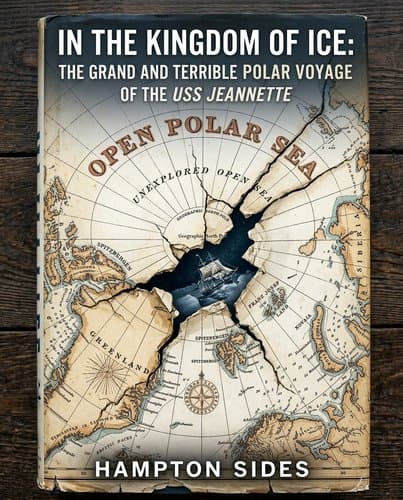
20897517_in-the-kingdom-of-ice
by Hampton Sides
Brilliant men sailed the USS Jeannette into Arctic catastrophe armed with the best maps, the finest science, and the full backing of the U.S.
In Brief
Brilliant men sailed the USS Jeannette into Arctic catastrophe armed with the best maps, the finest science, and the full backing of the U.S. Navy—and every one of those advantages helped kill them. Hampton Sides reveals how certainty itself becomes the deadliest force when everyone in the system shares the same fatal assumption.
Key Ideas
Expert Consensus Can Mask Shared Blindness
Scientific consensus is not the same as scientific truth — the Open Polar Sea theory was endorsed by the world's leading cartographers and was demonstrably wrong. When experts agree enthusiastically, ask what evidence would change their minds.
Institutional Alignment Magnifies Catastrophic Errors
Institutional legitimacy can make bad ideas lethal. The Jeannette disaster required a Navy imprimatur, a media baron's funding, Congressional authorization, and the world's best theoretical maps — all pointing in the same wrong direction. No single person or institution can catch an error when the entire system shares the same assumption.
Authority Masks the Largest Hidden Errors
The maps we trust most are the ones most worth questioning. De Long staked everything on Petermann's chart of the Lena Delta, which showed eight river mouths instead of two hundred. The more authoritative a source, the more catastrophic the error when it's wrong in a place where you have no room to recover.
Loyalty Cannot Substitute for Critical Competence
Loyalty is not always a virtue in high-stakes decisions. De Long's choice to give Danenhower a second chance over his doctor's unequivocal medical advice was an act of genuine humanity that removed his navigator from duty at the worst possible moment. Compassion and competence are not the same thing, and conflating them can transfer the cost of one person's vulnerability onto everyone else.
Risk Architects Escape Consequences Most Successfully
The absent architect of a catastrophe often escapes accountability. Bennett funded the expedition, shaped its public narrative, and then spent its most dangerous months designing a tennis club. The man most responsible for the Jeannette's mission bore the least of its consequences — a pattern worth recognizing in any enterprise where those who design the risk are insulated from its results.
Who Should Read This
History readers interested in World History and Military History who want a deeper understanding of how we got here.
In the Kingdom of Ice: The Grand and Terrible Polar Voyage of the USS Jeannette
By Hampton Sides
15 min read
Why does it matter? Because the maps we trust most are the ones most likely to kill us.
In the winter of 1879, the most sophisticated polar expedition ever assembled sailed confidently north toward a sea that didn't exist. The charts were authoritative. The science was peer-reviewed. The ship was reinforced with American elm and Oregon pine, lit by Thomas Edison's newest invention, equipped with Alexander Graham Bell's telephone. The men were disciplined, the funding was limitless, the theory was endorsed by the world's leading geographers. Every decision made sense — and every decision was wrong. This is what makes the Jeannette something stranger than a disaster story. A case study in how certainty kills. How the most dangerous maps aren't the blank ones, but the ones drawn with absolute confidence over territory no one has actually seen. The question that haunts this story is the one that haunts all ambitious failures: what happens when intelligent people reason their way, step by logical step, directly into catastrophe?
The Last Great Mystery Pulled Men Toward It Like a Drug
In April 1873, the sealing ship Tigress was pushing through loose floes off Labrador when a lone Inuit in a kayak appeared out of the mist, screaming and waving his arms. The crew leaned over the railing, bewildered, until the fog parted enough to reveal what the man was pointing at: a jagged slab of ice carrying nineteen people — men, women, and children — who erupted in cheers and fired guns into the air when they saw the ship. When the survivors came aboard, hollow-eyed and frostbitten, their lips still greasy from a breakfast of raw seal intestine, their leader George Tyson explained what had happened. They had been drifting on that ice slab since October. The ship they had fallen off of was the Polaris, a U.S.-funded Arctic expedition vessel whose commander, Charles Francis Hall, had died months earlier under circumstances later confirmed as arsenic poisoning.
The story landed on the American public like a depth charge. A naval rescue mission was dispatched almost immediately, and a 28-year-old lieutenant named George De Long volunteered to captain a 28-foot steam launch called the Little Juniata on the most dangerous leg of the search — four hundred miles north along Greenland's coast toward Cape York, through waters that had swallowed entire whaling fleets. De Long had never been to the Arctic before and had no particular desire to go. What happened to him up there is the real opening of this story. Threading between capsizing bergs in a freezing fog, ramming through unbroken pack ice, surviving a 36-hour gale that threatened to grind the little boat to splinters, he discovered something unexpected: he loved it. At one point he anchored to a berg to chip fresh water from its flank, only to pull away seconds before a massive overhang sheared off and crashed into the sea. He returned to New York changed in a way his wife Emma noticed instantly. He was already talking about going back.
That pull makes more sense when you understand what the North Pole represented in the 1870s. It was, genuinely, the last significant blank on the map — unknown in the most fundamental sense. Nobody could say with confidence whether it was land, ocean, ice, or open water. Whether it was warm or frigid. Whether it was inhabited. A German geographer named Ernst Behm compared humanity's ignorance of the poles to a family that has lived in a house for generations without ever once climbing to the attic. The New York Times insisted that men would never be content leaving the top of the earth a permanent mystery. For a naval officer like De Long, stuck in a peacetime fleet that contemporaries called a laughingstock of rusting ships and stalled promotions, one successful polar voyage could rewrite a career entirely. The Arctic wasn't recklessness. It was the only rational bet available.
The Expedition Was Born from a Drunken Scandal and a Newspaper Empire's Hunger for Spectacle
On New Year's Day 1877, James Gordon Bennett Jr. arrived drunk at the Manhattan home of his fiancée's family, helped himself to another drink, and then, standing beside the grand piano in the drawing room with guests looking on, unbuttoned his trousers and urinated into the instrument. He was escorted out bodily and thrown into the street. Three days later, Caroline May's brother met him on Fifth Avenue with a horsewhip. Bennett took the beating for a moment, then grappled the man into a snowbank until both of them were bleeding. Too proud to apologize and too reckless to walk away, he challenged May to what became one of the last formal duels fought on American soil — a pistol affair at dawn near the Maryland-Delaware border, conducted under assumed names with surgeons standing by. May was winged in the shoulder. Bennett boarded a steamer for Paris shortly afterward and never really came back.
This is the origin story of the USS Jeannette.
Bennett was already the most powerful newspaper publisher in the United States when he destroyed his social life in that drawing room. He owned the New York Herald outright — the paper that had funded Henry Stanley's search for Livingstone in Africa and turned the dispatches into an international sensation. His core belief about journalism was simple and radical: a newspaper should not merely cover events but manufacture them. Public drama was the product. Emotion was the delivery mechanism. The Livingstone story had proved the formula worked at enormous scale, and Bennett had been hunting for an encore ever since.
When George De Long came to his marble-floored offices in 1874 and pitched an expedition to the North Pole as both America's destiny and a private-public enterprise in need of a patron, Bennett saw it immediately for what it was: content that could dwarf Africa. He agreed to fund everything — the ship, the crew, the refit, the Herald correspondent who would sail aboard and file dispatches. De Long would get his polar voyage. Bennett would get the story.
The World's Best Scientists Built an Elaborate Case for Something That Didn't Exist
The Open Polar Sea was not a sailor's daydream. It appeared on official British Admiralty charts and U.S. Navy maps, endorsed by Matthew Fontaine Maury and championed by the most authoritative cartographer alive. The theory had institutional stamps from every body that mattered. That it turned out to be entirely fictional makes the coming catastrophe harder to explain away as simple recklessness.
The theory had an almost seductive internal logic. Warm-water currents — the Pacific's Kuro Siwo and the Atlantic's Gulf Stream — swept northward from the tropics like a planetary circulatory system, argued Navy officer Silas Bent. They tunneled under the Arctic ice, he claimed, keeping a central polar basin liquid and navigable year-round. The ice that stopped every explorer at roughly the 80th parallel was just a thin outer ring, a 'girdle,' and once a ship punched through it, open water awaited. A thermometer, not a compass, would guide the way. The idea was so thoroughly accepted that cartographers didn't hedge it — they printed OPEN POLAR SEA across the top of the world as simple geographical fact.
The man who made De Long believe most completely was August Petermann, the Sage of Gotha, whose mapmaking institute in a small German city was the global clearinghouse for geographical knowledge. Petermann had never been within a thousand miles of the Arctic. He directed expeditions from his study. But his maps were the best in the world, his reputation was absolute, and when he sat with James Gordon Bennett in 1877 and laid out the route — through the Bering Strait, riding the Kuro Siwo's warmth, up along a mysterious landmass called Wrangel Land that Petermann believed formed one arm of a continent arching over the pole — Bennett left Gotha so convinced he briefly considered sailing to the pole himself.
On the exact day the Jeannette left Le Havre — July 15, 1878 — a Herald reporter found Petermann in his garden and asked him about the voyage. He predicted smooth sailing, manageable cold, and possibly Inuit civilization living directly beneath the pole. Ten weeks later, on September 25, 1878, he was found hanged in his villa. The expedition sailed on toward an Open Polar Sea whose most ardent champion had not lived to see it disproven — or to answer for it.
The Theory Was Being Disproved in Real Time While the Ship Was Already at Sea
What if the mission was already doomed before the Jeannette cleared the Golden Gate? Not through bad luck, but because the science it rested on was being systematically demolished by other scientists at the same moment De Long was sailing north.
Dall's report, when it finally landed, was merciless. William Healey Dall, a Harvard-trained naturalist working for the U.S. Coast and Geodetic Survey, had spent years measuring the Kuro Siwo — the Japanese current that Silas Bent and August Petermann had promised would melt a warm-water highway to the pole — and the data said otherwise. The current frayed and weakened long before it reached the Bering Strait. The dominant flow at the strait ran cold, and it ran south. Dall called the open polar sea idea not just wrong but embarrassingly unscientific: the strait was 'incapable' of carrying enough warmth to affect the polar basin, and nothing in the findings gave any reason to expect ice-free water anywhere in the polar sea. De Long never saw the report. He had already sailed.
The trap finished closing on September 7, 1879. A large floe shoved the Jeannette sideways, other slabs tightened around her hull, and within minutes she was locked solid — 'nipped,' in the whalers' term — at 72 degrees north, eight full degrees short of where De Long had planned to winter. The ship canted at such an angle that men couldn't lie in their bunks without bracing against the walls. De Long stared out over the ice and recorded the question that had no good answer: where was the Kuro Siwo? His thermometers had found nothing — no warm upwelling, no hint of a current tunneling north. The thermometric gateway that had justified this entire voyage was simply absent.
Over the long winter months that followed, locked and drifting, De Long and his navigator Danenhower talked through the evidence during late-night sessions in the wardroom and arrived at what was, for its time, a genuinely original insight: the pole was not an open sea but a permanent shifting mass of ice rotating slowly, like a watch's hands, driven by wind and current. Then, somewhere in the dark of that frozen winter, De Long picked up his journal and wrote what amounted to an epitaph for everything the expedition had been built to prove. The thermometric gateway to the North Pole, he declared, was 'a delusion and a snare.' He was right. It had just taken a trapped ship at 72 degrees north to prove it. What De Long and Danenhower couldn't yet see was how that ice moved — and why understanding its mechanics might have changed everything about how they responded to it.
De Long's Greatest Strength — Loyalty to His Men — Became a Structural Liability
Think of it as a structural engineering problem. A ship can be reinforced against ice pressure along its hull, its keel, its every seam — but if the navigator is confined to a darkened cabin going blind, no amount of timber and iron saves you. De Long understood ships. What he couldn't see was how his instinct to trust and redeem the men around him was quietly hollowing out the mission from the inside.
The pattern started before the expedition left the Atlantic. Somewhere near the southern tip of South America, Danenhower pulled De Long aside and confessed to a history of 'melancholy' — a breakdown three years earlier, a stint in a Washington asylum for the insane, a padded cell, a rescue engineered by his family's connections to the Secretary of the Navy. De Long listened, weighed it, and decided that a man who came forward voluntarily deserved the benefit of the doubt. The troubles were old, the performance had been excellent, and if Ulysses Grant had trusted this man, so would he.
Then Dr. Ambler investigated and told De Long flatly that sending a man with a documented history of suicidal depression into the perpetual darkness of an Arctic winter wasn't a calculated risk — it was a foreseeable catastrophe. De Long knew Ambler was right. He tried to remove Danenhower from the roster. The Danenhower family's political connections to the Navy Department made that impossible; an official notice arrived declaring all doubts about Danenhower's fitness 'groundless.' De Long's hands were tied.
By late 1879, with the Jeannette locked in the ice, the hidden bill came due. Ambler diagnosed Danenhower with syphilitic iritis — second-stage syphilis attacking his left eye — and confined him to a blacked-out cabin, goggles, blindfolds, no navigational work of any kind. A dozen eye surgeries followed, performed with opium and a knife. De Long had reinforced every timber except the one that mattered: he was now navigating an Arctic ice pack without a navigator, and he didn't even know why.
After the Ship Sank, the Ice Itself Became the Enemy — and It Was Winning
At four o'clock on the morning of June 13, 1881, the watchman Kuehne called out to anyone still awake: if you want to see the last of the Jeannette, now is the time. She had been lying on her side for hours, the tip of her smokestack nearly level with the water. Then, with a sudden rattling of timber and ironwork, she righted herself — rose upright like a ship again, like a ship that had simply changed its mind about dying. For a few moments she floated exactly as she had been built to float. Then she began to sink straight down, gathering speed as she went, and as she dropped the yardarms snapped upward along the masts so that the rigging looked, as one of the men described it, like the arms of a skeleton thrown up in final surrender. Then she was gone, at latitude 77 degrees north, roughly a thousand miles from the Siberian coast.
Thirty-three men stood on the ice watching the hole where their ship had been. They had their sleds, their boats, their pemmican. They also had, without quite naming it, the only thing that was going to matter: each other.
For eight days they hauled eight tons of gear south across the pack, the mood improbably cheerful — men fainting from exhaustion and waking up cracking jokes, singing echoing across the broken ice. De Long walked point with the ice pilot Dunbar, planting black flags and calling the ragged corridor a 'road,' a word that made the men laugh. Then, on June 25, he put his sextant to his eye and took a positional reading. He checked it again. He had Melville check it independently. The answer came back the same every time: the ice pack was drifting north faster than they could march south. After eight days of effort that should have bought them twenty miles of progress, they had actually moved twenty-eight miles backward. Every step they had taken, every rope that had cut into their chests — erased and then some.
De Long told almost no one. He confided in Ambler and Melville and then actively avoided his other officers to prevent the questions he knew they would ask. When he put the sextant down, witnesses noted nothing unusual about his expression. He simply looked out at the ice. It was the most important navigational finding of the entire journey, and he buried it. The captain of a scientific expedition — one that had already exploded the Open Polar Sea myth, disproved the Kuro Siwo theory, and correctly mapped the Arctic as a year-round frozen basin — was now suppressing his own data to keep thirty-two men hauling sleds into a wind that was beating them. The expedition had spent two years generating knowledge. It was ending with knowledge deliberately unshared. 'If we go on this way,' De Long wrote privately, 'we will never get out.'
Three Boats Left Together; One Arrived Alone
On the evening of September 12, 1881, George De Long turned to look for Lieutenant Chipp's second cutter and saw nothing. The sixteen-foot boat had vanished into the Laptev Sea, somewhere between the wave troughs, in thirty-degree water, with all eight men aboard — among them the expedition's ice pilot, Dunbar, and Chipp himself. De Long knew the arithmetic: capsized in that cold, you had minutes. He also knew he couldn't turn back. In a full gale, reversing course in an overloaded boat would kill everyone he still had. He drove on.
What followed was not a test of character. De Long had already proven his character over and over — in the Bering Sea, on the ice pack, through three years of slow catastrophe managed with iron composure. What followed was a test of cartography. Specifically, it was a test of how much trust you could place in a map drawn by a man in Leipzig who had never seen the Lena Delta. Petermann's map failed him completely.
The Lena Delta is one of the largest and most baffling river systems on earth — eleven thousand square miles of braided channels, shifting sandbars, and seasonal ice that rearranges itself every year. Petermann had drawn eight river mouths. The actual number is over two hundred. He had marked villages where there were empty hunting huts and hunting huts where there was nothing at all. The Yakuts who actually knew this country had already retreated upriver by mid-September, fleeing the floods that followed the annual ice formation — and De Long arrived one week too late to find them.
He landed eight miles from a settlement called North Bulun: a hundred people, permanent structures, winter supplies, a clear river channel running straight to it. De Long's men waded ashore through ice that sliced their shins, dragging the expedition's logs across tidal flats that froze solid around their ankles each night. The village that would have saved them was never in view because Petermann had not known it existed.
By the time De Long sent his two strongest men, Nindemann and Noros, ahead on foot to find help, the group had been reduced to its last measures of survival. The Irishman Collins — who had spent months in a private fury over De Long's command decisions — gripped Noros by the hand as the pair prepared to march south. 'When you get to New York,' he said, 'remember me.' The bitterest man on the expedition, stripped of every grievance by the cold, down to that one request.
The Bodies Were Found Exactly Where a Correct Map Would Have Put Them
On March 23, 1882, George Melville was trudging along a frozen back channel of the Lena Delta when he spotted something dark in the snow several hundred yards ahead: four sticks lashed into a crude marker, with a hunting rifle hanging from them. He recognized it immediately as belonging to Alexey, the expedition's only skilled hunter. Whatever that rifle represented, nothing good had left it there.
What Melville found next, climbing toward higher ground, was a copper teakettle smudged black from countless fires — and then a human arm projecting from the snow at an odd angle, frozen rigid, bent at the elbow. When he excavated the man it belonged to, he found Captain George De Long lying on his right side, head pointing north, wearing his Navy jacket under a filthy overcoat, a chronometer still hung around his neck. Beside him lay the blue silk flag Emma De Long had stitched for the expedition — the one meant to fly over the North Pole. In his pockets: five gold coins, two pairs of spectacles, and a small silk pouch containing a lock of hair and a crucifix inlaid with pearls. His left arm had frozen in that raised, cocked position because it was the last thing he had moved: he had used it to fling his journal away from the fire's embers before he died.
That journal told the rest. Glycerin from the medicine chest. Boiled boot leather. Willow tea. The entries grew shorter as the men grew weaker, collapsing finally into a sparse accounting of deaths — Iverson, then Dressler, then Boyd and Görtz in a single night — until the last line, on October 30: 'Mr. Collins dying.' Then the pages went blank.
Dr. Ambler was found a few feet away, exactly where Emma De Long had asked him to be. He had died holding De Long's loaded revolver in one hand — unfired, probably kept ready in hope that some animal might come near enough to shoot. His other hand bore a deep bite mark where, near the end, he had gnawed his own flesh. The gun never went off. He had kept his promise to the last.
Melville eventually learned that a Yakut food depot containing the preserved meat of twenty-three reindeer had been sitting a few miles away, unknown to De Long's men, the whole time. The wrong map had put them ashore eight miles east of a navigable channel. Eight miles.
Melville buried the ten bodies under a cairn of permafrost rocks at a bluff the Yakuts renamed Amerika Khaya — America Mountain — high enough to survive the spring floods, visible on clear days from a hundred miles away.
What the Drift Proved
The wreckage that saved the next expedition belonged to the expedition that was destroyed. Fridtjof Nansen, the Norwegian explorer who would become the first to successfully cross the Greenland interior, stood on a Greenland beach, looked at planks from the Jeannette's hull, and understood something De Long had died proving: the ice drifts, slowly and without mercy, from one side of the world to the other. He built the Fram, a ship designed to be squeezed and carried rather than resist, and rode that drift across the polar ice pack and home alive — the exact thing De Long had tried and failed to do. The knowledge was real. The tuition, however, had already been collected — from Alexey's rifle planted in the snow, from Ambler's bitten hand, from the blue silk flag that was supposed to fly over a pole it never reached. The map which gets corrected is sometimes corrected by the people it kills, and the generation that benefits rarely gets to thank the one that paid.
Notable Quotes
“We banked fires, secured the vessel with ice anchors and remained. We could proceed no farther.”
“As far as the eye can range is ice,”
“Not only does it look as if it had never broken up and become water … it looks as if it never would. It would take an earthquake at least to get us out of our besetment.”
Frequently Asked Questions
- What is In the Kingdom of Ice about?
- This book reconstructs the doomed 1879 Arctic expedition aboard the USS Jeannette, examining how scientific consensus, institutional authority, and expert maps combined to send men to their deaths. Hampton Sides reveals how the expedition was founded on the Open Polar Sea theory—endorsed by the world's leading cartographers—which proved demonstrably wrong. The Jeannette disaster reveals critical dangers about certainty when "the cost of being wrong falls on others." Through this historical lens, Sides explores what happens when elite consensus, institutional legitimacy, Congressional authorization, and authoritative maps all point in the same direction—but toward catastrophe.
- What are the key takeaways from In the Kingdom of Ice?
- The book reveals several critical insights: scientific consensus is not scientific truth (the Open Polar Sea was endorsed by world-leading cartographers yet proved wrong), institutions can make bad ideas lethal by concentrating authority and shared assumptions, and maps from authoritative sources carry catastrophic risk when wrong in unforgiving places. Sides emphasizes that "loyalty is not always a virtue in high-stakes decisions"—De Long's compassion toward his navigator removed him from duty at the worst moment. Finally, the absent architect escapes accountability: Bennett funded the expedition but bore least of its consequences, a pattern revealing how those who design risk become insulated from it.
- Why should I read In the Kingdom of Ice?
- This book offers urgent lessons for understanding how competent institutions collectively make catastrophic decisions. Hampton Sides demonstrates that institutional legitimacy can make bad ideas lethal: the Jeannette required Navy backing, Congressional authorization, media funding, and world-class theoretical maps—yet all pointed wrong. The expedition wasn't sabotaged by incompetence but destroyed by consensus. Sides reveals how the most authoritative sources deserve the most skeptical examination, and how those insulated from consequences often design the riskiest decisions. For anyone concerned with institutional failure, expert hubris, or how certainty can kill, this book provides historically grounded insight into patterns still reshaping modern institutions.
- How does the Jeannette disaster reveal institutional failure?
- The USS Jeannette disaster demonstrates that no single person or institution can catch an error when an entire system shares the same false assumption. The expedition was authorized by Congress, funded by media baron James Gordon Bennett, mapped by the world's leading cartographers, and approved by Navy officials—all based on the Open Polar Sea theory. When every authority converges on one direction, correcting course becomes impossible. De Long staked everything on Petermann's chart showing eight river mouths instead of two hundred; catastrophic errors come not from lone dissent but from aligned consensus. This pattern reveals how institutional structures can amplify rather than mitigate collective delusions.
Related Book Summaries



Read the full summary of 20897517_in-the-kingdom-of-ice on InShort