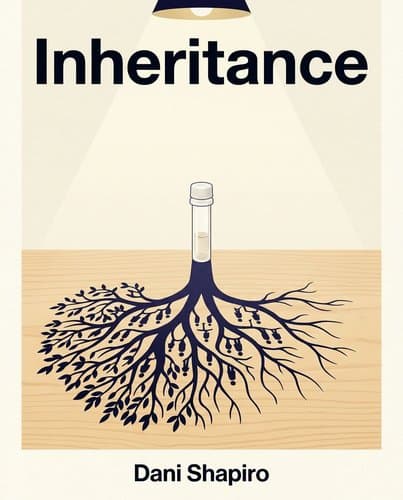
40364332_inheritance
by Dani Shapiro
A $99 DNA test at fifty-four unravels the family memoir Dani Shapiro spent her whole career writing — and forces a reckoning with whether identity is something…
In Brief
Inheritance (Janu) traces what happens when a DNA test overturns a fifty-four-year-old identity built on a biological secret. Through her own experience of late-life paternity discovery, Dani Shapiro examines how donor-conception secrets are made, why the mind resists knowing, and how identity can hold two biological truths at once without either canceling the other.
Key Ideas
Genetic testing permanently ends biological secrecy
Consumer DNA tests have permanently ended the era of biological secrecy. Any person conceived through anonymous donor insemination — an estimated 30,000–40,000 per year in the United States alone in the 1960s — can now be found by their biological relatives with a $99 kit and a genealogy website. Families carrying these secrets should assume, not wonder, that they will eventually surface.
Motivated unknowing protects against unbearable truths
'Motivated unknowing' is a real and powerful psychological defense. Shapiro had physical evidence (her face), verbal evidence (her mother's slip about Philadelphia), and social evidence (strangers insisting she couldn't possibly be Jewish) for fifty-four years — and couldn't integrate any of it. When the cost of knowing feels unsurvivable, the mind stops seeing what's directly in front of it.
Medicine deliberately designed parental deniability systems
The medical establishment of the 1960s deliberately engineered parental deniability into donor conception. The word 'treatment' instead of 'donor,' the uninformed second obstetrician, the destroyed records — these weren't oversights. They were designed to give couples the option to not-know. Understanding this changes the moral calculus of what parents 'chose': many were encouraged into a gray zone the system created.
Two fathers, two truths, simultaneously real
Having a biological father and a social father doesn't require choosing which relationship is real. Shapiro arrives at the position that she is genuinely 'cut from Ben Walden's cloth' and permanently 'Paul Shapiro's daughter' — and insists both are true simultaneously, without one canceling the other. Grief and love can be aimed at two different men for two different reasons.
Paternity secrets grieve two different fathers
The grief in a late-life paternity discovery isn't only about the new relationship — it's a second grief for the father you thought you had, and for what the secret may have cost him. Shapiro discovers that her father's lifelong diminishment and depression were partly the price he paid, knowingly or not, for becoming her father under a weight he may have carried alone.
Presence answers identity and purpose questions
The three questions the acupuncturist offers — 'Who am I? Why am I here? How shall I live?' — are not sequential. You don't need a complete answer to the first before the second becomes available. 'Hineni' — full presence to your life as it actually is — turns out to be a form of answer to all three at once.
Who Should Read This
Readers who connect with first-person stories about Memoir and Family and want to see the world through someone else's eyes.
Inheritance
By Dani Shapiro
10 min read
Why does it matter? Because what makes us who we are has almost nothing to do with DNA — and almost everything to do with the secrets our families keep about it.
We're willing to question almost everything about ourselves — our choices, our worth, our memory — but not where we came from. Lineage feels like bedrock: the one fact that exists before we existed, that can't be revised or misremembered. You know whose child you are.
Dani Shapiro knew. She'd built her entire writing life around it: memoir after memoir circling her father, an Orthodox Jew with a wounded soul, tracing his grief and his prayer and the long shadow he cast over everything she became. Then, at fifty-four, she spit into a plastic vial, and when the results came back, the bedrock dissolved.
What Inheritance asks, and refuses to rush toward answering, is whether the self built on a family secret is less real than the truth concealed beneath it. The answer is stranger, and more consoling, than you'd think.
Half a Second Is All It Takes to Split a Life Into Before and After
It's 10:30 on a weeknight in Connecticut, and Dani Shapiro is making a packing list. A West Coast trip in the morning, a pre-dawn departure to catch the flight — she needs to confirm San Francisco weather, fold a sweater, check off toiletries. Her husband Michael has been somewhere else in the house, and when she hears his footsteps pounding up the stairs she can tell from their rhythm that something has shifted. He comes through the door with his laptop open, a DNA comparison result loaded on the screen.
Her half-sister Susie had done genetic testing years before. Shapiro had recently written to ask if she'd share the results — a quick way to make sense of her own Ancestry.com numbers, which had come back oddly diluted: 52 percent Eastern European Ashkenazi, when everyone she'd ever known as family traced straight back to the same Jewish villages in Poland. The two testing kits had sat on the kitchen counter for weeks, unopened, becoming scenery between the coffee maker and the blackboard. She'd spit into hers one evening after lamb chops and a glass of wine, then gone back to clearing the dishes.
Now Michael sits beside her on the small chaise in the corner of her office. Directly behind them, a black-and-white portrait of her paternal grandmother hangs in a gilded frame — hair pulled back, gaze level and calm. On the screen, a comparison table lists shared DNA segments and the estimated number of generations to a most recent common ancestor. The calculation had taken 0.04538 seconds.
Michael points to the generational distance figure — 4.5, meaning strangers — and says what it means: Shapiro and Susie are not half-sisters. Not related in any degree.
What lands is a specific kind of shock — not the cinematic kind. Something quieter: a flatness, a suspension, the particular stillness before a mind understands what it has just learned. And you can understand why. The future is genuinely unknown; you make your peace with that. But the past is supposed to be the one fixed point. Shapiro had spent years digitizing family photographs for hundreds of descendants, showing her son documentary footage of great-great-great-grandparents praying at ancestral graves in Poland, telling him explicitly: this is where we come from, and this cannot be taken from you. All of that was the floor of who she was. In 0.04538 seconds, the ground dropped.
The Evidence Was Written on Your Face — You Just Couldn't Afford to Read It
The discovery didn't arrive from nowhere. The evidence had been accumulating for fifty-four years — written on her face, spoken by strangers, encrypted in her own fiction — and Shapiro simply couldn't afford to read it. In her own novels, narrators longed to belong to their father's Orthodox family but were never recognized by their face; secrets wore families down to almost nothing. She was writing her own history without knowing it.
The clearest proof comes eight months after the DNA test, at a writers' conference in Washington, D.C. An old friend from a Vermont literary fellowship describes a scene from decades earlier: the poet Mark Strand (Poet Laureate at the time, a man who'd spent his life on the precise weight of words), sitting across a picnic table from Shapiro and repeating, with mounting fury, that she wasn't Jewish. He had her face in front of him: white-blond hair, pale coloring, angles that had no business belonging to an Orthodox family from New Jersey. Impossible, he kept insisting, getting angrier each time, as if she were lying to his face.
Shapiro has no memory of the event. None. Not the table, not the night, not the man who later became one of her literary heroes, whose line she would use as an epigraph in one of her novels. The information entered her and disappeared without a trace.
What makes this harder than ordinary forgetting is the timing. She was in her early thirties at that fellowship, only a few years after her mother had let slip, in a moving car on a winter night, that sperm was sometimes mixed in the type of insemination procedure used to conceive her. She already had the biological clue. Strand was reading her face like a text that contradicted its own caption. And still nothing registered. This is motivated unknowing: the mind's refusal to process information whose implications it cannot survive. Not ordinary forgetting, which comes after knowing. Something prior to that: the mind declining to let certain facts in. She had built her entire self on being her father's daughter — more than that, only her father's daughter. Evidence against that thesis wasn't evaluated and discarded; it was never processed at all.
Tracing the clues backward is worse than the original shock. Shocking things arrive without warning. Inevitable things announce that you have, in some sense, always known.
A Secret Kept for Fifty Years, Cracked Open in Thirty-Six Hours
Anonymous donor conception rested on a structural assumption: what was sealed would stay sealed, protected not by ongoing effort but by the absence of any mechanism to break it. Consumer DNA testing didn't pick those locks — it made them irrelevant.
Thirty-six hours after the bedroom discovery, Shapiro is still in her hotel bed in San Francisco's Japantown, both laptops open, coffee gone cold. She and Michael have been working through the night on a single lead: a mysterious first cousin listed in her Ancestry matches as "A.T.," nothing but a small blue cartoon figure and a genetic probability. Michael, whose journalism career was built on tracking evidence through hostile countries, makes a key inference: the page administrator's listed name, Thomas Bethany, is likely reversed. Not Thomas Bethany — Bethany Thomas.
They send a direct message to Jennifer Mendelsohn, a journalist Shapiro knows only from Twitter, whose brief bio reads "genealogy geek." She joins by speakerphone and within minutes outpaces both of them. A family tree, a maiden name, a Facebook cross-reference: a photo of a middle-aged woman in a striped sweater, Ohio, football games, bouncy houses. Her husband appears in a caption under a wedding photo: Adam Thomas. The initials match. Then Jennifer searches Adam Thomas alongside his Ohio town and finds his mother's 2010 obituary. She reads it aloud: church-centered life, survived by five children, twenty grandchildren, a sister, two brothers. Those brothers are the hinge. One of them, by the logic of first-cousin genetics, is Shapiro's biological father. Jennifer reads the name: Dr. Benjamin Walden, a thoracic surgeon, retired, a speaker on medical ethics, a graduate of the University of Pennsylvania School of Medicine. When the word doctor lands, Shapiro and Michael exchange a glance. They had been working from a guess about a medical student, a pair of initials, a reversed name. The whole chain took about an hour.
From A.T. on Ancestry to a name in a Portland obituary: thirty-six hours and a Twitter DM. What the system couldn't account for, in 1962 or any year before about 2010, is that you could hand a stranger your DNA and trace it backward through an obituary to a specific name in under two days. The promise of anonymity wasn't broken. It was simply outrun.
The Word 'Treatment' Was Designed So Your Parents Wouldn't Have to Know
What did Shapiro's parents know? The question sounds like it should have two answers: they knew, or they didn't. For months after her discovery, Shapiro could only think in those terms: either a rogue doctor had deceived both parents, or they had looked their only child in the eye for fifty-four years while hiding the truth. Then she got Dr. Alan DeCherney on the phone.
DeCherney had trained as a Penn ob-gyn resident in the early 1970s, close enough to the era of Dr. Edmond Farris (the Penn fertility specialist who had treated her parents) to know how the clinic operated. He confirmed that her father's sperm would have been mixed with a donor's. Standard practice. When she pressed him on the specific words that would have been used, he gave her the answer: a treatment. Couples were told the husband's sperm would receive a treatment, a boost, something to help it along. No donor was mentioned. Afterward, the pregnant woman was typically referred to a different obstetrician who knew nothing about the insemination, so the birth certificate could be signed without anyone technically lying.
The architecture was precise. You couldn't be deceived by what you'd declined to ask about.
DeCherney's justification was blunt: everything had worked out fine. The husband had never known, and that counted as success. The protocol's goal was to protect the husband's ego, not the child. It worked. For fifty-four years, it worked.
What makes this worse than ordinary deception is that the system handed Shapiro's parents a single word (treatment) and let them hear only what they needed to hear. Her educated parents could choose to interpret "we'll treat his sperm" as medicine rather than substitution. The clinic was designed, architecturally and linguistically, to make that choice available. Wendy Kramer, who founded the Donor Sibling Registry and had spoken with thousands of donor-conceived people, told Shapiro flatly that in every story she'd encountered, the mother had always known. And yet the system made it possible to know and not-know at once: to consent without ever naming, to yourself, what you'd consented to.
The clearest evidence that Shapiro's mother inhabited this double state sits in the final letter she wrote before dying of lung cancer. She was manufacturing genetic continuity to the last, linking her grandson's head-rubbing to a tendency toward migraines on the paternal side. Then, in the closing paragraph (in lowercase, tucked inside parentheses, as if it barely occupied the page), she mentioned a handwritten note from a Mrs. Farris, and noted that the doctor behind it was the reason Shapiro existed at all. She didn't confess. She parenthesized. The whole thing lowercase, in brackets, the grammatical shape of something you're almost not saying — close enough to a confession to matter, buried just deeply enough to deny.
The Man Who Raised You and the Man You Came From Are Both Real
Shapiro is in the Chicago apartment of her ninety-three-year-old Aunt Shirley — Juilliard-trained pianist, Paul's closest confidant, the last surviving member of her father's generation — telling her what she's found. DNA results. A first cousin. A retired doctor in Portland named Ben Walden. As she speaks, Shirley grows still in the way of a small animal in a forest: ears up, barely breathing. Then come five words: "Dad isn't my biological father."
Shirley doesn't move. Doesn't blink. Then she leans forward and grabs Shapiro's hand.
"I'm not giving you up."
Over the long afternoon that follows (coffee, bagels, Hebrew theology), Shirley insists that what existed between Paul and Dani was genuine in the most rigorous sense she can offer. "Between you and Paul there was paternity, ownership, kinship," she says. The bond wasn't made of biology but of everything they built together: a shared language, a history, a way of being in the world. She closes with a line that has ninety-three years behind it: in all of this, the postscript is that it's really called love.
But holding Paul as her true father also means reckoning with what that truth cost him. Watching a documentary about Barry Stevens, another donor-conceived person, Shapiro notices his social father walking several feet behind his family at a California winery, head bowed, hands clasped behind his back, as if he doesn't quite deserve to walk beside them. She recognizes the posture. Her own father had retreated steadily throughout her childhood, growing quieter and more withdrawn with each passing year. She had always had explanations (his depression, the unhappy marriage), but now she sees another possibility: a man who accepted a secret as the price of becoming a father might spend the rest of his life feeling that he'd borrowed a role that wasn't fully his.
That grief doesn't replace the love; it joins it. Shapiro was shaped by Ben Walden's biology and made by Paul Shapiro's choices, and the book insists, without apology, that both of those things are true at once.
Knowing the Truth Doesn't Undo You — It Demands a Fuller Version of Who You Are
When a navigator finally gets a fix on position after sailing blind, we imagine the hard part is over — the crisis was not knowing where you were, and now you know. The fix doesn't return you to port. It tells you, for the first time, where you actually are.
She marks the new coordinates. At a tattoo parlor in Los Angeles, she asks for a swallow: not a fierce bird, not a hovering hummingbird, but one that soars. The artist works it into the front of her shoulder and tucks tiny compasses into the design. Migratory birds find their way by geomagnetic field, stars, and light. The map is inside them. At fifty-four, Shapiro finally knew which way was north. Two weeks later, in a Connecticut probate court, she legally changes her name from Daneile (her mother's idiosyncratic coinage, which never appeared on any legal document until the birth certificate) to Dani Shapiro. One document she leaves unchanged: the birth certificate reading daughter of Paul. Not sentiment. A statement of fact.
But the memoir doesn't end in a courtroom. It ends at Powell's Books in Portland, where Shapiro reads to a full standing crowd. Her biological father Ben is in the fourth row: white-haired, blue button-down, the man whose face finally explained her own. As she speaks, she catches herself moving her hands in a gesture she recognizes as his. Her body had been doing this for decades without anyone to compare it to.
She is still looking for someone else. Paul Shapiro, dead for thirty years, has been present at almost every important moment of her life, and he is present here too, in the way of absence. She calls to him in Hebrew: hineni. The word means something closer to total availability than location: I am here, all of me, nothing held back. Abraham says it to God, Moses at the burning bush.
That is what the memoir delivers: not the self from before, restored, but a self large enough to hold a biological father in the fourth row and a dead father she is still speaking to — and say, to both: here I am.
What "Here I Am" Actually Requires
What the memoir finally asks is whether you can live in the truth of two things that don't resolve each other. Shapiro stands at a lectern in Portland, her hands moving in a gesture that belongs to a man she met as an adult, and she looks for a man who has been dead for thirty years. Both searches happen at once. Hineni — here I am — is the word she offers. It promises nothing: not peace, not understanding, not a complete account of who you are. Only presence. The discovery didn't close anything; it demanded that she show up more fully to a life that was always, it turns out, more complicated and more hers than she knew.
Notable Quotes
“I put these together, thinking I might show them to you,”
“A man and woman stood on the porch of a farmhouse. She wore a flowered dress. He was in shirtsleeves. I once again had the sensation of not being able to compute what I was looking at.”
“He was a lawyer in Cleveland.”
Frequently Asked Questions
- What is Inheritance by Dani Shapiro about?
- Inheritance traces what happens when a DNA test overturns a fifty-four-year-old identity built on a biological secret. Through her own experience of late-life paternity discovery, Shapiro examines how donor-conception secrets are made, why the mind resists knowing, and how identity can hold two biological truths at once without either canceling the other. The memoir explores the psychological, medical, and familial dimensions of discovering your biological father decades after being born through anonymous donor insemination, addressing both personal and universal questions about identity and belonging.
- How have consumer DNA tests changed donor-conception secrecy?
- Consumer DNA tests have permanently ended the era of biological secrecy. Any person conceived through anonymous donor insemination — an estimated 30,000–40,000 per year in the United States alone in the 1960s — can now be found by their biological relatives with a $99 kit and a genealogy website. Families carrying these secrets should assume, not wonder, that they will eventually surface. This technological shift means secrets maintained for decades can be unexpectedly exposed, fundamentally changing family dynamics and forcing a reckoning with biological truths deliberately hidden.
- Can someone have two fathers at the same time?
- Yes, according to Shapiro's framework. Having a biological father and a social father doesn't require choosing which relationship is real. She arrives at the position that she is genuinely "cut from Ben Walden's cloth" and permanently "Paul Shapiro's daughter" — and insists both are true simultaneously, without one canceling the other. Grief and love can be aimed at two different men for two different reasons. This approach challenges conventional thinking about paternity, suggesting that multiple biological and social truths can coexist without conflict or hierarchy.
- What is motivated unknowing and why does it prevent awareness?
- Motivated unknowing is a real and powerful psychological defense that prevents the mind from integrating information it finds unsurvivable. In Shapiro's case, she had physical evidence (her face), verbal evidence (her mother's slip about Philadelphia), and social evidence (strangers insisting she couldn't possibly be Jewish) for fifty-four years — and couldn't integrate any of it. When the cost of knowing feels unsurvivable, the mind stops seeing what's directly in front of it. This mechanism explains how families maintain biological secrets across decades, even as evidence accumulates.
Related Book Summaries
Read the full summary of 40364332_inheritance on InShort