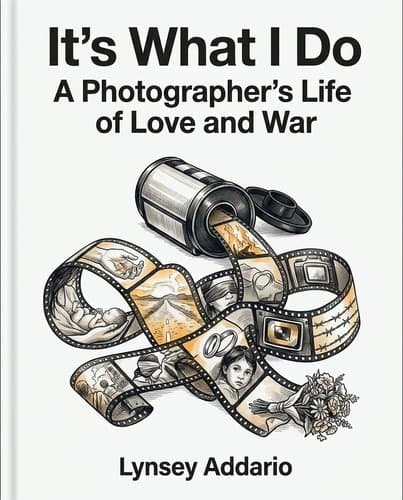
22571757_it-s-what-i-do
by Lynsey Addario
A war photographer discovers that the compulsion driving her into conflict zones—the inability to choose safety over truth—is both her greatest professional…
In Brief
A war photographer discovers that the compulsion driving her into conflict zones—the inability to choose safety over truth—is both her greatest professional gift and the force that makes lasting love nearly impossible. Addario's memoir is a raw reckoning with what total vocation actually costs.
Key Ideas
Sacrifice reveals itself through absence
Total commitment to a vocation rarely announces itself as a sacrifice in the moment — it reveals itself slowly, through the relationships that fray and the funerals you miss, long after the original choice was made.
Identity enables both access and risk
Access in conflict reporting is not only about credentials or courage. It is about who you are perceived to be — and Addario's gender, which created real physical vulnerability, also opened doors sealed to her male colleagues.
Luck outweighs expertise in survival
Professional skill and experience in dangerous environments provide less protection than we want to believe. Addario's own evidence — Paul Moran dying seconds after she fled, Tim Hetherington surviving the Korengal only to die in Libya — suggests that survival in extreme conditions involves irreducible luck that no amount of judgment can fully offset.
Excellence demands isolation despite support
The same psychological trait that makes someone extraordinary at a high-stakes vocation — the inability to choose safety over the work — is often the trait that makes them hardest to build a life alongside. Finding someone who says 'do your work, and come back when you finish' is not a solution to this tension; it is a way of making it survivable.
Witnessing deepens rather than diminishes
Witnessing suffering changes what you see when you look at ordinary life. Addario's pregnancy didn't make her less effective as a photographer — it made the distance between her subjects' lives and her own impossible to ignore, which deepened rather than blunted what she could show.
Who Should Read This
Readers who connect with first-person stories about Memoir and Resilience and want to see the world through someone else's eyes.
It's What I Do: A Photographer's Life of Love and War
By Lynsey Addario
12 min read
Why does it matter? Because the person bearing witness to history pays a cost that never appears in the photographs.
There's a photograph Lynsey Addario doesn't show you. It's the one taken just before — before the front page, before the prize, before the kidnapping. It's the moment she's standing on a press riser in Buenos Aires with a 50mm lens pointed at a balcony that's barely a speck, certain her career is finished before it starts. That moment of almost-quitting is the real story. Because she didn't quit. And then she didn't quit again, in Peshawar, in Fallujah, in a Libyan armored personnel carrier in the dark. This book is about what happens to a person who keeps choosing the photograph over the exit — not despite loving her life, but because of it. What it makes of her. What it costs the people who love her. And why, after everything, she's still a sahafiya — still a woman journalist — still raising the camera.
A Tap on the Shoulder Changed Everything — But Luck Isn't the Whole Story
She is standing on a press riser in Buenos Aires, three hundred yards from the balcony of the Casa Rosada, Madonna about to appear, and the only lens she has is the 50mm that came with her father's old Nikon. Through the viewfinder the balcony is a speck. Then a tap on her shoulder. A stranger pulls her camera body from her hands, clicks it onto a 500mm lens she didn't even know was compatible, and hands it back. Madonna fills the frame. The image runs front page the next morning, and Lynsey Addario gets a job paying ten dollars a picture.
The tap only works if you'd already done something to deserve being on the riser. Addario had talked her way onto the Evita film set by pleading with security guards, insisting she would be famous someday — the kind of unearned confidence that either gets you through a gate or earns you a polite escort to the sidewalk. The luck landed on someone who had already committed to being in position to receive it.
That logic — spend everything, position yourself, trust that the opening will come — becomes the organizing principle of her early career. She takes the fifteen thousand dollars her family gives her as a wedding gift and uses it to buy professional camera equipment, trading the most conventional marker of a woman's future for the tools of an entirely uncertain one. She spends five months following transgender sex workers through the Meatpacking District, bringing cookies and milk to earn trust, learning from an AP editor named Bebeto how to wait for light and read a scene. These are not glamorous stories. They are the unglamorous apprenticeship that the Buenos Aires anecdote could make you skip over.
The stranger on the riser gave her a break. What she did with it was hers.
The Work Was the Third Person in Every Relationship
Addario's grandmother Nina had been married for decades to a good provider — a man who let her play cards without demanding she account for her time, who trusted her completely, who watched quietly as she enjoyed her freedoms. A good man. Then one afternoon, while her husband was at work, a figure from her past rang the doorbell: Sal, the man she'd walked with on the main boulevard as a teenager, the man who made her laugh but had no money and no future. They drank coffee, talked over old times, and when she walked him to the front door, he grabbed her in the foyer and kissed her the way she hadn't been kissed in fifty years. 'I have been waiting over fifty years to do that, Antoinette,' he said. His wife died three days later, and Nina couldn't even call him — the kiss had made a phone call impossible. What she was left with was the coffee, the conversation, and the memory of what passion felt like. Addario never forgot the story. It settled into her as a conviction: she would not spend her life wondering about the kisses she'd missed.
The problem was that the work kept taking her away. She watches the Taliban fall on television in Mexico City because she flew home to salvage a relationship with a man named Uxval, who broke up with her the night before the bombing of Afghanistan started because he wanted a girlfriend in flesh and blood, not on email. She flies nine thousand miles from the front line to cry in a smelly gym, and he shows up at the door as though nothing happened and carries her to the bedroom. They settle back into mountain bikes and icy beers, and she tries to be a real girlfriend — attentive, present, normal — while images of refugee camps keep surfacing in her mind. The relationship ends two years later when she opens her laptop and finds his inbox full of love notes from a secretary named Cecilia, a woman who matches her handbag to her shoes and has every weekend free.
What Addario eventually finds in Paul de Bendern, the Reuters Turkey bureau chief, isn't someone who doesn't mind her absences. It's someone with a specific sentence that makes the absences survivable: do your work, and come back when you finish. No negotiation, no accumulated resentment, no list of missed occasions. Just a sentence. It is not a grand romantic gesture; it is something closer to structural engineering. The work could continue. The home would hold. That sentence is what Sal never offered Nina, and what every man before Paul failed to provide — not because they were bad men, but because the sentence requires you to genuinely mean it, and most people can't.
Being a Woman in the Field Is Both the Vulnerability and the Access
Being a woman in a conflict zone is a form of access that male colleagues cannot buy, earn, or charm their way into. Addario's career is built on this paradox: the same vulnerability that makes her a target also opens rooms permanently closed to men.
The clearest proof is nine mornings at the Taliban embassy in Islamabad, in a room thick with body odor, being ignored by every official until every man has been seen. She lies to the visa clerk, Mohammed, from the start — married, two sons back in New York — because the math of respect in that world requires it. But over those nine mornings something shifts. She starts asking him questions. He has no wife, no mother to arrange one, and his loneliness spills out in a way it never would have to a male journalist. Then he leans forward, checks over his shoulder, and asks in a near-whisper whether it's really true that men and women in America live together without being married. He is a functionary of a regime that beats women for showing their ankles, and he is desperately, humanly curious about American dating. Addario tells him the truth. He concludes that America sounds like a fine place. The visa arrives.
Male photographers couldn't have that conversation. They couldn't get into the Kabul basement where girls were secretly learning to read, or the women's hospital where patients were dying for lack of male doctors willing to treat them. The Taliban's own gender rules created a shadow corridor of access that ran directly to the stories the world most needed to see.
But the same exposure that opens those corridors offers no protection in a crowd. At an anti-American protest in Peshawar, with dozens of hands moving from her camera to her body in coordinated aggression, Addario tries the polite approaches — swatting, invoking the Islamic concept of shame — before finally delivering a karate kick from middle school and cracking a man across the skull with a five-pound camera lens. She sprints back to the car to find her male colleagues lounging, reviewing their photographs, entirely unaware anything had happened. They were never in the crowd the same way she was. That invisibility protected them. It also meant they missed everything she'd seen from inside it.
Experience Doesn't Make You Safer. It Just Accumulates Your Exposure.
Skill and experience are not the same as safety. They are just the things you accumulate while the odds keep running against you.
Here is the clearest proof Addario offers: a morning in the hills near Halabja, early in the Iraq war, when a convoy of press vehicles stopped near a Kurdish checkpoint. The shooting between allied peshmerga fighters and an Islamist militia had paused, giving journalists a brief window to photograph. Addario was working alongside an Australian cameraman named Paul Moran when her stomach clenched — not a thought, not a calculation, a physical burning — and she ran back to her car. The door slammed. Then the bomb went off. Moran had stayed a few seconds longer to get one more shot, and the blast killed him. Addario's survival had nothing to do with her experience, her cultural knowledge, or her professional judgment. It was a gut feeling she followed and he didn't, in what amounted to a coin flip measured in seconds.
Then her BlackBerry lit up twice in rapid succession at a meeting in New York. Tim Hetherington — killed in Libya. Chris Hondros — killed in Libya. Both men were among the most seasoned conflict photographers working. Both had spent a year embedded in Afghanistan's Korengal Valley, where American forces were dropping the majority of their bombs in that country at the time. They survived that. Then a single mortar in Misurata ended both of them on the same afternoon. Addario sat in the conference room and asked herself the question directly: did survival just come down to statistical probability? The longer you stayed in the game, the more exposures you accumulated, and at some point the number simply came up. No amount of competence changes that arithmetic.
The book never resolves this tension, because it can't be. Addario keeps going back — to Libya, to Somalia while five months pregnant, to wherever the story is — not because she has found a way to make the math work in her favor, but because she has decided the work matters more than the answer to the question.
The Night the Muslim World's Respect for Women Meant Nothing
The soldier behind her in the armored personnel carrier doesn't announce himself. One moment Addario is bound and blindfolded in the dark, a prisoner of Qaddafi's forces somewhere in the Libyan desert, and the next she feels a hand moving across her body. She does what she has always done in the Muslim world: invokes the framework that has protected her through a decade of work. 'You are Muslim,' she says. 'I have a husband.' He covers her mouth with his fingers. She can taste the salt and mud on his skin as he keeps going — her breasts, her body, methodical and unhurried — for the next thirty minutes. The appeal to shared values, the performed respectability, the professional calculations that got her through Taliban checkpoints and into guarded compounds: none of it registers. The only thing that stops him is another soldier in the vehicle, a stranger with a conscience, who pulls her into the shelter of his arms. Then the first soldier pulls her back. Then the second. Her survival at that moment depends entirely on which stranger proves more determined.
Libya dismantles everything that came before it. Across years of conflict reporting, Addario had built a set of tools — cultural fluency, gender performance, a photographer's ability to read a room — and those tools had functioned as a kind of professional armor. The Garma kidnapping earlier in her career had been survivable partly through her own resourcefulness. The zip ties, the blindfold, the hand tracing her face in the dark while a soldier whispers something she can't understand — she eventually asks her colleague Anthony Shadid to translate, and he takes a long time to answer before saying: he is telling you that you will die tonight. There is nothing to perform, no cultural register to activate, no leverage she can locate. She is entirely at the mercy of strangers' choices.
She survives. Six days after capture, the group is handed over through a Turkish Embassy negotiation and she reunites with her husband Paul in Tunisia. Then, weeks later, sitting in a New York publishing meeting, her phone lights up twice: Tim Hetherington dead in Libya, Chris Hondros dead in Libya — two of the most experienced conflict photographers alive, killed in a single mortar strike in Misurata. The men who made it through the Korengal Valley, arguably the most lethal posting in Afghanistan at the time, didn't make it through a Tuesday afternoon in Libya. Addario sits paralyzed in the conference room and the question arrives fully formed: does survival just come down to who the second soldier decides to pull toward him? She never answers it. The book doesn't let her.
She Hid Her Pregnancy for the Same Reason She Resented Editors Who Hid Her Photos
What separates an editor who suppresses an inconvenient image from a photographer who suppresses an inconvenient pregnancy? The answer is supposed to be obvious — power, complicity, self-interest — but when you hold the two episodes next to each other, the moral geometry gets uncomfortable.
In the Korengal Valley, Addario photographs a young Afghan boy named Khalid, his body peppered with American shrapnel — the civilian cost of a war the U.S. military preferred to narrate as a precision operation. Back in New York, editors under pressure from military public affairs officers doubt her account, then bury the most damaging images. A man behind a desk decides what the public can handle, and the photograph of a bleeding child disappears into a drawer. Addario is furious. This is exactly the suppression her entire career argues against: institutions managing reality to protect their own comfort.
Then she gets pregnant. Five months along, she boards a flight to Mogadishu — the kidnapping capital of the world, in the middle of a famine — and tells her editors nothing. The calculation is precise: a pregnant photographer is one editors reassign, sideline, write off. So she performs normalcy, hides the thing about her body that powerful people would use to override her professional judgment, and files the story. In a field hospital she kneels beside a dying eighteen-month-old boy named Abbas Nishe, his mother pressing his tiny mouth shut in anticipatory grief, and she feels her own child move inside her while she shoots. She captures it and says nothing about the rest.
The parallel the book never names: both suppressions are rational responses to institutions that can't be trusted with the full picture. Addario hides her pregnancy for the same structural reason the editors hid Khalid's wounds — disclosure hands control to someone whose interests don't align with yours. The difference is whose body is being managed. The fury she feels in New York is real. So is the calculation she makes in Mogadishu. The book asks you to hold both without resolving them.
Motherhood Didn't Soften Her Work. It Made the Stakes Unbearable to Hold.
She is nursing Lukas at four in the morning in their London flat when the phone starts ringing. Dozens of missed calls. The subject lines in her inbox: I'm so sorry. Sad news. Anthony Shadid — the colleague who had stayed calm and cracked jokes during their six days of captivity in Libya less than a year earlier — had died of an asthma attack crossing into Syria. Tyler Hicks had carried his body across the border to Turkey, where Shadid's wife and two-year-old son were waiting. Addario feels the grief and then, almost immediately, the recognition: had she not gotten pregnant, she would likely have been there too. She knew exactly why he went back. It was the same reason she would go back. That knowledge doesn't soften the loss — it just removes the distance you'd need to feel righteous about it.
Three months after giving birth, she returns to work. Alabama first, photographing mothers addicted to methamphetamine for the Times Magazine. She cries the entire way to the airport, and keeps crying until she raises the Nikon to her eye and takes the first frame. Then she is inside the work again, and the work holds.
But something has permanently changed in what the work costs her. When she returns from assignments, Lukas runs toward the nanny, not her. On Skype calls from hotel rooms in India or Uganda, he calls for his father. She cushions the absences with music class and playground mornings, two worlds with nothing in common except the person moving between them. The balance isn't achieved — it's managed, imperfectly, one trip at a time.
What motherhood actually does is strip away the last insulation between Addario and her subjects. Photographing a mother in Somalia or Syria had always required empathy, but now it requires something closer to recognition. She can read, in the precise angle of a stranger's body over a sick child, the specific weight of a fear she herself carries every night at bedtime. The women she has photographed for years — fighting for their children against famine and war — had always moved her. Now she understands what they were defending. Not an idea. A specific, irreplaceable person.
She doesn't resolve this. The book doesn't offer resolution because there isn't one — only the honest, uncomfortable place she actually occupies: a mother who chooses to witness war, knowing the choice extracts something from the child waiting at home, and finding that the work still matters enough to make it.
What the Photographs Cannot Hold
There is a word for what she becomes when she raises the camera on that hillside: sahafiya. Journalist. The refugees call it out and she answers it, and you understand that this is not a job title but the full account of a person — the Buenos Aires riser, the Taliban visa clerk, the soldier's hand in the dark, the nursing sessions at four in the morning, everything. She is not running toward the frame because she has made peace with the costs. She is running because this is what she is, formed by every choice that preceded this one. The photographs exist. Her son exists. The mined hillside exists. Whether those facts can coexist in a life that still counts as honest — she doesn't resolve it, and neither will you.
Notable Quotes
“Please, don’t. Please. I have a husband.”
“I have a husband. Please.”
“My arms are bound so tightly, it’s killing my shoulders.”
Frequently Asked Questions
- What is It's What I Do about?
- It's What I Do: A Photographer's Life of Love and War is a 2015 memoir by conflict photojournalist Lynsey Addario that traces her career documenting wars in Iraq, Afghanistan, Libya, and Darfur. The book examines the profound personal costs of total vocational commitment—to relationships, safety, and ordinary life. Addario reflects on how gender shaped both her vulnerability and her access to conflict zones, while exploring the role of luck versus skill in survival. Ultimately, the memoir reveals how witnessing extreme suffering transforms one's perspective on everyday life and challenges the possibility of building sustainable personal relationships alongside such demanding work.
- What are the key takeaways from Lynsey Addario's It's What I Do?
- The memoir reveals that vocational sacrifice emerges slowly through frayed relationships and missed funerals. Addario demonstrates that gender provides both vulnerability and unexpected access in conflict zones, showing how the same characteristic that increased her risk also expanded her opportunities. Survival in extreme conditions depends heavily on luck beyond the control of skill or judgment. The psychological traits enabling extraordinary performance in high-stakes work often make building personal relationships difficult, yet partnerships that support the work make such tensions survivable. Finally, witnessing suffering alters how one perceives ordinary life; Addario's pregnancy deepened rather than diminished her ability to authentically document her subjects' experiences.
- How does gender shape Lynsey Addario's experience as a conflict photographer?
- Gender shaped Addario's experience in profoundly contradictory ways. Her female identity created real physical vulnerability in war zones, exposing her to specific dangers her male colleagues didn't face. Yet paradoxically, being a woman also opened doors sealed to her male colleagues—providing unexpected access to conflict zones and sources. This contradiction runs throughout the memoir: the same characteristic that increased her risk also expanded her opportunities. Addario's reflection on gender reveals that access in conflict reporting isn't simply about credentials or courage, but fundamentally about identity—how one is perceived shapes both the perils and possibilities of frontline journalism.
- What does Addario's memoir reveal about the relationship between professional skill and personal survival?
- Addario's memoir argues that professional skill provides less protection in dangerous environments than we might assume. She cites specific evidence: Paul Moran died seconds after she fled a situation, and Tim Hetherington survived the deadly Korengal only to die later in Libya, suggesting that "survival in extreme conditions involves irreducible luck that no amount of judgment can fully offset." This finding challenges the belief that experience and judgment guarantee safety. The book also explores how the psychological traits enabling extraordinary performance—an inability to prioritize safety over the work—often strain personal relationships. Addario suggests that sustainable partnerships aren't solutions but ways of making this tension survivable.
Related Book Summaries
Read the full summary of 22571757_it-s-what-i-do on InShort