13532186_joseph-anton
by Salman Rushdie
Forced underground by an ayatollah's death sentence, Salman Rushdie spent nine years learning that the greatest threat wasn't assassination—it was becoming the…
In Brief
Forced underground by an ayatollah's death sentence, Salman Rushdie spent nine years learning that the greatest threat wasn't assassination—it was becoming the symbol his enemies had made of him. A searing memoir about protecting your identity when governments, allies, and your own survival instincts conspire to erase it.
Key Ideas
Recognition protects against isolation and capitulation
The need to be accepted by those who have decided to hate you is not a character flaw—it is a human vulnerability that, under enough isolation and pressure, can make you do their work for them. Recognizing this trap is the first step to escaping it.
Public acts restore incrementally stolen identity
Identity is not fixed: it can be stolen incrementally, through a pseudonym, a race erasure, a craven public statement, until the person in hiding no longer resembles the person who went in. Recovery requires active, repeated, public acts of reclaiming who you are.
Freedom embodied in refusing institutional smallness
Political freedom is not abstract—it is embodied in specific daily acts: the decision to give a public reading, to refuse an apology, to hail a cab alone. Defending free expression means refusing to make yourself small even when every institution around you suggests smallness would be safer.
Meaning-making sustains agency amid powerlessness
The person who shapes a crisis into a coherent narrative—who finds the literary frame, the philosophical inheritance, the right name—retains a form of agency even when all practical agency is gone. Meaning-making is itself a form of resistance.
Only visible strength enables safe negotiation
Capitulation rarely satisfies those demanding it. The Paddington Green signing did not reduce the danger; it increased it. The lesson Rushdie draws—and the evidence supports—is that the only negotiations worth entering are those conducted from a position of visible, public strength.
Who Should Read This
Readers who connect with first-person stories about Memoir and Resilience and want to see the world through someone else's eyes.
Joseph Anton
By Salman Rushdie
12 min read
Why does it matter? Because the person you fight hardest to erase is yourself.
On Valentine's Day 1989, Ayatollah Khomeini sentenced Salman Rushdie to death—and Rushdie nearly finished the job himself. Not with despair, but with something more insidious: the hunger to be forgiven, to be claimed again by the culture that had disowned him. That hunger would eventually drive him into a police station on Christmas Eve, where he signed away his own convictions to satisfy men who held him in contempt. The assassins never got close. His own need nearly did. Joseph Anton—a pseudonym assembled from Conrad and Chekhov, carried for thirteen years—is not really a book about a fatwa. It's about what happens to a self when governments, enemies, allies, and your own fracturing psychology all conspire to replace the man with the symbol. The question underneath every page: when everything is stripped away, are you defending the book, or the person who wrote it—and do you still know which one you are?
The Day a Death Sentence Stole His Name
On Valentine's Day 1989, a BBC reporter called Salman Rushdie on his private line and asked how it felt to know he had just been sentenced to death by Ayatollah Khomeini. It was a sunny Tuesday in London. He said, 'It doesn't feel good.' Then he ran downstairs and barred the wooden shutters of his Islington row house—a gesture so instinctive and so useless that he would later remember it with something close to embarrassment. The shutters were all he had.
What happened next was replacement. By the time he reached the CBS studios in Knightsbridge, where journalists had already fixed a word to the story that would follow him for the next decade, the transformation was underway. The word was 'fatwa'—technically not a synonym for death sentence, but language had already moved without him.
More wounding than the edict itself was what it did to his name. He was no longer 'Salman,' the person his friends recognized. He had become 'Rushdy'—a horned figure on placards, a hanged man with a red tongue in crude protest cartoons. 'Satan Rushdy.' A name stripped of its owner and repurposed as a symbol. His actual history—sixteen books, a life built from stories, a family surname chosen to honor a medieval Arab philosopher who championed reason over dogma—none of it survived contact with that cartoon. The man was being erased; the effigy was being constructed in real time.
That night, hiding in a basement flat in Islington almost nobody knew about, listening to police officers patrol the pavement outside, he made one promise he could keep. He would call his nine-year-old son Zafar every evening at seven o'clock. Not a grand gesture—just a fixed point in a day that no longer had any. Normalcy as an act of will, offered at the exact moment it became impossible.
His Father Named Him for a Battle He Didn't Know He Was Entering
Rushdie didn't stumble into a clash between reason and religious authority. He was named for it. When his father Anis discarded the family's cumbersome Old Delhi surname and replaced it with 'Rushdie,' he was paying deliberate tribute to Ibn Rushd—a 12th-century Córdoban philosopher who had argued, against fierce opposition, that Aristotelian reason and Islamic faith were not enemies. Ibn Rushd lost that argument in his lifetime; the literalists won, and much of the medieval Islamic philosophical tradition collapsed. Anis, a serious student of Islam who held no religious belief himself, chose this name as a quiet declaration of where he stood in that ancient dispute.
Salman carried the name for twenty years before grasping what it meant, and another twenty before the fatwa made it a battle standard. That gap is the point. His father had embedded a philosophical position into his identity before he was old enough to understand it—a time capsule that only detonated when it was needed. When the Ayatollah's edict came down in February 1989, the centuries-old argument between reason and dogma, between the freedom to interpret and the demand to submit, had found its next combatant. The name on the placards was the same name Ibn Rushd's opponents had tried to bury eight hundred years earlier.
None of this made the danger abstract or manageable. But the man hiding in a Lonsdale Square basement, listening to police footsteps outside, wasn't simply a novelist who had offended the wrong people. He was standing in a specific tradition—one his father had silently enrolled him in at birth.
Survival Is Not Heroic—It Is Grinding and Humiliating
The real damage of the fatwa was not the death threat. It was the paperwork. Within days of the Valentine's Day announcement, Rushdie's protection officers told him he needed a new name—not for literary reasons, but logistical ones. His own name was unspeakable, a word that could not appear on a check or a rental agreement without getting him killed. The police needed something their tongues could manage under pressure, in public, without giving anything away.
He tried combining the first names of writers he loved. Vladimir Joyce. Marcel Beckett. Franz Sterne. Each sounded ridiculous, a costume rather than a skin. Then he put Conrad and Chekhov side by side and found the combination that didn't embarrass him: Joseph Anton. It had weight and privacy both—a name that carried literary loyalty without advertising it.
The officer called Stan heard it, said 'jolly good,' and immediately shortened it to 'Joe.' Rushdie detested the abbreviation from the first moment, though he couldn't fully explain why. Both names were equally false, equally imposed. But 'Joe' felt like the erasure of even the fiction he had chosen for himself—stripped to a monosyllable someone else found convenient. He had no grounds to object, and so he didn't. That helplessness is the texture of what followed.
There was a further instruction: the name should not sound Asian, because people sometimes put two and two together. So he surrendered not only his name but his visible identity—the race legible in his face, now something to be obscured in what he called himself. A man who had spent his career writing about the crisis of belonging, about what it costs to be neither fully here nor fully there, was now required to perform whiteness as a condition of staying alive.
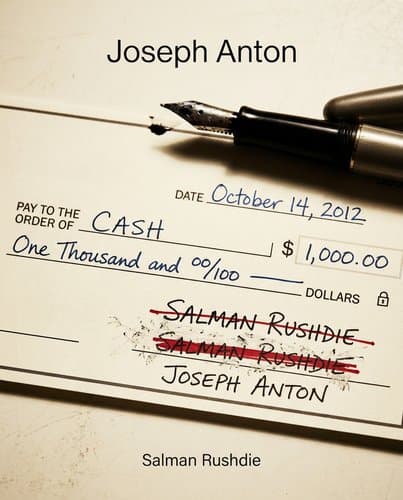
What this produced was not heroism but routine humiliation. The clearest image of it comes later in the memoir: Rushdie writing a check, watching his own hand form the letters J-o-s-e-p-h A-n-t-o-n, signing for something as ordinary as groceries or a week's rent, the name feeling no more natural for all the repetition. The pseudonym never became a skin. It stayed a costume—ill-fitting, slightly absurd, a daily reminder that the self he had built over forty years was now a liability to be managed. That was the grind of it: not acute crisis but the slow subtraction of everything that tells a person who they are.
The Worst Thing He Did Was Try to Make His Enemies Love Him
On Christmas Eve 1990, Hesham el-Essawy—an Egyptian dentist who had appointed himself as moderate emissary between Rushdie and Britain's Muslim leaders—led him through a basement corridor at Paddington Green police station and into a room arranged like a courtroom. Six men sat in a straight line behind a long table. A single upright chair faced them. El-Essawy whispered that these were important people who had cleared their schedules, that he must please sit, that everyone was waiting. He walked in and sat down.
He should not have walked in. He knew it even then. The impulse that carried him forward wasn't courage or strategy—it was the oldest wound in his life, the unpopular boarding-school boy's craving to be accepted by the people who had decided to hate him. A year of isolation, of hiding in borrowed cottages and crouching behind kitchen counters, had not hardened him against that need. It had deepened it. He wanted his culture back.
The six men had prepared a document—ungrammatical and clumsy, but clear enough in substance: he was reaffirming his Islamic faith and agreeing to prevent any paperback edition of The Satanic Verses. They urged him to revise the language. He was the great writer; they were not. He took the paper to a corner table and sat with it. He knew he was no more religious than he had been that morning. He signed anyway.
There were embraces. Congratulations. The police guided him out through the corridor and into a car. When he reached the house in Wimbledon where he was then staying, he went directly to the bathroom and was violently sick. His body, as he later put it, was expressing its opinion about what his mind had done. The revulsion was immediate and total—not guilt exactly, but the physical knowledge that he had torn something out of himself that could not be put back.
The brutal irony arrived within days. The Iranian regime did not interpret the document as a concession deserving reciprocity. They moved the goalposts. The police informed him the threat assessment had not improved. It had increased. The capitulation had cost him everything and purchased nothing, which was, in retrospect, the only possible outcome. His adversaries were not waiting for an apology. They were waiting for a precedent, and he had given them one. The belief that the right words, the right gesture of humility, could make the people who had condemned him unsee what they had decided to see—that belief, not the fatwa, was the trap. And the moment he forgot it, he handed his enemies the only victory they ever truly won.
Freedom Begins When You Stop Needing Your Enemies' Approval
No apology satisfies someone who needs a devil. Rushdie understood this the morning after the Paddington Green disaster, lying fevered in bed while the Gulf War started on television and his sister Sameen rang to ask if he had taken leave of his senses. Iran raised the bounty. The hardliners flew to Tehran to ensure nothing changed. The six men who had embraced him now demanded the full withdrawal of the book, reversing what they had signed. He had given away everything and gotten nothing back—because, as he now saw, there was nothing to get. You cannot negotiate your way out of being someone else's symbol.
What followed was not a dramatic reversal but a slow, deliberate reconstruction: the decision to stop asking permission and start taking up space. The first real test came at an awards dinner. When the Writers' Guild named Haroun and the Sea of Stories the best children's book of the year, his senior police handler declared the outing impossible—an act of 'self-aggrandizement' that endangered 'the citizenry of London.' Rushdie's reply was simple: he knew where the Dorchester was and had the money for a taxi, so the only question was whether the police were coming with him. They came. He stood before the book world, apologized for materializing and dematerializing in the middle of dinner, said 'in this free country I am not a free man,' and received a standing ovation that brought him, a man not given to tears, close to weeping. The citizenry remained unharmed. It was a small act. It was also the template for everything that followed.
The larger stage came in December 1991, when he flew to New York on a Royal Air Force transport to speak at Columbia University. Moving from behind a curtain into the auditorium lights, he heard the audience draw a single collective breath—then sustained, welcoming applause. He couldn't see the faces; the lights blinded him. It didn't matter. He spoke about religious persecution, about what a single human life was worth, and then he began the work of undoing his Paddington Green surrender, restoring himself to what he actually believed: that free speech was not a luxury of the comfortable but the whole game, life itself. When he finished he felt, as he put it, cleaner—not through any theological absolution, but through the simpler mechanism of telling the truth after a period of lying. The enemy's approval was no longer the prize. His own coherence was.
He Nearly Died Under a Mountain of Manure on Christmas Day
On a sunny December afternoon in New South Wales, driving south from Sydney toward a friend's secluded beach house, Rushdie reached for the eject button on the cassette player—a fraction of a second's inattention—just as an articulated container truck swung wide out of a side road. What followed seemed to unspool in slow motion: a tearing shriek of metal on metal, the driver's door crumpling inward, the car skating sideways toward a tree that was definitely, unavoidably coming. He watched Elizabeth jerk forward against her seatbelt, saw a small white puff escape her lips like a speech bubble, and thought with genuine terror that he might be watching her life leave her body. In the backseat, Zafar—sixteen, stretched out to the audiobook of the Iliad—woke from a dead sleep and said, 'Did something happen?'
They survived. The car had bounced off a wheel rather than being dragged underneath, which would have decapitated everyone. A case of wine meant as a gift for their host had launched forward like missiles; the bottles hit the windshield rather than their skulls, by a margin of inches. When paramedics arrived, the first thing one of them said, staring at the bloodied figure on the grass, was whether he could get an autograph. The driver was blameless—carrying liquid fertilizer. After nearly seven years of professional assassins and Iranian intelligence plots, Rushdie, Elizabeth, and Zafar had come within a single tire-bounce of dying under a mountain of fresh manure on Christmas Day.
That absurdity is the point. This crash belongs in the middle of the longer reclamation project, not as proof that the danger had passed—because it hadn't. While the British public had grown bored with his case, impatient with its cost and certain the threat must have faded, MI5 had recently delivered the opposite verdict in a sand-colored fortress by the Thames. Two officers, politely referred to as Mr. Morning and Mr. Afternoon, told him that Khamenei and intelligence minister Fallahian had set a long-term, deniable, 'Bakhtiar-style' assassination plot in motion. Patient. Professional. Years in the planning. The British public's diminishing interest had no effect on the calibration of the threat; it simply meant the threat now operated in a space no one was watching.
He Lied to the Woman He Loved on Her Deathbed and Was Right to Do It
Clarissa was sitting up in her hospital bed when she looked him full in the face and asked the question he had hoped she wouldn't ask. She had been sliding toward unconsciousness—gaunt, jaundiced, barely able to grip a pen—when he leaned over and kissed her three times on the side of the head. Somehow she rallied, opened her eyes, and asked with naked terror: 'I'm not dying, am I?' He said no. He said she was just resting. He told her this knowing it was false, and for the rest of his life he would turn the moment over, uncertain whether he had given her a gift or a theft.
Bone cancer killed Clarissa Luard, in November 1999. But the years of concealment and pressure and displacement had already cost her years with Zafar, years in which a boy who needed stability got instead a father who materialized and dematerialized like a fugitive. When Rushdie and his son left the hospital to let her sleep—just a few hours, just to rest themselves—she faded beyond reach. The phone rang before dawn. They drove to Hammersmith through empty streets while Zafar, that large young man who had grown up carrying a secret he couldn't explain to his friends, wept in his father's arms the whole way there.
A few years later came Elizabeth West, who had moved with Rushdie through the worst of it, borne a son inside a house full of armed policemen, and watched the life she had signed on for slowly become something else entirely. His departure for Padma Lakshmi—a woman he described as a mirage, a figure who seemed to embody the open, unguarded American life the fatwa had made impossible—earned him the most accurate indictment of his behavior he would ever receive. Elizabeth told him: you saw an illusion and you destroyed your family for it. She was right. He knew she was right. He went anyway.
Zafar weeping in the car. Elizabeth's verdict delivered without cruelty, which made it worse. These were not collateral damage in any military sense—they were the people closest to him, and the fatwa reached them precisely because of that proximity, bending lives that had no quarrel with anyone, asking impossible things of people who had not chosen the fight.
Freedom, When It Came, Arrived Without Fanfare
Think of a prisoner who marks the days on a cell wall, who builds an entire inner life around the moment of release—and then finds, when the door finally opens, that there is nothing waiting on the other side but an ordinary street. No trumpet. No transformation. Just the same world he left, a little older, a little harder to read.
That is roughly how it happened. At ten in the morning on March 27, 2002, two Special Branch officers named Bob Sait and Nick Cottage sat down with Rushdie at the Halcyon Hotel in Holland Park and told him, in the clipped procedural language of a case being closed, that the threat level against him had been drastically reduced. Sait began his prepared remarks and called him 'Joe'—then stopped himself, mid-sentence, and corrected it: 'Salman.' Thirteen years of the wrong name, and in the moment it was finally surrendered, the correction landed in the air like the smallest possible ceremony. They shook hands. They stood up. They left. The police Jaguars pulled away from the curb, and Rushdie stood in the doorway of the hotel watching them go, and then laughed—not from relief exactly, but from the sheer abruptness of it. Just: gone.
Before he left, one of the officers who had worked his case—a man who had spent the protection years completing a degree in postcolonial literature—pressed a small metal object into his palm. A bullet: the one accidentally discharged inside the Bishop's Avenue house during the long years of hiding, a near-miss folded into the routine of survival and nearly forgotten. 'Thought you might want it as a souvenir,' the officer said. It was the only monument on offer.
He walked out onto Holland Park Avenue and raised his arm for a cab. No one watched. The cab stopped. He got in. The freedom he had spent thirteen years arguing for, insisting on, demonstrating in restaurants and airports and on the sidewalks of New York, arrived not as a vindication but as an ordinary Tuesday. Which was, in the end, exactly what he had always said he wanted—to be allowed to be unremarkable, to be Salman Rushdie rather than Joseph Anton, in a world that had simply stopped paying attention to the distinction. He got it. He hailed the cab.
The Bullet in His Pocket
The bullet Rab Connolly pressed into his palm was not a trophy. It had never been aimed by an enemy. It had gone off inside the house, among the people paid to keep him safe, in the ordinary chaos of a life conducted under siege. That is what the memoir finally asks you to hold: not the drama of the fatwa but the quiet, structural damage of thirteen years spent becoming someone else in order to survive. Joseph Anton was a solution. He was also a wound. And when the officers shook hands and the Jaguars pulled away and Rushdie raised his arm for a cab on an unremarkable Tuesday morning, the real question wasn't whether he was free. It was whether the man who walked out was the same one who had barred the shutters. The answer the book offers, honestly and without consolation, is: almost.
Notable Quotes
“to know that you have just been sentenced to death by the Ayatollah Khomeini?”
“Excuse me—Salman, as you know, we’ve been maintaining this protection on advice from the intelligence services, until such time as they felt it was right to lower their assessment of the threat against yourself.”
“It’s been a little strange, Bob,”
Frequently Asked Questions
- What is Joseph Anton about?
- Joseph Anton is Salman Rushdie's memoir recounting his decade in hiding following Iran's fatwa, during which he lived under a false name with constant police protection. Written in third person, the book examines how political violence erodes identity and explores resistance to capitulation when governments, institutions, and enemies pressure you to disappear. Rushdie demonstrates how maintaining one's sense of self becomes a crucial act of resistance. The memoir connects personal survival to broader questions of political freedom and the cost of defending free expression. Through his extraordinary experience, Rushdie illuminates the daily, embodied nature of freedom and the psychological toll of forced invisibility.
- What are the key takeaways from Joseph Anton?
- Joseph Anton teaches that human vulnerability—the desire to be accepted by those who hate you—is not a flaw but a trap. "The need to be accepted by those who have decided to hate you is not a character flaw—it is a human vulnerability that, under enough isolation and pressure, can make you do their work for them." Identity is not fixed; "it can be stolen incrementally, through a pseudonym, a race erasure, a craven public statement, until the person in hiding no longer resembles the person who went in." Recovery demands "active, repeated, public acts of reclaiming who you are." Meaning-making becomes resistance when all else fails, and capitulation rarely achieves desired results.
- What does Joseph Anton reveal about identity and self?
- Joseph Anton reveals that identity is not fixed but perpetually vulnerable to erosion. "It can be stolen incrementally, through a pseudonym, a race erasure, a craven public statement, until the person in hiding no longer resembles the person who went in." This theft of self happens gradually, often imperceptibly. Recovery therefore requires aggressive intervention: "active, repeated, public acts of reclaiming who you are." Rushdie demonstrates that maintaining identity under state pressure and institutional indifference is itself a political act. Each public reading, each refusal to disappear into anonymity, each assertion of your original name counters the forces demanding your erasure.
- How does Joseph Anton explain resistance and freedom?
- Joseph Anton demonstrates that political freedom is not abstract but embodied in daily choices: "the decision to give a public reading, to refuse an apology, to hail a cab alone." Defending free expression requires refusing to diminish yourself despite institutional pressure toward safety through silence. By writing in third person and finding philosophical meaning in his ordeal, Rushdie shows how meaning-making becomes a form of resistance when external agency is constrained. The memoir illustrates that shaping a crisis into coherent narrative retains agency even when practical options are limited. Ultimately, Rushdie argues that "the only negotiations worth entering are those conducted from a position of visible, public strength."
Related Book Summaries
Read the full summary of 13532186_joseph-anton on InShort