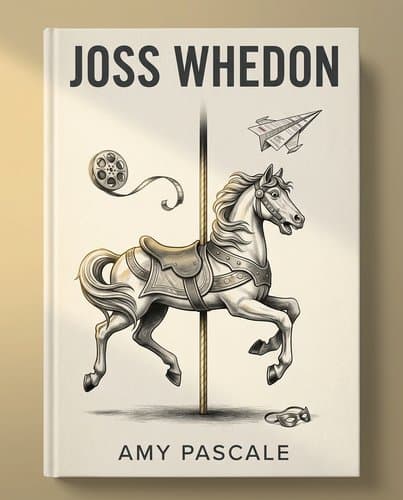
18778170_joss-whedon
by Amy Pascale, Nathan Fillion
From a failed Buffy film to a $1.5 billion Avengers debut, Joss Whedon's career reveals how creative humiliation becomes raw material—and why the chosen family…
In Brief
Joss Whedon (Augu) traces the career of the writer-director behind Buffy, Firefly, and The Avengers, showing how professional setbacks and the pursuit of creative control shaped his most influential work. It reveals how collaboration, chosen-family dynamics, and institutional independence defined both his successes and failures — offering readers a practical lens on vision, authority, and building work that lasts.
Key Ideas
Failure drives creative breakthroughs
Treat your biggest failures as research: Whedon's most celebrated work — Dr. Horrible, the Buffy TV series, Serenity — emerged directly from specific professional humiliations. The failure wasn't a detour; it was the catalyst.
Authority shapes creative integrity
Creative control matters most at the point where your vision meets someone else's incentives. Whedon's pattern was consistent: when he held the authority (Buffy, Dr. Horrible, Much Ado), the work reflected his values; when he didn't (the 1992 film, Firefly's marketing, Alien: Resurrection), the gap between what he made and what was sold became unbridgeable.
Honest hierarchy sustains creative teams
The 'chosen family' you build around your work needs honest hierarchy as much as warmth. Whedon's collaborators thrived when they understood both the affection and the authority — and fractured when the mythology of belonging obscured the reality of who was actually in charge.
Build independent systems for control
When institutional systems fail you, build a smaller one you control entirely. Dr. Horrible's $200,000 budget and server-crashing launch proved that direct creator-to-audience distribution wasn't a consolation prize — it was a more honest version of what Whedon had always been trying to do.
Success reveals your core values
Scale doesn't change your core instinct — it just reveals it more clearly. The man who directed the highest-grossing film of its year immediately went home and made a twelve-day Shakespeare film with no permits in his backyard. Knowing what you actually value is the only compass that survives success.
Who Should Read This
Readers interested in Memoir and Artistic Expression, looking for practical insights they can apply to their own lives.
Joss Whedon
By Amy Pascale & Nathan Fillion
12 min read
Why does it matter? Because the man who directed the highest-grossing superhero film ever made built his entire career on the premise that the hero usually loses.
Here's the thing about Joss Whedon: his entire creative philosophy fits inside a single, unglamorous sentence — that's a victory, I'll take it. Not triumph. Not vindication. Just survival, squared. A man who got mugged on a crowded Broadway sidewalk while everyone watched — and characteristically turned it into the opening of a pilot — who had his dialogue rewritten on set by a bored actor, who built three television universes simultaneously (Buffy, Angel, Firefly) and watched the one he loved most get strangled in its first season: he turned every one of those humiliations into the engine of something better. The pattern is too consistent to be accidental. The Buffy film failed, so he built the show. Fox killed Firefly, so he invented Dr. Horrible in a hotel room. And every time he clawed back control, he found that the thing protecting his vision wasn't authority. It was the people in the room with him — and what it cost him to keep them there.
Helplessness Was the Point All Along
On the set of The Avengers in June 2011 — a $220 million production where daily explosions left everything coated in ash — Joss Whedon stopped to tell a story about a little girl at a county fair. He'd watched her board a spinning ride she clearly wasn't ready for, knuckles white, face clenched in the particular expression he recognized because, he said, he wore it most mornings walking to work. Then, slowly, her grip loosened. By the ride's end she had her hands in the air. Whedon stood there watching and felt his head explode. 'I just watched someone get stronger,' he said. 'That's the purest moment of my life.'
Here is the paradox you have to sit with: the man directing the most expensive superhero ensemble ever assembled described his life's purpose not as spectacle, but as watching someone survive their own terror. And when you trace that instinct back, it leads somewhere uncomfortable.
Whedon once talked through his work with Stephen Sondheim, comparing what each of them was really writing about beneath the surface material. Sondheim said he always wrote about yearning. Whedon, stung by how elegant that answer was, went away and did the honest accounting. What he came back with was a single word: helplessness. Every empowerment story he'd ever told, he realized, grew directly from his 'fear and hatred' of what it feels like to be a person with no power — a non-being, in his words.
This wasn't a theoretical position. He was the smallest of three brothers, a slight kid with red hair who got regularly mistaken for a girl, who felt intimidated by his father and 'mercilessly' outpaced by his older siblings. The strong female characters, the ragtag crews who refuse to quit, the heroes who lose more than they win — none of that came from confidence. It came from a boy who understood, from the inside, exactly what it costs to hold on until the ride turns. The aesthetic he built over thirty years — the chosen families, the refusal to let characters stay defeated — was less a creative philosophy than a coping mechanism that happened to work at scale.
Every Major Failure Produced Something Better
Every major failure Whedon experienced produced something more durable than the success would have. The pattern holds across a decade of Hollywood disappointment, and what came out the other side was a television aesthetic unlike anything that existed before it.
The clearest illustration is Speed. In late 1993, Whedon was brought onto the production one week before cameras rolled, handed a script everyone agreed was broken, and proceeded to rewrite every line of dialogue. He grounded Keanu Reeves's cop as a polite lateral thinker rather than a maverick hothead. He made a doomed bus passenger sympathetic — overriding objections by arguing that you can only break an audience's heart with someone they already care about. He wrote the film's most quoted line. Then the Writers Guild gave the sole screenplay credit to the original writer, Graham Yost, on the basis that Whedon had touched only the dialogue rather than the plot's architecture. A decade later, Yost himself would estimate Whedon's contribution at 98.9 percent.
What that arbitration produced, more than bitterness, was a conviction Whedon carried into every project afterward: the only way to own what you make is to be the person running it. Not a script doctor. Not a staff writer. The one whose name on the door is the final answer. When you watch Buffy the Vampire Slayer — the television series, not the film — what you're watching is partly the institutional memory of a man who was stripped of credit for his own sentences. The obsessive commitment to voice, to every line sounding like itself, to stories that couldn't be handed off without falling apart: all of it connects to the lesson the WGA taught him in an arbitration hearing.
The failed Buffy film a year earlier had taught him the other half. Donald Sutherland quietly dismantled Whedon's script from inside the character — rewriting his own dialogue on set, undermining the tone Whedon had built, doing it in takes good enough that nobody stopped him. Whedon eventually walked off the production rather than watch. When a friend suggested he simply let it go, Whedon refused. His reasoning was professional and personal at once: you cannot sit down to write something if part of you believes it will be bent into something unrecognizable. The script has to be imagined as perfect and whole, or the imagination shuts down entirely.
The two failures are the same failure, encountered from opposite directions. One took his words and gave them to someone else's name. The other took his name and gave it to someone else's choices. Together they produced a writer who understood that the only protection was authorship — complete, structural, undeniable — and who spent the rest of his career building the conditions that made it possible.
The Moment He Stopped Asking Permission
What does it actually look like when a writer stops being someone else's instrument and starts running their own laboratory? For Whedon, it looked like a pitch meeting at a fledgling network in 1995 where he paused mid-sentence to size up the executives across the table. When he told them Buffy the Vampire Slayer would be a cross between The X-Files and something else, the 'something else' changed depending on what he saw in the room. Empty suits got Beverly Hills, 90210 — a safe, recognizable hit. Anyone who seemed like they actually understood the business got My So-Called Life, the short-lived, critically adored series Whedon considered the most honest portrait of adolescent pain on television. He was, in that moment, filtering for collaborators willing to bet on something real.
The WB turned out to be exactly desperate enough to be useful. The network was barely a year old, hemorrhaging ratings against actual networks, and willing to greenlight a show about a teenage vampire slayer because they had nothing to lose. When the WB showed genuine enthusiasm for the pitch, Whedon's agent Chris Harbert offered a blunt corrective: 'Yeah, they have no idea what they're doing.' Whedon heard that and took the deal anyway. A network that didn't know the rules couldn't enforce them.
What he built inside that opening was the creative structure he'd been unable to claim anywhere else. Executive producer status meant directorial access. Directorial access meant he could stand on set and ensure the line landed the way the line was written. The 'Buffy Way,' as his writers came to call it, meant starting every story from an emotional truth — a real wound, a universal humiliation — and reverse-engineering the plot from there. The second-season episode 'Innocence' is the purest demonstration: Buffy sleeps with Angel, he loses his soul and turns cold and cruel, and Whedon's explanation for why the story had to go exactly that way was precise. 'Breaking her heart,' he said, 'was going to be way, way more terrifying than piercing it.' He wasn't writing supernatural horror. He was writing the universal experience of giving yourself completely to someone and watching them become a stranger. The monster was the delivery mechanism.
His whole career up to that point had been the slow accumulation of permission he never needed to ask for once he had this.
The Chosen Family Was Always Hierarchical
Think of it like this: the family you choose is still a family, which means it still has parents and children, favorites and forgotten middle kids. Whedon's 'chosen family' wasn't a rejection of hierarchy — it was a hierarchy he got to design himself, which is both more generous and more complicated than the alternative.
The clearest window into how that worked is Tim Minear's first year on Angel. Minear arrived skeptical — he thought the spin-off was a pale imitation of Buffy — and spent months feeling like a freshman eating lunch at the wrong table. The Buffy writers upstairs were being handed Angel scripts while the actual Angel staff broke and re-broke stories that never seemed to go anywhere. When Minear finally got his crack at an episode, he and a co-writer ground through forty sleepless hours to deliver a draft. Greenwalt called him in and announced he wanted to wipe his ass with half of it. Minear's response — 'be sure to keep the brads in' — landed with the defiance of someone who'd already decided to quit. He went back to his office to pack.
What stopped him wasn't a promotion or an apology. It was a recognition that he and Joss shared the same immune system: neither of them could be leveraged by money or prestige. The two things that don't matter to me, Minear told Greenwalt, are prestige and money. That admission made him impossible to threaten, which made him exactly the right person to work for a showrunner whose greatest gift and greatest liability were the same thing — an absolute refusal to let the work become someone else's.
But Minear had already identified the cost before he reached that epiphany. When he confronted Greenwalt about the premiere party at Joss's house — the one the entire Angel writing staff had been excluded from — he said something that cut through the mythology cleanly: this man created a show about high school because he felt unpopular, and now the office is high school and he's the popular one. The critique was accurate. Joss was genuinely shy; the Angel writers were strangers; the party was in his home. All of that was true, and none of it made the exclusion land any differently for the people who weren't invited.
The mythology and the reality coexisted because they were both real. By the end of that first season, Minear described Joss as his best friend and credited him with giving him a new language for what stories are actually doing. The hierarchy produced the thing it also sometimes damaged: people who were shaped, permanently, by working inside it.
Fox Sold a Cosmic Hooker When He'd Made a Space Western
When the marketing reel arrived at Mutant Enemy's offices, the room assumed it was for Fastlane — Fox's glossy, maximalist cop drama. Then the Smashmouth kicked in and the words 'cosmic hooker' appeared on screen next to a shot of Inara, and Chris Buchanan's mouth fell open. The marketing executive, when pressed, was perfectly cheerful about it: his job was to get people to watch; they'd figure out what it actually was after that. Buchanan pointed out, gently, that this guaranteed you'd sell them a wacky space comedy and then hand them something else entirely. The executive did not seem troubled by this.
The gap that moment exposed wasn't just between Whedon's vision and Fox's promotional instincts. It was the same gap that had swallowed the Buffy film a decade earlier, when a studio handed a carefully constructed tone to people who wanted something campier, and the gap that had swallowed his Speed credit, when an arbitration board decided that rewriting every line of dialogue doesn't constitute writing the movie. Each time, the institution processed what Whedon made and produced a different object. Each time, the lesson was the same: control the frame or watch someone else hang the painting.
What Fox had actually bought was a frontier ensemble built on the premise that ordinary people — not Jedi councils, not Federation brass — bear the weight when governments shift. Whedon had refused to break up its married couple even when Fox made that a condition of the pickup, reportedly telling the executives to drop the show rather than compromise it. He'd assembled nine characters with military-precise specificity, mapping out not just plot but the lighting logic, the costuming details that would distinguish one faction from another, the exact tonal register of the dialogue. Nathan Fillion sat with him before a pilot script even existed and came away describing the completeness of the vision as unlike anything he'd encountered in television.
Fox aired the episodes out of sequence, buried them on Friday nights, and canceled the series before the first season finished filming — announcing it on set while the cast was performing scenes of hysterical laughter, leaving them to spend the rest of the day hungover and heartbroken, doing comedy. Five days later, Whedon's son was born. The pattern held: the dismantling produced the space where the next thing would grow.
When He Bypassed the System Entirely, He Won
The WGA strike didn't derail Whedon — it handed him the proof he'd been building toward for twenty years. When the guild walked out in November 2007 and all studio work stopped, Whedon didn't wait. He sat down with his brothers Zack and Jed and Jed's girlfriend Maurissa Tancharoen and started writing a musical about a low-rent supervillain who wanted to join an evil league and couldn't quite manage it. The whole thing was designed to exist entirely outside the studio system: no network notes, no development hell, no AMPTP. He'd be the studio himself.
The casting alone tells you how much capital he'd accumulated. When he called Nathan Fillion to describe the project, he barely got through a sentence before Fillion said yes. Then Whedon mentioned it was a musical. Then he mentioned Neil Patrick Harris was also cast. Fillion, who'd hosted karaoke to pay for college and badly wanted to work in that register with Whedon, paused and reconsidered: being recorded singing was one thing, he said, but being recorded singing next to Neil Patrick Harris was something else entirely. He did it anyway. That's what fifteen years of earned trust looks like — people commit before the pitch is finished.
The budget came to $200,000, funded personally by Whedon and his wife Kai. Every cast and crew member shared in the gross, a direct structural argument against the residuals fight that had just shuttered Hollywood. When the series dropped at midnight on July 15, 2008, traffic hit a thousand viewers per second and crashed the servers. Within five weeks it sat at number one on iTunes. It won a Hugo Award. It won Whedon his first Emmy. The $200,000 web musical shot during a labor dispute outperformed films with a hundred times the budget by the only measure that actually counted: it reached the people it was made for, directly, with nothing in between.
Cancel Firefly, and you get a man who's done waiting for permission. That's the engine.
The Avengers Was a Cult Show That Somehow Got $220 Million
Imagine handing a musician who spent twenty years playing dive bars a concert hall, a full orchestra, and a $220 million budget. The question isn't whether they can fill the room — it's whether they'll try to sound like a different musician. Whedon didn't.
When Kevin Feige handed him Zak Penn's existing Avengers draft, Whedon's response was immediate: tell everyone this script never existed. He won the job with five pages and a tagline — 'Some Assembly Required' — built around the argument that the team's only real drama was the friction between people who had no business being in the same room. That's the premise of every ensemble he'd ever written. The Avengers were, structurally, the Scoobies with better suits.
The proof is in Tom Hiddleston's email after reading the first draft. The actor was so overwhelmed he sat down and wrote what amounts to a love letter — calling the Loki he'd been given a Hans Gruber with supernatural powers, played in the register of James Mason. Grand, feral, elegant, genuinely dangerous. He said it might be the most gloriously fun part he'd ever faced. Whedon wrote back offering 'an uncharacteristic fist bump' and promised he was still working on it. That exchange — a writer and an actor jointly thrilled by what a character might become — is identical in spirit to the conversations happening in a hotel room in 2007 when he and Drew Goddard hammered out Cabin in the Woods in three days, or around the kitchen table when Dr. Horrible was a $200,000 bet against the studio system.
Whedon noticed the irony. The A-list cast was perpetually unavailable for rehearsal, which meant he was always scrambling under pressure — the same condition he'd described on every low-budget project he'd ever made. Scale changed nothing essential. The moment the shoot ended, rather than take a vacation, he went home and filmed a Shakespeare adaptation in his backyard with the same friends he'd always worked with — the same people who'd shown up for Dr. Horrible, for the table reads, for all of it. The billion-dollar film and the micro-budget Much Ado About Nothing came from the same place: his backyard, more or less, just with more explosions.
The Backyard Shakespeare Film Was His Most Honest Answer
The first thing Whedon did after finishing principal photography on a $220 million superhero film was go home and start making a Shakespeare movie he couldn't legally shoot in his own driveway. When an LAPD officer arrived mid-production to shut things down — a neighbor had complained, the streets were city property, no permits — Whedon told everyone to pause. Clark Gregg, playing a father about to disown his daughter at a wedding, did the opposite. He called action on himself and started shouting louder than he had in any previous take. They were fighting Johnny Law for art. Kai went to sort out the permits. Gregg kept yelling. They got the shot.
That scene is a better answer to the question of who Whedon is than any box office number. Four days after The Avengers opened to a billion dollars, he posted to his fan community: if you think setting a box office record compares to someone telling you your work helped them through a hard time, you're probably new here. He meant it. Much Ado About Nothing — twelve days, black-and-white, shot in his backyard, one-tenth the budget of a television episode — was made with the exact same people he'd been doing private Shakespeare readings with for a decade. The scale was irrelevant. The hunger was identical.
Both projects came from the same instinct: build the frame yourself or watch someone else hang the painting. The Avengers gave him the largest possible canvas and required him to fight for every brushstroke. The backyard film gave him nothing — no budget, no studio, no permits — and produced the thing he credited with giving him the mental clarity to finish editing the blockbuster at all. The billion-dollar film and the twelve-day Shakespeare shoot weren't opposites. They were the same person, working the only way he'd ever known how.
What 'Tiny Victory' Actually Means
Nathan Fillion said the Whedon hero takes whatever small thing they managed to hold onto and calls it a win — genuinely, without irony. What you have to decide, having watched the whole arc, is whether the man who said that about his characters was describing wisdom or a very sophisticated way of not wanting too much.
Here's what complicates it. In 2003, Charisma Carpenter was fired from Angel mid-season, seven months pregnant, after what she later described as years of humiliation on set. Whedon controlled that room completely. He'd built a creative culture people loved and a workplace some of them couldn't survive. The county fair girl who finally releases her grip is a beautiful image — but someone had to be holding her that tight in the first place.
The billion-dollar weekend and the Hugo Award sit in the same mental drawer as a fan's letter, in Whedon's telling. He insisted those things weigh the same. Maybe they do. But notice what he did the moment he had everything: he went back to his backyard, shot Much Ado About Nothing on no budget with no permits and people he already loved, and called that a victory too. The question of whether that's freedom or flight isn't rhetorical anymore. The fact that he kept asking it might still be the most honest thing about him.
Notable Quotes
“his smile is nothing but a glimpse of his skull”
“sketched … out in Dickensian detail, explaining what powers the various types of vampires, slayers, and watchers wielded, and why.”
“was such a fresh and improved take from the movie”
Frequently Asked Questions
- What is the Joss Whedon biography about?
- This biography by Amy Pascale and Nathan Fillion traces Joss Whedon's career as the writer-director behind Buffy, Firefly, and The Avengers. It examines how professional setbacks and the pursuit of creative control shaped his most influential work. The book reveals how collaboration, chosen-family dynamics, and institutional independence defined both his successes and failures. It offers readers "a practical lens on vision, authority, and building work that lasts." The narrative connects specific professional humiliations to his most celebrated creative achievements, showing how institutional and personal dynamics shaped his career trajectory.
- What are the key lessons from the Joss Whedon biography?
- The biography teaches that major failures become creative research catalysts—Whedon's most celebrated work emerged directly from professional humiliations. Creative control proves decisive: when Whedon controlled authority, his work reflected his values; when he didn't, gaps emerged between creation and presentation. The book emphasizes that sustainable teams need "honest hierarchy as much as warmth," balancing affection with clear authority. Finally, it argues that when institutions fail, building smaller systems you control entirely—like Dr. Horrible's direct distribution model—can prove more effective than chasing institutional scale. Success reveals rather than changes core instincts about what matters.
- How important was creative control to Joss Whedon?
- Creative control was decisive to Whedon's success and satisfaction. When he held authority—over Buffy, Dr. Horrible, and Much Ado—his work reflected his core values. When he didn't, as with the 1992 film, Firefly's marketing, and Alien: Resurrection, "the gap between what he made and what was sold became unbridgeable." The book traces this pattern through his institutional independence: Dr. Horrible's $200,000 budget proved that direct creator-to-audience distribution was not a consolation prize but "a more honest version of what Whedon had always been trying to do." Control over both creation and distribution defined his artistic integrity.
- How did Joss Whedon handle failure and build his teams?
- Whedon treated failures as research catalysts rather than career detours—his most celebrated work (Buffy, Serenity, Dr. Horrible) emerged from specific professional humiliations. Regarding team-building, the biography emphasizes that chosen family requires both genuine connection and clear authority structures. Collaborators thrived when they understood "both the affection and the authority," but relationships fractured when "the mythology of belonging obscured the reality of who was actually in charge." The book reveals that successful creative teams balance warmth with transparency about power dynamics. This insight offers practical guidance for anyone building collaborative environments where accountability and belonging coexist.
Related Book Summaries
Read the full summary of 18778170_joss-whedon on InShort