62039291_king
by Jonathan Eig
America canonized King by amputating his most dangerous ideas—anti-capitalism, anti-militarism, a guaranteed income for all Americans.
In Brief
King: A Life (2023) recovers the full, unedited Martin Luther King Jr. — his depression, his FBI persecution, and his radical demands for guaranteed income, reparations, and an end to militarism that mainstream memory has systematically erased.
Key Ideas
King's Actual Radical Demands Remain Unfinished
Read King's actual speeches from 1967–68, not just the 1963 highlights — his calls for nationalization of industries, a guaranteed income, and his direct indictment of American militarism are the parts the comfortable version erases, and they remain his most unfinished work.
Courage Proven Through Documented Personal Crisis
Courage under documented conditions of terror is more instructive than idealized fearlessness — King's depression, midnight crises, and private collapse are what make his public stands worth studying, not evidence against them.
Nonviolence Chosen Under Fire, Not Inherited
Nonviolent commitment is not a precondition for leading a nonviolent movement — King converted to lived nonviolence during the boycott, not before it; the more realistic model is discipline chosen under fire, not virtue possessed from birth.
FBI's Documented Surveillance Campaign Against King
State surveillance of political dissidents is not theoretical — the FBI ran a documented multi-year campaign of psychological warfare against King, including a suicide letter mailed to his office, while he was winning the Civil Rights Act; knowing this changes how you evaluate 'national security' arguments against any dissident.
Radical's Legacy Measured by Demands Met
The honest measure of whether a radical's legacy is genuinely honored is whether their actual demands were implemented — King demanded reparations, a guaranteed income, and an end to militarism; the poverty rates on streets named after him are the answer to whether those demands were heard.
Who Should Read This
Readers interested in Political Figures and World History, looking for practical insights they can apply to their own lives.
King: A Life
By Jonathan Eig
11 min read
Why does it matter? Because the "I Have a Dream" speech you think you know was a demand, not a wish.
You already know Martin Luther King Jr. The Lincoln Memorial. The dream. A saint who loved his enemies, changed America through nonviolence, and earned a federal holiday. That version is warm and settled and almost completely wrong.
Eig built this biography from evidence the official story cannot survive: thousands of newly released FBI files, audiotapes Coretta recorded after the assassination, an unpublished memoir by his father, Martin Luther King Sr. What emerges is a man who kept a loaded pistol at home until a colleague talked him out of it, who watched Kennedy die on television and told his wife he knew the same was coming for him, who stood at the Lincoln Memorial and issued an ultimatum — not a wish — for economic reparations and an end to American brutality.
America built the icon by removing everything that made him dangerous. Eig puts it back.
Audiences Have Been Listening to the Dream Speech for So Long They've Stopped Hearing What It Says
Repeat a word often enough and it stops meaning anything. Say "freedom" a hundred times in a row and it turns into pure sound, no meaning attached. Something similar has happened to the "I Have a Dream" speech. You've absorbed it in enough classrooms, ceremonies, and holiday specials that it lives in your nervous system as a feeling rather than an argument, warm and ceremonial, a hymn that ends with everyone embracing. The specific demands have dissolved into the current of King's voice.
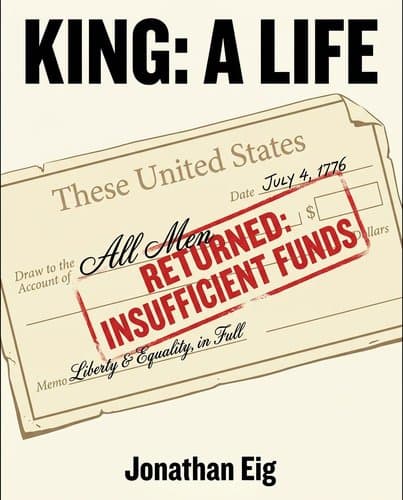
But King didn't open that sequence with a vision. He opened with a transaction. "In a sense, we've come to our nation's capital to cash a check," he told the quarter million people gathered at the Lincoln Memorial in August 1963. The metaphor is precise by design. A check names a specific debt, owed by a specific party, collectible on demand. It assumes the creditor has standing to insist. King was telling America it had signed a promissory note in the language of the Declaration of Independence ("all men are created equal") and spent nearly two centuries bouncing it. He was presenting it for payment.
Earlier in the same speech, before the crowd had any idea how the afternoon would end, King named what the debt consisted of: police brutality, economic exclusion, the daily geography of segregation. He was itemizing the bill. When he abandoned his prepared text and improvised the "dream" sequence (which he hadn't planned, and which TV networks had already begun cutting away from), the soaring language didn't replace those demands. It was the emotional engine meant to make them feel inevitable and just.
What decades of replay did was separate the engine from the vehicle. The dream circulates in school assemblies stripped of the invoice King attached to it. Listeners receive the feeling and float past the words — the check, the debt, the brutality named out loud. Eig's biography treats this as a quiet theft: from King's legacy, and from anyone who needs to understand what he was actually asking for, and why the debt hasn't been paid.
King Was Afraid — Which Is Exactly What Makes His Courage Worth Studying
It's past midnight in Montgomery, Alabama, and King is alone in the kitchen. Minutes earlier, an anonymous caller told him he had three days to leave town or he would be killed and his house blown apart. He hung up. Unlike the composed figure we've come to imagine, he walked the floors of his house unable to stop shaking.
He didn't feel certain. He didn't feel called. He made coffee.
He sat at the kitchen table and thought about Coretta asleep down the hall, his infant daughter in her room, and the real possibility that his decision to lead the boycott was going to get all of them killed. It had been only weeks since the boycott began. King was twenty-six years old. He had never been in jail. He was the new pastor in town, chosen partly because he hadn't yet accumulated enough local history for the city's different Black factions to resent him. He asked himself whether he was prepared to die. He didn't have an answer.
What he did have was a prayer. He told God he was weak. He confessed he couldn't let the people see him like this. Then he heard something — an inner voice telling him to stand up for what was right, that he would not be abandoned. The experience became known as the "Vision in the Kitchen," one of the most repeated stories in civil rights history. He rose from the table. He led the boycott to its conclusion, went to jail twenty-nine more times, and gave the most famous speech in American history.
The point isn't the vision. The point is what came before it: a man at a kitchen table at midnight, genuinely terrified, asking himself if he was prepared to die and not knowing the answer.
King's courage was the kind exercised by someone who could feel fear. As a teenager, he twice attempted suicide. As an adult, he was hospitalized repeatedly for what he described as exhaustion and what those around him recognized as depression. The FBI, which had planted bugs in his hotel rooms, had recordings of him with multiple women who weren't his wife. After his death, scholars found that his doctoral dissertation at Boston University had been partly plagiarized. He slept four hours a night during the boycott. He told Coretta, as they watched Kennedy die on television, that the same thing was coming for him, and she couldn't contradict him because she believed he was right. By early 1968, colleagues found him on hotel balconies at three in the morning, singing funeral hymns.
None of this diminishes the courage. It defines it. The fearless man who walks into danger is performing a role his nature made easy. The frightened man who walks into danger anyway — that's a choice.
King Launched the Boycott with Armed Guards and a Pistol in His Living Room
That fear makes the standard story of how he arrived at nonviolence even stranger to look at closely. Here's what you think happened: Martin Luther King Jr. arrived in Montgomery already shaped by Gandhi, Thoreau, and the theology of nonviolent resistance, a prepared vessel for the moment history called him into. That story is cleaner, and it is wrong.
Bayard Rustin arrived in Montgomery in early 1956. A tall, brilliant veteran activist who had spent his career at the center of American pacifist organizing, he found King's house guarded by armed men and a pistol in the living room. The boycott was already underway. King's home had already been bombed, with Coretta and their infant daughter inside. The armed guards made sense.
Rustin sat with King in what both men later described as a very long philosophical discussion of nonviolence. Not a lecture. A conversation. It ended with King making a decision: he disposed of the gun and told the guards to do their work unarmed.
King later dated his actual conversion to that period — not to Morehouse, not to Crozer Theological Seminary, where he had read Gandhi seriously and had what he called an intellectual awakening to the idea that love could be a force for social transformation. He was precise about this. "Living through the actual experience of the protest," he wrote afterward, "nonviolence became more than a method to which I gave intellectual assent; it became a commitment to a way of life." That sentence does real work if you let it. The books gave him an idea. The boycott gave him a practice.
The founding act of the most famous nonviolent movement in American history began with a man who had a gun and chose, in the middle of the fight, to put it down. That's the more honest version of how moral transformation works — not before the trial, but inside it.
The FBI Mailed King a Suicide Letter While He Was Leading the March on Washington
How far did the federal government's campaign against King actually go? Most people assume the answer is: surveillance overreach from an overzealous director, embarrassing in retrospect, but ultimately the story of a man who won anyway. That assumption is wrong by so much that it changes what the entire story means.
The FBI had a defensible rationale for watching King in the early 1960s. He was close to Stanley Levison, a former Communist Party donor who had channeled sums to the party roughly equal to the price of a median American home, year after year into the early sixties. Then the FBI's own analysts conducted a full investigation and concluded that the Communist Party, then about four thousand members nationwide, exerted "little or no influence" on the civil rights movement. Hoover received that sixty-eight-page report one week before the March on Washington and rejected it entirely. Two days after King addressed a quarter million people at the Lincoln Memorial, a senior FBI official named William Sullivan reversed the report's findings, not because new evidence had emerged, but because the director needed it reversed. Sullivan's memo named King "the most dangerous Negro of the future" and stated that the bureau might need to act beyond "conclusive evidence that would stand up in testimony or court." That phrase was a documented authorization to destroy, not monitor.
What followed was unlike anything directed at a single American citizen. FBI agents bugged King's hotel rooms across the country. Sullivan then had the bureau's own laboratory assemble a composite recording from the most explicit material captured and mailed it, in an unmarked package, to SCLC — the Southern Christian Leadership Conference — headquarters in Atlanta. Inside was an anonymous letter — typewritten, deliberately misspelled to suggest a disaffected Black author — that called King a "colossal fraud" and an "abnormal animal," then closed with a line that means only one thing: "there is only one thing left for you to do. You have just 34 days." The letter was sent thirty-four days before Christmas. The package sat unopened at SCLC headquarters for weeks while King traveled. He did not know, during those weeks, that the federal government had mailed him a suicide note.
When news of the shooting reached Hoover in April 1968, he said: "I hope the son of a bitch doesn't die. If he does, they'll make a martyr out of him." That sentence names what the whole apparatus had been for: not building a legal case, but breaking a man. The campaign ran underneath the Nobel Prize, underneath every march and speech. King addressed a quarter million people at the Lincoln Memorial in August 1963. By October, federal agents were recording every call placed to or from his home. The two facts lived in the same country at the same time, and the standard telling of that era foregrounds only one.
The King America Celebrates Would Never Have Said 'The Greatest Purveyor of Violence Is My Own Government'
King kept moving through all of it. But the King who came out the other side was not the one America decided to remember.
August 5, 1966, Gage Park, a nearly all-white neighborhood on Chicago's southwest side. King arrives two hours late to find Confederate flags, men pounding the sidewalk with baseball bats, and a sign wishing him dead by stabbing. He starts walking anyway. A thrown knife misses him and hits a marcher instead. Then a rock catches him squarely between the shoulder blades, just below the neck. He drops to his knees, closes his eyes, and braces for the bullet he assumes must be following. It isn't. He rises slowly, tells his aides he's okay, and says something that didn't make it into the holiday mythology: "I think the people of Mississippi ought to come to Chicago to learn how to hate."
Chicago produced none of the leverage Birmingham had. Mayor Daley signed a housing agreement that community organizers dismissed as empty promises before the ink dried. Congress killed the federal fair-housing bill. SCLC donations fell forty percent. By late 1966, sixty-three percent of Americans viewed King negatively — he had dropped off Gallup's most-admired list entirely.
Chicago also produced a different King than the one the holiday commemorates.
David Halberstam spent ten days with King in early 1967 and asked whether King had moved toward Malcolm X's philosophy. King would never endorse separatism. But his answer made clear he had traveled somewhere new. "For years, I labored with the idea of reforming the existing institutions of the society, a little change here, a little change there," he said. "Now I feel quite differently. I think you've got to have a reconstruction of the entire society, a revolution of values." He floated nationalization of certain industries, a guaranteed annual income, massive urban economic investment. On white America, he was blunt: "Most Americans are unconscious racists."
Three months earlier, at Riverside Church in New York, he had called the U.S. government the world's greatest purveyor of violence. The New York Times called the speech "a demagogic slander." Johnson, in what his press secretary described as cold anger, had a syndicated columnist publish a piece questioning King's loyalty. Barry Goldwater called the conduct close to treason. Donations fell further still.
The King on the posters holds none of these positions. He doesn't call your government the world's leading exporter of violence. He doesn't suggest nationalizing industries or a guaranteed income. He doesn't say most white people are unconsciously racist. That version of King got quietly set aside — which may be exactly why, a few years after his death, those in power finally agreed to give him a holiday.
In Hallowing King, America Hollowed Him — the Streets Named After Him Are the Evidence
The most honest measure of what America heard from Martin Luther King Jr. is not what happens on the national holiday. It's what happens on Martin Luther King Jr. Boulevard.
Nearly a thousand American cities and towns have named streets after King. On those streets, poverty and segregation rates run significantly higher than local and national averages. The school bearing his name likely has fewer resources than the school across town that doesn't. The memorial in Washington, a thirty-foot granite figure and the only national monument on the Mall dedicated to a person of color, had no King books for sale in its gift shop when Eig visited in spring 2022. The institution built to honor him couldn't be bothered to sell the work of his mind.
This is what canonization accomplished. The holiday, the statues, the street names. None of it required America to address the three forces King spent his final years fighting: racism, militarism, and the materialism that kept both in place. The icon that emerged from his death carries only what cost nothing to celebrate. The "I Have a Dream" sequence, replayed until it functions as a hymn, carries listeners right past the specific check King said America owed — past the itemization of police brutality, economic exclusion, and a four-century debt that hadn't been paid. The demand became decoration.
The streets named after him are where the answer lives. They tell you what America chose to hear, and what it chose to ignore.
Eig's biography is an argument that we cannot afford the simplified version any longer. The real King — the frightened man at the kitchen table at midnight, the one who put a gun down and chose something harder, the one who called his own government the world's greatest purveyor of violence — was making specific demands of the country. He said our survival depended on the willingness to stay awake.
The Question the Holiday Won't Ask
The comfortable King costs you nothing. You can admire him on a federal holiday, feel moved by the dream sequence, and walk away unchanged — because that version of him never made a demand you couldn't absorb without consequence. But the King in these pages was doing something harder. He was telling you what the debt actually was, who owed it, and what would happen if it kept going unpaid. He named your government the world's leading exporter of violence. He demanded a guaranteed income, an end to militarism, a reckoning with four centuries of compounding interest. Those demands didn't disappear when the icon arrived. They're written into every poverty rate on every boulevard that carries his name. The check King laid at the Lincoln Memorial — naming the debt, the creditor, and the consequences of default — is still outstanding. He told you what was at stake. Our very survival, he said, depends on our ability to stay awake.
Notable Quotes
“The people who are here want you, not me,”
“Something is happening in Memphis,”
“Something is happening in our world.”
Frequently Asked Questions
- What is King: A Life about?
- King: A Life (2023) recovers the full, unedited Martin Luther King Jr. through newly declassified files and exhaustive research. The book reveals King's depression, FBI persecution, and radical demands for guaranteed income, reparations, and an end to militarism—aspects that mainstream memory has systematically erased. Jonathan Eig demonstrates that restoring King's contradictions and dangers is the only way to take his actual legacy seriously. The work moves beyond the sanitized version often presented in mainstream narratives, instead presenting King as a complex, struggling figure whose most challenging ideas remain unfinished.
- What radical demands did King make that have been forgotten?
- Understanding King's complete legacy requires engaging with his later speeches and economic vision. In his 1967–68 addresses, King advocated for nationalization of industries, guaranteed income, and directly indicted American militarism—proposals that represent his most unfinished work. These later addresses reveal a King pushing for systemic economic transformation far beyond the civil rights focus of his 1963 'I Have a Dream' speech. The book emphasizes these demands for economic redistribution and critique of military spending remain largely unfulfilled. Understanding King's true legacy requires confronting these redistributive proposals and his forceful condemnation of American foreign policy, ideas that remain politically urgent today.
- How does King's depression and personal struggles relate to his leadership?
- King's mental health struggles were inseparable from his political leadership, not a contradiction to it. The book reveals King's documented depression, midnight crises, and private collapse as the very conditions that tested his courage and commitment. Eig argues that 'courage under documented conditions of terror is more instructive than idealized fearlessness.' Rather than viewing personal suffering as evidence against his achievement, these struggles demonstrate that King's nonviolent commitment deepened through psychological hardship. Understanding his actual struggles reframes his legacy—as discipline proven under genuine hardship, not virtue possessed from birth.
- What did Jonathan Eig reveal about FBI surveillance of King?
- The FBI conducted systematic psychological warfare against King even during his greatest triumphs. According to the book, 'the FBI ran a documented multi-year campaign of psychological warfare against King, including a suicide letter mailed to his office, while he was winning the Civil Rights Act.' This was not retroactive speculation but documented fact occurring in real-time as King achieved major legislative victories. Eig demonstrates that understanding this covert government campaign fundamentally changes how we evaluate 'national security' arguments used to justify surveillance and repression of political dissidents. The historical pattern is clear: such arguments have consistently been invoked to suppress any serious challenge to establishment authority.
Related Book Summaries
Read the full summary of 62039291_king on InShort