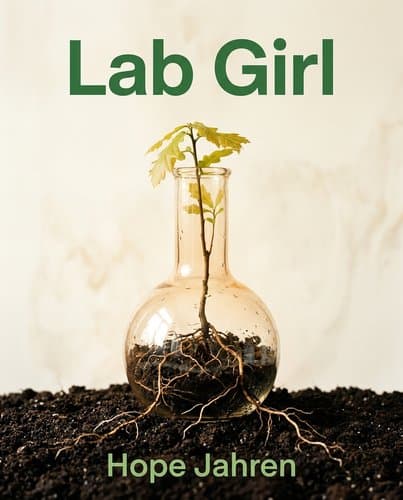
25733983_lab-girl
by Hope Jahren
Plants risk everything on a single germination, and so did Hope Jahren—building a life in science through poverty, obsession, and an unlikely partnership that…
In Brief
Lab Girl (Marc) blends memoir and science to explore what it means to build a life around research.
Key Ideas
Work sustains while concealing costs
The lab — or any vocation pursued at full intensity — functions simultaneously as refuge and trap: it sustains the people who build their lives inside it while demanding costs the institution never fully acknowledges.
Discovery is solitude before meaning
Scientific discovery is not triumph. It is isolation — being the first person alive to know something, weeping at a window, waiting for someone else to arrive so the knowledge means something.
Creative bonds transcend formal categories
The partnership at the center of a creative or scientific life is rarely legible as friendship or employment. It exists in the space between: built on mutual rescue, economic asymmetry, and a loyalty that precedes any formal agreement.
Total commitment spans genius and crisis
Total commitment — the inability to stop, to retreat, to be anywhere but the work — is the same quality in a great scientist and in a psychiatric crisis. The book refuses to separate these as distinct.
Exploitation structured into scientific careers
Institutions need all-consuming dedication from scientists while structuring their careers to ensure poverty, instability, and — for women — occasional invisibility. Naming this isn't complaint; it's description.
Courage to commit is biological
Plants are not passive. A barrel cactus amputates its own roots to survive drought. A two-thousand-year-old seed waits in a peat bog for conditions that will never come — and one day they do. The 'courage' to commit everything to one irreversible direction is encoded in plant biology, not invented by humans.
Real science is daily wondering
Planting one oak tree is both a small act and a serious one. Mark your children's heights in the bark. Put $5 a month in a savings account for when it gets sick. The daily practice of watching and wondering — and saying your hypotheses out loud until people roll their eyes — is what science actually looks like.
Who Should Read This
Science-curious readers interested in Memoir and Scientists who want to go beyond the headlines.
Lab Girl
By Hope Jahren
13 min read
Why does it matter? Because the lab is a church, and science is a way of being alive — not just a career
Most people assume scientists chose their profession the way someone chooses accounting or law — practical, considered, a reasonable fit. Hope Jahren didn't choose science. She found the only place she could fully exist and never left. In Lab Girl, she moves between two kinds of truth simultaneously: the cellular mechanics of how a seed commits everything to a single root with no possibility of retreat, and what it costs a human being to live by the same logic. The plants she studies have been making that all-or-nothing gamble longer than there have been trees. Jahren has been making it since she was a child hiding under lab benches. This book is about what happens when you recognize your own survival strategy inside another living thing — and about the person who stayed broke and loyal and improbably present while you figured that out.
You've Been Looking at Green Things Your Whole Life Without Actually Seeing Them
Hope Jahren, a botanist who studies land plants from Hawaii, wants to break that indifference with a single exercise. Look out your window. What you see first — cars, buildings, sidewalks — represents years of deliberate human effort: mining, engineering, bricklaying, wiring. Now look again and find something green. That green thing was not designed last year or last century. It was invented roughly four hundred million years ago, and no human being on earth knows how to make it. We can build a hundred-story skyscraper in a few years. We cannot manufacture one leaf.
Jahren grew up sleeping ten feet from a blue-green spruce, separated from it only by a bedroom window. As a child she hugged it and hid beneath it; as a scientist she came to understand that her climbing barely registered to the tree — the equivalent of a faint vibration. But that tree had a life. It spent a dangerous infancy as a seed, caught between the risk of waiting too long and the risk of germinating too early. It defended itself for eight decades against insects and animals, paying for every drop of protective sap with a seed that would never exist. Then in the spring of 2013, it miscalculated — put out new needles before a May blizzard arrived and snapped its branches under the combined weight of foliage and snow. Her parents cut it down. She found out months later, standing in sunshine four thousand miles away.
The tree had milestones. It made a fatal mistake. It had a story. You just weren't watching.
The Lab Is a Church — and Also a Trap
The lab is not where Hope Jahren goes to work. It is where she goes to be herself — which turns out to be the same place she has always been.
She grew up literally beneath her father's lab benches, a small girl playing with pH tape and air nozzles while he prepped experiments for the next day's students. He never said no when she asked to handle the equipment. On the walk home through Minnesota winters, they didn't speak — not because they had nothing to say, but because silent companionship was the deepest thing their family knew how to offer. The lab was where she could exist without explanation.
Years later, building her first independent laboratory at Georgia Tech, Jahren recreated that feeling from scratch. Two basement rooms, each barely three hundred square feet. A mass spectrometer and four vacuum lines crammed in. The furniture came from the Salvation Army. They hauled away whatever the state surplus warehouse would release to anyone with a government ID — equipment they might need someday, against a future neither could predict. The hoarding wasn't irrational. It was the instinct of people who had learned that no institution would reliably provide what they needed, so they'd better build the stockpile themselves.
On Friday nights they ate frozen McDonald's cheeseburgers reheated from bulk — purchased during a campus twenty-five-cent special — and watched Jerry Springer with Reba, Jahren's Chesapeake Bay retriever, sleeping under the bench. This is what scientific life actually looks like at its most honest: broke, slightly feral, and suffused with a contentment that money couldn't have produced because money wasn't there to produce it.
Jahren calls the lab a church. Same rituals, same refuge, same inability to ever fully walk away. She grew up in both, and neither one ever let her go.
A Seed Knows Something We Don't: Waiting Is Not the Same as Doing Nothing
What does it actually mean to wait? Not to procrastinate, not to hesitate — but to hold everything you are in suspension, fully alive, until the one right moment arrives.
Jahren's answer comes from a peat bog in China. Scientists recovered a lotus seed, scratched its hard outer coat, added water, and coaxed it into growth. Then they radiocarbon-dated the empty shell. The seed had been dormant for two thousand years — alive the whole time, its embryo intact, carrying a complete blueprint of root and shoot through the rise and fall of entire human civilizations. Jahren's response to this is four words: 'I wonder where it is right now.' The casualness of that sentence is the point. The plant didn't know it had waited two thousand years. It just waited until the conditions were right, and then it became what it had always been.
But the flip side of that patience is absolute commitment. Once a seed pushes its first root downward, there is no second-guessing and no retreat. The plant surrenders all mobility forever — it will face drought, frost, and predators without any possibility of moving away. The odds against any individual seed surviving this gamble exceed a million to one. And yet the root, if it wins, can split solid bedrock and pump water more efficiently than any mechanical device humans have engineered.
Jahren's laboratory life runs on this rhythm: not restless activity, but the discipline to stay dormant until conditions are real, followed by the courage to commit everything, irreversibly, in one direction. The waiting is not nothing. It is the whole preparation. No beginning is possible without it — and each of us gets exactly one chance to take the plunge. That kind of commitment, Jahren would learn, is easier when you don't have to make it alone.
The Partnership That Built Everything Was Never Quite Payable
Summer 1994, Central Valley of California: a six-week soil taxonomy field course, 105-degree heat, and a student named Bill who looked like a young Johnny Cash and had somehow ended up ten meters from everyone else, digging his own private hole with a harpoon-shaped shovel he'd brought from home rather than use the department's equipment. When Jahren picked up his clipboard, she found his official evaluation completed with precision — then a second column down the right margin containing his second-best answers, and at the top, where students were asked to specify the 'best use' infrastructure for the site, he'd written 'juvenile detention center' in careful handwriting. She hired him on instinct. Her advisor asked how she knew Bill was the smartest one in the class. She said she didn't know it — she felt it.
What followed was a partnership that lasted decades, built on mutual rescue and never quite balanced in dollar terms. Jahren signed the grants, gave the lectures, wrote the papers. Bill fixed the mass spectrometer at midnight, greased the door hinges so secretaries wouldn't hear him sleeping in the windowless office he'd moved into after she admitted she couldn't pay him a living wage. He foiled the windows of his Volkswagen van — no reverse, no first gear, a starter that required a three-hour cool-down — and parked it in campus lot P3 under a willow tree, cutting off his fluid intake at six each evening because he had no acceptable option for urination. Jahren understood exactly what she was asking of him. She promised better, and she kept working toward it.
The Wyoming van rollover is where you see what actually held them together. Jahren, manic from steroid injections, drove their research crew from Atlanta toward a geophysics conference in San Francisco with no travel budget and a borrowed university van. A rancher friend warned of storms and recommended a southern route. Jahren proved with a piece of string on a map that the northern path through Wyoming was sixty miles shorter. The van rolled in the high desert outside Rawlins. When it finally came to rest on its ceiling, Jahren was laughing and bleeding. Everyone survived. At a Super 8 motel that night, she and Bill lay side by side on a king bed, fully clothed with their boots on, laughing until their stomachs cramped. At some point Bill redrew what they were to each other: not friends, just two stranded people splitting a room. Jahren decided family was the closest word she had for it. They drove the wrecked van to San Francisco the next morning.
The Same Quality That Makes a Great Scientist Can Also Break Her
The quality that makes a great scientist can also break her — and in Jahren's case, they are not two separate things.
When Jahren describes the onset of full mania in a chapter written in second-person present tense, she is not writing about an interruption to her scientific life. She is writing about the same inability to stop, to modulate, to be anywhere but fully inside whatever is happening. The vertebrae seem to detach. Blood roars through the skull. Nothing can be loud enough or move fast enough. You fill cassette tape after cassette tape with revelations, talking until your voice gives out and you're coughing blood, pacing until you collapse, getting up and continuing because you are so close to something. The certainty is total: you are the one person in billions who has broken free of existential weight, the one for whom the world has been waiting. That grandiosity is psychosis. But the underlying drive — the refusal to stop before the thing is finished, the physical compulsion to document before the insight escapes — is the same drive that kept Jahren in the lab past midnight while everyone else went home.
Then it ends. A tooth on the floor. Someone else's hands dabbing at the blood. Sleeping pills administered like drops of water to a fallen bird. Gray numbness. Then, by luck she describes as embarrassingly random, a doctor who looks at her hard and says five words: 'You don't have to live this way.' He is matter-of-fact. People have this and they manage it. She describes wanting to get on the floor and kiss his hand.
Years later, packing to move, she finds the cassette tapes from those episodes in a closet. She pulls the magnetic tape out of each one — reels of shiny brown thread, a curling mess where the revelations used to be — and buries the whole tangle under a magnolia tree. She calls it the placenta she was attached to while she struggled in the dark waiting to be born. Then she goes inside and packs everything she is taking with her, and tries to forgive herself for what she is leaving behind. The burying is not recovery. It is just the beginning of learning to hold the two things together: what the drive costs, and what it builds.
The Institution That Needs You Will Also Try to Make You Invisible
Eight months pregnant, close to becoming the first woman ever tenured in a hundred-year-old Johns Hopkins department, Jahren shows up one morning to sit beside her lab equipment because the hum of the machines is the only thing that still feels normal. Then her husband comes to her office that evening with the look of someone delivering a death notification. The department chair has ruled that she cannot enter the building while on medical leave. He did not come to tell her himself. Jahren grabs her coffee cup and hurls it at the floor with everything she has. It bounces, rolls sideways, and sits there. The cup's refusal to break is somehow the worst part: one more piece of evidence that even her fury cannot reach the people who made this decision.
The math underneath that moment is worth holding. The entire NSF budget for paleobiology — every fossil, every ancient pollen grain, every question about how plants changed the history of life on Earth — runs to six million dollars a year across the whole country. Thirty to forty grants, averaging around $165,000 each. Pay one experienced technician a modest salary, add the benefits, and then add the university's cut — taken automatically, called overhead, running as high as forty-two percent — and you have spent $150,000 of that grant. What remains for three years of actual laboratory work is ten thousand dollars.
The institution needs her absolute devotion. It also makes sure she can never quite afford it, can never quite be comfortable, and — when she becomes visibly pregnant — decides it would rather not look at her. Walter didn't deliver the news himself because, as her husband Clint tells her, he was afraid of her. They are all afraid of her. They just aren't afraid enough to treat her as if she belongs there.
Discovery Feels Like the Loneliest Moment of Your Life
It is past midnight, and Jahren is alone in a borrowed laboratory, watching a strip of paper chart the invisible. She has scattered powdered hackberry seed pit onto a glass slide and fed it into an x-ray diffraction machine — a device that bounces electromagnetic waves off mineral crystals and reads the pattern back, the way you'd identify a tuning fork by the frequency of its ring. She chose the midnight shift partly to avoid a hostile post-doc who worked days, and she has a three-quarter-inch ratcheting wrench in her back pocket.
The readout comes. One long, smooth arc — nothing like the sharp spikes she and her advisor had predicted. Unmistakably opal. Hackberry seed pits, those tiny stony fortresses, are reinforced with opal. No one on Earth knows this yet. She is the only person in a universe of billions to hold this particular fact.
And she stands there and cries.
We get scientific discovery wrong: we imagine a door swinging open onto light. Jahren describes something closer to exile. The realization that she could do real science arrived fused to another — that in doing so, she had permanently closed off the kind of life every woman she'd ever known was living. The discovery was genuine. The loneliness was genuine. They were the same moment.
She waits at the window for sunrise, unwilling to touch anything. Then Bill appears — her lab partner, sitting in a lawn chair he'd pulled from a dumpster, listening to a radio playing static, waiting for no reason he could have named. She holds up the readout. He pulls the battery from the radio and looks at her. He'd known he was sitting there waiting for something, he tells her. Turns out it was that. It is, somehow, exactly enough.
Plants Aren't Passive. They're Running the Same Gamble You Are.
Think of a gamble where you stake everything on a single direction, with no ability to change course once you've started, and where the only possible outcomes when conditions finally arrive are complete recovery or death. That's not a metaphor for scientific life. That's a barrel cactus.
When a barrel cactus faces severe drought, it doesn't adapt gradually. It performs an act of radical self-amputation: it sheds its own roots, because if it kept them, the parched soil would pull moisture back out of the plant faster than it could hold on. Rootless, it can still survive for four days. If the drought continues, it contracts for months — the accordion folds along its body pressing inward until they close entirely, the spines thickening into a hard protective shell around what is now just a dormant ball of plant, punished by the sun, waiting. It can hold that posture for years. Then rain arrives. Within twenty-four hours, the cactus either returns to full biological function or reveals itself to be dead. There is no gradual recovery. No partial credit. The binary is total.
By the time you've spent a few hours with her — in the pre-dawn lab, in the overturned van, watching the opal readout emerge on the x-ray diffractor — you already know what full commitment with no guarantee of return looks like. The barrel cactus isn't illustrating her life. It's living the same logic. You make the irreversible call, you hold everything in suspension against conditions you can't control, and then you find out. The plant isn't passive. It's running the same gamble. It just started earlier, and it never expected anyone to notice.
Two Rainbows Are Actually One Thing
The sweet potato harvest is finished. The soil is still dark and fragrant with turned earth, and Jahren and Bill are sitting inside a Hawaiian greenhouse with their bare feet buried in a cool, damp mound of potting mix, wearing the kind of exhaustion that only arrives after days of work you believe in. The experiment behind them was sobering: sweet potatoes grown under elevated carbon dioxide levels — the concentrations we're headed toward if emissions go unchecked — grew larger. They also became measurably less nutritious, lower in protein, regardless of how much fertilizer was applied. The poorest nations depend on sweet potatoes for dietary protein. Bigger potatoes, fewer nutrients. Jahren doesn't have an answer for that. She says so plainly, and moves on.
Then Bill points toward the mountains, and she looks up at a double rainbow — a sharp, vivid primary arc bracketed by a second, wider, softer one. Most people don't register the second rainbow. Bill says it's always there; the main rainbow probably assumes it's alone. Jahren plays her half of the exchange: the two are actually one phenomenon. A single ray of light moving through difficult weather just produces what looks like two separate things. They both sit with that for a moment, and then Bill says that rainbows are self-centered and need to get over themselves. The conversation ends there, but the point holds. Two things that look distinct, that people keep trying to label and categorize — siblings, colleagues, something else entirely — are actually one continuous process. Jahren doesn't name what she and Bill are to each other. She says: I do us because us is what I know how to do.
The epilogue delivers its alarm plainly: since 1990, humanity has added more than eight billion new stumps per year. At that rate, within six hundred years, every tree on Earth will be gone. Then Jahren pivots from that number to a single, concrete request. Plant one tree. Not a Bradford pear — they split at the trunk in the first real storm. An oak, ideally: the bur oak, slowest and strongest. Check it every day. Plan ahead for when it gets sick.
And carve Bill's name into it, Jahren asks. He won't read the book. He says he can remember the last twenty years perfectly well without her help, and she has no answer for that. But she wants his name somewhere permanent. The best way to give something a home, she has learned, is to make it part of a tree. The one you plant tomorrow will grow slowly, anonymously, without asking for credit. Plant it anyway.
What It Means to Carry a Leaf
Here is what Jahren is finally asking: not that you memorize the biochemistry of a leaf, or feel guilty about a trillion lost trees, or admire her suffering from a safe distance. She is asking you to go outside tomorrow and push something living into the ground, then come back the next day to check on it — and the day after that, until checking becomes a habit and the habit becomes a relationship and the relationship outlasts you. Carve a name into the bark. Not your own. Someone who taped foil across a van window so you could sleep, someone who pulled up a lawn chair and waited without knowing why. The world invented the leaf four hundred million years ago and has been losing it ever since, and the person who understands that most precisely spent her career in a basement, broke and laughing, watching plants wait. She watched long enough to know: the waiting was never nothing. Neither is this.
Notable Quotes
“You don't have to live this way.”
“Oh, this is great. This will give us a stable two-hundred-twenty-volt supply. Exactly right for the mass spectrometer. Just completely perfect,”
“We used to have a dog that chewed her paws,”
Frequently Asked Questions
- What is Lab Girl about?
- Lab Girl blends memoir and science to explore what it means to build a life around research through Hope Jahren's career as a geobiologist. The book examines how plants and scientists share the same logic of total commitment, revealing what that dedication costs both individual scientists and institutions. Jahren offers an honest look at scientific work, creative partnerships that sustain research, and the discipline of sustained wonder. She explores how the lab functions simultaneously as refuge and trap, sustaining those who build their lives inside it while demanding unacknowledged costs.
- What are the key insights about scientific discovery in Lab Girl?
- Scientific discovery, according to Jahren, is not triumph but rather profound isolation. The book challenges the triumphant narrative often surrounding scientific breakthroughs, instead revealing the lonely emotional reality of being the sole holder of new knowledge. In Jahren's words, "being the first person alive to know something, weeping at a window, waiting for someone else to arrive so the knowledge means something" captures this isolation. She emphasizes that meaning in discovery comes from the ability to share knowledge with another person, making scientific work fundamentally relational despite its isolating nature.
- How does Lab Girl describe the relationship between scientists and institutions?
- Lab Girl reveals the fundamental paradox in scientific institutions: they require total commitment from scientists while structuring careers to ensure poverty, instability, and invisibility—particularly for women. Jahren describes this not as complaint but as clear description of institutional reality. The book shows how the lab "functions simultaneously as refuge and trap: it sustains the people who build their lives inside it while demanding costs the institution never fully acknowledges." Through her work, Jahren exposes the economic asymmetries and structural inequalities that characterize scientific careers and how institutions depend on the willingness of scientists to sacrifice stability.
- What does Lab Girl suggest about commitment and creativity?
- Lab Girl argues that in creative and scientific work, "the inability to stop, to retreat, to be anywhere but the work" characterizes both exceptional scientists and psychiatric crises—the book refuses to separate these as distinct. Jahren explores how creative and scientific partnerships exist in ambiguous spaces between friendship and employment, built on "mutual rescue, economic asymmetry, and a loyalty that precedes any formal agreement." This nuanced exploration challenges conventional ways of understanding professional dedication. The book reveals that sustained commitment in science is both what makes great work possible and what can become consuming and destructive.
Related Book Summaries


Read the full summary of 25733983_lab-girl on InShort