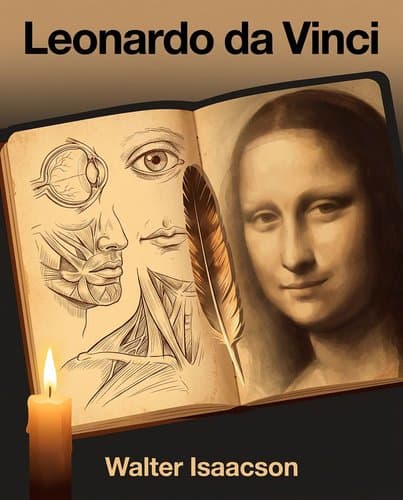
34684622_leonardo-da-vinci
by Walter Isaacson
Relentless curiosity—not talent—made Leonardo da Vinci a genius. Isaacson reveals how his habit of chasing useless knowledge across anatomy, optics, and…
In Brief
Leonardo da Vinci (Octo) draws on Leonardo's thousands of notebook pages to reconstruct how history's most creative mind actually worked. Walter Isaacson shows that Leonardo's genius was less divine gift than disciplined practice — structured curiosity, cross-domain observation, and a refusal to stop learning — offering readers a transferable model for thinking more originally across art, science, and work.
Key Ideas
Structure curiosity into daily practice
Make curiosity structural: Leonardo didn't trust himself to stay curious naturally — he scheduled it in to-do lists full of things he wanted to understand, not accomplish. Adding one question with no practical payoff to your week is a practice, not a personality trait.
Pursue knowledge for its own sake
Seek knowledge without a use case in mind: Leonardo's optics research (pursued for its own sake) directly produced the Mona Lisa's flickering smile; his water-vortex studies (also pursued freely) explained how the aortic valve closes. Useless knowledge has a long lag time before it transforms something.
Unfinished projects absorb new insight
Treat unfinished work as still-open learning: a project you haven't declared done can absorb new knowledge; one you've shipped cannot. Leonardo returned to Saint Jerome thirty years later with anatomy he'd learned in the interim. Some works improve by waiting.
Cross-disciplinary connections enable breakthroughs
Cross-disciplinary reading is not a distraction — it's the mechanism: Leonardo's discoveries about light entering the eye (optics) determined his painting philosophy (no sharp lines); his study of water eddies (engineering) explained heart-valve mechanics (anatomy). The most useful insights came from domains that had no obvious connection.
Observe details before drawing conclusions
Start with details, not summaries: Leonardo's observation method was explicit — look at each element separately, word by word, before drawing any conclusion. Resist the impulse to know what something is before you've actually seen it.
Outsider status sparks genuine innovation
Outsider status can be a design advantage: because Leonardo had no guild membership and no Latin education, he wasn't constrained by the received wisdom those institutions transmitted. He built his methods from scratch, which meant they were genuinely his.
Collaboration amplifies individual brilliance
Collaborate actively and often: Vitruvian Man emerged from shared sketches and dinner conversations with Francesco di Giorgio and Giacomo Andrea. Leonardo's best anatomy came while working with Marcantonio della Torre. Genius starts alone; the best execution usually doesn't.
Documentation enables future discoveries
Write things down on paper: five hundred years later, Leonardo's notebooks are still producing new discoveries — the aortic valve theory confirmed by MRI, the smile mechanism explained by neuroscience. His tweets, had he sent any, would be gone.
Who Should Read This
Readers interested in Scientists and Creative Thinking, looking for practical insights they can apply to their own lives.
Leonardo da Vinci
By Walter Isaacson
9 min read
Why does it matter? Because the greatest creative mind in history couldn't do long division.
At thirty, Leonardo da Vinci wrote what may be the most audacious job application in history. Ten paragraphs to Milan's ruler: mobile bridges, armored chariots, multi-barrel cannons — none of which he had actually built. Then, paragraph eleven, almost as an afterthought: he could also paint. That sentence would eventually produce the two most recognized paintings in human history. But Isaacson's biography isn't interested in the miracle of those masterpieces — it's interested in what the same mind demanded of itself. The man who kept the Mona Lisa unfinished for sixteen years wrote himself a note reading "tell me if anything was ever done," dissected cadavers at midnight to understand a smile, and left behind more brilliant incomplete work than most people produce in a finished lifetime. That's not a tragedy. That's the same curiosity, operating without a shutoff valve.
He Was Born an Outsider — And That Became His Greatest Advantage
On a Saturday night in April 1452, somewhere in the Tuscan hills near the village of Vinci, a baby boy was born. His grandfather Antonio picked up a pen and noted the birth at the bottom of an old family notebook: the father's name, the date, the time, the child's name. The mother wasn't worth including. Five years later, when Antonio listed his household dependents in a tax document, he described the boy as "non legittimo" — born out of wedlock.
That notation shaped everything that followed.
Five generations of Leonardo's family had been notaries in Tuscany. They carried the honorific "Ser," certified by the Arte dei Giuduci e Notai, a guild of judges and notaries. His great-great-great-grandfather, his great-great-grandfather, his own father Piero: all trained in Latin, all bound by guild protocols, all legitimate. The rule was plain: illegitimate sons could not join. When Piero da Vinci left his infant son in Vinci and rode back to Florence that Monday to notarize papers for clients, he was stepping into a tradition Leonardo would never be allowed to enter.
Walter Isaacson calls this Leonardo's good luck.
The guild didn't just bar a profession — it enforced a way of thinking. Latin-school education meant absorbing centuries of accumulated doctrine: classical authority, the medieval consensus on how the world worked, answers approved before you'd thought to ask the questions. Leonardo got none of it. Aside from some basic commercial arithmetic at what was called an abacus school, he was self-taught. He sometimes felt the gap. He called himself "an unlettered man," but came to understand what the gap had given him. He began signing his notebooks "Leonardo da Vinci, disscepolo della sperientia": disciple of experience. When educated men dismissed him for lacking book learning, he pushed back with contempt: the men parading their Latin credentials, he wrote, were living off borrowed authority, dressed in other people's thinking rather than their own. What he was doing required something they couldn't inherit. It required experience.
He had no choice but to look. Without a canon to defer to, without inherited answers, the world itself became his only source: the way light fell across a face, the mechanics of a bird's wing as it spread on descent, the spiral a current makes around a submerged stone. The illegitimacy that set him apart from his family's tradition kept his eyes open, and he spent the rest of his life learning how to use them.
Curiosity Is a Practice, Not a Personality Trait
Most of us treat curiosity as something that happens to us, a spark that either catches or doesn't. Leonardo's notebooks reveal something more uncomfortable: he scheduled it.
In the 1490s, working in Milan, Leonardo kept a running list of things he needed to learn. One that survives reads like a fever dream. He wants to measure the city and its suburbs. He needs to find someone who can show him how to square a triangle. He must ask a bombardier how the tower of Ferrara was built, ask someone else how people walk on ice in Flanders, track down a hydraulics expert who can explain canal locks in the Lombard style. And then — without transition, without explanation — he reminds himself to "describe the tongue of the woodpecker."
Not paint one. Not observe one. Describe its tongue. Anatomically. In writing.
The art critic Adam Gopnik read these lists and landed on the conventional verdict: Leonardo "remains weird, matchlessly weird, and nothing to be done about it." Isaacson sees something else: a mind that turned wonder into method. The woodpecker's tongue had no application. It would not improve his painting or his engineering. Leonardo wanted to know because he had cultivated a habit of noticing things all the way down, not glancing but really looking, really following. Elsewhere in the notebooks, he describes it as a learnable technique: begin with the details of something and don't move to the second step until the first is fixed in memory. Look word by word.
The range in that to-do list is easy to admire. The discipline is harder to see. These aren't spontaneous enthusiasms; they're appointments. "Get the measurement of the sun promised me by Maestro Giovanni Francese, the Frenchman." He tracked down experts. He showed up. Every time a new question opened, it split into several more. That's how one man filled more than seven thousand pages of notes on anatomy, botany, geology, water flows, optics, mechanics, and the behavior of birds in flight, while also painting the Mona Lisa.
Isaacson's point, which cuts against the genius mythology, is that Leonardo wasn't simply born this way. He built the habit deliberately, the way you build any habit: by doing it every day, on a schedule, even when the object of curiosity seems ridiculous. Even when you have to remind yourself — in writing, on a list — to go to the bathhouse on Saturday and look at the men.
He Never Finished the Painting Because He Was Still Learning How
What if Leonardo's unfinished paintings weren't abandoned? What if they were held open on purpose?
The evidence against him is real. In March 1481, a monastery outside Florence drew up a contract designed to prevent exactly this. Leonardo had to supply all materials himself, deliver within thirty months, or forfeit the panel without compensation. He also assumed a 150-florin dowry obligation tied to the property he'd receive as payment. Within three months he'd defaulted, borrowed money for paint, and accepted a bundle of firewood for decorating the monastery's clock. He never finished the Adoration of the Magi. He left it with a friend and departed for Milan.
By the conventional reading, this is failure. Distraction wearing the costume of genius.
But then there's Saint Jerome in the Wilderness.
The haggard saint kneels with one arm outstretched, a rock raised to beat his chest in penance, his body twisted between shame and inner resolve. Here's the strange detail: the sternocleidomastoid — the long muscle running from collarbone up the side of the neck — is rendered as a paired structure. Accurately. But Leonardo didn't formally discover it was paired until his dissection work in 1510, thirty years later. Art historian Martin Clayton's explanation, confirmed by infrared analysis: two phases of painting, three decades apart. Leonardo returned to a canvas he'd begun in his twenties and corrected the anatomy with knowledge he'd earned in his fifties. The neck isn't evidence of what he knew in 1480. It's evidence that he kept the canvas open like a question, waiting for a better answer.
That's what's worth holding. When we call Leonardo's unfinished paintings failures, we're imposing deadline culture onto a man who didn't think that way. He believed every new discovery might require another pass. He was right about the neck. He carried the Mona Lisa from Florence to Milan to Rome to France, adding thin glazes through 1517, sixteen years after he started. He never delivered it to the commissioner. He never collected payment. He died with it beside him.
The same impulse that made the Mona Lisa what it is also left that monastery outside Florence paying someone else to finish the job.
The Mona Lisa Was Built from Science He Didn't Know He'd Need
Stare directly at the Mona Lisa's mouth and the smile disappears. Look away, toward her eyes or the landscape behind her, and it's back. That isn't a quirk of perception. It's an engineered optical event, and understanding how Leonardo built it shows that his art and science weren't parallel interests running alongside each other; they were feeding each other directly.
Harvard neuroscientist Margaret Livingstone worked out the mechanism. The fovea (the center of the retina) resolves fine detail. Look directly at Lisa's mouth and it catches two barely perceptible downward curves at the corners of her lips. The impression: no smile, or something closer to reserve. Shift your gaze to her eyes or the landscape behind her, and your peripheral vision takes over, a region of the retina wired for shadows and broad shapes, not sharp edges. Those slight downturns vanish. What remains are the soft shadows Leonardo applied in up to thirty translucent glaze layers. Those shadows read as a smile. Look away to find it; stare and it's gone.
Leonardo could engineer this because he'd spent years dissecting eyes and faces on cadavers. While the Mona Lisa sat in his studio in the early 1500s, he was spending nights at the hospital morgue peeling skin to map every muscle controlling the mouth. He traced the buccinator — the muscle that flattens the cheek as a smile begins — and followed each nerve back toward its origin in the brain. None of this was strictly necessary for depicting a face. He could have learned enough by watching people. But knowing the mechanism gave him something observation alone couldn't: a precise map of what each shadow represented, down to the muscle underneath.
The other half came from optics. Dissecting eyes and mapping how light spreads across the retina rather than converging at a single point, he concluded there are no sharp lines anywhere in nature, not on objects, not on faces. "The line has in itself neither matter nor substance," he wrote. It's a mathematical abstraction, not a physical thing. Painting precise contour lines around a face was a depiction of something that doesn't exist. The soft, haze-edged quality we call sfumato wasn't a stylistic preference. It was the direct consequence of a philosophical conclusion reached through mathematics and anatomy.
"The Soup Is Getting Cold"
On September 7, sometime in the early 1490s, a boy Leonardo had recently taken into his household — Gian Giacomo Caprotti, ten years old, already nicknamed Salai for "Little Devil" — stole a silver stylus worth twenty-two soldi from a studiomate named Marco. When Marco searched for it, he found it in the boy's box. Leonardo wrote this down in the same small, impassive handwriting he used for observations about arterial branching, water eddies, and the anatomy of the aortic valve. The entry sits without agitation. Then, next to a related line, the same handwriting suddenly doubled in size: Thief. Liar. Obstinate. Greedy.
Sixteen years later, a shopping list Leonardo was dictating mid-thought dissolved into: "Salai, I want peace, not war. No more wars, I give in."
For thirty years, Leonardo kept this man around: dressing him in elaborate pink outfits, buying him twenty-four pairs of fancy shoes, recording each theft with quiet precision. The man who had filled seven thousand pages with the workings of the natural world couldn't win an argument with his own housemate.
There's one more thing. Buried inside that same 1490 theme sheet (twelve-by-eighteen inches of branching-pattern geometry, horse sketches, water studies, botanical drawings) is a recipe for tawny hair dye. Nuts boiled in lye, combed through wet hair, dried in sun. Isaacson doesn't dwell: Leonardo was deep into his thirties by then. Perhaps he was resisting going gray.
Then there's the last notebook page.
In his final years at Amboise, Leonardo was still working through a geometry puzzle he'd been circling for decades: how to vary the legs of a right triangle while holding its area constant, a problem from Euclid with no practical application and enormous personal pull. He drew the triangles, shaded the rectangles inside them, labeled the chart. Then he stopped. One line, in his characteristic right-to-left mirror script: Perché la minestra si fredda. Because the soup is getting cold.
That is the last thing Leonardo da Vinci ever wrote. Not a summation, not a farewell. A man who knew the cook was downstairs, the household already at the table, and the geometry would still be there after dinner.
What the Woodpecker's Tongue Teaches
Leonardo put "Describe the tongue of the woodpecker" on a to-do list with no practical application in sight. He eventually learned what you now know: it extends more than three times the length of the bill, retracts by wrapping around the inside of the skull, and absorbs impacts that would otherwise be fatal — one of nature's stranger engineering solutions, hiding in something most of us glance past without a second thought. It took an appointment on a to-do list to get there.
When did your to-do lists stop including items like that? At some point, most of us began listing only things that needed doing — and quietly dropped the things worth knowing. Leonardo's genius wasn't a gift. He willed it into existence, notebook by notebook, question by question. The only thing separating his notebooks from ours is that he actually opened them.
Notable Quotes
“In this work of Leonardo,”
“there was a smile so pleasing that it was more divine than human.”
“While painting her portrait, he employed people to play and sing for her, and jesters to keep her merry, to put an end to the melancholy that painters often succeed in giving to their portraits.”
Frequently Asked Questions
- What is Leonardo da Vinci by Walter Isaacson about?
- The book reconstructs how Leonardo's mind worked by drawing on thousands of notebook pages, showing that genius resulted from disciplined practice rather than divine gift. Isaacson demonstrates Leonardo's transferable model of thinking: structured curiosity, cross-domain observation, and continuous learning. The work reveals how Leonardo's creative process—combining rigorous observation with knowledge-seeking across unrelated disciplines—produced breakthroughs in both art and science. By studying Leonardo's methods, readers learn how to cultivate originality in their own thinking and work, making this biography both a historical account and a practical guide for developing creative thinking skills.
- What are the key principles Leonardo da Vinci used for creative thinking?
- Leonardo's genius came from reproducible practices, not innate talent. The book identifies his core methods: maintain structured curiosity through deliberate practice; pursue knowledge freely without requiring immediate practical application; treat unfinished projects as ongoing learning opportunities; integrate insights from multiple disciplines; observe details thoroughly before drawing conclusions; leverage outsider status as an advantage; and collaborate actively. The book emphasizes that "useless knowledge has a long lag time before it transforms something," explaining why Leonardo's unfocused studies eventually revolutionized both art and science through unexpected connections across different fields.
- How did Leonardo da Vinci's cross-disciplinary approach lead to breakthroughs?
- Leonardo's genius emerged from connecting unrelated fields of study. His optics research, pursued independently, directly enabled the Mona Lisa's flickering smile; his water-vortex studies explained aortic valve mechanics. The book demonstrates that "cross-disciplinary reading is not a distraction — it's the mechanism" for original thinking. Leonardo's discoveries about light entering the eye determined his painting philosophy of avoiding sharp lines, while water-eddies study explained heart-valve function. This pattern reveals how valuable insights originate in unexpected domains. By systematically studying fields with no obvious connection to his primary work, Leonardo created synthesis unavailable to specialists.
- Is Leonardo da Vinci's notebook practice still relevant today?
- Yes, documentation remains surprisingly powerful centuries later. Leonardo's notebooks continue revealing new discoveries—the aortic valve theory confirmed by modern MRI technology and the smile mechanism explained by contemporary neuroscience. The book emphasizes that "five hundred years later, Leonardo's notebooks are still producing new discoveries." This contrasts with ephemeral digital communication, which leaves no compounding record. The takeaway is direct: systematic documentation of observations, sketches, and questions creates intellectual capital that can be revisited and reinterpreted as new knowledge emerges, making careful recording a practice anyone can adopt regardless of field.
Related Book Summaries

Read the full summary of 34684622_leonardo-da-vinci on InShort