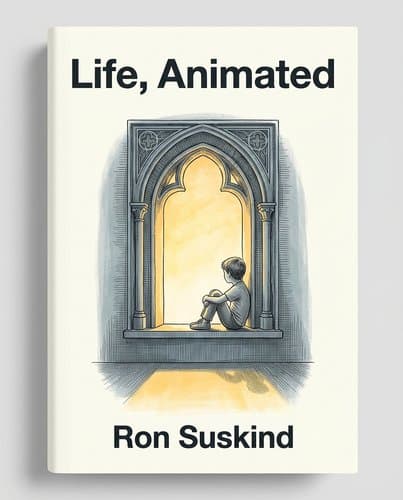
21424655_life-animated
by Ron Suskind
When Owen Suskind stopped speaking at age three, his family thought they'd lost him—until they discovered he'd rebuilt his entire inner world through Disney…
In Brief
When Owen Suskind stopped speaking at age three, his family thought they'd lost him—until they discovered he'd rebuilt his entire inner world through Disney films. This stunning memoir reveals how one boy's 'obsession' became the language that brought him back to life.
Key Ideas
Special interests as meaningful pathways, not symptoms
Reframe 'special interests' in autistic individuals as potential pathways — the passion is not a symptom to redirect but a language to learn and work with
Unconventional language reveals preserved inner life
When a child (or anyone) loses conventional language, look for the unconventional system they've built in its place before assuming absence of inner life
Sibling emotional load requires community support
The sibling of a disabled person carries a specific, often invisible emotional load — seeking out communities of siblings is as important as seeking support for the child with the diagnosis
Normalcy pursuit costs community understanding and belonging
Trying to preserve 'normalcy' after a life-altering diagnosis can have hidden costs: the comfort of familiar routines may come at the price of the community that actually understands what you're going through
Repetitive narratives serve as therapeutic mirrors
Fixed, repeatable narratives — films, books, rituals — can serve as psychological mirrors, letting someone track their own emotional growth over time; don't underestimate the therapeutic function of a story someone returns to obsessively
Imagined inner guides are tools for self-knowledge
Self-knowledge, for Owen and perhaps more broadly, often comes through the internal dialogue we have with imagined guides — the 'gargoyles' we invent are not delusions but tools for thinking; nurturing that inner voice matters
Who Should Read This
Readers who connect with first-person stories about Memoir and Mental Health and want to see the world through someone else's eyes.
Life, Animated
By Ron Suskind
10 min read
Why does it matter? Because the 'obsession' you were told to manage may be the only open door.
Most people assume autism is an absence. No language, no connection, no interior life worth reaching. A door, shut. What Ron Suskind discovered, watching his three-year-old son Owen disappear into silence, is that the door wasn't shut — it had simply opened somewhere else. Owen didn't stop wanting to connect. He found a different grammar for it: Simba's grief, Quasimodo's isolation, Aladdin's hunger to be known. Disney animated films became the language his family eventually learned to speak back to him in. What followed — years of finding, losing, and finally reaching each other — turns out to be one family's story and a challenge to everything we think we know about autistic minds, about obsession versus passion, and about the quiet violence of keeping things normal at all costs. The accumulated cost of that choice, as this book documents, is real.
A Boy Disappears, and a Family Seals Itself Off
Sometime after Owen Suskind stopped speaking around age three, his family made a decision that felt, at the time, like an act of love. They had just moved to Washington, D.C. Owen had been diagnosed with autism. The world, as his mother Cornelia describes it, had been turned upside down. So the family planted their feet. They called their old friends. They kept the same rhythms, the same routines, the same social life they'd always had — deliberately, consciously, because they believed that keeping things normal was the best thing they could do for their older son Walt.
It didn't work the way they hoped. The unintended consequence of chasing normalcy was that the Suskinds sealed themselves off from the one community that might have actually helped: other families raising children with autism. People who would have recognized the particular exhaustion in Cornelia's face. People who wouldn't have needed an explanation. Instead, the family lived inside what Cornelia would later describe as a shrinking, bounded world — increasingly cut off from any shared understanding of what they were living through. And Walt, the child they'd been trying to protect, was the most denied the company of kids who would have known exactly what his daily life felt like.
Cornelia, self-described as a deeply private person, sat with this for years before she could name it as a mistake — and the realization only crystallized when the family's story became a book. The response broke something open in her. Letters came from parents who'd felt the same isolation, from siblings of autistic children who had grown up, like Walt, believing their experience was theirs alone. What those letters made plain was the cost of the original choice: when you hold so tightly to the life you had, you never find the life that's actually available — the one where someone looks you in the eye and says, without any explanation required, I know what this is. Walt had spent his adolescence carrying a complicated emotional weight, the hopes and fears and unresolved anxieties about his brother's future, without ever meeting anyone who carried something similar. The letters proved that people existed who could have said those words. The Suskinds just hadn't known to look for them.
Autistic People Don't Lack the Desire to Connect — They Lack the Tools
Here is the thing most people get backwards about autism: the withdrawal, the fixation, the hours spent in a single obsessive world — that is not the absence of a desire to connect. It is the desire to connect, expressed through the only channel that happens to be open.
Owen Suskind says this plainly, in language stripped of any academic softening. The common assumption — that autistic people prefer solitude, that they are simply less interested in other humans — is, in his word, wrong. What autistic people lack are not the motives everyone else has. They lack the ordinary social machinery, the small instinctive tools most people deploy without thinking. And so they route around the damage, building their own infrastructure out of whatever material lies closest at hand.
For Owen, that material was Disney animation. For his friend Connor, it was superheroes. Each of them found a subject intense enough to hold everything — emotion, memory, identity, a whole interior world — and that subject became the language they used to reach other people. Not a distraction from connection. The medium through which connection was possible at all.
The proof is in what Owen did with it. When he enrolled in a residential school program on Cape Cod, he started a Disney Club — not to watch movies in comfortable isolation, but specifically to meet people. Members would gather, screen a film, and talk about it. What they were doing, Owen notes, was talking about themselves. The movie was the vocabulary; the feelings were entirely real. That club is where he met a young woman named Emily, who loved Dumbo. They fell in love. He later moved to an independent living community and started the club again from scratch, because he already knew exactly what it could do.
The obsession everyone might have wanted to manage — measured, reduced, redirected toward something more conventional — turned out to be the only open door in the room. The question was never whether Owen wanted in. It was whether anyone understood the language he was using to knock.
Disney as a Mirror: How the Same Film Watched Hundreds of Times Becomes a Map of the Self
Think about what happens when you rewatch a film you first saw as a child. The movie is identical — same scenes, same lines, same ending — but something has shifted, and the shift is you. That gap between the fixed story and the changed viewer is exactly what most of us notice once, dimly, and then forget. Owen Suskind built an entire psychological life out of it.
Owen's formulation is almost mathematical in its precision: the movies don't change, which is what he loves about them. He changes. Each time he screens one of his favorites — and he has watched some of them hundreds of times — he holds two things simultaneously: the emotion he feels right now, and the memory of every emotion he's ever felt watching the same moment. The film becomes a fixed axis, and he can plot his own movement around it. Across a hundred viewings, he can see and feel his own growth in a way that ordinary memory, which fades and distorts and rearranges itself, cannot reliably provide.
His deepest example is The Hunchback of Notre Dame. When Owen was bullied in high school, retreating into himself rather than risking participation in the world, he found Quasimodo's situation literally his own: a person watching life pass by from a safe height, involved nowhere, risking nothing. The gargoyles who advise Quasimodo offered something more than comfort, though. One of them tells Quasimodo directly that life is not a spectator sport — that if you only watch, you will watch your life go by without you. Owen understood this not as advice delivered from outside but as a truth Quasimodo already carried, waiting to surface. The answers were always within him. The story just gave them a shape.
Watched once, that is a nice animated film. Watched a hundred times across a decade of changing circumstances, it becomes a record of a life in progress — and eventually, a map of where you've arrived.
The Gargoyles Only Appear When He's Alone — and That's the Point
What if the most useful therapy for autism doesn't come from outside at all? Owen Suskind's deepest insight about his own development is also the one most likely to be overlooked — not because it's obscure, but because it's hidden inside a children's movie most people assume they've already understood.
In 'The Hunchback of Notre Dame,' Quasimodo has three gargoyle companions — Hugo, Victor, and Laverne — who advise him, challenge him, and push him toward the life he's been too frightened to enter. Most viewers take them as comic sidekicks, the wisecracking support crew that Disney cartoons do so well. Owen noticed something different: these three only ever appear when Quasimodo is completely alone. No one else sees them. No one else interacts with them. They exist, Owen concluded, exclusively in Quasimodo's imagination — which means they aren't advisors arriving from outside but the sound of his own inner voice, given faces and names so he can actually hear it. When Laverne tells Quasimodo that life is not a spectator sport — that if he only watches, he will watch his whole life pass him by — she isn't delivering wisdom from elsewhere. That wisdom already belongs to Quasimodo. He has always known it. The gargoyles are simply the mechanism by which he can surface what he already carries and say it to himself plainly enough to act on it.
Owen recognized his own architecture in this. He had spent years in the bell tower, in the quite literal sense that Quasimodo's isolation matched his own — bullied, socially marooned, choosing to observe rather than risk participation. Disney films, for Owen, worked the way the gargoyles worked for Quasimodo: an external form that made internal truth legible. The obsessive rewatching, the deep identification with characters, the Disney Club built to create friendship through a shared vocabulary — all of it was a method for accessing resources that were already present, not importing resources from somewhere else.
The clinical instinct is to treat an intense, consuming passion as a symptom to be gradually reduced and redirected. Owen's experience suggests the opposite move: the affinity is the door, and what's on the other side of it is not escape from the world but a way back in. Quasimodo didn't need someone to rescue him from the bell tower. He needed to hear, in a form he could receive, what he already knew.
Affinities Are Pathways, Not Symptoms — and Suppressing Them Closes the Only Open Door
The clinical advice given to most parents of autistic children still runs in one direction: the intense, consuming passion — for trains, for maps, for Disney animation — is an obsession to be gently managed, redirected, gradually crowded out by more useful activities. Ron Suskind spent years arguing the opposite. The passion is the pathway. Suppress it and you close the only door that was open.
He calls this framework affinity therapy, and the evidence he built it on was Owen. Not Owen as a cautionary tale about what happens when you fail to redirect a fixation, but Owen as proof of what the fixation itself can build: friendship, romantic love, identity, a capacity for emotional reasoning sophisticated enough to read a medieval bell tower as a map of the self. Every tool Owen developed for navigating the world ran through Disney animation, not around it. The club he started to make friends used film as its shared vocabulary. The relationship he built with Emily began because they both loved the same movie. The self-knowledge he accumulated came from watching the same scenes hundreds of times and noticing what changed each time — which was always him.
When the book launched in March 2014 and a nine-thousand-word excerpt landed in the Sunday New York Times Magazine, something broke open. By that evening the piece was the most-read story on the site, and letters began arriving from parents who said they were seeing their children differently — not their children's limitations, but the logic inside the behavior they'd been trying to extinguish. That response is the real argument. Those parents had been handed a framework that made the intensity make sense: the affinity isn't the problem you're managing around. It's the lever you've been standing on top of without knowing it.
The Cost of Keeping Things Normal Is Paid by Everyone Around You
Who pays the cost when a family decides to carry its hardest reality alone? The Suskinds found out, and the answer was Walt.
When Owen was diagnosed and the family landed in Washington, D.C., Cornelia and Ron made what felt like a protective choice: hold the old life together, see the old friends, keep things as close to before as possible — mostly for Walt's sake. The logic was tender. The effect was the opposite. By insulating themselves from other families raising autistic children, they denied Walt the one thing that might have actually helped him: the company of kids who already understood, without explanation, what his days looked like. He grew up carrying his fears about Owen's future — about what adulthood would hold for his brother, about what responsibility would eventually fall to him — entirely alone, because there was no one nearby who carried anything similar.
Walt only discovered how many people shared that weight after his father's book was published and strangers began writing in from across the country. What hit him hardest were the messages from other siblings. He'd assumed his particular emotional mixture — the love tangled with anxiety, the hope edged with grief — was specific to him. It wasn't. It turned out to be nearly universal among siblings of autistic people. He'd just never met them.
Here is what makes that revelation sting: Walt is careful to note that his daily life hasn't changed since the book came out. The labor is the same. The worry is the same. What changed was only the loneliness — and loneliness, it turns out, had been doing enormous quiet damage all along. The Suskinds thought they were keeping the family's story contained. What they were actually doing was ensuring that the person most affected by it, other than Owen, would have no mirror for his own experience for the better part of two decades.
Sharing a story risks judgment. Keeping it private guarantees isolation. The price for that privacy, as Cornelia eventually understood, is paid most directly by the siblings — the ones watching from just offstage, wondering if anyone else sees what they see.
The Sidekick Takes a Bow
The lights come up at Sundance, and Walt leans toward his brother. 'Hey buddy, take a bow.' Owen draws his hand across his waist and folds into a deep, practiced bow while the crowd cheers until it runs out of breath. He has never performed this gesture before in his life — and he has been rehearsing it for years. A thousand Disney scenes, stored and replayed, and somewhere in there was a bow that fit the moment exactly.
Owen arrived at that moment on his own terms, using the only language that ever reliably worked for him, stepping into the role the language always said was available. The sidekicks he'd loved and catalogued and quoted since childhood were never really the sidekicks. They were the heroes running slightly ahead of the story. He knew this. He said so before the book was even published, describing himself to his family as a diamond in the rough — Aladdin's phrase, because it was simply the most accurate one available.
By the time Owen stood on that Sundance stage, the bow wasn't a metaphor. It was evidence. The boy who had spent his adolescence watching from the bell tower — present but unparticipating, safe but sealed off — had spent the intervening years building, through the very obsession everyone might have wanted him to outgrow, every tool he needed to walk out into the light. The Disney Club, the friendship with Emily, the self-knowledge accumulated across hundreds of rewatchings of the same scenes: none of it was detour. It was the whole route.
The crowd cheers. Owen straightens up.
What the Bell Tower Was Always For
The temptation, when you love someone who has withdrawn somewhere you can't easily follow, is to call them back. To treat the interior world as temporary shelter, a phase to be outgrown on the way to the real life waiting outside. But Owen's story quietly dismantles that instinct. The bell tower wasn't the problem to escape — it was where the actual work of becoming himself was happening, frame by frame, viewing by viewing, gargoyle by gargoyle. The bow he took at Sundance wasn't proof that he'd finally left that world behind. It was proof of what that world had built. So the question the book leaves you with isn't how to draw someone out of the place they've made their own. It's whether you're willing to step inside it, take it seriously, and trust that something real is being constructed there — even when, especially when, you can't yet see the shape of it.
Notable Quotes
“Listen, Quasi, life’s not a spectator sport. If watching is all you’re gonna do, you’re gonna watch your life go by without you.”
“Hey buddy, take a bow.”
“I know what you’re going through.”
Frequently Asked Questions
- What is Life, Animated about?
- Life, Animated tells the true story of Owen Suskind, a boy with autism who lost his speech and reconnected with the world through Disney films. Ron Suskind chronicles how his son used animated movies as an alternative communication system when conventional speech became unavailable. Rather than viewing Owen's intense engagement with Disney narratives as a symptom to suppress, the family discovered these stories provided a bridge back to connection and self-expression. The book reveals what autistic inner life looks like when families meet it on its own terms, demonstrating how special interests can function as legitimate pathways for understanding and communication instead of problems requiring redirection.
- How do special interests function as communication systems in autistic individuals?
- According to Life, Animated, special interests should be reframed as potential pathways rather than symptoms to redirect. Owen's passionate engagement with Disney films wasn't a fixation to correct but a language to learn and work with. Through these stories, he developed an alternative communication system that allowed processing emotions, navigating relationships, and expressing his inner life when conventional speech was unavailable. The book demonstrates that recognizing special interests as legitimate forms of meaning-making unlocks powerful tools for understanding autistic inner life. When families work with these passions rather than against them, they discover bridges to deeper connection and understanding of their child's world.
- What role do repeated narratives and stories play in therapeutic growth?
- Life, Animated reveals that fixed, repeatable narratives—films, books, and rituals—can serve as psychological mirrors, allowing individuals to track their own emotional growth over time. Owen's repeated viewing of Disney films functioned therapeutically; each encounter facilitated deeper emotional processing and self-reflection. The book emphasizes not underestimating the therapeutic function of stories someone returns to obsessively. Additionally, self-knowledge often emerges through internal dialogue with imagined guides—the "gargoyles" we invent are not delusions but tools for thinking. Nurturing this inner voice and these imagined conversations proves profoundly important for psychological development and the capacity to understand ourselves.
- What does Life, Animated reveal about family life after an autism diagnosis?
- Life, Animated shows that trying to preserve "normalcy" after diagnosis carries hidden costs: "the comfort of familiar routines may come at the price of the community that actually understands what you're going through." The book addresses the often-invisible emotional burden siblings carry—seeking out communities of siblings becomes as important as supporting the diagnosed child. By embracing unconventional pathways and special interests rather than rigidly pursuing conventional paths, families gain authentic understanding and access to supportive communities. The narrative demonstrates that accepting your child's unique way of being can paradoxically connect you to deeper family bonds and genuine community support.
Related Book Summaries

Read the full summary of 21424655_life-animated on InShort