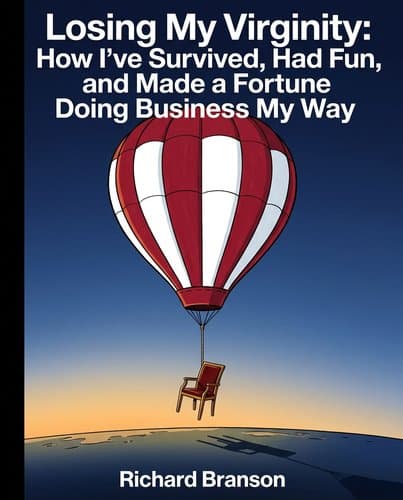
211099_losing-my-virginity
by Richard Branson
Richard Branson built Virgin into a global empire not through expertise but by targeting industries where dominant players had stopped caring—then structuring…
In Brief
Richard Branson built Virgin into a global empire not through expertise but by targeting industries where dominant players had stopped caring—then structuring each bet so failure stayed contained. His autobiography reveals how calculated risk, reputation as currency, and deliberate escape routes separate bold entrepreneurship from mere recklessness.
Key Ideas
Limit downside before making bold bets
Before any bold move, engineer the escape route first: Branson never committed to a large bet without a fixed downside limit — a one-year Boeing lease, a P&D deal that kept the master recording if the label failed, a company structure where one disaster couldn't sink the fleet.
Reputation as operational, not moral capital
Your reputation is operational infrastructure, not ethics: the moment Branson's 'good name' was in question (Dover, the BA smear campaign), capital dried up instantly — protecting it isn't about virtue, it's about preserving the trust that makes risky moves possible.
Target markets with complacent incumbents
Enter markets where the incumbent treats customers with contempt, not markets where you have expertise: Virgin's expansions — records, airlines, financial services, trains — share no technical overlap but share a single trigger: a dominant player who had stopped caring about the person buying the product.
Ring-fence divisions to isolate failure
Structure companies so one failure is a contained disaster, not a group collapse: Branson's 'ring-fenced' model meant Virgin Atlantic's Gulf War losses didn't kill Virgin Music, and the music sale didn't kill the airline — the architecture of separation was as deliberate as the individual bets.
Heed warnings, assess whether to proceed
The people who tell you 'over my dead body' are often right about the risk and wrong about whether to take it: Simon Draper's objections to the airline were financially correct; Branson's decision to proceed anyway was also correct — the lesson is to separate the quality of the warning from the question of whether the downside can be survived.
Outlast stronger competitors through structure
When facing a more powerful adversary, the goal is not to outspend them but to outlast them long enough for one structural advantage to land: in the BA war, that advantage was libel law — a simpler, faster legal route than anti-trust that BA handed Branson by issuing a public denial.
Who Should Read This
Business operators, founders, and managers interested in Business Leaders and Memoir who want frameworks they can apply this week.
Losing My Virginity: How I've Survived, Had Fun, and Made a Fortune Doing Business My Way
By Richard Branson
9 min read
Why does it matter? Because the man who looks reckless is running the most rigorous risk system in the room.
Most people assume Richard Branson's willingness to bet everything — on a balloon, on an airline, on a punk band nobody else would touch — comes from some genetic restlessness, a personality the rest of us simply weren't issued. That assumption is comfortable. It lets you admire the highlights reel without asking the harder question: what's actually holding the structure together? Because when you read this book closely, something strange happens. The near-death moments and the near-bankruptcy moments start to look identical. The same architecture appears at 42,500 feet over the Pacific and in a Lloyds Bank meeting: identify the escape route first, then go further than anyone thinks is survivable. 'Screw it, let's do it' isn't a mood. It's a methodology — one built on a very specific relationship with failure, refined over decades of stress-testing that ended with Branson signing away Virgin Music and then sprinting down Ladbroke Grove in tears. Once you see the pattern, the whole story changes.
The Daredevil and the Spreadsheet Are the Same Person
Picture Alex Ritchie on the roof of a pressurized capsule somewhere over the Atlas Mountains at two in the morning, fingers working frozen bolts in total darkness while the altimeter below him ticks down: 3,700 feet, 3,400, 2,900. The trained third pilot, Rory McCarthy, had been grounded in Morocco with pneumonia that morning. Alex was the engineer who had designed and built the capsule — he had never jumped from a plane in his life. Richard Branson, crouched at the hatch watching him, had already pressed Alex's hand to the ripcord and said 'that's your cord' before sending him out. At 2,400 feet, with no altitude left to bail out, Alex freed the last tank. The balloon lurched and held.
Most people read that sequence as proof of Branson's famous recklessness — the 'screw it, let's do it' personality charging headlong into situations a saner person would avoid. But look at the specific reason they survived. It was not the trained pilot who saved them; it was the man who had built the escape mechanism. Branson had structured the crew so that the person most likely to solve a catastrophic failure was on board. When the failure arrived — and it arrived within hours — the engineering knowledge already existed inside the capsule. The downside had been covered, quietly, before the balloon ever left the ground.
Branson narrates his life as adventure, which makes the architecture underneath it easy to miss. The daredevil and the spreadsheet are the same person — which means the thing most people assume is his personality is actually a system, and systems can be learned.
Your Reputation Is Not a Moral Virtue — It's Your Only Collateral
In August 1971, Richard Branson spent a night in a Dover prison cell after Customs officers caught him selling records he'd declared as export stock on the domestic market — a scheme he'd run four times to clear a £15,000 debt. The cell door closing was the worst thing he could imagine. Not the physical confinement. The loss of any say over when it opened again.
The next morning his mother drove to the courthouse and put up the family home — Tanyards Farm — as his £30,000 bail. They looked at each other across the magistrate's court and both cried. Then she told him not to apologize, to keep a clear head, and to deal with it directly. He walked out and negotiated a settlement: £15,000 immediately, £45,000 over three years — three times the illegal profit, paid back to stay out of court.
What Branson took from that cell was something his parents had said for years: a person's good name is their only real asset. He'd always heard it as a moral instruction. He left Dover understanding it as a capital structure. Every bank loan, every partnership, every supplier willing to extend credit before a contract existed — all of it ran on trust no document could manufacture. The customs scheme had nearly destroyed that trust in an afternoon. From that point forward he kept a specific question in front of every deal: if this unravels publicly, what survives? The answer had to be: the name does.
The Only Rule Worth Having: Protect the Downside, Then Go All-In
Every apparently impulsive Branson decision was a precisely engineered hedge. The boldness was real — but it always had a floor underneath it.
The clearest demonstration is the Tubular Bells deal in 1973. The record existed: forty-five minutes of overdubbed instrumental music by a twenty-year-old who had been sleeping on the Manor's floor. Island Records offered Branson and Simon Draper a licensing arrangement worth 18 percent of sales. Minus the 5 percent owed to Mike Oldfield, that was 13 percent profit with zero promotion risk, zero marketing cost, guaranteed income from an asset they'd barely spent money to produce. The arithmetic was flattering. A double-platinum run of 600,000 copies would net Virgin roughly £171,000 for doing almost nothing.
They turned it down.
Instead they demanded a Pressing and Distribution deal: Island would manufacture and ship the records, taking 10 to 15 percent for that service, while Virgin handled all the promotion itself. On the same 600,000 copies, that structure returned roughly £658,000 to Virgin after all costs — nearly four times as much. The risk was that if the record failed, the promotion spending evaporated with it and the label died. Branson's answer to that risk was not courage. It was a specific belief: they had fourteen record shops capable of selling this record directly to people who would buy it on the spot after a single listen. The downside existed — they quantified it. They had a mechanism to limit it. Then they went all-in.
Tubular Bells sold over thirteen million copies. Virgin went from surviving to solvent to wealthy on the difference between 13 percent and 50 percent of a catalogue they owned outright.
The pattern held a decade later when Branson negotiated the Virgin Atlantic launch. He secured a one-year lease on a single Boeing jumbo, with the right to return the plane if the route failed. Branson's own accounting put the maximum loss at £2 million against that year's £11 million profit — less than a third of one year's earnings. When Simon Draper said he'd only proceed over his dead body, that was Branson's reply: not an appeal to destiny, just the numbers. Structure the bet so failure is survivable. Then go all-in.
Being Second Choice Is a Slow Death — Brand as Disruption Weapon
What actually makes a brand worth anything? Branson answered that question in 1971 not with a theory but with beanbags. The Virgin Records shop on Oxford Street arrived at a moment when buying a record meant queuing in front of uniformed staff at WH Smith who rang up your copy of a Doors album with the same dead expression they'd use for a bag of flour — functional, faintly hostile. Branson and Simon Draper built the counter-move: sofas, headphones, free coffee, staff who actually wanted to talk about Van der Graaf Generator. You could stay for an hour before deciding whether to buy anything. People started buying records from Virgin not just because of the price but because the shop felt like it was on their side — and that feeling transferred to the name above the door.
That move repeated every time Branson entered a new market. The opening conditions were almost identical: an incumbent treating customers as a captive audience rather than people worth impressing. British Airways in the 1980s ran Upper Class as a premium-priced inconvenience. Coca-Cola and Pepsi had divided a market so thoroughly that a new entrant seemed absurd — until Virgin Cola started taking shelf space and Coke dispatched a senior executive from Atlanta to England specifically to run a suppression campaign. He offered retailers deals they couldn't refuse. He threatened to pull Coke fridges from smaller shops. It was a serious mobilization of serious resources, and it meant that the world's most valuable drinks brand had noticed a scrappy British upstart enough to fight it personally.
Branson read that not as a threat but as a receipt. A receipt proves the transaction happened — that something changed hands, that the other side felt the cost. Coke wouldn't send a SWAT team for something that didn't worry them. The suppression campaign was, paradoxically, the clearest evidence that Virgin Cola had real power.
The brand, in other words, is a disruption mechanism, and it only works when the incumbent is already handing customers a reason to defect. Branson's entry logic in every new market was the same as it had been with Tubular Bells: structure the downside so it's survivable if you're wrong, then let the brand signal what an expensive advertising campaign never could — that someone in the market is actually on your side.
When the System Gets Stress-Tested: The BA Dirty Tricks War
Here is a claim worth sitting with: Branson's entire risk architecture — cap the downside, own the asset, let the brand do the disruption work — was designed to survive market failure. It had no defence against a state-backed monopolist willing to manufacture insolvency from the outside.
The clearest proof is a letter. In March 1991, Peter Fleming, a former British Airways marketing executive, wrote down what he had witnessed from inside BA's headquarters. BA had been deliberately applying for Tokyo and Australia slots it had no intention of using, solely to prevent Virgin from getting them. A special sales force had been deployed around Gatwick to offer fares so low they crushed yield for every airline operating there — while BA maintained its high-fare monopoly at Heathrow, where Virgin couldn't yet fly. Most damaging of all, BA staff had been accessing Virgin's booking files through the shared computer reservations system, effectively reading Branson's passenger lists. And after Virgin filed a formal complaint with European courts, multiple managers instructed Fleming to destroy every document that mentioned Virgin. His conclusion: 'BA lacks integrity and this stems right from the top with Lord King.'
What makes this more than a tale of corporate villainy is the financial mechanism it activated. BA's hired PR man was feeding journalists a story about a supposed drug problem at Branson's nightclub. Separately, he was placing financial analysis suggesting Virgin was insolvent. A long piece in the Guardian asked whether Branson's balloon was about to burst. Each story shifted investor perception a little further. Nervous investors made the banks nervous. Nervous banks pulled credit. Pulled credit made the insolvency real. Branson's Lloyds banker later told him that if the same article had appeared in the Financial Times rather than the Guardian, the lending consortium would have pulled out entirely — and the banks would not have needed to confirm whether the story was true. The perception of collapse was enough to cause the actual thing. BA understood this. Branson's downside protection assumed the risks he could price. It had never priced a competitor willing to manufacture the appearance of a crisis until the crisis became real. Starve the airline of capital by making investors too nervous to touch it; let the debt do the rest.
You Have to Burn Your Best Asset to Prove Your Philosophy Works
Simon Draper stood up to address the Virgin Music staff at Harrow Road and simply couldn't do it. He opened his mouth, and then he was crying — openly, in front of everyone. The room turned to Branson, who was barely holding on himself. He told them they could all come work for the airline if EMI didn't suit them, thanked them, and walked out the door and started running. He ran for nearly a mile down Ladbroke Grove, tears going, until he passed a newspaper stand with a poster reading 'BRANSON SELLS FOR £560 MILLION CASH.' He kept running.
The number was extraordinary. The problem was what it meant. Peter Gabriel had warned him: sell Virgin Music and you will wake at three in the morning wishing you hadn't. Branson knew he was right. He had built that label from a biscuit tin in a Notting Hill bedsit, kept it alive through the Sex Pistols fallout and the 1980 recession, and watched Simon's instinct compound year after year — Human League, Phil Collins, Culture Club — until Virgin was the most exciting record label in the world. He didn't want to sell it. He had to.
The BA campaign had done its work with the banks. Branson sold the thing he loved to protect the thing everyone had told him was insane.
He arrived home to an empty house and stood at the kitchen window watching a fox cross the garden, steal a chicken carcass, and vanish into the hedge. The last photo he'd seen of BA's chairman showed the man on horseback in full hunting gear. He thought about that. Then he put the kettle on.
The Same Risk Logic That Crosses Oceans Can Cross Civilisations
The same logic that caps the downside before going all-in applies whether the asset you're protecting is a record label or a breathable atmosphere. The scale changes. The architecture doesn't.
When Al Gore sat in Branson's London living room and walked through the climate data — the tipping points, the timelines, the feedback loops already in motion — Branson's first instinct wasn't philanthropic. It was structural. He'd just watched his airline's fuel bill jump by half a billion dollars in a single year. The incumbent energy system was treating the planet the way British Airways had treated its passengers: as a captive audience with nowhere else to go. BA had competed on contempt, betting that passengers had no alternative. The energy majors were running the same play, only the captive audience was everyone, and the exit option was a different planet. Branson recognised the pattern.
His answer came in a bathtub. In 2006, he pledged every future profit from the airline and train businesses — the whole stream, not a percentage, not a foundation gift — to developing clean fuels. The public commitment ran to roughly three billion dollars over ten years. The structure was identical to the Tubular Bells deal: identify the asset, believe the market will move, commit fully rather than hedging at the margin. The difference was only that the market in question was the survival of a hospitable climate.
The Pendolino trains make the same argument. When government advisors told Virgin its safety specifications were overbuilt — too heavy, too expensive, not required by regulation — Branson refused to strip them out. The crash at Grayrigg in 2007, at nearly a hundred miles per hour, killed one person. Investigators called the survival rate a miracle. Branson's response was that it wasn't a miracle at all. It was engineering built above the minimum because the minimum assumes nothing goes wrong. The same philosophy that put the capsule's own engineer on the roof over the Atlas Mountains.
Protect the downside. Then go all-in. The methodology scales all the way up.
What the Sprint Down Ladbroke Grove Actually Means
He ran past the headline in tears having just made the best deal of his life — and the worst. That tension never resolves, and Branson wouldn't want you to think it does. The philosophy doesn't promise you keep what you love most. It promises that if you've structured the downside correctly, losing it won't be the final entry. The music funded the airline. The airline funded the rockets. The rockets, he now argues, might help save the planet — the same risk logic that once covered a balloon crossing the Atlantic now being applied to whether the atmosphere survives the century. Same question, civilisational stakes: if this fails in the worst way, what's the floor? The daredevil and the spreadsheet were always pointing somewhere larger than any single bet.
Notable Quotes
“Never mind the bollocks, here’s The Sex Pistols”
“Never mind the priests, here’s The Sex Pistols”
“Never mind the rubbish, here’s The Sex Pistols”
Frequently Asked Questions
- What is the main business philosophy in Losing My Virginity?
- Branson's philosophy centers on limiting downside before committing to bold moves. The book shows how "before any bold move, engineer the escape route first" — he never committed to large bets without fixed downside limits. His approach separates the quality of warnings about risk from the question of whether the downside can be survived, illustrated by his decision to launch Virgin Atlantic despite Simon Draper's financially sound objections. This philosophy allowed Virgin to expand across industries without technical expertise, relying instead on identifying markets where incumbents had stopped caring about customers.
- How does Branson manage risk and structure businesses to avoid catastrophic failure?
- "Structure companies so one failure is a contained disaster, not a group collapse" through a ring-fenced model. Branson's architecture of separation was deliberate — Virgin Atlantic's Gulf War losses didn't kill Virgin Music, and the music sale didn't kill the airline. Before any bold move, he engineered fixed downside limits: a one-year Boeing lease, a P&D deal that kept the master recording if the label failed. This approach meant individual ventures could fail without cascading across the entire group, making organizational structure as critical as the specific bets themselves.
- What does Branson say about choosing which markets to enter?
- "Enter markets where the incumbent treats customers with contempt, not markets where you have expertise." Virgin's expansions across records, airlines, financial services, and trains share no technical overlap but a single trigger — a dominant player who had stopped caring about customers. Rather than competing on technical knowledge, Branson identified industries where customer service was weak. This explains Virgin's diverse portfolio and why expertise in one field wasn't required for expansion. The opportunity lay in incumbent complacency, not in Branson's domain mastery.
- How did Branson handle competing against larger, more powerful adversaries?
- Against powerful competitors, Branson's goal wasn't to outspend them but to outlast them "long enough for one structural advantage to land." In the BA war, that advantage was libel law — a simpler, faster legal route than anti-trust that BA handed Branson by issuing a public denial. Your reputation is operational infrastructure: the moment Branson's good name was in question, capital dried up instantly. Protecting reputation isn't about virtue but preserving the trust that makes risky moves possible. Branson turned BA's strategic error into a legal advantage.
Related Book Summaries
Read the full summary of 211099_losing-my-virginity on InShort