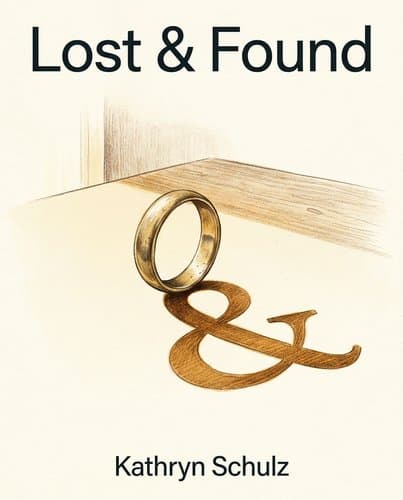
57800384_lost-found
by Kathryn Schulz
Grief doesn't arrive as sadness—it comes as restlessness, irritability, and the ache for what you could never fully access: another person's entire experience…
In Brief
Grief doesn't arrive as sadness—it comes as restlessness, irritability, and the ache for what you could never fully access: another person's entire experience of being alive. Schulz reveals why loss and love don't alternate but coexist permanently, and why attention is the only honest response to both.
Key Ideas
Grief manifests as anxiety, not sadness
Grief often arrives as anxiety, irritability, or boredom rather than continuous sadness — this is not a sign something is wrong with how you're mourning, it is how mourning actually feels
Grief mourns the inaccessible inner life
The deepest grief is not for a person's absence but for what you can never access: their experience of being alive from the inside — the whole of a life, radically specific, that you loved but could never fully inhabit
Findings require both effort and luck
The most important finds in your life require both systematic attention (moving in the right direction) and pure luck — neither alone is sufficient, and neither can be engineered in advance
Loss and finding coexist permanently
Loss and finding are not phases you move through sequentially; they coexist permanently — accepting this is not resignation but the clearest possible accounting of what a life actually contains
Attention grounds us more than acceptance
Attention — deliberate, patient noticing of what is actually present — is more honest and more useful than either unbroken grief or forced acceptance
Who Should Read This
Readers who connect with first-person stories about Memoir and Mental Health and want to see the world through someone else's eyes.
Lost & Found
By Kathryn Schulz
10 min read
Why does it matter? Because loss and finding aren't opposites — they're the permanent texture of being alive.
Ten days after her father died, Kathryn Schulz told a stranger on a customer service call that she had lost him — and heard, for the first time, how strange the word was. In that crack between meanings, she found her subject: a word that holds misplaced wallets and the deaths of entire lineages without distinction. This book offers no stages, no map to recovery. The argument is that loss and finding are not opposites that alternate but permanent, overlapping conditions — and that attention, not resolution, is the only honest response to a life built of both.
We Use One Word for Lost Keys and Lost Fathers — and That's Not an Accident
The word "loss" contains a small scandal: it names, without distinction, a misplaced wallet and a dead father.
Ten days after her father died, Schulz found herself telling a stranger — a customer service representative, over a locked magazine account — that she had lost her father, and the phrase, which had always been ordinary, suddenly wasn't.
So she looked it up. "To lose" traces to an Old English root meaning to perish, related to the "lorn" in "forlorn" — both from a Proto-Germanic word meaning to separate or cut apart. The modern sense you reach for most — misplacing an object — didn't appear until the 13th century. Losing one's mind came three centuries after that; losing one's heart, a century later still. Loss began, in the language itself, with our own lives and each other. It expanded outward only later, reaching wallets and car keys at the furthest edge of what was always the same word.
We tend to treat loss as a spectrum — trivial at one end, catastrophic at the other, a clear distance between them. The etymology refuses that. The trivial came after death and grief; it's an extension of the same root. Loss always had this range, because losing anything carries, in some compressed form, the same rupture: something that was here is, suddenly, just gone.
Grief Is Not Sadness — It Looks More Like Anxiety, and Sometimes Just Boredom
More than a year after her father died, Schulz was in a Manhattan café with her laptop when she overheard a man at the next table tell his friend: "I wish my daughter would call me more often." The words on her screen blurred. A bite of bagel went tasteless in her mouth. Nothing about the moment was predictable. No photograph, no anniversary, no obvious occasion. Just a stranger's mild complaint, and grief arrived like a wave from an empty sky.
Grief, she finds, is not a continuous emotional storm. It's more like anxiety with bouts of boredom. C.S. Lewis, writing after his wife's death, observed that no one had prepared him for grief to feel so much like fear. Schulz recognized it immediately. The sensation wasn't centered on her father's absence. It was formless dread, a part of her mind that had forgotten he was dead and was scanning for whatever was wrong. She felt like she was bracing for something that had already happened.
In between those surges: tedium. She'd open her laptop, stare at it, close it. She'd sleep ten hours and wake to the same leaden fact. The tidal-wave sadness she'd anticipated arrived rarely and without warning, more like weather than a permanent condition. What stayed was exhausting and shapeless, the emotional equivalent of a chronic low-grade fever.
But grief is never an abstraction. What she was carrying was a specific man. Isaac Schulz, fluent in six languages learned across a childhood that refused to stay in one country. His mother, the youngest of eleven in a Jewish village near Lodz, was sent alone to Palestine as a teenager; every sibling who stayed behind died at Auschwitz. Isaac didn't know his biological father had died until his own wedding night. At seven, he rode in the back seat as his uncle was shot dead in the front, the family pressing on through a war zone toward a ship out of Haifa. He arrived in America at barely twelve, crossing in steerage, and came up on deck only when land was near. First sight: the Statue of Liberty.
That is who she was mourning. Not an abstraction. A specific consciousness (six languages, an enormous warmth, passionate opinions about baseball and apple crisps and Edith Wharton) who had survived more loss than most people ever face, and who spent forty years filling every room he entered with his particular gravity.
The deeper loss comes into view later, when Schulz reads a Walt Whitman poem Isaac had loved, and something shifts. She had been mourning what she could no longer reach through her father — his conversation, his responses, the way he held any idea against his inner light. But the loss underneath that is something she never had in the first place: what it was actually like to be him. She had never had access to that, and when he died, it ended. No accumulation of memories adds up to a single moment of what he felt. He had loved life the way someone loves it who barely survived to have it at all. When he died, that whole private universe simply went dark.
You Cannot Find Something Important Until You Already Half-Know It's There
On a Sunday evening in the summer of some distant year, an eleven-year-old boy named Billy was walking home across a pasture when something made him turn around. A flicker at the edge of his vision, maybe, or a change in the air. He turned, saw something dark hurtling toward him from the sky, and ran. When he looked back, it was gone.
He went out the next day and searched. He didn't know what he was looking for until he found it: a stone starkly out of place in the ordinary soil, smooth and exceptionally heavy. A meteorite, one that had traveled more than a hundred million miles from the asteroid belt before burning through earth's atmosphere and landing in the fields he knew. He recognized it instantly.
Finding has a paradox at its heart. You can't search for something you have no image of at all, but if you knew exactly what you were looking for, you wouldn't need to search. Meno posed this to Socrates about virtue, and it holds everywhere. William James, the American psychologist, put it most clearly: finding requires a partial image, what he called a wraith of the sought thing. His novelist brother Henry James extended this to writing: authors find new ideas the way Columbus found San Salvador, not by knowing the destination, but by moving in the right direction for it.
Billy had both things. He was lucky to be present when the meteorite fell, and then patient enough to walk the land the next morning until the stone declared itself. Neither alone would have sufficed.
Schulz finds the same structure in her own story. She had spent her thirties arranging her days (solitary runs, long reading, the quiet of work) in ways that seemed designed to prevent a partner from arriving. She tried briefly to search; it was graceless and comic. Then a mutual friend introduced two people by email, mentioned vaguely that they'd adore each other, and one spring day a woman named C. drove two hundred and fifty miles for lunch. Their first meeting lasted two and a half hours. Their second date lasted nineteen days.
C. was everything Schulz hadn't known she was looking for: different in age, class, religion, geography. A devout Christian from a peninsula Schulz hadn't known existed, from a census-designated place of 167 families. No algorithm would have generated the match. Yet something in Schulz recognized it the moment C. walked up the street toward her.
The two stories turn out to be one. The meteorite Billy found in those fields as a boy — the stone that had traveled for centuries through space, scorched through the atmosphere, and gone cold at its core — now sits on the hearth by the woodstove in C.'s childhood home. Billy is C.'s father. The most important finds arrive as pure luck, but only ever to someone who was already, somehow, moving in the right direction.
'And' Is Not a Conjunction — It's the Architecture of a Human Life
Think of how you'd tell the story of your own life. Loss came, then time passed, then something better arrived. We narrate existence as a sequence because that's the only way sentences flow — one thing, then another.
Schulz's third section argues this is wrong, and it starts with a word we've stopped hearing.
The ampersand (&) was born when Roman scribes fused the letters of "et" (Latin for "and") into a single cursive stroke. By the 1800s it had become the 27th letter of the English alphabet, until teachers found that reciting it left students hanging: "X, Y, Z, and…" The Latin fix, "per se and," blurred over generations into "ampersand." A connection encoded in punctuation, hiding in plain sight.
What makes "and" unlike every other conjunction is what it refuses to say. "But" signals contrast; "because" signals cause; "and" carries nothing: it joins things without specifying their relationship, which is exactly how the most important parts of life arrive. William James argued we should speak of "a feeling of and" as readily as "a feeling of cold": the awareness that things have been brought into relationship whether or not they belong together. The feeling of "and," Schulz concludes, is the fundamental texture of being alive.
Her proof is the night she proposed to C. She'd been waiting months for the right moment. That evening she made soup, lit a candle, set the table. Her father's wedding ring (worn for forty-nine years, then polished by a jeweler back from dark bronze to what it looked like the day her parents first bought it) was in her pocket. Then C. walked in the door with a cross of ashes on her forehead.
It was Ash Wednesday. Lent: the season of mortality, dust to dust. Schulz almost waited again. But C. told her about a service she'd once officiated, where a small girl, suddenly grasping the point of the occasion, had shouted in the solemn hush of the sanctuary: I don't want to die.
The candle flame bent. Schulz had a dead father's ring in her pocket and a living woman in front of her, and she understood: she would wait forever if she waited for a moment without sorrow in it. She stood up and led C. to the couch.
The ring is both at once — a father's end, a marriage beginning. The ash means death; the evening means proposal. Schulz turns to Philip Roth, the American novelist, for the formulation: "Life is and." We don't live in either/or but with many things at once, everything connected to its opposite. Loss and finding aren't sequential events, a sad chapter followed by a better one. They are simultaneous, permanently joined. Grief and gratitude arrive together; love carries fear inside it from the first moment; even joy contains its own anticipatory mourning. This isn't a problem to solve. It is the shape of existence itself.
What Attention Offers Is Not Comfort — It's the Only Honest Form of Presence
On the anniversary of her father's death, Schulz woke feeling unmoored — grief without ceremony, no grave to visit, no fixed ritual to anchor it to. C. took her to an arboretum. They walked a loop, then stopped on a wooden bridge over a pond and stayed for over an hour. Two turtles on a submerged log. A heron shifting six inches eastward across sixty minutes. Algae drifting on the surface.
She hadn't arrived looking for an answer. But standing there, doing nothing but looking, she found the only one the book offers: attention, the discipline of noticing what is actually present.
Attention is not consolation. Her father was still gone; no heron changed that. The dread she'd carried for months didn't lift: the lovers' question of which of them would die first, the feeling of resting her head against C.'s chest and listening to a heartbeat she couldn't stop worrying about, too quick, too insistent, too obviously belonging to someone she could lose. The math of love never resolves: however long you have, it ends before you're ready. Attention doesn't fix this. It lives inside it.
The arboretum gave her an afternoon of slowed-down looking, the world still going, still complex, still worth watching. That turns out to be enough. Not because it erases what's coming, but because it's what presence means: being here for what is here.
The book closes on a quiet announcement: C. and Schulz are expecting a child — a new "and" to inhabit, and a new loss to carry in advance. The child will lose them; they already know it. But a child is also continuation, the link between what exists now and what doesn't yet, a finding and a future loss held in the same word. We are the "and," Schulz writes: the word that joins the sentence to whatever comes next.
The Sentence Worth Sitting With
The arboretum doesn't resolve anything — not her father's absence, not the dread of loving someone whose heartbeat you've already started to count. But it demands something harder than comfort: that you actually look, not at what's been lost or what you're afraid to lose, but at what is stubbornly, specifically here. That patience — the willingness to stay until something moves — turns out to be what the whole book was practicing.
A child is coming. That is both a finding and a future loss, an "and" the couple will spend a lifetime inhabiting. To receive joy while knowing it will cost you — that's not a contradiction the book tries to resolve. We are the "and," Schulz writes — the link, the word that joins the sentence to whatever comes next.
Notable Quotes
“when to use the subjunctive, how to distinguish”
“correction, he furnished, in an instant, an unforgettable mnemonic device:”
“I don't want to die!”
Frequently Asked Questions
- What is Lost & Found about?
- Lost & Found explores how loss and finding are not opposites but permanent, simultaneous conditions of every life. The book draws on personal grief and philosophical reflection to show how deliberate attention to both absence and discovery—rather than moving through stages—gives the clearest and most honest account of what a human life actually contains. Schulz challenges conventional wisdom about grief being a linear process, arguing instead that mourning involves complex, coexisting emotional states that should be honored and observed rather than overcome.
- What does grief feel like according to Lost & Found?
- Grief often arrives as anxiety, irritability, or boredom rather than continuous sadness—this is not a sign something is wrong with how you're mourning, it is how mourning actually feels. This insight reframes what many people experience as failed grief into a natural, valid expression of loss. Schulz shows that the cultural expectation of sustained sorrow often creates shame and self-doubt for grievers experiencing other emotions. By normalizing the diverse emotional landscape of mourning, the book validates experiences that conventional grief narratives have pathologized, offering relief to those who have questioned their own emotional responses to loss.
- What does Lost & Found say about finding important things?
- The most important finds in your life require both systematic attention (moving in the right direction) and pure luck—neither alone is sufficient, and neither can be engineered in advance. This framework challenges the notion that success or discovery comes solely from planning and effort, or conversely, from pure chance. Schulz explores how meaningful discoveries emerge from the interplay of intention and circumstance, where our deliberate choices create conditions for serendipity but cannot guarantee outcomes. This perspective applies equally to personal growth, relationships, and creative breakthroughs, showing that the paradox of wanting without controlling is central to human experience.
- What is the deepest form of grief according to Lost & Found?
- The deepest grief is not for a person's absence but for what you can never access: their experience of being alive from the inside—the whole of a life, radically specific, that you loved but could never fully inhabit. This distinction reveals that loss extends beyond the practical or relational impacts of death; it touches something more fundamental: the radical particularity of another consciousness that remains forever unknowable. Schulz's observation reorients how we understand mourning, moving beyond guilt or regret to a more poignant recognition of the unbridgeable gap between ourselves and others, even those closest to us.
Related Book Summaries

Read the full summary of 57800384_lost-found on InShort