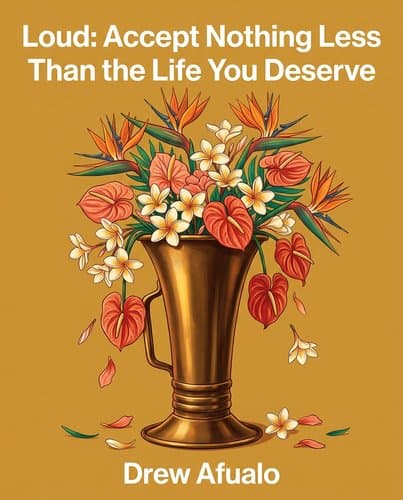
195791316_loud
by Drew Afualo
Stop shrinking yourself to make others comfortable—Drew Afualo's razor-sharp guide teaches women to decenter men from their self-worth and ambitions, treating…
In Brief
Loud: Accept Nothing Less Than the Life You Deserve (2024) argues that women are socially conditioned to shrink themselves — through performed niceness, body anxiety, and relationship urgency — at the cost of their own ambitions and self-worth.
Key Ideas
Choose authentic kindness over social performance
Distinguish 'nice' from 'kind': niceness is a performance society extracts from women at their own expense; kindness is a genuine act you choose freely — stop optimizing for the first one
Relationship timeline urgency reveals manipulation
The 'leftover women' narrative is a manipulation tactic designed to make you settle before you understand your own worth — treat urgency around your relationship timeline as a red flag about whoever is creating it
Free your mind from appearance judgment
Try body neutrality instead of body positivity: the goal isn't to love how you look but to stop spending cognitive energy on it — your body's job is to keep you alive, not to pass an audition
Question critics who benefit from doubt
Before accepting criticism about your ambition, work ethic, or personality, ask who benefits from you believing it — the people most invested in you shrinking are rarely the people most invested in your success
Confidence develops through practice, not inheritance
Build confrontation as a skill: start with low-stakes corrections (mispronounced name, wrong coffee order) before you need the muscle for high-stakes moments — confidence is reps-based, not a personality trait you either have or don't
Self-sufficiency enables authentic partnership formation
You can only choose a partner well from a position of not needing one — 'dying alone' isn't a failure state to be avoided but the psychological ground from which genuine partnership becomes possible
Who Should Read This
Readers who connect with first-person stories about Confidence and Self-Improvement and want to see the world through someone else's eyes.
Loud: Accept Nothing Less Than the Life You Deserve
By Drew Afualo
13 min read
Why does it matter? Because the approval you've been trained to seek is the exact thing standing between you and yourself.
Here's a quiet assumption most of us carry around like loose change: that making yourself easier to deal with — smaller, softer, more agreeable — is just the sensible trade-off for getting along in the world. Not ideal, but practical. Drew Afualo grew up watching her parents live the arrangement most people call impossible, and something about that image made the standard trade-off look like a scam. She didn't build nine million followers out of bitterness or a bad breakup. She built them because she'd already seen what a life without that particular bargain could look like — and once you've seen it, the approved version stops being practical and starts being insulting. Loud is the case she makes for refusing it entirely, starting from the inside out.
She Was Raised in a House Where the Rules Were Already Different
Picture Drew Afualo's father — six-foot-six, a man who walked onto a junior college campus and got recruited to the football team on the spot, who eventually made it all the way to the NFL — standing in the kitchen, doing the dishes. Not occasionally. Routinely. Because while he was handling the house, Drew's mother was climbing the corporate ladder, pulling in the income, and running the family's finances with the kind of focused ambition that would eventually let her retire early. This wasn't a compromise the Afualos had negotiated after some argument about fairness. It was just how the household worked. Drew's father took genuine pride in it.
Grow up watching that — as your baseline, your normal, the thing that happens every day before dinner — and certain conversations become almost impossible to take seriously. When a man implies that his girlfriend should be the one to cook on a night in, or that she shouldn't dress a certain way because of the attention it might invite, Drew doesn't hear a preference. She hears someone proposing an arrangement that makes no sense, like insisting the sun rises in the west. Her zero-tolerance policy toward gendered expectations isn't a scar from some relationship that left her bitter. It's a standard she absorbed so early that anything below it registers as foreign.
The reframe the book opens on is this: most people assume a woman with hard limits around how she'll be treated has been through something that broke her open and left her rebuilding from the rubble. Drew's origin story runs the opposite direction. She was handed a template of what partnership actually looks like — her parents' household, where the Samoan concept of 'aiga' plays out in practice: collective stakes, shared direction, no one rowing against the canoe — and she simply can't unknow it. The bullshit detector isn't a wound. It's a gift from a household where nobody ever asked her to lower the bar, so she never learned how.
Pick-Me Was a Survival Strategy, Not a Character Flaw
Drew was fourteen, new to her high school, still finding her footing, when a boy her teammates practically swooned over asked for her number after a volleyball shift. She handed it over. He texted that night. The conversation was forgettable — the textbook dead-air back-and-forth of a teenage boy with nothing to say — but she was buzzing anyway, because his attention felt like proof. Proof she was worth noticing. That's the pick-me logic in its purest form: male approval as confirmation of your own value.
The conversation escalated fast. He asked for a photo. She sent a grinning selfie on a flip phone, possibly with a thumbs-up. He wanted something else entirely. When she refused, he didn't just accept it — he punished her. Called her a prude. Spread it around school. Signed off with: you're not even that cute. The whole architecture of male entitlement in one text exchange: the presumption that he was owed something, the escalation when she didn't comply, the immediate pivot to her inadequacy when she held a line. She was fourteen and she handled it with more spine than most adults could muster — but that's almost beside the point. The exchange happened because she'd already absorbed the idea that his opinion of her meant something.
She's careful not to look back at that girl with contempt. Drew was doing what the culture taught her to do — treating male approval as the currency that bought safety, belonging, status. The problem isn't the girl running the calculation. It's a system that set the exchange rate. And what eventually cracked it open wasn't a single awakening moment but a slow accumulation of evidence: that no matter how cool, agreeable, or non-threatening she made herself, the men holding the validation were never going to give it away for keeps. You can fold yourself into the smallest possible box and someone will still find you lacking. The pick-me bargain doesn't fail occasionally. It fails structurally, every time.
The Moment She Failed Her Own Standard
It is 2013, summer in California, and Deison — who hates the beach — has driven her little sister and their nine-year-old brother several hours to the shore and is lying on a towel working up the nerve to say something. When she finally does, she tells Drew she has been dating a woman she met through rugby, that the relationship is eight months old, and that she is gay. Drew's response is to stand up and walk away. She spends the entire time on the beach thinking about herself — about feeling betrayed, about the secret, about how her sister had apparently told their mother first.
Afualo is the same person who, by her own account, has zero tolerance for people who center themselves when someone else needs them. The woman who will eventually call out men for making women's pain about their own ego. She watched Deison cry, felt the wrongness of it, and still couldn't stop the spiral. Days of silence followed. And then the thing that finally broke her: Deison, who had been the one hurt, offered to return to Oregon early so Drew could have more space. The person who had needed courage just to speak was now doing the emotional labor for them both.
Afualo is honest about what was actually happening underneath the hurt feelings — internalized homophobia she hadn't examined, assumptions baked in so thoroughly she didn't know they were there. She had grown up watching Deison crush on boys, had absorbed the cultural default that those crushes were simply what girls did, and Deison's coming out didn't just surprise her; it exposed how completely she had accepted a framework she would have loudly rejected if you'd described it to her in the abstract. The compulsory heterosexuality she'd absorbed without knowing — the invisible assumption that a life without men at the center is somehow incomplete or unreal.
The reconciliation came slowly: a real apology, then the deliberate work of asking about Deison's girlfriend the same way she'd always asked about the boys. What does she study? What's her family like? Small questions, but they were the proof of concept. This failure is, by her own framing, the origin point of the loudness. The aggressive, sometimes alienating LGBTQIA+ advocacy isn't a personality trait she was born with. It is a debt she is paying back — and the repayment, she'd be the first to tell you, is nowhere near finished.
'Dying Alone' Is a Power Move, Not a Last Resort
What if the reason you keep ending up with the wrong person is that you're still negotiating from fear? That's the uncomfortable question sitting at the heart of these two chapters, and Drew Afualo's answer is blunt: you cannot choose well from a position of need. The 'leftover women' narrative depends entirely on you believing that being alone is a failure state. The moment you stop believing that, the leverage disappears.
Afualo's late-college experience with a man she'd met on the beach is the clearest demonstration of what it costs to suspend that understanding, even briefly. He was a few years older, proactive in a way that read as maturity, and she stayed interested even after she noticed that every plan had to be on his schedule. She ignored it. When the truth came out, it was worse than shadiness: he had another partner entirely, a long-term relationship she'd never been told about. He offered apologies, then excuses, then more apologies, cycling through them like he was working a checklist.
The moment that actually clarified everything wasn't the confrontation with him. It was the phone call she received at two in the morning weeks later — his partner, who had found Drew's name and reached out. Afualo made a choice in that moment that could have gone differently: she could have gotten defensive, or competitive, or simply hung up. Instead she listened for hours. She validated what the woman had experienced. She told her they both deserved better and encouraged her to leave. No shared enemy, no rivalry for a man neither of them should have wanted — just one woman recognizing that another woman needed to be heard.
That call is where the 'I'd rather die alone' mantra stops being a joke and becomes a genuine framework. Because what Afualo walked away with wasn't bitterness toward men in general; it was clarity about her own position. She had allowed someone undeserving into her orbit because some part of her was still running the old calculation — that a relationship, even an imperfect one, was worth more than no relationship. Once she stopped running it, something shifted. The fear of ending up alone, which had been background noise she barely acknowledged, simply went quiet.
She's careful to separate the feeling of loneliness, which is an emotion that passes, from the state of being alone, which is neutral. One is a wave. The other is just a fact about your Tuesday evening. When you can hold that distinction, the entire scare tactic collapses. The 'leftover women' myth only works if you've already agreed that a woman uncoupled at forty is someone running out of options. Afualo's reframe is that she's someone who refused to settle before she understood her own value — which is a different thing entirely.
Your Body Is a Vessel, Not an Audition
At the University of Hawai'i, a white male acquaintance told Afualo, without much prompting, that if he saw her standing with friends who didn't look like her — shorter, less Samoan — he'd approach them first. She scared him. He'd default to whoever felt safer. He wasn't trying to wound her; he was just describing the math. And here's the part that surprises people: she felt weirdly relieved. The conversation clarified something she'd been circling for years. The problem was never that she was too much. It was that men running that particular calculation had nothing to offer her in the first place. You can't lose a competition you were never entered in.
That's the uncomfortable freedom body neutrality actually delivers — and it's a harder sell than it sounds. Most conversations about body image assume the goal is learning to love what you see in the mirror, trading shame for celebration. Neutrality refuses that trade entirely. The body isn't good or bad; it's a container. The only thing it owes you is keeping you upright. The only thing you owe it is gratitude for doing so. Aesthetic judgment just doesn't apply.
When Afualo stopped arranging herself for an audience that, once examined closely, didn't have the authority it claimed, she found she had significantly more energy — for work, for the people she loves, for the parts of herself that don't change when she gains a pound or grows an inch. Her integrity, her humor, her capacity to show up. Those stay constant. The body is temporary scaffolding. Stop treating it like the building.
Think about what it would mean to go to the gym purely for the mechanical fact of keeping a body functional — not to shrink it, not to earn a treat, not to inch it closer to some image in your head. Just maintenance, the way you'd change the oil in a car. Now ask yourself honestly how much mental real estate would free up if appearance were simply off the table.
The Firing That Launched Everything — and Why That's the Wrong Lesson
If the previous section was about reclaiming your body from other people's judgments, this one is about reclaiming your ambition from a system that was never designed to hold it.
She sat in her car in the parking structure, all her desk belongings in a box on the passenger seat, two and a half hours of freeway between her and home. Less than a year earlier, she had cleared eight rounds of interviews to land this role at a sports media conglomerate — a position that came without health insurance, occasionally required five days a week despite being classified as part-time, and credited her ideas to her supervisor when they performed well. Then she was called into a conference room and let go. The specific language the company used to justify the decision: she lacked the ability to engage an audience.
Her father picked up on the first ring and said, congratulations.
Afualo initially thought everyone around her had lost their minds. Her family and her boyfriend had all warned her about corporate America — they were freelancers and small business owners who watched her pour two and a half hours of daily commuting into a job that was quietly dismantling the confidence she'd spent college building. She had watched a colleague who shared her entry-level title reveal, almost without embarrassment, that she had been in the same role for eight years. Passed over so many times she had simply stopped picturing anything else. That's what the 'pay your dues' bargain actually delivers: not a ladder, but a waiting room with no announced departures.
The honest argument here isn't that perseverance eventually wins. Afualo was working inside a structure designed to consume ambition from people who looked like her, and the fact that it consumed hers says nothing about her capability — it says everything about the structure. The company told her she couldn't engage an audience. Within months, she was doing exactly that, for millions of people, on her own terms, without a supervisor to hand the credit to. The feedback was accidentally true; the conclusion they drew from it was completely wrong. They meant it as a verdict. It turned out to be a map.
Being Mean Is an Act of Self-Preservation, Not a Character Flaw
The label 'mean' has always been a control mechanism. Calling a woman mean signals that she has stepped outside the performance expected of her — the endless smoothing over, the careful softening, the reflexive apology for taking up space. Afualo's argument is that this performance was never a virtue. It was extraction. Refusing to perform it is where self-respect actually begins.
The asymmetry that clarifies everything comes from a Margaret Atwood essay written forty years before it went viral online. Women's greatest fear, Atwood observed, is being murdered. Men's greatest fear is being laughed at. Afualo absorbed this not as a clever observation but as a strategic map. If ridicule is what men dread most, then ridicule is the proportionate tool — not cruelty for its own sake, but the one lever available that creates real discomfort. When men who spend their days weaponizing fatphobia and misogyny against strangers emotionally collapse the moment Afualo roasts their appearance, they are proving her point in real time. They can make others bleed. They cannot take a paper cut.
This is why she draws a hard line between 'nice' and 'kind.' Niceness is a performance anyone can fake — it's what the self-proclaimed nice guy deploys to make basic decency sound like an extraordinary gift, and then weaponizes as guilt when a woman doesn't reward it. Kindness is action. When you conflate the two, you end up extending patience to men who are not being kind at all — they're just managing your behavior. The four types she identifies map four specific exits, not four invitations to understand someone better: the scary guy requires physical distance, the nice guy requires seeing through the performance, the guy who gives you the ick requires trusting that instinct without explanation, and the one there's no saving requires you to stop trying.
Being called mean by men like this isn't an indictment. It's confirmation that the performance has stopped — that you're choosing from fullness rather than fear.
The Relief That Changed Everything
Pili's face went white. He'd looked at the test so she wouldn't have to, and when he turned around she could see it before he said a word. Several years into their relationship, her period had been late long enough to stop dismissing — always irregular, yes, but not like this. The test said positive. She sat there in disbelief while he paced, and when she finally spoke, the first question out of her mouth was 'What're we going to do?' He sat down, took her hands, and said that whatever she decided, he would be there. She already knew what she wanted. She just couldn't say it yet.
The drive to the women's health clinic felt interminable. No music. Pili holding her hand while she cried quietly the entire way. She went inside alone and cried through her story to the nurses, who were patient in a way she hadn't expected strangers to be. They tested her again. The wait was maybe ten minutes. It felt geological.
The second test came back negative. A false positive. She was not pregnant.
The relief she felt was not ambivalence, not complicated, not tinged with even a flicker of loss. It was pure, overwhelming joy — the kind of reaction that functions as its own answer. She had been told her whole life that the moment would come, that when she was old enough, or in love enough, or just facing the reality of it, her instincts would finally click into place. They did. Just not in the direction anyone had predicted. The 'time coming' everybody promised turned out to be confirmation that motherhood wasn't something she wanted.
What made this harder than a simple relief was the cultural weight pressing against the clarity. As a Samoan woman, she had grown up inside a community where family legacy lives in bloodlines and last names, where a big extended family is pride and continuity made visible. That weight doesn't disappear when you get a clear answer about yourself — it just becomes something you have to carry toward the people who love you and say it out loud anyway. Admitting — first to herself, then to Pili, then to her mother — that she would not be extending that line through her own children cost her something real. Her mother's response was to meet her where she was: a Christmas gift for a future home, with a note that assumed dogs, not children. That was the whole conversation.
Voluntary childlessness, when you get there through a crisis rather than a calm declaration, feels less like a loss and more like the moment you stop carrying weight you never agreed to pick up. The desire either is a yes or it isn't — and knowing which one you are, clearly, honestly, without softening it for someone else's comfort, is not selfishness. It's the minimum integrity you owe yourself, and the minimum fairness you owe anyone you might otherwise have pulled into a life you didn't actually choose.
The Voice She's Lending You Until You Find Your Own
There's a moment Drew describes when a friend, mid-crisis, squared her shoulders and lifted her chin — summoning Drew's energy like a borrowed coat until she could find her own warmth. That image is the whole book in miniature. The loudness was never the destination; it was always on loan. Drew built it from a household where the rules were already fair, from a firing that turned out to be a map, from a phone call at two in the morning where she chose solidarity over rivalry. Her specific path is hers. But the thing the path was pointing toward — the self that stops shrinking to make other people comfortable — that part belongs to you. And that borrowed coat fits you too. She's been there the whole time, watching you make yourself smaller. You can stop now.
Notable Quotes
“If I find out that one of you is dating and the other one didn’t tell me, well, first, just know that I will find out. And when I find out, you’re both getting in trouble for not telling me.”
“Just someone who isn’t horrible and is kind of funny is the baseline, though I’m not seeing many who can even meet that as of right now.”
“Men are afraid women will laugh at them. Women are afraid men will kill them.”
Frequently Asked Questions
- What is 'Loud: Accept Nothing Less Than the Life You Deserve' about?
- 'Loud: Accept Nothing Less Than the Life You Deserve' (2024) argues that women are socially conditioned to shrink themselves through performed niceness, body anxiety, and relationship urgency. The book draws on Drew Afualo's personal experience and cultural critique to address how these conditioning patterns undermine women's ambitions and self-worth. It provides practical tools for building confidence, setting standards, and constructing a life defined on your own terms rather than society's expectations. The work challenges readers to reject performative behaviors and embrace authenticity.
- What's the difference between being 'nice' and being 'kind' according to Loud?
- Drew Afualo distinguishes 'nice' from 'kind' by identifying niceness as 'a performance society extracts from women at their own expense' while 'kindness is a genuine act you choose freely.' The book argues women should stop optimizing for niceness, which is externally demanded and depleting. True kindness emerges from genuine choice and doesn't require self-erasure. This distinction helps readers identify when they're performing for others versus acting authentically. Recognizing this difference is foundational to accepting nothing less than the life you deserve.
- How does 'Loud' address the pressure women feel about their relationship timeline?
- 'Loud' identifies the 'leftover women' narrative as 'a manipulation tactic designed to make you settle before you understand your own worth.' Drew Afualo advises treating urgency around your relationship timeline as a red flag about whoever is creating it—not about you. The book argues this pressure is weaponized to prevent women from establishing standards for themselves. By recognizing the manipulation underlying these narratives, readers can make partnership choices from a position of self-knowledge rather than fear. Understanding this dynamic is crucial for building genuine, equal relationships.
- What does 'Loud' teach about confrontation and confidence?
- 'Loud' presents confrontation as 'a skill' that can be developed through practice, not an innate personality trait. Drew Afualo recommends 'start[ing] with low-stakes corrections (mispronounced name, wrong coffee order) before you need the muscle for high-stakes moments.' This practice-based approach reveals that 'confidence is reps-based, not a personality trait you either have or don't.' By building confrontation skills gradually, readers develop the capability to set boundaries and advocate for themselves. The book emphasizes that confidence emerges from consistent practice, making it accessible to everyone.
Related Book Summaries
Read the full summary of 195791316_loud on InShort