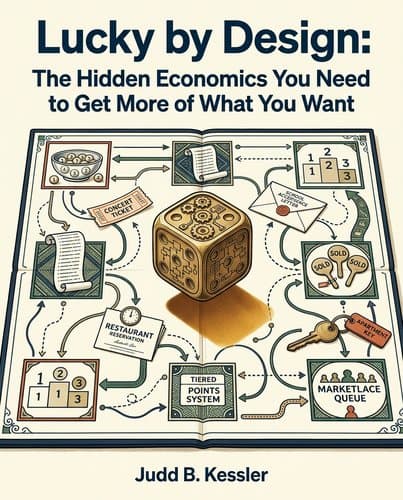
225819751_lucky-by-design
by Judd B. Kessler
Most people think luck is random, but hidden economic rules quietly determine who gets the apartment, the job, the spot—and once you learn whether you're in a…
In Brief
Most people think luck is random, but hidden economic rules quietly determine who gets the apartment, the job, the spot—and once you learn whether you're in a race, lottery, waitlist, or matching market, you can stop hoping and start engineering the outcomes you want.
Key Ideas
Race Strategy: Choose Risk Level Early
In any first-come, first-served race, identify whether it's a 'race' or a 'stroll' — if a seller specifies a precise start time, it's a race. Decide in advance whether to go for gold (high-value, high-competition) or settle for silver (lower risk, still good), and line up a Plan B to lower the emotional cost of failure.
Early Waiting Lists Guarantee Lower Competition
Waiting lists are not passive: the optimal strategy is to join early (when competition is low), limit the number of holds you take (to force yourself to signal genuine desire), and consider multi-listing across geographies when the rules permit — understanding that only the wealthy can typically exploit geographic arbitrage.
Multiply Lottery Entries and Find Gaps
In lotteries, look for ways to enter multiple times (send a spouse, recruit friends, exploit bonus-point systems) and concentrate your entries where competition is visibly low. 'Hard' lotteries that require real effort filter for genuine desire — they're worth entering even if the odds look worse.
Algorithm Type Determines Your Ranking Strategy
Know which matching algorithm you're in before submitting ranked preferences. In a deferred-acceptance (strategy-proof) system, list your true first choice first. In an immediate-acceptance system, you must rank your safety option higher than you actually prefer it or risk losing it entirely.
Signal Specific Interest to Non-Obvious Targets
In choose-me markets (jobs, college admissions, dating), don't waste signals on generally desirable targets — they already know everyone wants them. Send signals to people who might not realize you find them specifically compelling. Idiosyncratic interest is the signal with the highest return.
Pricing Prevents Wasteful Over-Consumption
Never price a resource at zero, even with an up-front fee, unless you want people to consume it past the point of genuine value. The AAirpass failure is a template: any 'unlimited' offering creates an incentive to use it even when you don't actually want it.
Design Rules to Elevate Your Needs
Every rule you set — on your team, in your home, for your calendar — is a market design choice. Identify which E you're sacrificing (efficiency, equity, or ease), do it deliberately, and build in the fourth E: Elevate, meaning the system should serve your needs as the designer, not just the participants'.
Who Should Read This
Business operators, founders, and managers interested in Behavioral Economics and Microeconomics who want frameworks they can apply this week.
Lucky by Design: The Hidden Economics You Need to Get More of What You Want
By Judd B. Kessler
10 min read
Why does it matter? Because the outcomes you blame on luck are actually markets you don't know you're playing
You didn't lose that concert ticket to bad luck. You lost it to a rule you didn't know existed. Same with the school lottery, the job offer, the apartment that went to someone else twenty minutes after you found it. These felt like random outcomes — the universe shrugging — but they were actually markets, running on hidden logic, allocating scarce things according to systems most people never think to examine. Some of those systems reward speed. Some reward patience. Some punish honesty and reward strategic deception. Some can be gamed with information you already have, if you know where to look. What researchers have found is unsettling: the outcomes you've been calling luck are largely engineered. Once you can see the machinery, you stop being the person things happen to.
You're Already in a Market — You Just Don't Know the Rules
Natalie is four years old, and she has just lost at rock-paper-scissors for the third time in a row. Her older sister figured out the pattern immediately: Natalie throws scissors every single round. She knows the hand shapes, but she doesn't know that predictability is fatal. The mechanics without the strategy leave her watching her sister claim the better bath time while she waits her turn.
Most of us are Natalie in markets we don't recognize as markets. When Taylor Swift announced her Eras Tour in 2022, she set ticket prices between $49 and $499 — well below what fans would have paid and far below what the market could have cleared. A sold-out stadium at $49 nosebleeds means demand swamps supply by orders of magnitude. Swift left enormous money on the table, and she did it deliberately. Charging whatever the market would bear would have priced out the devoted fans who stream her songs year-round, buy the merchandise, and generate the loyalty that makes a billion-dollar career possible. Price the tickets to clear the market, and you hollow out the fan base that makes the market worth having.
So if price didn't decide who got in, something else did. That something else — the rules governing who waits in what queue, who gets a presale code, who the algorithm selects — is what economist Judd Kessler calls a hidden market. Most of the allocations that matter most in life work this way: school seats, job offers, organ transplants, restaurant reservations. They aren't pure price markets, and they aren't random. The rest of this book is about learning to read those rules before the round starts.
No System Can Be Fair, Fast, and Efficient at the Same Time — So Every Rule Has a Loser
No allocation rule is neutral. Every system for distributing something scarce encodes a choice about which value to sacrifice — and if you don't know which sacrifice was made, you can't see where the system bends.
The 1893 Cherokee Outlet Opening makes this concrete in the most dramatic way imaginable. The U.S. government wanted to give away six million acres of Oklahoma land to settlers — for free, to whoever got there first. First-come, first-served seemed clean: people who wanted land badly enough would race hardest for it, and everyone lined up at the same starting gun. But the system demanded so much from participants — days standing in line for entry certificates, a physical race across the territory, then another sprint to the nearest land office to file the claim — that it collapsed under its own weight. Cheating was the rational response. Settlers sneaked past cavalry lines and staked claims before the noon pistol fired. When legitimate claimants arrived at the land office, they found their 160 acres already registered by someone who had flouted the rules. Those cheats became known as Sooners — a name that now adorns Oklahoma's university sports teams, a permanent monument to what happens when a rule is so punishing to follow honestly that gaming it becomes the only sensible strategy.
That's the trap. Kessler identifies three things every allocation system tries to deliver: efficiency (the resource goes to whoever values it most), equity (everyone gets a fair shot), and ease (you can participate without jumping through punishing hoops). The Cherokee race was meant to be efficient and equitable. It sacrificed ease so completely that it undermined both. You can have two of the three. Never all of them.
When you encounter a system that feels frustrating or rigged, you're almost always looking at a deliberate or accidental choice about which one got thrown overboard. Spotting that choice is the first move.
In a Race, Cleverness Only Gets You So Far — Until the Ferraris Show Up
Imagine you've trained for months for a 100-meter sprint. You show up on race day, crouch at the starting blocks, and discover your opponents are sports cars. That's the situation facing anyone who tries to buy tickets to a sold-out concert or snag a restaurant reservation the moment the window opens.
First-come, first-served systems feel meritocratic — the most motivated person wins. And for most of human history, that was roughly true. But once ticket buying moved online and the rules stayed first-come, first-served, a new kind of competitor entered the race. Automated bots have no fingers to fumble, no screen to parse, no moment of hesitation. When Hamilton tickets went on sale at $159 apiece, bots bought 78% of the available inventory before most fans had finished loading the Ticketmaster page. One brokerage alone allegedly captured 30 to 40% of all tickets, then flipped them on resale sites for an average of $1,200 each. The race hadn't been won by passionate theatergoers who clicked faster. It had been won before the starting gun.
The insight here isn't "practice clicking faster." When the race is captured by speed advantages no human can match, the smart move is to stop running the race everyone else is running. Look for structural workarounds instead — the back door, the physical presence at the venue before the phone lines open, the end-of-day pharmacy window where leftover vaccines go to whoever is standing there. The race rewards speed. The loophole rewards noticing that the game has a side entrance.
Waiting Lists Aren't Passive — They're a Game With Moves
When Steve Jobs needed a liver transplant in 2009, he didn't join the list closest to his Palo Alto home. He registered at a transplant center in Memphis, where the average wait was 48 days — compared to 306 days nationally. Multi-listing, as transplant specialists call it, is perfectly legal: patients can register at centers across different regions, improving the odds that a compatible organ becomes available nearby. Jobs bought a home in Memphis and could fly in on a private jet within hours of a call. The strategy worked. The catch is visible immediately: legal for everyone, executable only by those wealthy enough to maintain a second residence and charter-flight access. A rule that looks neutral on paper runs on money underneath.
List design shapes outcomes in subtler ways too. During COVID, the New York Public Library let patrons place holds on up to fifteen ebooks at once. Demand exploded, wait times stretched to months, and the obvious fix seemed like buying more digital copies. Instead, the library cut the hold limit to three. Complaints followed — but wait times collapsed. Fifteen holds cost almost nothing to place, so patrons reserved books they were only vaguely curious about. Three holds forced genuine prioritization. When a hold costs something, even just the sacrifice of another hold, it becomes a real signal of desire rather than a hedge against boredom. Shorter lists moved books into readers' hands faster.
The takeaway across both cases is the same: list rules aren't neutral infrastructure. They're the game board. Knowing them — who can multi-list, what a hold actually costs, what happens if you decline an offer — is the difference between playing strategically and just waiting.
Lotteries Are Fair by Design — And Winnable by Strategy
Here's what most people think about lotteries: you fill out the form, you wait, fate decides. The randomness is the whole point. Nobody can game pure chance.
Kessler walks into a charity fundraiser with twenty raffle tickets and immediately starts gaming it. Around the room, each prize sits next to a clear glass fishbowl holding the entered tickets. He spots a Le Creuset cookware set — retail value several hundred dollars, something his partner had been eyeing — with barely ten tickets in the bowl. Instead of spreading his twenty tickets across multiple prizes, he drops all twenty into that one bowl. Now there are thirty tickets total, and most of them are his. But the real move isn't the math. It's what the pile communicates to everyone who walks past. Anyone scanning the room sees the cookware bowl looking crowded and moves on to easier targets. By concentrating early and visibly, Kessler doesn't just improve his own odds; he actively discourages competition. The bowl that looked winnable at ten tickets looks like a long shot at thirty. He wins the set. The lottery was random. Everything around it was not.
The Broadway ticket lottery for a hot show technically gives one entry per person, but once it moved online, asking a friend to enter on your behalf takes sixty seconds of her time and costs her nothing unless she wins, at which point she just picks up the tickets. One motivated person plus a few cooperative friends becomes five entries in a supposedly one-entry-per-person system.
For the highest-stakes lotteries, the architecture rewards patience too. Many states run big-game hunting lotteries with bonus-point systems: lose this year, earn an extra entry next year. Lose again, earn another. South Dakota takes this further by cubing the bonus points — someone who has lost nine years running enters the tenth lottery with a thousand times the weight of a first-time applicant. Enter early, enter every year, and a lottery gradually transforms into something closer to a queue.
The insight threading through all of it: lotteries randomize the draw, but they don't randomize how many times you enter, when you enter, or how visibly you signal to competitors that the bowl is already crowded. Those are decisions. Make them deliberately.
Whether Honesty Is the Best Strategy Depends Entirely on Which System You're In
Whether to tell the truth in a ranked-preference system is the most consequential question you'll face in any matching market — and the answer depends entirely on which algorithm is running underneath.
Two systems dominate how schools, hospitals, and programs sort through applicants. In an immediate-acceptance system, once a school fills a seat, that seat is gone. If your true first choice is competitive and you rank it first, but you get rejected, your second choice may already be full from round one. You get pushed further and further down your list, possibly to nothing. The only rational response is to rank a school you're likely to get into near the top, even if it isn't your favorite. You're not reporting preferences — you're playing a guessing game about what other families ranked.
Deferred acceptance works differently. Schools hold applicants tentatively rather than committing immediately, continuing to compare as new applications arrive. A student with higher priority can bump you even if you ranked the school first and they ranked it fourth — but your priority at a school doesn't change based on where you put it on your list. You can rank your true first choice first without sacrificing your safety options. There's nothing to game.
The cost of not knowing which system you're in showed up at scale in the 2021 New York City Democratic mayoral primary. The city used ranked-choice voting, which let voters rank up to five candidates. Over 140,000 ballots were effectively silenced in the final round between Eric Adams and Kathryn Garcia — many belonging to supporters of the eliminated progressive Maya Wiley, who almost certainly preferred Garcia but hadn't ranked her. Adams won by roughly 7,200 votes. Those exhausted ballots weren't cast by disengaged voters. They were cast by people who followed the rules as they understood them, never grasping that leaving slots blank meant surrendering their voice at the moment it mattered most. The mechanism rewarded using every slot. Nobody told them clearly enough.
The practical rule is this: first figure out whether you're in a strategy-proof system, then act accordingly. In a deferred-acceptance match, rank your true preferences honestly, use every slot available, and include at least one safety option. In an immediate-acceptance system, rank like you're bidding at auction — with one eye on what you actually want and the other on what you can realistically win.
In Choose-Me Markets, Signaling the Wrong Thing Is Worse Than Saying Nothing
What are you actually signaling when you send the most impressive version of yourself to everyone at once? Probably nothing useful — because when every applicant projects the same polished ambition, the signal disappears into the noise.
Kessler's sharpest demonstration of this comes from a South Korean dating platform, where researchers gave participants virtual roses to attach to a subset of their proposals. A rose cost nothing in money, but each person had only two, making the supply scarce. The results were striking: proposals sent with a rose were accepted 20% more often. But when the researchers dug into who was receiving the roses, they found something uncomfortable. Most participants were attaching them to their top-ranked matches — the most conventionally desirable people in the pool. And for those recipients, the roses did almost nothing. Highly sought-after people already assumed others found them attractive. The rose told them what they already knew.
When someone sent a rose to a partner who might reasonably have wondered whether they were out of the sender's league, acceptance rates jumped 50% compared to an unadorned proposal. The signal worked precisely because it was surprising — it conveyed information the recipient genuinely didn't have.
The same dynamic plays out in academic hiring. Candidates broadcasting general excellence — publications, prestigious advisers, top-five rankings — are competing in a category where everyone is shouting the same thing. Worse, a candidate who looks like a future star gives lower-ranked departments a reason to screen them out entirely: why invest in a flyout for someone likely to take a better offer? This is what Kessler calls top-coding — being so obviously qualified that your application reads as a flight risk. The antidote is signaling idiosyncratic interest: telling a teaching-focused college that you specifically want to be there, not just that you're excellent enough to be anywhere.
The question isn't how to seem maximally attractive. It's how to tell one specific person something about your desire for them that they couldn't have assumed on their own.
You Can Design the Markets Around You — But You Have to Know You're the Designer
Most people never realize they're the one setting the rules. Kessler's final move is to show that market design isn't something economists do to organ registries and stock exchanges — it's something you're already doing every time you set a budget rule, a meeting cadence, or a chore division. The only question is whether you're doing it deliberately.
His sharpest illustration of what happens when you're not: in 1981, American Airlines sold lifetime unlimited first-class passes for $250,000, hoping to raise emergency cash. The logic seemed sound — a huge upfront payment, spread over decades of future flights. What the airline failed to model was what happens when the marginal price of anything drops to zero. One pass-holder accumulated 24 million miles on a United equivalent of the program — roughly 50 round trips to the moon — because once you've paid the lump sum, every flight costs you nothing, so even a trip you barely care about is worth taking. The airlines bled millions before killing the programs. Pricing anything at zero doesn't reveal how much people want something; it reveals how much they'll consume when wanting doesn't matter.
The fix isn't complexity — it's the Costco model: a membership fee buys access, but you still pay per item. Commitment upfront, without handing over an unlimited claim on your time.
That's the fourth E: Elevate. The first three — equitable, efficient, easy — protect your market participants. Elevate means the rules are also allowed to protect you. Kessler filters his Wharton course applicants not by who clicked fastest but by who emailed months in advance and wrote detailed essays — costly signals that sort for motivation rather than timing luck. Your calendar can shed recurring meetings that hold prime slots by historical accident rather than current value. Your household task division can achieve what Kessler calls envy-freeness: each person owns conception, planning, and execution of their assigned tasks, so no one is carrying an invisible mental load while the other person takes credit for the visible work.
You are already designing these markets. The only variable is whether you know it.
The Moment You Stop Calling It Luck
Natalie still throws scissors. She's not unlucky — she's just playing a game she doesn't know is a game. The book's whole argument rests on that distinction: most of the outcomes that feel like fortune or fate are actually the downstream effects of rules you never knew were there. Once you see them, everything shifts. You start noticing which queue has the shortest wait time for a reason, which lottery bowl nobody else has crowded, which rose goes to the candidate who surprises the room rather than impresses it. And closer to home, you realize you've been setting rules all along — for your team, your household, your calendar — without knowing you were the designer. The fourth E gives you permission: build systems that work for you too. The rules haven't changed. You have.
Notable Quotes
“22.8 percent of the enlisted men in combat units”
“all Army troops killed in action”
Frequently Asked Questions
- What is Lucky by Design about?
- Lucky by Design reveals that competitive markets—including races, waitlists, lotteries, and job markets—operate by hidden rules that determine winners. The book, drawing on mechanism design and behavioral economics, teaches readers concrete strategies to stop relying on luck and start competing with purpose. It covers how to navigate first-come, first-served races, optimize waitlist strategies, understand lottery odds, submit ranked preferences correctly in matching systems, and signal interest effectively in choose-me markets. The book also explores how pricing and rule-setting function as market design choices that affect human behavior and outcomes.
- What strategies does Lucky by Design recommend for winning races and waitlists?
- In first-come, first-served races, identify whether it's a "race" or a "stroll"—if a seller specifies a precise start time, it's a race. Decide in advance whether to go for gold (high-value, high-competition) or settle for silver (lower risk, still good), and line up a Plan B. For waitlists, the optimal strategy is to join early when competition is low, limit holds to signal genuine desire, and consider multi-listing across geographies when rules permit. Only the wealthy typically exploit geographic arbitrage. Both strategies require deliberate planning to reduce emotional costs and increase success odds.
- How should you rank preferences in matching markets according to Lucky by Design?
- Know which matching algorithm you're in before submitting ranked preferences. In a deferred-acceptance system, "list your true first choice first." In an immediate-acceptance system, "you must rank your safety option higher than you actually prefer it or risk losing it entirely." The algorithm type determines whether you should reveal true preferences or strategically misrepresent them. Understanding the mechanism design prevents costly mistakes, and Kessler emphasizes that submitting ranked preferences correctly is one of the most important concrete strategies readers can implement across their lives.
- What does Lucky by Design teach about signaling in choose-me markets?
- In choose-me markets like jobs, college admissions, and dating, don't waste signals on generally desirable targets—they already know everyone wants them. Instead, send signals to people who might not realize you find them specifically compelling. "Idiosyncratic interest is the signal with the highest return." By targeting signals toward those less obviously pursued, you're signaling genuine preference and higher perceived value. This contrasts with broadcasting generic interest to popular choices, which signals less commitment. The strategy applies whenever you're selecting from options that are simultaneously selecting you.
Related Book Summaries

Read the full summary of 225819751_lucky-by-design on InShort