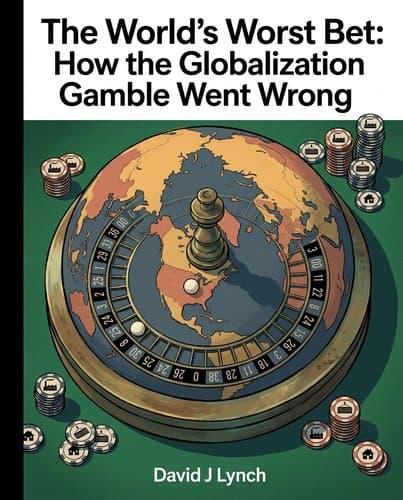
223296326_the-world-s-worst-bet
by David J Lynch
Globalization's losers weren't collateral damage—they were a deliberate choice. Lynch exposes how policymakers, economists, and executives knew exactly who…
In Brief
The World's Worst Bet: How the Globalization Gamble Went Wrong (2025) examines how U.S. trade policy — from NAFTA through China's WTO entry — failed working Americans not through ignorance but through deliberate choices to prioritize growth over protection.
Key Ideas
Deliberate abandonment of worker safety net
The safety net failure was a choice, not an accident: Lawrence Katz had a $4 billion worker protection plan ready in 1993. It was abandoned because of fiscal hawkishness and AFL-CIO politics — a $30 million fig leaf replaced a serious commitment. Every subsequent consequence flowed from that decision.
Geographic mobility was impossible for displaced workers
Aggregate economic gains don't automatically reach displaced workers — and mobility is not a solution. Economists told Ohio factory workers to 'just move.' The research shows they couldn't: family ties, children with special needs, underwater mortgages, and the destruction of entire local economies meant geographic mobility was theory, not policy.
Geopolitical warnings sacrificed for financial returns
China's non-convergence with liberal norms was visible to anyone looking. Matt Pottinger, Tim Clissold, and corporate executives who actually operated in China were sounding alarms throughout the 2000s. The optimism wasn't ignorance — it was a choice to prioritize Wall Street returns over geopolitical reality.
Trade safeguards rejected for diplomatic convenience
Trade enforcement tools existed and went unused. The WTO safeguard provision Charlene Barshefsky negotiated specifically for China's entry was rejected four times by the Bush administration, which prioritized post-9/11 diplomacy over protecting American industries. The tools were there; the political will wasn't.
Visible intervention masks underlying policy failure
The Carrier deal is the template for understanding populist industrial policy: high-profile intervention, short-term optics, long-term failure. Trump saved 1,100 jobs publicly, the company eventually cut 632, invested in automation, and built a new plant in Shanghai anyway. Visibility is not the same as effectiveness.
Cognitive automation threatens majority of employment
AI is the second China Shock — and the political coalition fighting the first one is unprepared for it. The new industrial policy protects manufacturing jobs that are 8% of employment. The next wave targets the 60% of advanced-economy jobs involving cognitive tasks. The safety net gap that broke the last system is still there for the next one.
Who Should Read This
History readers interested in Macroeconomics and Geopolitics who want a deeper understanding of how we got here.
The World's Worst Bet: How the Globalization Gamble Went Wrong
By David J Lynch
12 min read
Why does it matter? Because the people who designed the globalization system knew it would hurt millions of workers — and chose not to stop it.
The easy story is that the 1990s trade consensus was a noble experiment that ran into bad luck — unforeseeable crises, unpredictable autocrats, complexity no one could have mapped. David Lynch spent thirty years as a foreign correspondent watching that story get told, and he stopped believing it. Because the costs were never invisible. Economists modeled them. Labor negotiators itemized them. A $4 billion worker safety net sat fully designed on a table in Washington and got swapped for thirty million dollars so the budget numbers looked cleaner. The people who made that swap knew exactly what they were doing — they just assumed the people absorbing the damage would absorb it quietly. That assumption held, until it didn't.
The Bet Sounded Reasonable — Because It Was
The 1990s free-trade consensus deserves more credit than history now gives it, because the theory was actually quite good.
Consider the intellectual position Joe Biden occupied when he stood on the Senate floor in September 2000, urging his colleagues to normalize trade relations with China. The US economy was nearly ten times larger than China's — a gap so vast that serious people compared China's global economic footprint to that of the Netherlands. Biden wasn't being reckless. He was being empirical. And the empirical record of the previous two decades pointed in one direction: countries that opened their markets grew richer, and countries that grew richer eventually demanded political rights. South Korea had done it. Taiwan had done it. Chile and Argentina had done it. The pattern was consistent enough that a Stanford economist had run the numbers and produced a forecast: once China's per-capita income crossed roughly $7,000 a year, the pressure for democratic governance would become irresistible. He put that date at around 2015.
Seven hundred million people had entered democratic systems within living memory. The Berlin Wall had been rubble for a decade. The Soviet Union had dissolved without a shot. That's not ideology — that's extrapolation from a genuine historical pattern, offered at the peak of the longest democratic winning streak the modern world had ever seen. The certitude in the Senate chamber that fall reflected something real. Long enough that it had started to look like a law of nature.
The failure that followed cannot be dismissed as predictable wishful thinking or corporate greed. The people who made this bet were not fools or cynics. They were reasoning from the best available evidence about how the world worked. What makes that winning streak worth understanding is how completely it stopped winning.
The Price Tag Was Always Visible — They Just Refused to Pay It
Here's the question worth asking: if the costs of free trade were always visible — if economists knew that factory towns would take the hit while coastal consumers banked the savings — why did the United States do almost nothing to protect the people in the crosshairs?
The honest answer is that the Clinton administration chose not to. This wasn't a Republican blockade or a bureaucratic accident. When NAFTA was moving through Congress in 1993, Lawrence Katz, the Labor Department's chief economist and a Harvard professor, sat down with business and labor groups to negotiate something that could have changed the story entirely. His proposal was concrete: roughly $4 billion for training, job search support, more generous unemployment benefits, and wage insurance — a genuine cushion for any worker displaced by trade, not just those who could prove their factory had moved to Mexico. He thought he saw a rare opening, a moment when Republicans would support the package to help NAFTA pass while Democrats would want it to protect workers. The window was real. He wasn't wrong about the politics.
But Treasury Secretary Robert Rubin's fiscal instincts closed that window. What Congress actually approved was a five-year, $30 million retraining program — less than one percent of what Katz had proposed, written to lapse before most displaced workers had finished their first round of retraining.
Clinton had campaigned on giving globalization a human face. He signed NAFTA with a fig leaf instead. The communities that would spend the next decade absorbing the blows — the furniture towns in North Carolina, the textile mills in South Carolina — got a program so underfunded it might as well have been symbolic. The government would later spend far more keeping those same displaced workers on disability rolls for the rest of their working lives, paying for the wreckage rather than preventing it.
The winners of globalization knew the costs existed, knew where they would land, and decided that was someone else's problem to solve.
Anyone With Boots on the Ground Could See China Wasn't Democratizing
In 2003, Matt Pottinger was a Wall Street Journal reporter in Beijing when he arranged to meet a whistleblower at a Starbucks — the kind of Western-branded, ostensibly neutral space that was supposed to signal China's convergence with the open world. The source had information about a uranium mine in the country's far west whose toxic runoff was poisoning a local river. Central authorities had ordered the operation shut down; local officials had quietly cut deals to reopen it. Before Pottinger could finish the meeting, a man standing behind him threw a punch and told him in English to get out of China. The man worked for the Ministry of State Security.
That wasn't the incident that finally broke Pottinger's faith in the convergence thesis — it was confirmation of a pattern he'd been watching for years. He'd seen plainclothes police beat protesters in Tiananmen Square. He'd been detained in a rural village after interviewing farmers whose land had been seized, and had to hide his notes down his waistband to keep them from being confiscated. He'd watched the government lie systematically about SARS infection rates during the 2003 outbreak, the kind of institutional deception that couldn't be explained away as a local anomaly. By 2004, he'd reached a conclusion the architects of the China trade deal hadn't bargained on: the Communist Party wasn't reforming. It was waiting — accumulating power until it was strong enough to reshape the world on its own terms.
So at 31, Pottinger quit journalism and enlisted in the Marines.
That decision is worth sitting with. This wasn't a man who had given up on America or retreated into pessimism. It was the opposite — someone who had watched the evidence long enough to conclude that what was coming would require a different kind of response than filing dispatches. Back in Silicon Valley, investors who'd met Baidu's founder in a Beijing taxi were telling anyone who'd listen that China was essentially a free country. Meanwhile, workers at factories like Xin Qiao Electronics were earning fifteen cents an hour for fourteen-hour days.
Both men were looking at the same country. Only one of them was surprised by what came next, or by how little had actually changed.
The 'China Shock' Wasn't a Metaphor — It Was an Address in Tennessee
Jackie Starks earned $24.76 an hour at the Goodyear tire plant in Union City, Tennessee — union wages, steady shifts, the kind of job that bought houses and put kids through college. When the plant closed in 2011, she found work. It paid $10.25 an hour.
That cut — roughly sixty percent of her former income — is the number the aggregate trade statistics don't show you. The economists who modeled China's WTO entry calculated net gains: cheaper goods for consumers, higher returns for shareholders, an overall surplus for the national ledger. They didn't model Union City, Obion County, Tennessee, where two thousand workers hit the unemployment line at the same moment in a county whose retraining infrastructure could absorb thirty or forty students at a time. The Trade Adjustment Assistance program, designed in the 1960s as a safety net for trade-displaced workers, was supposed to bridge people like Starks to new careers. In Obion County, it functioned as paperwork. There were no new careers in sufficient supply. There was just the math of $10.25.
The plant that closed had been genuinely excellent at its job. A twenty-year Goodyear veteran named Kent Greer had helped deliver five million tires in a single year without a single defect — a manufacturing record that would have seemed implausible to anyone who believed American workers had grown complacent. The tires didn't fail. The economics did. Chinese imports flooded in priced barely above what it cost American producers to buy the rubber and chemicals to make their own. You cannot run a union shop, with American wages and American safety standards, against that margin.
When the Obama administration finally imposed tariffs on Chinese tires in 2009 — 35 percent, the kind of number that sounds decisive — an independent analysis found that each job the measure preserved had cost American consumers roughly $900,000 in higher prices. That figure gets cited as proof that protectionism is foolish. It's actually proof that waiting a decade to act, while the damage compounded and the industry hollowed out, made any intervention grotesquely expensive. The Bush administration declined to use the WTO safeguard provision four separate times, calculating that post-9/11 diplomacy required a cooperative Beijing more than it required a solvent tire industry in Tennessee.
By 2017, one in three jobs in Obion County had disappeared. The people who remained weren't statistics. They were the people who couldn't move — who had parents to care for, houses underwater, roots that economists classify as 'low geographic mobility' and communities recognize as home. The fury that eventually reshaped American politics didn't emerge from abstract anxiety about globalization. It had a zip code. What it also had, though few in Washington were paying attention, was a cause — and that cause didn't stop at wage competition. The next chapter in the story was outright theft.
While American Workers Suffered, China Was Robbing the Companies That Employed Them
David Hickton arrived at a downtown Pittsburgh Hilton at 7:30 a.m. wanting to talk about mentoring troubled teenagers. He'd crashed a regular breakfast between the CEO of US Steel and the head of the United Steelworkers — two men who rarely agreed on anything — and figured they'd be good allies for his charitable program. They were. Then they turned the conversation. Both men told the federal prosecutor the same thing: Chinese hackers had been inside their computer systems for years, and Washington was doing almost nothing about it.
What Hickton uncovered when he launched his investigation made the theft of wages and jobs look like only half the story. A unit inside the People's Liberation Army, operating out of Shanghai's Pudong district, had used deceptively authentic emails to trick employees at Westinghouse, SolarWorld, Alcoa, and the steelworkers union into clicking links that handed over full access to their networks. The hackers worked under aliases — 'UglyGorilla,' 'KandyGoo' — and were methodical. When Westinghouse was negotiating with a Chinese state-owned firm to build nuclear plants in China, the unit stole the equivalent of 700,000 pages of emails detailing Westinghouse's negotiating positions. When SolarWorld filed trade complaints against Chinese solar manufacturers, the same unit broke into the company's US subsidiaries and extracted its financial position, cost structure, and legal strategy. Three weeks after Alcoa announced a joint venture with a Chinese aluminum company, Alcoa executives became phishing targets.
Mutual economic benefit, in practice, looked like this: American companies were invited into China's market, and China used the access to drain them of the proprietary knowledge those companies had spent decades accumulating. The theft didn't supplement the trade relationship — it was built into it. Tim Draper learned the same lesson from a different angle when his investment in YeePay, a Chinese payments company, was effectively seized — a state-backed firm forcing a buyout at one-sixth its value, leaving Draper with a rule he applied from then on: no more money into China. The workers lost their wages. The companies lost the intellectual property that would have let them compete next time. And the investors learned that the rules could change the moment a Chinese firm decided it wanted what you had built. The game was rigged at both ends — and the financial crisis was about to make the bill come due faster than anyone expected.
The 2008 Financial Crisis Handed Beijing the Argument It Had Been Waiting For
Wang Qishan pulled Paulson aside at their diplomatic meeting and said what Beijing had been too politic to say for years. 'You were my teacher,' he told the Treasury Secretary, 'but now here I am in my teacher's domain, and look at your system, Hank. We aren't sure we should be learning from you anymore.' Wang had learned the craft of finance partly from Paulson himself, back when Paulson ran Goldman Sachs. That history made the line land harder.
Most Americans saw the housing crash as a plumber's problem — bad loans, greedy banks, a regulatory failure in lower Manhattan. What they missed was the pipe running in from overseas. China's export machine generated more dollars than it could absorb at home. Those surpluses flowed back to the United States as purchases of Treasury bonds, driving down American interest rates by nearly a full percentage point. Cheaper money meant cheaper mortgages. Cheaper mortgages meant that lenders who might otherwise have hesitated found themselves competing to push loans onto borrowers who couldn't afford them. The trade boom didn't just coexist with the housing bubble — it inflated it. When it burst, the wreckage stretched from Countrywide's loan offices to the factory towns that had already spent a decade absorbing the China shock. The concentrated losses of one era fed the political fury of the next.
What made 2008 historically different wasn't just the damage. It was what the damage did to the argument. For years, Washington had lectured Beijing about open markets, flexible exchange rates, and restrained government. Then the American-built system imploded. Chinese President Hu Jintao told Paulson privately that Beijing's refusal to move its currency faster had turned out to be the right call — China was stable, pumping nearly $600 billion into the global economy, while the United States was explaining how it had nearly destroyed the financial system it had spent decades asking others to emulate. The lecture circuit ran in reverse now. And no one in the American government had a convincing answer.
The humiliation was diplomatic. The consequences were electoral. The factory towns already hollowed out by the China shock had absorbed the job losses; now they absorbed the foreclosures too. Sixteen years later, that accumulated grievance would find a very different kind of messenger.
A Three-Minute YouTube Video Did What Economists and Unions Could Not
On February 10, 2016, a Carrier Corporation executive named Chris Nelson stood in front of 1,400 workers at an Indianapolis heating equipment plant and explained that their jobs were moving to Monterrey, Mexico. The moment he said 'Mexico,' the room erupted. Someone yelled 'Fuck you.' Another worker wondered aloud how long before people started destroying the place. Nelson tried to press on — 'I've got information that's important to share' — but he was drowned out. Carrier was making the move because Mexican workers earned three dollars an hour. The workers in that room earned twenty.
Someone filmed it. The three-and-a-half-minute clip went viral before Nelson had finished speaking, and within days both Donald Trump and Bernie Sanders were using it as a campaign prop. Not because they manufactured the outrage — but because it had been building for a generation, and here it was, unedited: a man looking his workers in the eye and telling them their labor was worth three dollars.
The conventional explanation for what happened in November 2016 reaches for culture — racial anxiety, educational sorting, a rural America that felt looked down on by the professional class. Those forces were real. But economists David Autor, David Dorn, and Gordon Hanson mapped the actual vote tallies against trade exposure data and found something more precise. They calculated that if Chinese import competition had been half as intense, Hillary Clinton likely carries the industrial Midwest and wins the presidency. Howard County, Iowa — a place that gave Barack Obama a 21-point margin in 2012 — swung to Trump by 20 points four years later. That's a 41-point reversal. It tracked almost perfectly with the local intensity of import competition. Not cultural drift. Not media. The specific factories that had closed in specific counties.
The Carrier story has a coda that makes the arithmetic even colder. Trump negotiated a high-profile deal to keep the plant open, claimed credit for saving over a thousand jobs, and held a victory rally in Indianapolis. Within two years, Carrier had laid off 632 workers anyway, invested sixteen million dollars in automation to eliminate more, and broken ground on a ninety-five million dollar facility in Shanghai. The jobs didn't come back. They were replaced by machines, or they moved anyway, just on a schedule that didn't conflict with an election. What the Carrier video captured wasn't an aberration. It was the whole story in three minutes and thirty-two seconds.
The New Industrial Policy Is the Right Diagnosis With the Same Missing Prescription
Bob Ulrich was 58 when the steel door factory in Niles, Ohio, where he'd worked since Vietnam, crated up its equipment and shipped it to Monterrey. He eventually landed at the GM plant in Lordstown, a few miles away — but under the two-tier wage system that had crept into American manufacturing, he was classified as a 'temp.' The man next to him on the instrument panel line, doing identical work, earned $28.50 an hour. Ulrich earned $14.50. Then, two days before Christmas, GM announced Lordstown was closing too. Riddled with arthritis and a chronic lung disease, he filed for disability. His son Brian — also laid off from Amweld — enrolled in nursing school, retrained in two years, and eventually reached six figures as a clinical nurse manager. The father absorbed the shock and went under. The son pivoted and survived.
Biden's industrial policy looked at that story and concluded the lesson was: build more factories. Bring the supply chains home. Spend $53 billion on semiconductors. Jake Sullivan stood at the Brookings Institution in 2023 to declare that 'more trade is good' had calcified into catechism rather than argument, and he was right. But Brian Ulrich didn't escape by working on an assembly line — he escaped because nursing pays enough to rebuild a middle-class life and can't be shipped to a cheaper country. The administration has no serious answer for what workers do while the new factories are being built, or what they do if the factories don't need them once automation catches up.
The next shock is arriving before the last one is resolved. In 2023, Goldman Sachs estimated that generative AI could automate tasks covering 300 million full-time jobs globally — and unlike the China shock, it isn't targeting the factory floor. It's targeting the cognitive work that college-educated Americans were told to retrain into. By the administration's own estimates, the CHIPS Act creates roughly 115,000 semiconductor jobs over a decade. That's a rounding error against the scale of what's coming.
Sullivan was right that the old consensus was a catechism. But the new one is being administered by people who still haven't built the safety net Lawrence Katz proposed in 1993 — wage insurance, real income support, health care and retirement decoupled from any single employer. The bet changed. The infrastructure for losing it didn't.
The Bargain That Was Never Actually Made
Bill Clinton admitted, years later, that the sequencing was supposed to go differently — health care first, worker protections first, then open the markets. He never fought for that order. What that admission quietly concedes is that the bet had two halves: trade would create wealth, and the winners would share enough of it to cushion the people it displaced. The first half happened. The second never did — not in 1993, not after the China Shock, not after 2008, not yet. The workers who eventually burned the system down weren't operating on grievance and nostalgia. They were doing arithmetic. The people now rebuilding that system have the diagnosis right and the tariffs in place, but they still haven't paid the thirty-year-old bill. And the second shock may dwarf the first: picture the paralegal in Akron, the radiology tech in Fresno, the junior accountant in any mid-size city who spent decades acquiring exactly the kind of credential that was supposed to be automation-proof — all of them staring at the same software that just passed the bar exam. White-collar this time. Bigger numbers. Less political sympathy. The question worth carrying forward is whether this time the winners will finally write the check they declined to write in 1993, or hand it, again, to the next Bob Ulrich.
Notable Quotes
“Joey, a job is about a lot more than a paycheck,”
“It’s about your dignity. It’s about respect. It’s about being able to look your kid in the eye and say, ‘Honey, it’s going to be okay,’ and mean it—and mean it.”
“a global economy with a human face.”
Frequently Asked Questions
- What is The World's Worst Bet about?
- The World's Worst Bet examines how U.S. trade policy from NAFTA through China's WTO entry deliberately failed working Americans by prioritizing growth over worker protection. Drawing on economics, politics, and on-the-ground reporting, David Lynch traces why displaced workers were left behind, why China never adopted expected liberal reforms, and what these failures mean for AI disruption. The book argues these weren't accidental policy oversights but deliberate choices by political and corporate leaders to pursue aggregate gains while ignoring their uneven distribution across regions and workers.
- Why were American workers left behind by globalization according to The World's Worst Bet?
- American workers were left behind not through accident but through deliberate policy choices. Lynch reveals that economist Lawrence Katz had a $4 billion worker protection plan ready in 1993, but it was abandoned for a $30 million fig leaf due to fiscal conservatism and AFL-CIO politics. The book challenges the "just move" narrative economists promoted to Ohio factory workers. Research shows geographic mobility wasn't feasible: family ties, children with special needs, underwater mortgages, and destroyed local economies made relocation impossible. The safety net failure was fundamentally a choice, not an economic inevitability.
- What does The World's Worst Bet reveal about U.S. policy toward China?
- The World's Worst Bet reveals that U.S. policymakers made deliberate choices about China policy. Lynch documents that experts like Matt Pottinger and Tim Clissold, plus corporate executives operating in China, warned throughout the 2000s that China wouldn't converge with liberal norms. As Lynch demonstrates, "The optimism wasn't ignorance — it was a choice to prioritize Wall Street returns over geopolitical reality." The book also documents that enforcement tools existed but were rejected: Charlene Barshefsky negotiated WTO safeguard provisions specifically for China's entry, yet the Bush administration rejected them four times. Political will to protect American industries was absent.
- How does The World's Worst Bet connect past trade policy failures to AI disruption?
- The World's Worst Bet argues that AI represents a second China Shock, yet the political coalition that fought the first disruption is unprepared for the second. Lynch explains that current industrial policy protects manufacturing jobs, which comprise only 8% of employment, while AI targets 60% of advanced-economy jobs involving cognitive tasks. The Carrier deal exemplifies the failed approach: Trump publicly saved 1,100 jobs, yet the company eventually cut 632, invested in automation, and built a new plant in Shanghai. The critical lesson is that visibility isn't the same as effectiveness, and the underlying safety net gap remains unfilled.
Related Book Summaries

Read the full summary of 223296326_the-world-s-worst-bet on InShort